
comparison
Normal phase is a different solvent logic
Choose normal phase only when its polar stationary phase and non-polar mobile phase match the analyte better than reversed phase.
- Author
- EVRINTH Editorial Team
- Published
- 8 October 2026
- Updated
- 8 October 2026
- Reading time
- 7 min
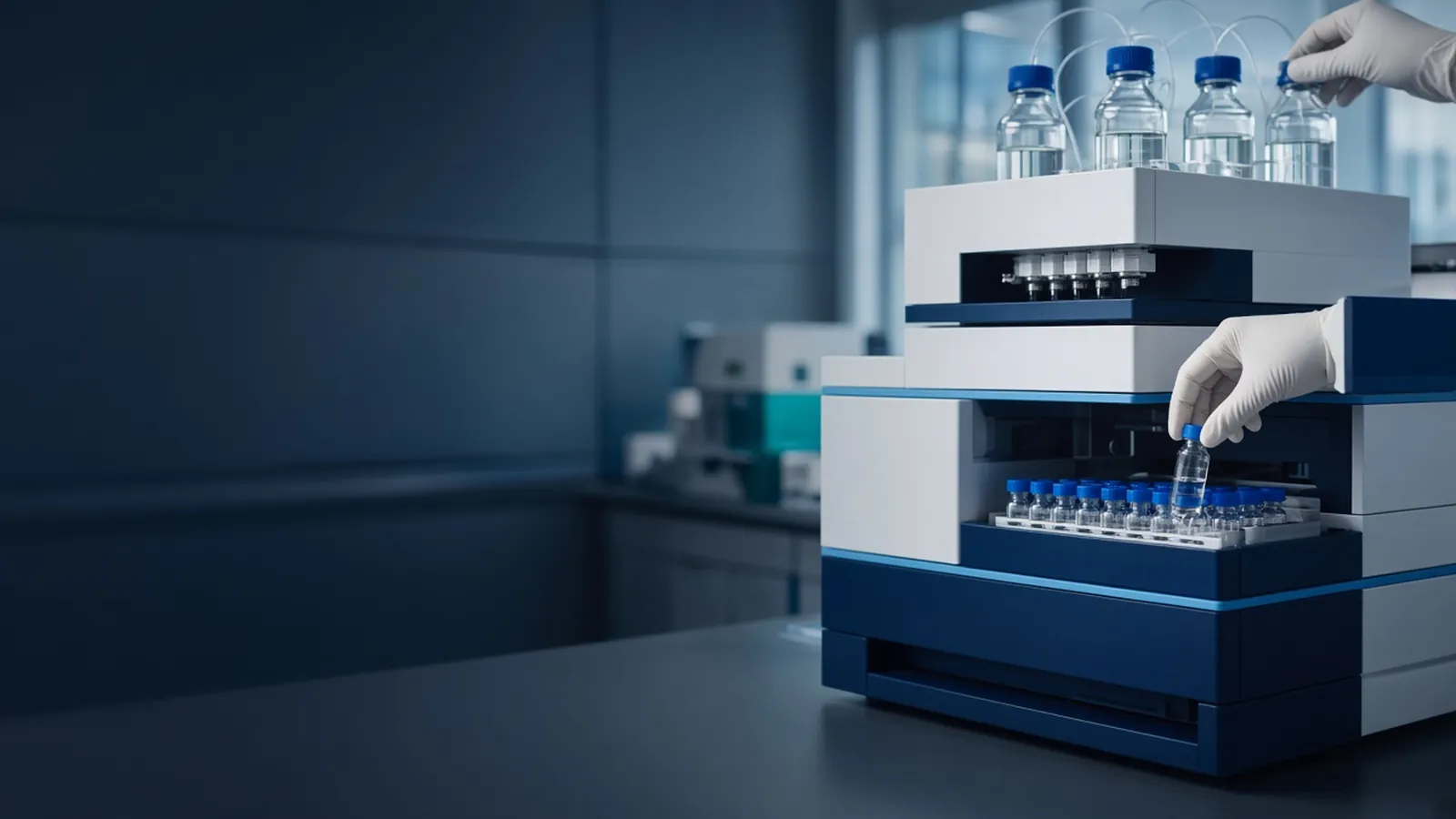
Normal phase keeps a polar stationary phase and a non-polar mobile phase. Solvent strength then runs by a different rule from the reversed-phase methods most life-science benches use every week. The decision is whether your analyte actually needs that rule. The map of modes, including reversed phase, ion exchange, and affinity chromatography, is in chromatography methods in life-science labs.
Two directions for "stronger solvent"
Chromatography separates by distribution between a stationary phase and a mobile phase that moves. In reversed phase the stationary surface is hydrophobic. Water is the weak solvent. Acetonitrile or methanol is stronger for hydrophobic analytes: raise the organic fraction and retention usually falls. In normal phase the stationary surface is polar. Bare silica, diol, cyano, and amino phases are common classes. The bulk mobile phase is non-polar, often a hydrocarbon such as hexane or heptane. The modifier is more polar: an alcohol, an ester, or a chlorinated solvent chosen for selectivity. Raise that polar modifier and retention usually falls, because the modifier competes for the polar surface.
The practical trap is muscle memory. A chromatographer who "adds organic to elute" on a C18 column and then adds more hexane on a silica column has turned the strength knob the wrong way. More hydrocarbon on a normal-phase column is usually a weaker mobile phase. The analyte sits longer. More polar modifier is the elution direction. Write the strong solvent's name in the method so the next person does not inherit a habit from a different mode.
Water is a silent modifier on bare silica. A bottle of hexane that has picked up moisture, or a sample that still contains a trace of water from an extraction, can move retention as much as a deliberate change in alcohol content. Normal-phase methods that must be repeated either control water or move to a bonded polar phase that is less thirsty. Say which choice you made. A retention time from a dry winter week can miss the window in a humid laboratory if water was never a written variable.
What each mode can and cannot show
Reversed phase is the default for many peptides and drug-like small molecules because they dissolve in water-organic mixtures and separate by hydrophobicity. It struggles when everything elutes in the void because nothing is hydrophobic enough to care about the C18. That is a rational moment to consider normal phase or a hydrophilic-interaction cousin, not a moment to lengthen the C18 column and hope.
Normal phase can resolve polar compounds and some isomers that reversed phase merges. It is a poor home for a salty aqueous protein fraction. Ion exchange and affinity chromatography exist for charged biopolymers and tagged proteins. Forcing a protein lysate onto bare silica in hexane is not a creative normal-phase method. It is a precipitation experiment. If the research question is a polar metabolite in an organic extract, normal phase is in scope. If the question is a His-tagged enzyme, stay with the aqueous modes and a fraction collector sized for water.
Hydrophilic-interaction chromatography sits beside normal phase and is often the life-science version people actually need: a polar phase, a mostly acetonitrile mobile phase, and a controlled water content that elutes hydrophilic analytes as water increases. It uses the solvent bottles an HPLC already understands better than a hexane method does. It still follows polar logic, so a reversed-phase gradient copied line for line will start at the wrong end. Name the mode in the title of the method file.
A peak in any of these modes remains a detector response. Co-elution is still possible. A fraction collected under an apex still needs an assay before you call it one compound. Identity of a protein impurity, if that is what you are chasing in a different mode, starts from sequence resources such as UniProt and from reporting practice associated with HUPO. Normal phase does not generate that identity by itself.
Equipment class and the branch when retention wanders
You need a polar column with a stated pH and solvent window, a pump whose seals and check valves tolerate the non-polar solvent, a detector that can see the analyte in that solvent, and bottles that close. Refractive-index detection is sometimes used for analytes with no chromophore. It dislikes composition gradients. Ultraviolet detection needs a solvent that is transparent at the wavelength. Hexane is more forgiving in the ultraviolet than many polar modifiers. Check the modifier's cutoff before you decide the baseline is "dirty".
Equilibrate until retention of a standard is stable across two injections. If the second injection comes earlier, water or a strong modifier is still equilibrating, and samples will wander. Pause and extend equilibration. If the standard is stable and the sample splits, look at the injection solvent. A sample dissolved in the polar modifier and injected onto a weak hydrocarbon mobile phase will distort, just as a strong solvent distorts reversed phase, with the chemical identities swapped. Match the sample solvent to the starting mobile phase or to something weaker.
If you meant to collect a fraction and the peak is broad, a slower change in modifier, or a longer column of the same chemistry, is the selectivity-preserving next step. Switching to ion exchange because the peak was wide answers a different question. Do that when charge is the difference you can use, and record it as a mode change.
| Question | Reversed phase | Normal phase |
|---|---|---|
| Stationary surface | Hydrophobic bonded phase | Polar silica or a polar bonded phase |
| Weak mobile phase | Water-rich | Non-polar hydrocarbon-rich |
| Change that usually elutes | More acetonitrile or methanol | More polar modifier |
| Everyday life-science fit | Peptides, many small molecules | Polar organics, some lipids and isomers |
| Aqueous protein fraction | Often plausible after desalting | Usually the wrong solvent system |
Failure modes that come from the solvent logic
A method that slowly loses retention over a week of normal-phase work often has a wetter mobile phase than the one you validated, or a drier one. Date the bottles and cap them. A method that gains retention after you "cleaned" the column with a polar solvent may simply be re-equilibrating for many column volumes back to a weak hydrocarbon. Budget that time. Calling the column dead because the first injection after a methanol wash stuck is premature.
Fraction collection in volatile hydrocarbons concentrates quickly and also evaporates. Label tubes at once and cap them. A fraction that was a peak at the detector can be a film on the tube wall an hour later in a warm room. That is a handling fact. It is also why the collector and the hood belong in the same plan.
Safety
Hydrocarbon solvents, chlorinated modifiers, and alcohols are flammable or toxic chemical hazards. A biosafety cabinet is the wrong enclosure for a hexane bottle. Use the ducted chemical control your assessment names, bond and ground as the instrument manual requires, and treat waste as solvent waste. The WHO laboratory biosafety manual frames biological risk for the sample. It does not replace the chemical assessment for the mobile phase. This is research guidance, not a clinical method.
What the enquiry needs
State why reversed phase was not the right selectivity, the analyte class, the sample solvent, the detector, whether fractions must be collected, and the pressure and materials limits. Ask for polar-phase chemistry and a modifier the hardware can wet. Use the scientific instruments catalogue and the quote request. A protein method that actually belongs in water can be discussed from the custom protein expression and purification reference, which is an enquiry prompt and not a claim that a purification is underway. ---
Questions from the bench
When should a laboratory leave reversed phase and try normal phase?
Try normal phase when the analyte is polar enough that it barely retains on a hydrophobic column, or when a non-polar mobile phase is the solvent the sample already lives in, as with some lipid extracts. The stationary phase is polar and the strong solvent is the more polar modifier. If the molecule is a typical peptide in water, reversed phase remains the clearer first choice. Switching modes is a selectivity decision, not a pressure decision.
Why does adding a more polar solvent speed elution in normal phase?
On a polar surface the analyte is competing with the mobile phase for that surface. A more polar modifier occupies the surface and raises solvent strength, so retention falls. That is the reverse of the everyday reversed-phase habit, where raising acetonitrile makes the mobile phase a better solvent for a hydrophobic peptide and also speeds elution, but for a different chemical reason. Copying a reversed-phase gradient shape into hexane will not reproduce the lesson you think you are copying.
Is hydrophilic-interaction chromatography the same as normal phase?
Both use a polar stationary phase and an organic-rich mobile phase, and both are easily confused on a whiteboard. Classical normal phase is usually a water-poor, non-polar bulk solvent with a controlled polar modifier. Hydrophilic-interaction methods keep a water-rich layer at the surface and elute with a high-acetonitrile mobile phase that becomes more aqueous. Water is a major variable in both, and the method file should say which one you ran.
What should a normal-phase column enquiry include?
Name the analyte polarity, the sample solvent, the need for a non-polar mobile phase, the detector, and whether you will collect fractions. Ask for stationary-phase chemistry, particle size, water tolerance, pressure rating, and a recommended modifier. Send that with the quote request. Ask which wetted materials survive the solvents. A reversed-phase HPLC system is not automatically a normal-phase system.
References
Manufacturer names identify published method classes. Trademarks remain with their owners. Catalogue records on this site are independent references for enquiry. They are not a statement of inventory, distribution rights or a supply commitment. This page is educational. It is not medical advice, a diagnostic protocol or a biosafety approval.
Catalogue
Related products and categories
These links follow the subject of the article into published manufacturer references. A listing is a reference for an enquiry, not a statement of stock or distribution rights.
Continue in this cluster
Related reading
Chromatography methods in life-science labsHow life-science chromatography separates molecules on a stationary phase, and what an HPLC or column peak does not prove about purity.A glossary of chromatography termsUse chromatography terms with their real limits: retention, resolution, void, and a peak that is only a detector response. Affinity and ion-exchange protein purificationHow affinity capture and ion exchange pull a protein from a lysate, and why each collected fraction still needs an identity check.