
protocol overview
Northern blot concepts for RNA
Plan a northern blot at decision level: intact RNA, a denaturing gel, transfer, and a probe that reports transcript size rather than an RNA-seq count.
- Author
- EVRINTH Editorial Team
- Published
- 8 October 2026
- Updated
- 8 October 2026
- Reading time
- 8 min
A northern blot reports the size of an RNA that a probe can bind, after that RNA has been separated under denaturing conditions and transferred to a membrane. The claim is a length and a hybridisation, not a count of molecules and not a list of splice junctions. This page is the decision-level overview of that path. Keeping the RNA intact enough to deserve the blot is protecting RNA during extraction. The DNA gel habits that do not transfer unchanged are in agarose gel electrophoresis for DNA. Research education only: not a clinical expression test and not a kit insert.
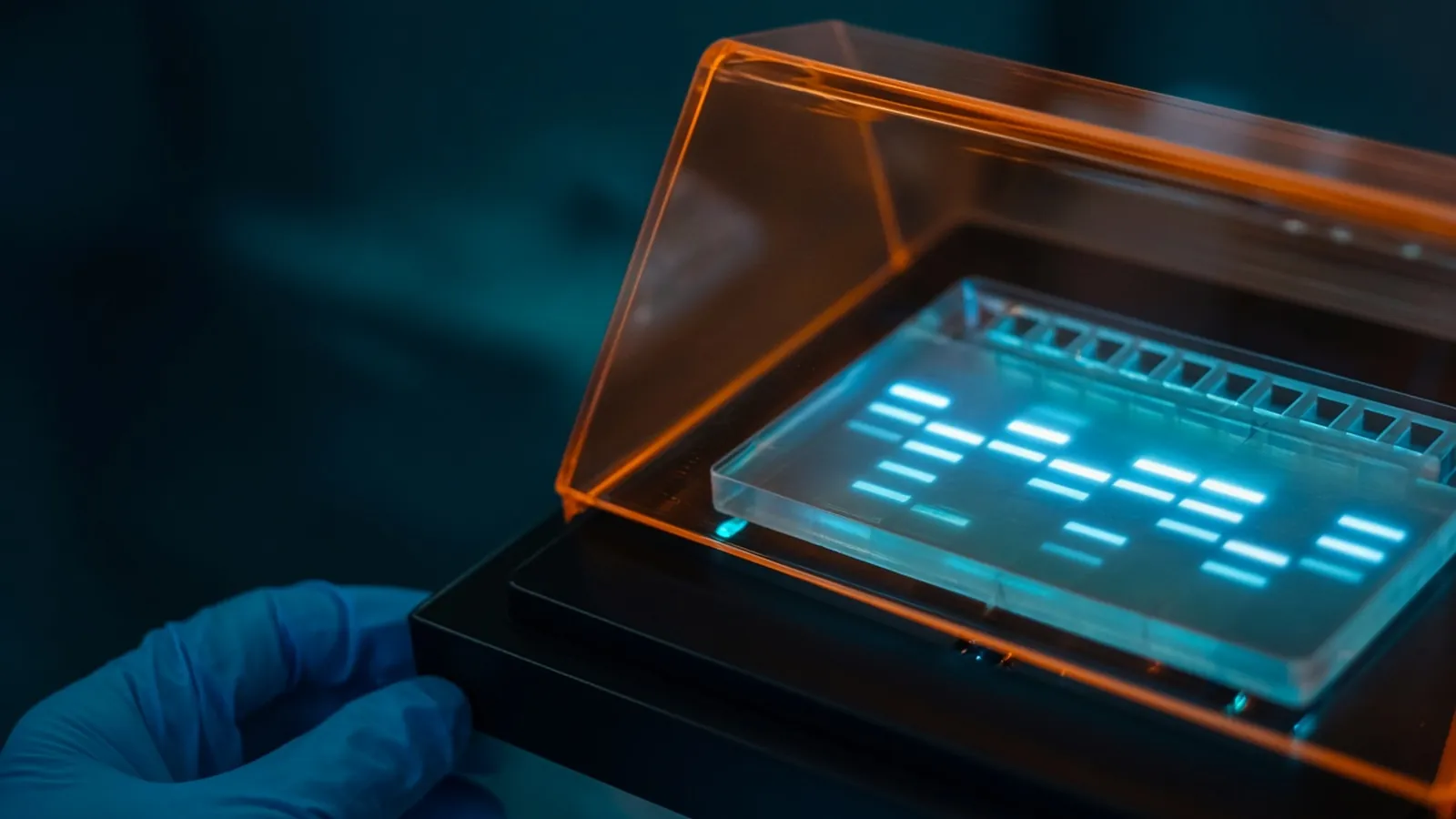
The photograph is a DNA agarose gel, bands glowing under an orange ultraviolet shield. Use it as a picture of shielded viewing. A northern gel is a denaturing RNA separation and may not look like that frame. Membranes, ladders and general molecular reagents are classes in the molecular biology catalogue. The transcript length and the probe class go on the quote request.
What decision the blot is for
Choose a northern concept when you need to see whether a transcript of a stated length is present and hybridises. A longer isoform, a truncated species, or a probe that should light one band and not a neighbour are that kind of question. Choose RNA-seq when you need many transcripts, junction evidence, or a designed abundance comparison across a library. Choose RT-qPCR when a short amplicon and a defined quantification are enough and you do not need the full length on a membrane. Mixing the sentences is how a band is reported as if it were a count.
The length you expect comes from the transcript annotation you actually mean, including the isoform. NCBI Nucleotide is a public place to check a recorded RNA or cDNA length. Your probe map has to hit that isoform and miss the relative you cannot afford to confuse with it.
Integrity before a band means anything
Ribonucleases are everywhere on a bench, and RNA's own chemistry is less patient than DNA. The extraction guide is the control plan: stabilise, denature RNases at lysis, and judge integrity apart from absorbance. A260/A280 near 2.0 is a cleanliness hint. It is not intactness. On a denaturing gel or a trace, eukaryotic total RNA should show ribosomal species if the large RNA is still there. A strong ribosomal pair supports a claim about those ribosomal RNAs. It does not prove every messenger is full length. A low smear means the large molecules are gone. No probe repairs that.
If the tissue is RNase-rich, say so before you copy a protocol written for cultured cells. Formalin-fixed or intentionally fragmented samples are cases where a "bad" ribosomal pattern can be expected. Write that exception in the notebook. Do not discover it after the blot is blank.
A denaturing gel, then a transfer, then a probe
Native agarose lets RNA secondary structure set part of the mobility. A hairpin runs differently from the same sequence held open. Size work therefore uses a denaturing system. Formaldehyde-agarose is the classical class. Glyoxal is another class. Follow the system your institution runs. Formaldehyde is a toxic chemical. Who may pour that gel, in what hood, with what waste path, is an SOP. This overview has no millilitre table.
Load an RNA ladder that is denatured the same way as the samples, with rungs on both sides of the expected transcript. A DNA ladder is not automatically a ruler for that gel. Loading dye shows the front and helps the sample sink. Where the dye sits is not a kilobase mark, and it changes with the gel. Stop before the transcript window leaves the slab.
Transfer the RNA to a membrane, often a positively charged nylon sheet used for nucleic acids. Contact, orientation and bubbles matter as they do in any blot. Fix the RNA by the method that sheet requires. Then hybridise a labeled probe. Radioactive and non-radioactive labels are the same two regulatory classes as on a DNA hybridisation blot: isotope under institutional radiation rules, or a chemical label such as a digoxigenin or biotin class under the detection note and the chemical rules. No activities and no recipes here.
Wash at a stringency that matches the question. A hot, low-salt wash keeps closer matches. A milder wash keeps relatives and can invent a second "isoform" that is another gene. Detect, and only then look at size. Interpolate between ladder rungs on that membrane's image. A band outside the ladder is "longer than" or "shorter than," not a number you typed because the annotation hoped for it.
| Stage | Decision | Branch if it fails |
|---|---|---|
| Integrity | Ribosomal picture acceptable for this sample type | Stop. Fix extraction. Do not probe a smear and call it full length |
| Denaturing gel | System known to open RNA structure | Do not size a native RNA band against any ladder |
| Ladder | RNA marker, same denaturation, flanks the transcript | Repeat. A DNA ladder is allowed only when its card says so |
| Transfer | Probe and ladder signals are on the sheet, not left in the gel | Check contact, time, and membrane activation or wetting |
| Stringency | Wash matches exact locus versus family | Extra bands at low stringency are not automatically isoforms |
| Claim | Length between rungs, this probe | Abundance and junctions belong to a different assay |
RNase as a workflow branch, not a slogan
Reserve tips and tubes for RNA. Gloves change when they have touched a DNA gel tray, a bacterial culture, or a door. Certified nuclease-free plastic is the straightforward purchase. Autoclaving does not, by itself, remove RNase already on plastic. Cold slows many enzymes where the protocol calls for ice. Cold is not a kill step, which is the extraction guide's point, and it is repeated here because a northern sample thaws on a warm block while someone hunts a ladder.
If a lane that should be intact is a low smear, suspect RNase before you suspect the gene. A side-by-side sample that stayed intact points at handling of the bad tube. A whole gel of smears points at the reagents or the bench. Pause the hybridisation. Probing degraded RNA produces bands you will want to believe.
Safety and what the band may not say
Formaldehyde and related denaturants, ultraviolet viewing if you stain a gel, and any isotope in the probe are institutional hazards. The orange shield in the photograph is the rule for ultraviolet work even when the gel in the frame is DNA. Ethidium bromide and alternative stains follow the bottle you actually have. Radiation rules are not optional because the science is interesting. The WHO Laboratory biosafety manual, 4th edition backgrounds the biological risk of the sample. It does not authorise isotope, and it does not make the blot a diagnostic expression test.
A band between ladder rungs supports a hybridising RNA of about that length under that stringency. It does not measure copies, prove a protein was translated, or replace a library-level expression study.
Heat, melting ice and a denaturing gel that waited
Ice disappears quickly in a hot laboratory, and a "cold" tube of RNA becomes a warm tube without looking different. Prepare the denaturing load when you are ready to run, not an hour earlier on a block. A formaldehyde gel that was poured and then left while the power dropped is not the gel you planned. Do not start an unattended overnight hybridisation if the oven will stop in a cut. Stringency follows temperature. A blot from an oven that cooled is a different wash from the one you will write down. Humidity that dries the membrane edge in a loose bag looks like a failed lane. Seal it and keep it wetted.
What to put in an enquiry
Name the organism or tissue, whether you need total RNA or an enriched fraction, the transcript length you must bracket, and whether the probe is allowed to be radioactive in your building. Say that integrity will be judged before transfer. Ask for an RNA ladder matched to the denaturing system, a membrane intended for RNA, and confirmation that a quotation is possible. The nucleic acid analysis pathway is the route when the size result still needs a sequence-level look. A kit title that says "expression" has not yet told you whether you will get a length, a count, or a short amplicon.
Decide whether a northern blot can answer the transcript question
- 01Judge integrity before any probeLook at ribosomal RNA on a denaturing gel or an electrophoretic trace, and treat a low smear as RNA you cannot size. Only intact enough RNA goes forward, and absorbance ratios do not make that decision.
- 02Match the gel and the ladder to a denatured transcriptUse a denaturing RNA gel system your institution already runs, and an RNA ladder treated the same way. A DNA ladder is a size scale only if its maker says it is valid in that system.
- 03Probe the isoform you meanChoose a probe sequence that distinguishes the transcript length you care about from a relative that would light under a loose wash. Hybridise and wash at a stringency that matches exact versus family.
- 04Write a size claim inside the ladder, not a countReport a hybridising length between flanking rungs, which is a different sentence from an RNA-seq abundance. If the question was counts or junctions, this blot is the wrong end point.
Questions from the bench
Why is a native agarose gel a poor way to size a transcript?
RNA folds. A hairpin can make a long transcript travel like a shorter one, so the band's position is shape plus length. Denaturing systems, formaldehyde-agarose among them, are used so length dominates. The photograph on this page is a DNA agarose gel under an orange shield. It shows documentation practice. It is not itself a denaturing RNA gel.
The ribosomal bands look degraded. Can I still trust a sharp probe signal?
Treat the sharp band as a fragment that hybridised, not as proof the full-length messenger was there. Degradation cuts RNA into pieces a probe can still find. If integrity failed, repeat the extraction under the conditions in the RNA protection guide. Do not normalise a story of transcript size to a smear.
How is this different from RNA-seq?
A northern band says a species of about this length hybridised to this probe under this wash. RNA-seq says reads were obtained and mapped, which can support abundance and junctions when the library and the analysis were built for that. One does not convert into the other. A 2 kilobase band is not a count. A count is not a length unless the reads actually span it.
What is the loading dye for, on an RNA gel?
It sinks the sample and gives a visible front so you know the run moved. It is not an RNA ladder and not a integrity score. Stop while the transcripts you care about are still on the gel. A dye that has run off, with no ladder in the photograph, ends the size claim.
References
Manufacturer names identify published method classes. Trademarks remain with their owners. Catalogue records on this site are independent references for enquiry. They are not a statement of inventory, distribution rights or a supply commitment. This page is educational. It is not medical advice, a diagnostic protocol or a biosafety approval.
Catalogue
Related products and categories
These links follow the subject of the article into published manufacturer references. A listing is a reference for an enquiry, not a statement of stock or distribution rights.
Continue in this cluster
Related reading
Agarose gel electrophoresis for DNAHow agarose percentage, buffer and a size ladder turn a DNA sample into a band, and what that band does and does not prove about identity.A glossary of electrophoresis termsDefine anode, cathode, sieving, mobility, stacking, resolving, electroendosmosis, Rf, and leading dye for an honest gel reading. Blocking buffers and background signalChoose milk or BSA and a wash that fits the antibody, then decide whether speckles are sample signal or block, secondary, or a dried membrane.