
guide
Protecting RNA during extraction
How to keep RNA intact from lysis to elution: RNase control, what A260 ratios do not prove, and the checks that show whether the preparation is still usable.
- Author
- EVRINTH Editorial Team
- Published
- 8 October 2026
- Updated
- 8 October 2026
- Reading time
- 8 min
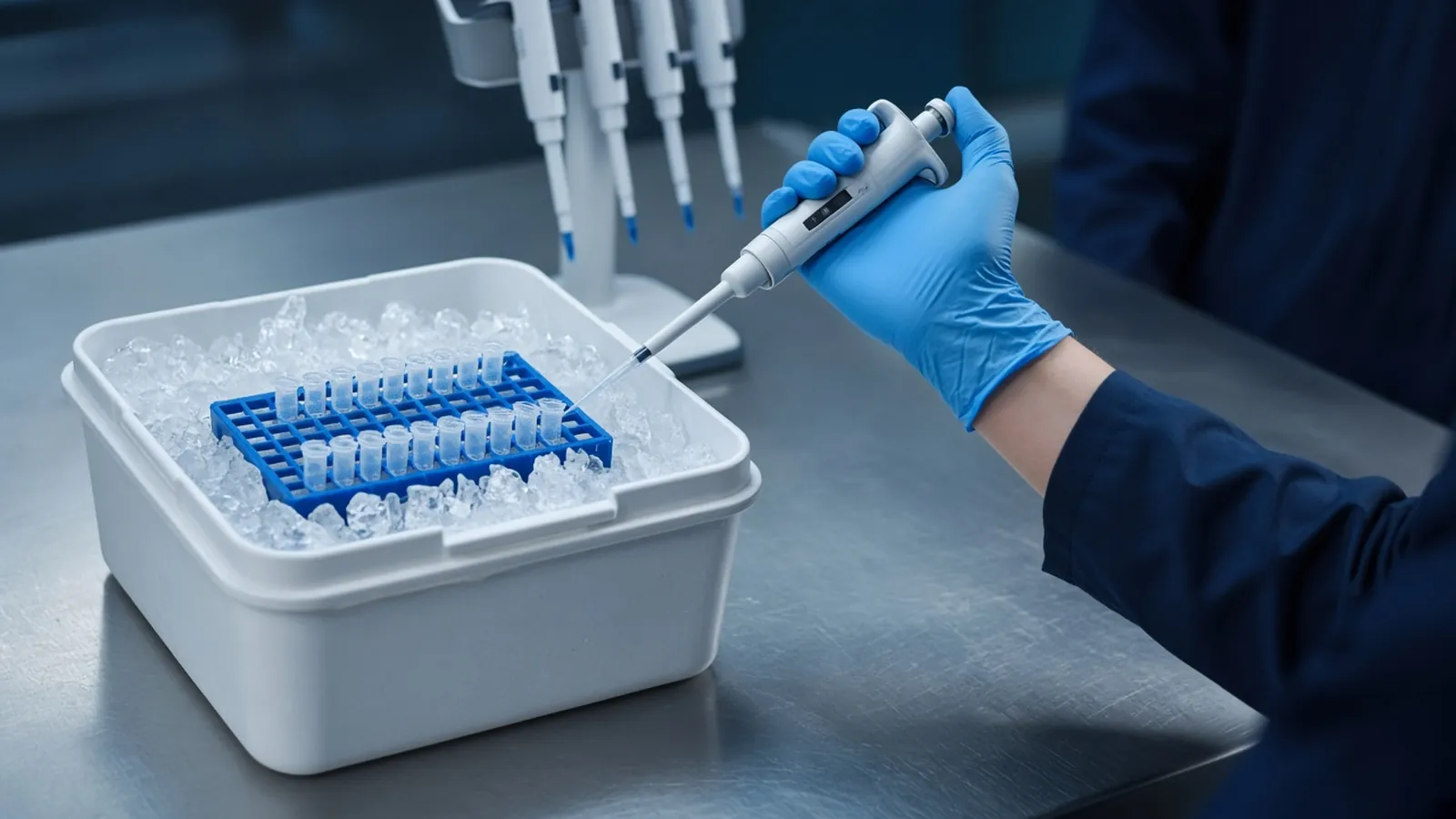
RNA extraction fails before the column if RNases have already cut the molecules you meant to measure. Ribonucleases are common on skin and in tissues, and they do not need a special buffer to work. The practical decision is whether the RNA that reaches the tube is still long enough and clean enough for the assay you named. This is a research explainer, not a kit insert and not a clinical collection protocol.
DNA methods and RNA methods share tubes and centrifuges and still answer different questions. The comparison of extraction classes is in how DNA extraction methods differ. Reagent and plasticware classes sit in the sample preparation catalogue. Send the specimen type with the quote request.
Why RNA is the fragile one
RNA carries a hydroxyl group on the 2-prime carbon of the ribose. Under alkaline conditions that hydroxyl can attack the backbone, so RNA is chemically less patient than DNA. Biology adds a second problem: cells use RNases constantly, and some of those enzymes refold and work again after treatments that would finish a typical DNase. A bench that looks tidy can still be an RNase bench if the same gloves handled a bacterial culture, a plasmid prep, or an uncovered tube of pancreatic enzyme.
Protection is a sequence. Stabilise the specimen. Open it in a chemistry that inactivates RNases at the moment of lysis. Keep the later washes and the elution on clean plastic. Cold slows many enzymes and is part of several protocols. Cold is not a substitute for a denaturing lysis. A sample that sat in a warm tube for an hour is not rescued by an ice bucket afterwards.
Pancreas, spleen and some tumours are rich in RNase. Cultured cells can still degrade if a pellet sits under spent medium. Name the tissue before you copy a protocol written for a different one.
What the chemistry has to accomplish
The lysis step is the protection step. Acid guanidinium-phenol reagents, and chaotropic buffers used with a silica column, denature proteins as they release RNA. Delay between thawing and lysis is costly: endogenous RNases are active until the denaturant arrives. A lump of tissue in an otherwise mixed tube keeps degrading inside the lump.
Silica columns and magnetic beads then bind nucleic acid so that proteins, including the now-denatured RNases, can be washed away. The same ethanol caution described for DNA applies here. A wet membrane carries solvent into the eluate, and reverse transcriptase is not grateful for it. Elute into nuclease-free water or the buffer the next kit accepts, and keep the tube cold or frozen once it is clean. Do not leave an elution standing on a warm block while you photograph the gel.
Phenol methods still have a place when the laboratory can handle the solvent. Take the aqueous phase without the interphase. Phenol left behind inhibits enzymes and inflates an ultraviolet reading. Waste follows the institutional chemical route.
Stabilization reagents let you hold tissue before extraction when the freezer is not in the same room as the collection. They are not a lysis buffer. Read the holding time and temperature on the product you have. A reagent for mammalian tissue is not automatically right for a leaf or a bacterial pellet.
Integrity is not a ratio
Absorbance at 260 nanometres estimates how much material absorbs like nucleic acid. The A260/A280 ratio is commonly watched around 2 for RNA, and A260/A230 is watched for leftover phenol, guanidine or carbohydrate. Those windows are hints. Protein pulls A260/A280 down. Solvent and chaotrope pull A260/A230 down. Neither ratio knows whether the RNA is 50 nucleotides or 5,000.
Integrity is a picture. On a denaturing gel, or on an electrophoretic trace, eukaryotic total RNA should show ribosomal peaks if the large RNA is still there. Instruments sometimes compress that picture into a score. A high score supports a claim about ribosomal RNA. It does not, by itself, prove every messenger is full length, and a low score does not automatically forbid a short amplicon assay. Formalin-fixed tissue and intentionally fragmented samples are obvious cases where a "bad" ribosomal pattern can still be the expected pattern. Say so in the notebook.
| Check | What a favourable result supports | What it does not prove |
|---|---|---|
| A260/A280 | Protein is probably not dominating the spectrum | That the RNA is long, or free of DNA |
| A260/A230 | Gross solvent or chaotrope carry-over is less likely | That inhibitors for your enzyme are absent |
| Ribosomal trace or gel | Large RNA survived extraction | That every transcript, or a small-RNA class, is intact |
| No-RT control in a later PCR | Signal depends on reverse transcription | That the quantification is accurate |
DNA contamination is the quiet roommate. Genomic DNA inflates A260 and can be copied by a polymerase if a later assay does not cross an intron or include a no-reverse-transcription control. DNase treatment, on a column or in solution, is the usual answer when DNA would change the claim. Remove or inactivate that DNase before reverse transcription. Some enzyme classes damage RNA during a casual heat step if divalent metal ions are still present. Follow the inactivation rule for the enzyme in your hand.
A no-template control and a no-reverse-transcription control belong to the assay that consumes the RNA. They are not optional once you intend to publish a transcript measurement. The MIQE guidelines describe what a quantitative PCR report should disclose, including sample handling. They are a reporting standard, not a licence to skip the gel.
When the trace looks degraded
Ask where the time went. Was the specimen frozen at collection, or did it wait in a corridor? Was the lysis buffer added to a frozen pellet that thawed slowly in a closed tube? Was homogenisation incomplete? Did a freeze-thaw happen because a freezer door was open or a power cut warmed the box? Each of those is a different repeat. Repeating the elution will not restore molecules that were cut in the tissue.
If only some samples in a batch look degraded, compare their handling rather than blaming the whole kit. If every sample looks degraded, including a fresh cell pellet you processed as a positive control, blame the reagents, the water, or the plastic, and retire the open aliquots. A positive control tissue of known quality is the fastest way to separate a bad morning from a bad method.
If the ratios are poor and the trace is fine, clean the RNA again or accept the limitation for enzymes that tolerate it. If the ratios are fine and the trace is a low smear, the molecules are gone. No spectrophotometer setting repairs that.
Benches, ice and power
Work with tubes and tips reserved for RNA. Filter tips reduce the chance that a pipette barrel becomes the contamination. Gloves change when you touch doors or a DNA gel tray. Autoclaving tips does not, by itself, remove RNase already on the plastic. Certified nuclease-free plastic is the straightforward purchase.
Keep lysates and enzymes on ice only where the protocol says so. A chaotropic lysis buffer is often used at room temperature because the chemistry, not the cold, is doing the inactivating. In a hot room, meltwater around a floating tube is neither cold nor clean.
Humidity and power cuts are ordinary failure conditions. A freezer that warmed overnight is a new experiment, not the same sample set. Record the excursion, and do not pool those tubes with a later batch as if the history were identical. Dry ice or a charged backup is an institutional planning question. It is not something this article can assign to your building.
Safety and the sourcing note
Phenol, chaotropes and biological specimens are the hazards. Follow the bottle and your biosafety rules. The WHO laboratory biosafety manual and the CDC BMBL are public references for that institutional decision. RNA from an infectious sample is not harmless because you called it nucleic acid.
EVRINTH can take a sourcing question. Name the organism or tissue, whether you need total RNA or an enriched fraction, the integrity the assay requires, the input amount, and whether DNase is part of the plan. The nucleic acid isolation enquiry reference is a prompt for that conversation. It is an independent method reference. Ask whether a quotation is possible. The sample preparation pathway is the wider route from specimen to assay.
Protect RNA from the moment the sample is taken
- 01Stabilise before you walk awayFreeze the specimen, or put it into a stabilization reagent of the class your tissue requires, at the place of collection. Time at room temperature is RNase time.
- 02Inactivate RNases at lysis, not afterwardsUse a lysis chemistry that denatures RNases as the cells open. Cold alone is a delay, not a kill step, and it only helps where the protocol actually calls for ice.
- 03Keep a dedicated path for the RNA tubesUse nuclease-free plastic, a clean bench, and tips that have not visited a DNA gel or a plasmid prep. Change gloves when you leave that bench.
- 04Judge integrity separately from absorbanceRead a gel or an electrophoretic trace for ribosomal RNA integrity, and treat A260/A280 and A260/A230 as contamination hints. Decide the downstream assay before you call the tube a pass.
Questions from the bench
Is an A260/A280 ratio near 2.0 proof that the RNA is intact?
No. That ratio is a rough comparison of nucleic-acid absorbance to protein absorbance. Intact and degraded RNA can share the same ratio. Integrity comes from the shape of a gel or a trace, usually the ribosomal RNA peaks, and from whether the assay you care about still works.
Do I need diethyl pyrocarbonate-treated water?
Most laboratories now buy water that is already certified nuclease-free. Diethyl pyrocarbonate treatment is an older route, and the chemical must be destroyed before use. It also reacts with amine buffers such as Tris, so it is easy to do badly. Certified water plus clean plastic is the calmer default.
Should every RNA prep be treated with DNase?
Treat when genomic DNA would inflate quantification or create a false signal in a reverse-transcription assay. Skip or redesign the step when you need DNA as well, or when the assay already distinguishes the two. Inactivate or remove the DNase by the rule for that enzyme class. Heat alone is not always enough.
Can a degraded RNA sample still answer a research question?
Sometimes. Short targets, some small-RNA questions, and specimens that were never going to yield long molecules can still be useful if you state the fragment length you actually have. A transcriptome that assumes full-length messages cannot. Match the claim to the trace, and do not hide a failed preservation step behind a normalised number.
References
Manufacturer names identify published method classes. Trademarks remain with their owners. Catalogue records on this site are independent references for enquiry. They are not a statement of inventory, distribution rights or a supply commitment. This page is educational. It is not medical advice, a diagnostic protocol or a biosafety approval.
Catalogue
Related products and categories
These links follow the subject of the article into published manufacturer references. A listing is a reference for an enquiry, not a statement of stock or distribution rights.
Continue in this cluster
Related reading
 How DNA extraction methods differHow silica columns, beads, precipitation and organic extraction change DNA yield, length and inhibitors, and which class fits the assay you actually plan toA glossary of purification termsDefine chaotrope, bind-wash-elute, yield, purity ratios and RIN, then walk a purification so those words describe one real workflow.Blood saliva and tissue as starting materialExplain how EDTA blood, heparin blood, saliva and solid tissue behave as extraction inputs, and why a serum tube is not whole blood.