
explainer
Blood saliva and tissue as starting material
Explain how EDTA blood, heparin blood, saliva and solid tissue behave as extraction inputs, and why a serum tube is not whole blood.
- Author
- EVRINTH Editorial Team
- Published
- 8 October 2026
- Updated
- 8 October 2026
- Reading time
- 9 min
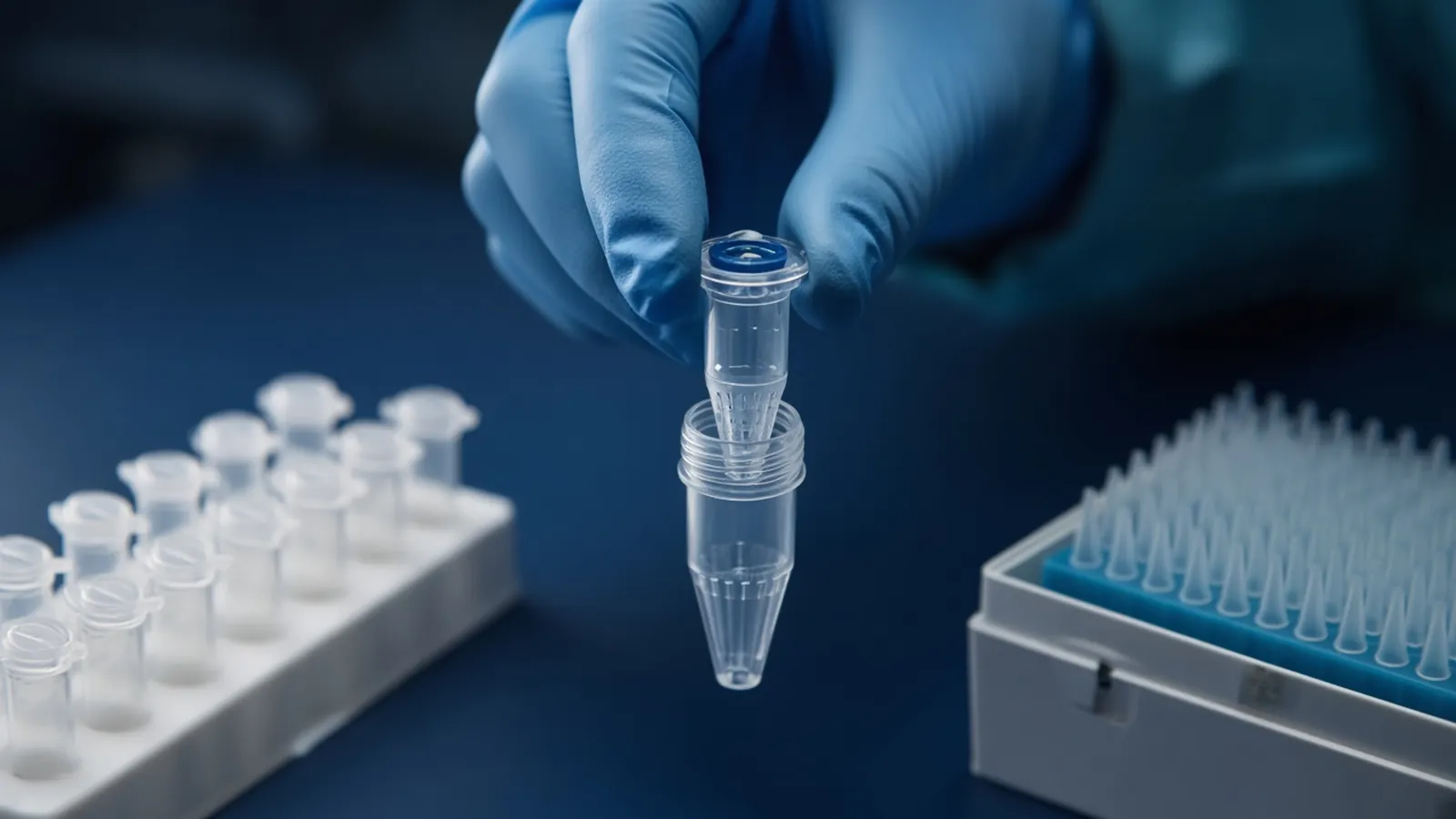
Blood, saliva and tissue are not three names for one input. Each is a different mixture, with a different dominant nucleic acid, a different inhibitor, and a different way of going wrong between collection and lysis. The decision this explainer supports is whether the tube in your hand can answer the question you wrote down, or whether you are about to extract the wrong compartment and blame the chemistry. Method classes that come after that decision are in how DNA extraction methods differ.
This is research education. It is not a phlebotomy instruction, not a consent document, and not a diagnostic test.
What each specimen physically is
Whole blood is cells plus plasma. The genomic DNA people usually want from a person is mostly in the white cells. Red cells contribute haemoglobin, which inhibits PCR if the prep is crude, and they contribute very little genomic DNA. Platelets and plasma contribute little genomic DNA and, if you are not careful with the question, a temptation to call any fraction "blood".
The cap additive is part of the specimen. EDTA anticoagulates by chelating metals and is the usual research choice when the downstream step is PCR. EDTA that carries into the reaction can also chelate magnesium, so the elution buffer and the volume you add still matter, but EDTA is not in the same class of trouble as heparin. Heparin anticoagulates by a different route and inhibits polymerases. It co-purifies readily enough that a heparin tube can yield a high A260 and a silent PCR. Citrate is a third additive you may see on a cap. Read the cap. Do not record "blood" and hope the additive was friendly.
Serum is what remains after clotting. The clot has taken the cells with it. Plasma is what remains after you spin an anticoagulated tube and remove the cells. Neither is whole blood. Cell-free DNA can be studied in plasma or serum, and it is usually scarce, short, and easily contaminated by cells if the spin was poor. Putting serum through a whole-blood protocol and expecting micrograms of genomic DNA is a category error. The silica column did not fail. The cells were never in the tube.
Saliva is a viscous secretion plus buccal cells plus microbes. Mucins clog a silica column. The microbial DNA fraction is large and variable, and A260/A280 cannot tell human sequence from bacterial sequence. A human SNP assay and a metagenome are different claims about the same tube. Calling the absorbance a human DNA concentration goes past what the instrument saw.
Solid tissue is a matrix that has to be homogenised. A cube with an intact core yields whatever was on the surface. Soft organ, fibrous muscle, and a fatty piece do not disrupt with the same shear, and the shear you use is the same choice as in any lysis: short PCR can tolerate it, long-read and careful RNA work may not. Tissue is also where RNA integrity is won or lost, because RNases in solid organs stay active until a stabiliser or a denaturing lysis arrives. Blood RNA has its own version of that race, including globin RNA from reticulocytes if you extracted whole blood without a depletion step the protocol owns. Saliva RNA is a different, often microbial, question. Do not export one specimen's RNA expectations onto another.
Collection chemistry you must write down
For blood, write anticoagulant, volume, and whether anyone already spun the tube into plasma. A haemolysed sample is a clue it warmed or froze badly: red cells broke, heme is everywhere, and white-cell DNA may still be there. Clots in an EDTA tube mean the tube was not mixed at collection. A clot is not a representative aliquot.
For saliva, write whether a stabilising collection fluid was used, because that fluid changes viscosity and the volume you extract. Neat saliva and diluted collection-kit liquid are different inputs. Write the question, human or microbial, in the same line.
For tissue, write the organ, the mass if you have it, and the time and temperature from excision to stabiliser or freezer. A piece that sat in a warm pot is a different specimen from a piece frozen at the bench. Stabilising reagents are not lysis buffers. They hold the specimen until extraction. Read the holding limits on the product you used.
Cold chain is part of the specimen, not a shipping afterthought. Fridge, freezer and the habit of not thawing twice are set out in storing biological samples from fridge to freezer. The handoff that matters here is the first one: collection site to the tube that will be extracted.
A path through an unlabelled rack
Pick up the tube and read the cap and the label before you look up a protocol. If it says serum or it has been spun and the cells discarded, do not use a whole-blood genomic method and then troubleshoot a low yield for an hour. Decide whether cell-free nucleic acid is actually the question. If it says heparin and you intend to do PCR, plan a spike-in and a cleanup or a tolerant polymerase, or ask whether an EDTA recollect is still possible. Recollect is a logistics and ethics question, not a step this page can assign.
If the tube is saliva and it will not pipette, treat viscosity as mucin. A collection system with a mucin-reducing class, or a clearing spin the protocol allows, belongs here. Forcing the string onto a silica column frit replicates the clog you would get from debris. If the scientific question is human genotype, remember the microbial DNA will still be in a successful elution.
If the tube is a tissue cryovial, confirm it is frozen solid and not half-thawed in a rack that warmed. Homogenise into the lysis buffer the nucleic acid requires, fast, with a disruption method matched to the fragment length. An intact chunk plus a clear supernatant is unfinished homogenisation. Cut or slice only if your biosafety rules allow that manipulation.
Then run the extraction you matched, with an input inside its capacity, and judge DNA by the assay plus a gel if length matters. Judge RNA by a trace. Use A260/A280 only as a protein hint after the matrix is identified. A good ratio from heparin blood is not a PCR permit. A good ratio from saliva is not a human mass.
| Specimen in the hand | Nucleic acid you are actually holding | Classic poison for the next enzyme | Fact to write beside the yield |
|---|---|---|---|
| EDTA whole blood | Mostly white-cell genomic DNA | Heme if red cells are crudely lysed; EDTA if it carries over | Volume and that the additive was EDTA |
| Heparin whole blood | Similar cells, different additive | Heparin, which can survive into PCR | The word heparin, plus a spike result |
| Serum or plasma | Little genomic DNA; cell-free DNA if that was the aim | Variable, often low yield mistaken for failure | Serum versus plasma versus whole blood |
| Saliva | Human cells plus microbial DNA | Mucin viscosity, and a mixed genome | Human question or microbial question |
| Solid tissue | The organ you homogenised, if the core was opened | RNases, incomplete disruption, heme in bloody organs | Mass, organ, and time to cold or stabiliser |
Failures that are really identity failures
Heparin blood, a fine ratio, a dead PCR, and an EDTA sample from the same person that amplifies: the additive was the experiment. Do not re-extract the heparin tube with the same casual wash and expect a new personality.
Serum processed as whole blood, yield near the floor, ratios irrelevant because there is almost nothing there: stop and name the compartment. If cell-free DNA was the goal, the method, the input volume and the contamination control are a different protocol.
Saliva library dominated by bacterial reads: the extraction worked. The question was human. The absorbance was a sum.
Tissue with a low yield and a chunk left in the tube: homogenisation was the method, and it was not finished. A longer elution will not fetch DNA from a core you can still see.
RNA from blood or tissue that sat warm: the integrity was decided at collection. A260/A280 near 2 does not reopen that decision. Stabilise the next specimen, and keep this one's trace with the delay written on it.
Safety, ethics, and the limit of a research extract
Human blood, saliva and tissue are specimens with institutional biosafety and ethics rules. A research extraction does not create a right to collect them, and it does not turn the eluate into a clinical result. Work inside the containment your committee has set. The WHO laboratory biosafety manual and the WHO biosafety health topic are public background, not a local approval. Sharps, clot waste and tissue homogenisers are part of the hazard even after you are "only" interested in nucleic acid.
Do not publish a PCR from heparin blood as a negative without a spike. Do not publish a saliva shotgun as a human genome without looking at the reads.
The handoff in a warm building
The operational gap is the corridor between collection and the freezer. A blood tube or a tissue pot that rides in a warm vehicle is not the specimen that was drawn. Haemolysis, clots, and lost RNA integrity are the visible forms. Record the time and whether a cold block was actually cold. A courier bag is not a freezer. If the receiving laboratory finds a thawed cryovial, that vial is a new history, as the storage guidance already says, and it should not be pooled with vials that stayed frozen. Saliva collection fluids have their own holding temperature on the product label. Follow that label rather than a habit borrowed from a blood tube.
What an enquiry needs for these starting materials
State whole blood, plasma, serum, saliva, or tissue, and name the organ. State the anticoagulant if it is blood. State DNA or RNA, human or microbial for saliva, and the time to cold if you know it. State the assay, because heparin plus PCR is a different request from EDTA plus a simple archival extract. State the input range so the capacity class can match.
Use the sample preparation catalogue and the sample preparation pathway. Send those facts with the quote request. The nucleic acid isolation enquiry reference is a way to frame the specimen and the assay. It is an enquiry reference. It does not mean the extraction is performed for you. Ask whether a quotation is possible. The acceptance check is an identified tube type, a recorded cold handoff, and an assay that fits that matrix.
Questions from the bench
Why does heparin blood fail PCR when the DNA looks abundant?
Heparin inhibits many polymerases and can travel with the DNA through a casual purification. A260/A280 can still look like a clean nucleic acid, because heparin is not a protein stain on that spectrum. EDTA is the usual research anticoagulant when PCR is the plan. If the tube in your hand is already heparin, a spike-in will show whether this eluate can amplify, and a cleanup or a tolerant enzyme class is a response, not a re-label of the cap.
Is serum a convenient substitute for whole blood?
No. Serum is the liquid left after blood has clotted and the cells have been removed. Plasma is the liquid from an anticoagulated tube after the cells are spun out. Genomic DNA for a typical genetic question comes mostly from white cells in whole blood. Serum and plasma contain far less of it, aside from cell-free DNA, which is a scarce and different target. A low yield from serum on a whole-blood protocol is the biology, not a broken silica column.
My saliva DNA quantifies well but the human assay looks muddy. Why?
Saliva carries human cells and a large, variable amount of microbial DNA. Absorbance counts both. A human genotyping PCR may still work, while a shotgun sequence of the same tube can be mostly microbial. Viscosity from mucins also clogs columns. Record whether the question is human or microbial before you call the extraction a success.
How soon does tissue need to be cold?
As soon as the biological question involves RNA, and sooner than people expect for DNA if the piece is large and warm. Time at ambient temperature is degradation time, especially for RNA integrity. Freeze or stabilise at the place of collection, and keep a record of the handoff. A later column cannot repair strands cut in a warm pot.
References
Manufacturer names identify published method classes. Trademarks remain with their owners. Catalogue records on this site are independent references for enquiry. They are not a statement of inventory, distribution rights or a supply commitment. This page is educational. It is not medical advice, a diagnostic protocol or a biosafety approval.
Catalogue
Related products and categories
These links follow the subject of the article into published manufacturer references. A listing is a reference for an enquiry, not a statement of stock or distribution rights.
Continue in this cluster
Related reading
How DNA extraction methods differHow silica columns, beads, precipitation and organic extraction change DNA yield, length and inhibitors, and which class fits the assay you actually plan toA glossary of purification termsDefine chaotrope, bind-wash-elute, yield, purity ratios and RIN, then walk a purification so those words describe one real workflow.Choosing a sample input for extractionSet an extraction input from the assay you will run and the kit capacity class, so too little sample is not missed and too much does not overload.