
guide
Choosing a sample input for extraction
Set an extraction input from the assay you will run and the kit capacity class, so too little sample is not missed and too much does not overload.
- Author
- EVRINTH Editorial Team
- Published
- 8 October 2026
- Updated
- 8 October 2026
- Reading time
- 10 min
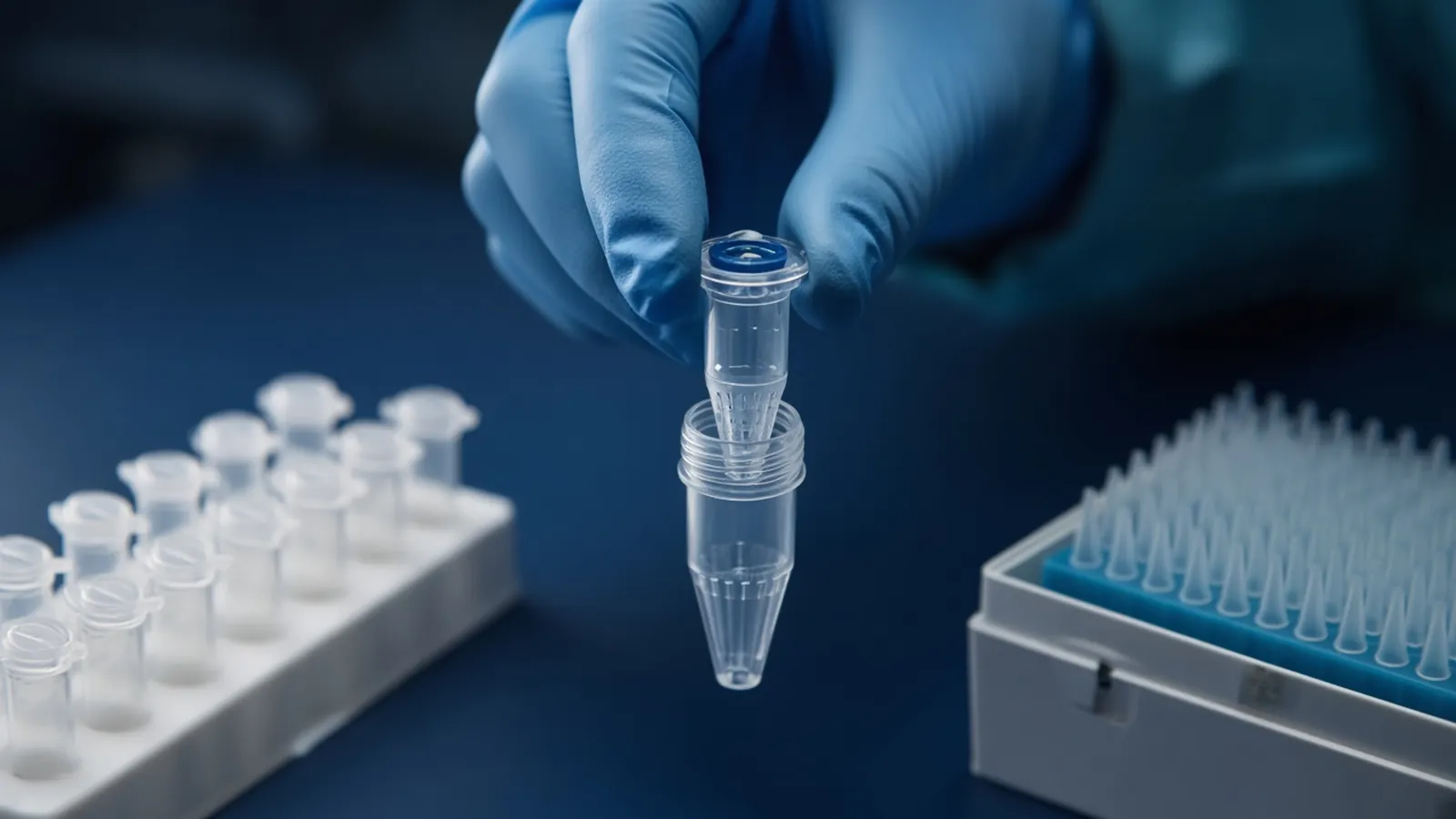
Sample input is the amount of specimen you ask one extraction to process. Too little, and the assay never sees its target, so a negative result is only a statement about sensitivity. Too much, and a silica column or a bead bed overloads: nucleic acid passes through, washes fail, purity falls, and for RNA the lysis buffer is titrated until RNA integrity collapses. The guide is how to pick a number you can defend. It is not a copied table of microlitres, because those numbers belong to the protocol card in your hand and change when the specimen changes.
Nucleic acid extraction methods differ in capacity as well as in chemistry. That map is in how DNA extraction methods differ. Volume inputs are only as good as the pipette, which is why accurate micropipetting technique sits beside any decision that starts with a blood tube or a swab eluted in a stated volume.
What input is doing inside the chemistry
A bind surface holds a limited mass of nucleic acid. Below that mass, recovery can still be poor if the DNA is so dilute that it adsorbs to the tube and never elutes in a useful concentration. Above that mass, extra nucleic acid does not wait its turn. It flows through, and the fraction that binds may do so together with protein, polysaccharide and chaotrope that the wash was sized to remove from a smaller load. The elution then shows a disappointing yield and a worse 260/230. People call this a bad kit. It is often a good kit used past its capacity class.
Lysis buffer has a matching limit. It has to denature proteins and, for RNA, inactivate RNases in the whole piece of tissue, not merely in a film on the outside. Double the tissue without doubling the buffer and the core keeps degrading while the outside looks extracted. RNA integrity is often the first casualty of an ambitious input. DNA yield can look acceptable from the same overloaded tube because DNA is more patient than RNA. If both are goals, the RNA limit sets the input, not the DNA ego.
The assay sets the floor. Endpoint PCR of an abundant gene can answer from a small swab. A genomic digest, a clone, or a sequencing library can demand more mass than that swab contains. Choosing the input is the overlap of three intervals: what you have, what the capacity class allows, and what the assay must receive after elution losses. If those intervals do not overlap, the honest outcome is to split, to change method, or to stop. Inventing an input by using the whole specimen "so as not to waste it" is how the intervals are ignored.
There is no universal microlitre figure in this article on purpose. A saliva kit, a blood kit and a plant kit can share a brand family and publish different maxima. Copy the maximum from the card you are running, next to the specimen name, in the units that card uses. That copied number is a capacity class. It is not a target you must hit. Working below the maximum is normal. Working above it is the overload.
Classes of specimen, measured differently
Tissue is a mass. Weigh the piece in a tared tube before lysis, on a balance your laboratory already checks. A wet weight and a dry weight are different quantities. Say which. A frozen piece gains frost and loses the comparison if you weigh it after it has sweated on the bench.
Liquid specimens are volumes. Blood, plasma, serum, saliva and culture supernatant are pipette decisions. Record the volume and the tube type. A "full swab" is not a volume until you state the elution volume you rinsed it in. Cells are counts, or they are a pellet from a stated culture volume at a stated density. "One flask" changes meaning when the flask was confluent and when it was not.
Sections on slides, biobank punches and fine-needle material may be too small to weigh. Record the count of sections, the thickness if you know it, and the source note. Treat yield as provisional. Two such preps can still be compared on the assay if you do not pretend the masses were equal.
Whatever the unit, write it before you add lysis buffer. Afterwards the specimen no longer exists as a measurable piece, and the story becomes "low yield" with no denominator.
The decision procedure
Read the assay minimum from the downstream protocol: how much DNA or RNA that reaction wants, in mass or in a concentration and a volume. Include a realistic loss on the extraction. If you do not know the loss, a pilot on a spare, non-precious aliquot is the way to learn it. Do not learn it on the only biopsy.
Read the capacity maximum from the extraction protocol for this matrix. If the card says the maximum is a mass of tissue, do not convert a blood volume onto that line by optimism. If you are between kits, the capacity class is one of the specifications you compare, beside fragment length and inhibitor tolerance.
Measure the specimen. If the measured amount is inside the capacity and, after a sober guess at recovery, can feed the assay, proceed and record the number. If it is above the capacity, split it. Two columns with half the tissue each will outperform one column with all of it. If it is below the assay minimum, pooling is allowed only when identity and permission allow. Otherwise change to an assay that can see less, or report that the input was insufficient. A negative PCR from an under-loaded extraction is not evidence of absence.
Then store the record with the elution: input, capacity class, elution volume, and the yield if you measured one. The next person can tell overload from biology only from that line.
| What you observe | Input story that fits | What to do before the next bind |
|---|---|---|
| Low yield, input above the card maximum | Overload or clogged silica column | Split; do not load the leftover lysate onto the same membrane |
| Low yield, input far below the maximum | Incomplete lysis, loss on plastic, or a truly poor specimen | Check lysis; do not "fix" it by adding the rest of an unknown mass |
| Dirty ratios only on the largest samples | Wash overwhelmed | Repeat inside the capacity class and compare |
| RNA trace worse as tissue mass rises | Buffer titrated, RNA integrity lost | Lower the input; do not compensate with a longer elution |
| Assay negative, input never recorded | Uninterpretable | Repeat with a measured input before you conclude |
| Two kit cards, two different maxima | You compared families, not one method | Write both classes; do not average them |
When the number and the tube disagree
A clogged column with lysate still on the frit is an input problem, a debris problem, or both. If the piece was already inside the published maximum, the fix is lysis or a pre-clear, not a larger load. A failed PCR from an unweighed "large" piece can be overload with inhibitors: if a dilution restores amplification, go back and weigh. Yields that scatter across a batch that was called identical often have inputs that scattered. Normalise only after you have a denominator, and do not normalise a damaged RNA trace away. Culture pellets counted by eye overload a silica column the same way. Record a count or a volume, not the adjective "big".
Safety when the specimen is the hazard
Weighing an infectious pellet on an open analytical balance can be the step that breaks containment. If the organism or the human specimen requires a cabinet, the measurement has to happen in a way your biosafety rules allow, even if that means a coarser balance inside the cabinet and a wider uncertainty. Write the uncertainty down. A precise mass obtained by an unsafe route is not a better input. The WHO laboratory biosafety manual is background for the institutional decision. It does not set your containment, and this guide is not a clinical collection protocol.
Chemical hazards stay with the lysis buffer you add after the measurement. Do not bring chaotrope bottles to the shared balance.
Specification writing when the balance is shared
In a laboratory where several groups use one balance, the defensible habit is a tare recorded in the notebook before the tube leaves the room. A later spreadsheet cannot reconstruct a mass that was never written. If the power fails, the written number remains the input. Do not re-weigh a tube that has already started to thaw and call it the same specimen.
When you write a sourcing enquiry, include the input range and the specimen, and ask which capacity class covers that range. A kit quoted for "DNA extraction" without a maximum is not comparable to the mass you actually cut. State units. State whether you need headroom below the maximum because the tissue is fibrous. That is the specification. A copied microlitre table from a public blog is not.
What else the enquiry carries
Add the assay minimum, DNA or RNA, and whether you will split over-capacity samples or need a format that accepts a larger class. Mention if the specimen cannot be weighed, so nobody promises a mass yield you cannot audit.
Look through the sample preparation catalogue and the sample preparation pathway. Send the range with the quote request. The nucleic acid isolation enquiry reference is a place to put the specimen and the assay side by side. It is an enquiry reference. It does not mean an extraction is performed for you. Ask whether a quotation is possible. The acceptance check is a recorded input inside a stated capacity class, and an assay that still makes sense at that input.
Set the input against the assay and the capacity class
- 01Write what the assay must be able to seeA short PCR can succeed on much less nucleic acid than a clone, a restriction digest, or a sequencing library. Record the minimum that would still answer the question.
- 02Copy the capacity class from the protocol you will runWrite the maximum specimen amount that card states for this matrix, in mass, volume, or cell number. Do not borrow a microlitre figure from a different kit and a different specimen.
- 03Measure the specimen you actually haveWeigh tissue, record blood or saliva volume, or count cells. A yield without a denominator cannot tell overload from a poor lysis. Pipette volumes the way a checked pipette allows.
- 04Split, pool, or stop before you bindAbove the capacity class, split the lysate across more than one silica column or bead tube. Far below the assay minimum, do not expect a negative result to mean absence. Record the input beside the elution.
Questions from the bench
Why did a larger piece of tissue give less DNA?
A silica column or a bead surface has a finite capacity. Above that amount, nucleic acid flows through and contaminants ride along, so the elution can be both poorer and dirtier. The extra tissue also titrates the lysis buffer, which is a particular problem for RNA integrity. Next time, weigh a piece inside the capacity class and keep the rest for a second prep rather than forcing one membrane.
Is there a universal microlitre table I should memorise?
No. Capacity depends on the chemistry, the specimen, and the format. A number copied from a different card is how columns clog and how yields become incomparable. Read the maximum for the matrix you have, write it in the notebook, and stay inside it. The decision is the comparison of your measured input with that class, not a secret table kept off the card.
What should I record if I cannot weigh a tiny biopsy?
Record the volume of the piece in the tube, the number of sections, or the description the collection note already used, and mark the yield as provisional. Do not invent a mass. Two preps with unknown inputs cannot be compared, and an enquiry about a kit cannot be matched to a capacity class you never measured. A photograph of the piece beside a scale bar is better than a guess.
Can I pool weak samples to reach the minimum?
Only when they are the same specimen type, the same question, and your protocol or ethics permission allows pooling. Pooling mixes identities and mixes inhibitors. If one swab was inhibitory, the pool becomes inhibitory. If the assay minimum is still out of reach after an honest measurement, change the assay or stop, and say that the input was below the method.
References
Manufacturer names identify published method classes. Trademarks remain with their owners. Catalogue records on this site are independent references for enquiry. They are not a statement of inventory, distribution rights or a supply commitment. This page is educational. It is not medical advice, a diagnostic protocol or a biosafety approval.
Catalogue
Related products and categories
These links follow the subject of the article into published manufacturer references. A listing is a reference for an enquiry, not a statement of stock or distribution rights.
Continue in this cluster
Related reading
How DNA extraction methods differHow silica columns, beads, precipitation and organic extraction change DNA yield, length and inhibitors, and which class fits the assay you actually plan toA glossary of purification termsDefine chaotrope, bind-wash-elute, yield, purity ratios and RIN, then walk a purification so those words describe one real workflow.Blood saliva and tissue as starting materialExplain how EDTA blood, heparin blood, saliva and solid tissue behave as extraction inputs, and why a serum tube is not whole blood.