
protocol overview
A glossary of purification terms
Define chaotrope, bind-wash-elute, yield, purity ratios and RIN, then walk a purification so those words describe one real workflow.
- Author
- EVRINTH Editorial Team
- Published
- 8 October 2026
- Updated
- 8 October 2026
- Reading time
- 9 min
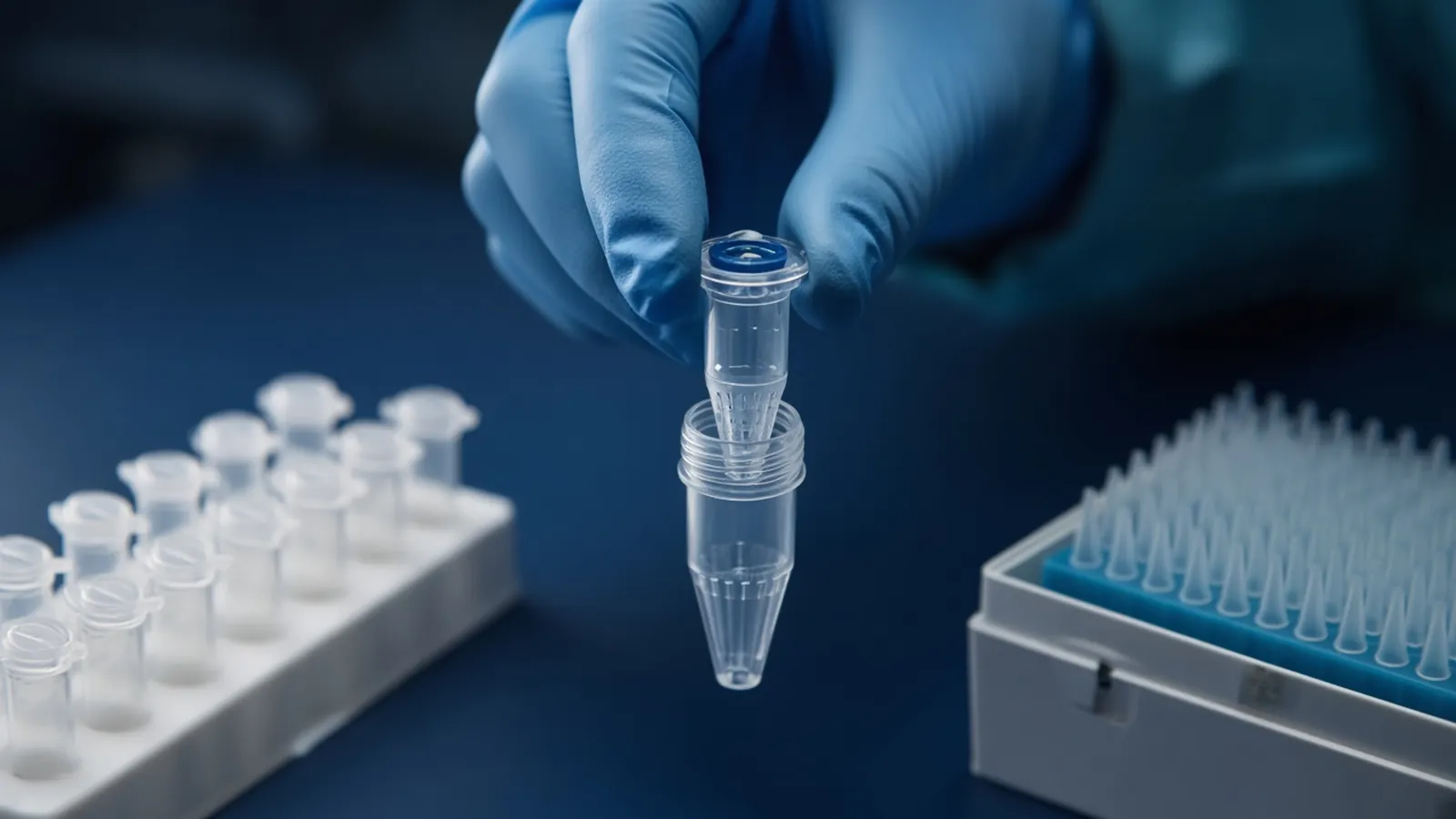
A glossary of purification terms is useful only if the words map onto a real nucleic acid extraction. Chaotrope, wash, flow-through, elution, capacity, yield, purity ratios, integrity, and RIN are often swapped in notebooks until a failed assay cannot be described. This protocol overview defines them and then walks one silica-column workflow so each word is used once in the right place. It is research language. It is not a copied kit insert and not a clinical method.
The method classes behind the words are compared in how DNA extraction methods differ. RNA handling before those words even apply is in protecting RNA during extraction.
Chaotrope
A chaotrope is a salt, often a guanidinium salt in this craft, that disrupts hydrogen bonding. In lysis it helps denature proteins, including many nucleases, and it drives nucleic acid onto silica. The chaotrope is why a lysate can sit in a harsh mixture and still give you DNA or RNA at the end. It is also why a wash must follow. Leftover chaotrope inhibits later enzymes and often pulls A260/A230 down. The salt is a tool during the bind and a contaminant afterwards.
Not every lysis is chaotropic. Enzymatic or alkaline plasmid lysis is a different opening step. If your sheet says chaotrope, the chemistry should actually have included one. Do not use the word as a synonym for "the first buffer."
Bind, wash, elute
Bind-wash-elute is the three-stage pattern of a silica column and of many magnetic beads. Nucleic acid binds the matrix in high chaotropic salt. A wash keeps it bound while proteins, salts, and the chaotrope leave. Elution releases it when the salt drops, usually into water or a mild buffer. Beads that use the same chemistry swap the spin for a magnet. The words do not change.
Bind is complete only within the capacity of that matrix. Capacity is the amount of nucleic acid, under the conditions the insert states, that the column or bead class can hold. It is a property of that class. A mini column and a larger column do not share a number, and this glossary will not invent one. Past capacity, extra nucleic acid does not wait politely. It leaves in the flow-through.
Flow-through is the liquid that passed the matrix and was not retained. In a successful bind it is waste, handled by the chemical waste rules for that kit. In an overloaded bind it is where the missing yield went. If recovery is far below the input you recorded, the flow-through is the first place to suspect, not the elution buffer.
Wash is both a step and a buffer. The wash buffer is formulated so nucleic acid stays on the matrix while contaminants move. Later washes are often alcoholic. A skipped wash leaves chaotrope. A wash left behind leaves alcohol. Either can make the next enzyme fail while the tube still contains nucleic acid.
Elution is the release step and the liquid that results. Low salt, the right pH, and a membrane the buffer can wet are the conditions. The elution buffer name and volume belong in the record, because Tris-EDTA and water are different plans for the same DNA.
Yield
Yield is recovered nucleic acid judged against the input you measured. Input may be cell number, tissue mass, blood volume, or culture density. Recovered amount is a mass, from a stated quantification method. A concentration without a volume is not a mass. A mass without an input is not a recovery. "Low yield" is an empty phrase until both numbers are on the sheet.
Two preps can have the same concentration and different yields because one was eluted in less volume. They can have the same yield and different usefulness if one is intact and the other is fragments. Yield does not grade integrity.
Purity ratios
Purity ratios here means A260/A280 and A260/A230 from a spectrophotometer, with a blank and a pathlength that match the calculation. A260/A280 near 1.8 for DNA and near 2.0 for RNA is a cleanliness hint about protein. A260/A230 often falls when chaotrope, phenol, or carbohydrate remains. The ratios do not identify the organism, do not prove the molecule is long, and do not prove a polymerase will work. They are hints you record beside the yield, not instead of it.
Integrity and RIN
Integrity is whether the molecules are still long enough for the assay you plan. A genomic DNA gel that shows a tight high band has a different integrity story from a smear of short pieces. A plasmid prep has yet another picture. Integrity is not a ratio.
RIN, the RNA integrity number used by a common electrophoretic instrument class, is a score computed from the RNA trace. It looks at ribosomal RNA peaks and the baseline between them and reports a number typically on a scale from 1 to 10. It is an electrophoretic integrity score. It is not a purity ratio and it is not an absorbance. A sample can have a high RIN and a bad A260/A230 if chaotrope remains. It can have clean ratios and a low RIN if the RNA was already cut before the column. RNA integrity in the notebook should say which of those you measured. The score's acceptability belongs to the library or assay note you are following, not to a universal cutoff invented here.
| Word | Belongs to | Does not mean |
|---|---|---|
| Chaotrope | Lysis and bind | Any first buffer |
| Capacity | That column or bead class | A number copied from another product |
| Flow-through | Unbound liquid | Automatic proof the DNA was absent |
| Wash | Contaminant removal | Elution |
| Yield | Recovered mass versus input | A concentration alone |
| Purity ratios | A260/A280 and A260/A230 | Integrity or identity |
| RIN | Electrophoretic RNA integrity | A purity ratio |
One workflow that uses the words in order
Start with a recorded input and a lysis that matches the specimen. If the lysis uses a chaotrope, say so. Clear debris before you load. Debris is not flow-through. It is material that never had a chance to bind.
Load within the capacity of the silica column or bead class in your hand. Collect the flow-through only until a first sample shows that the bind is working, then treat it as waste. If a later quantification shows almost no yield from a rich input, revisit that flow-through logic on the next prep by splitting the load, rather than by blaming elution first.
Wash as the insert sequences the washes. Do not skip the wash that removes the chaotrope, and do not leave the alcoholic wash on the matrix. Elute in the buffer and volume you have already decided to store or to assay. Write elution buffer on the tube.
Then make three separate statements. Yield: recovered mass against the input, with the quantification method named. Purity ratios: the two absorbance ratios as cleanliness hints, after a proper blank. Integrity: a gel or a trace, and a RIN if and only if you ran an RNA electrophoretic assay and you are willing to call it an integrity score.
Where the words get misused
Calling a RIN a purity result sends people to wash a sample that is actually degraded, or to throw away a clean but slightly off-ratio RNA that the assay could have used. Calling flow-through "the elution" swaps waste and product. Calling capacity "about the same for all mini columns" overloads one class and underfills another. Calling yield the absorbance number hides volume and input.
If a sentence in the notebook could be moved unchanged onto a different molecule, it is too vague. "Ratios were fine" does not say which ratio, which blank, or whether integrity was looked at.
Safety
Chaotropic salts are hazardous. Alcohol washes are flammable. Phenol, if a method class uses it, is an institutional chemical hazard and does not belong in a casual recipe here. Follow the safety data for the bottles you opened and the waste rules of the institution. Specimens stay inside the biosafety decision already made for that work. The WHO laboratory biosafety manual is background, not permission. None of these terms convert a research prep into a diagnostic result.
Writing the words into a specification
When you describe a prep in a sourcing note, use the glossary as a checklist rather than the word pure. Name the specimen, DNA or RNA or both, the matrix class, the elution buffer, which purity ratios you will record as hints, and whether RNA integrity will be a gel, a trace, or a RIN. State the input range so capacity is discussed as a class property. A specification that says "high yield and good ratios" cannot be compared with another specification. One that says recovered mass against a stated input, plus the two ratios, plus an integrity method, can.
What to ask
Send that vocabulary with the scientific need. The sample preparation catalogue and the sample preparation pathway are where materials and the surrounding assays sit. Use the quote request for the actual ask. The nucleic acid isolation enquiry reference is an enquiry reference, not a statement that a prep is already running. Ask whether a quotation is possible.
Record a purification in the words the workflow uses
- 01Name the chaotrope step and the matrixWrite the lysis class and whether nucleic acid bound on silica or on beads. Capacity belongs to that matrix class, so record the column or bead class rather than a nickname.
- 02Separate bind, wash, and elute in the notesRecord the flow-through as the unbound fraction and the wash as the step that should remove chaotrope and protein. Name the elution buffer and the volume, because elution is both the release step and the liquid you keep.
- 03Report yield against an inputCompare recovered nucleic acid with the input mass, volume, or cell count you actually measured. A mass with no input is not yet a yield.
- 04Keep purity ratios and integrity apartRecord A260/A280 and A260/A230 as cleanliness hints. Record integrity on a gel or a trace, and for RNA add a RIN only as an electrophoretic integrity score, not as another ratio.
Questions from the bench
Is a RIN a kind of A260/A280?
No. A RIN is an electrophoretic integrity score built from an RNA trace, usually reflecting ribosomal peaks and the signal between them. A260/A280 is a spectrophotometer ratio about how the solution absorbs light. A high RIN can sit beside a poor ratio, and a clean ratio can sit beside degraded RNA. Report them as separate claims.
Is flow-through always waste?
In a routine silica bind it is the fraction you meant to discard, and it should be poor in the nucleic acid you wanted. When a column is past capacity, the flow-through can hold the yield you lost. Keep it only until you know the bind worked, and dispose of it by the waste rules for that chemistry.
Does yield mean the concentration on the reader?
Concentration is mass per volume. Yield is how much you recovered relative to what you put in, or at least the recovered mass stated beside that input. A high concentration in a tiny elution can be a low yield. Write both, and name the quantification method.
Can I use these words for a plasmid prep and a tissue RNA prep alike?
The bind-wash-elute words still fit when the chemistry is silica or a related bead. The specimen, the lysis, and the integrity claim differ. A plasmid prep rarely needs a RIN. An RNA prep always needs an integrity statement if the next assay cares about length. Do not copy a DNA ratio target onto an RNA sheet.
References
Manufacturer names identify published method classes. Trademarks remain with their owners. Catalogue records on this site are independent references for enquiry. They are not a statement of inventory, distribution rights or a supply commitment. This page is educational. It is not medical advice, a diagnostic protocol or a biosafety approval.
Catalogue
Related products and categories
These links follow the subject of the article into published manufacturer references. A listing is a reference for an enquiry, not a statement of stock or distribution rights.
Continue in this cluster
Related reading
How DNA extraction methods differHow silica columns, beads, precipitation and organic extraction change DNA yield, length and inhibitors, and which class fits the assay you actually plan toBlood saliva and tissue as starting materialExplain how EDTA blood, heparin blood, saliva and solid tissue behave as extraction inputs, and why a serum tube is not whole blood.Choosing a sample input for extractionSet an extraction input from the assay you will run and the kit capacity class, so too little sample is not missed and too much does not overload.