
selection guide
Quarantine of a new cell line
A selection guide for quarantining a new cell line: separate housing, mycoplasma and identity checks, a visual inspection, a token freeze, and what risk
- Author
- EVRINTH Editorial Team
- Published
- 8 October 2026
- Updated
- 8 October 2026
- Reading time
- 8 min
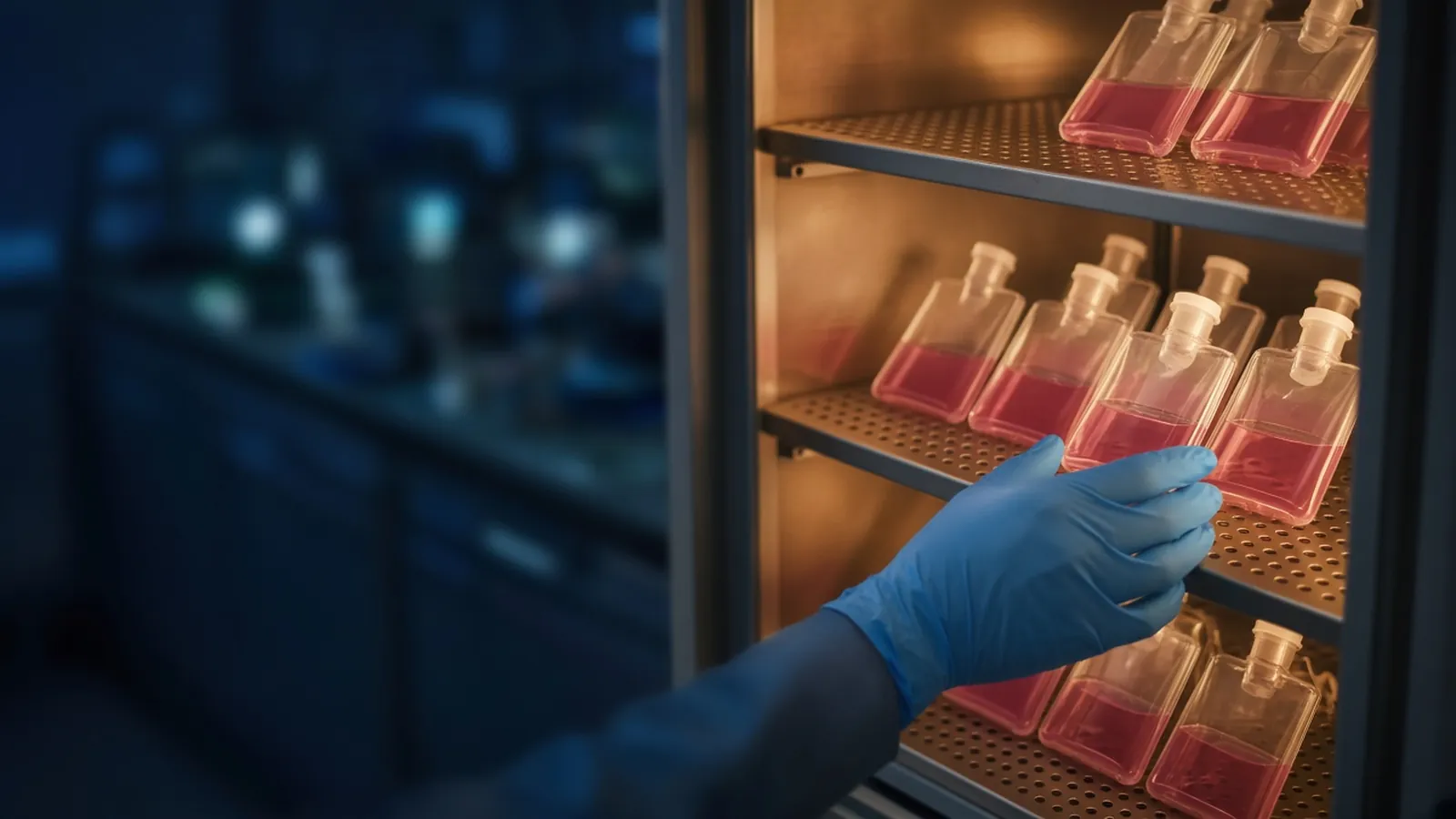
A new cell line does not join the main incubator on the day it thaws. Quarantine is the interval in which you keep it physically apart, look for the contaminants and identity failures you have the tools to see, and freeze a token backup before you trust the flask. It is a selection guide: which evidence is enough to open the gate, and which risk is still sitting there after you do. Everyday culture practice is in mammalian cell culture for research labs. Frozen inventory, once you have a vial worth keeping, is discussed in storing biological samples from fridge to freezer. Nothing in the release criteria below means the line has become safe.
What you are selecting for
You are selecting against three failures that travel with new vials. The first is a microbe you can see or that will cloud the medium: bacteria, yeast or fungi introduced at the source or during thaw. The second is mycoplasma, which often grows without cloudiness and which can already be in a flask that looks like a normal monolayer. The third is misidentification: the cells are a different line from the name on the tube. ICLAC documents how often names and cells part company. Quarantine is also a place to notice that the morphology never matches the description you were given.
You are not selecting against every virus, every genetic drift, or a biosafety question. Those need tests and decisions you have not performed just because the flask spent two weeks on a side bench. Write the limit at the top of the quarantine note so a later reader does not upgrade a negative mycoplasma result into a clean bill of health.
Housing comes first, before the test results exist. The stronger arrangement is an incubator that does not hold the laboratory's established lines. A clearly separated shelf is a weaker arrangement because the air is shared. Use a shelf only when the institution has accepted it. Sharing a water pan and a door with a precious line is not separation. Supplies should be divided too: media aliquots, pipettes and a bath habit that does not dip the new vial into water the main lines depend on.
Treat the quarantine incubator as its own small laboratory for the length of the hold. A pipette aid used on a cloudy quarantine flask and then on a maintenance flask has joined the two rooms. So has a medium bottle that was opened in both places. Write the split of supplies on the same note as the housing choice. If you cannot spare a second bottle of medium, aliquot it inside the cabinet before either culture is opened, and do not return a tip or a serological pipette to the shared pouch. The selection you are making is physical. A test result filed later cannot undo a shared pipette from day one.
Evidence, in an order that can fail
Thaw under the line's protocol, into the quarantine incubator, and write the passage you are willing to claim. If the supplier stated a passage, start from that number and record the rule. If they did not, record unknown rather than starting at passage one as if the cells were newborn.
Inspect daily for turbidity, unexpected debris, and whether adherent cells attach as the description says. A flask that clouds is the end of that vial's quarantine and the start of your contamination response. Do not move the neighbours in the main incubator into a "quick look" beside it.
Run the mycoplasma method your quality system already chose: a nucleic-acid test, a culture method, or another assay they have named. Know what a negative means for that kit. A negative is not every microbe. Time the test after the cells have grown enough for the assay's input, following the assay instructions, not before, when a dilute sample can look falsely calm.
Authenticate against a reference. For human lines, a short tandem repeat profile compared with a published or supplier profile is the common method. Other species need the assay your system names. Read ICLAC resources for why a profile, not a photo, closes an identity question. If there is no reference profile, say unmatched-to-reference, and do not invent a pass.
Freeze a token stock from an early quarantined passage once viability and attachment look acceptable, and before you have used the line in a large experiment. Label it as quarantine-era so nobody thaws it into the main box by mistake. Storage conditions belong to your freezing method and your tank rules.
Release to the main incubator only when all of the following are true: the institution's housing rule was followed, visual checks did not show contamination, the mycoplasma result is negative by the named method, the identity result matches the reference you stated, a token freeze exists and is recorded, and the person allowed to release lines has signed the note. Miss one, and the gate stays shut. A beautiful confluence is not a signature.
| Evidence in hand | Decision it can support | Risk that remains if you stop here |
|---|---|---|
| Vial label matches the order | You thawed the tube you think you ordered | The cells inside can still be the wrong line |
| Clear medium and an attached monolayer | No obvious bacterial or fungal bloom today | Mycoplasma, and a bloom that starts tomorrow |
| Negative mycoplasma by a named assay | That assay did not detect its targets | Organisms outside the assay, and a later introduction |
| Identity profile matches a reference | The profile agrees with that reference | A wrong reference, or a mix that the assay missed |
| Token freeze, location written | You can recover this passage if the flask dies | The frozen cells carry whatever the flask carried |
| Written institutional release | The line may enter the main incubator under your rules | Every hazard you did not test, including viruses |
| Supplier certificate alone | A document to file beside your own results | Contamination after their test, and a test you do not run |
Branches that keep the gate closed
If the mycoplasma control on the assay fails, the result is invalid. Do not record negative, and do not release. Repeat the assay. If the profile does not match, stop. Tell the people who might have shared reagents. A mismatch is not a cue to rename the cells and continue. If the morphology is wildly wrong but the profile matches, record the discrepancy and ask whether the medium or the thaw damaged them before you call it a new phenotype.
If the only incubator you have is the main one, you do not have quarantine until the institution defines an interim. Do not invent a shelf policy in the corner of a busy box because a parcel arrived on a Friday. Leave the vial frozen, under the storage rules you already follow, until housing exists.
A line from a collaborating laboratory is quarantined the same way as a line from a public collection. Courtesy is not a test. Public guides such as the ATCC culture guides tell you how that collection recommends you grow a line they ship. They do not waive your gate.
What release does not mean
Release means the evidence in your table was met and the main incubator may receive the line under the containment the institution already set. It does not mean the cells are non-infectious, authenticated against every database, or fit for a therapeutic use. The WHO Laboratory Biosafety Manual is a reference for writing containment rules. Quarantine does not assign a level and does not replace those rules. This guide is not medical advice. A token freeze from quarantine is a research backup. It is not a certified cell bank.
A warm parcel still starts at the gate
A vial that arrives warm after a courier delay is a reason to begin quarantine with extra suspicion, or to discard under your rules, not a reason to skip ahead because the experiment is late. Note the temperature condition you observed, without inventing a survival time. In a hot week, do not park the new flask "temporarily" beside a finished line while you look for space. Temporary is how shared air happens. When you source a line, ask which identity and mycoplasma documents the supplier will share, which passage the vial will carry, and whether a recommended medium family is stated. Put your own repeat tests and the housing you actually have into the timeline before you agree a date for the main incubator. A certificate that arrives after the cells are already on the shared shelf is a filing exercise, not a quarantine. Ask for the document class. Do not ask a supplier to declare the line safe to mix with your existing cultures. That sentence is yours, and only after the gate criteria are met. Vessel and medium classes for the quarantine incubator can be discussed from the laboratory consumables catalogue and the academic research reference. Use the quote request for that specification. Asking the question does not place the line in your main incubator, and it does not mean anyone else will run the quarantine for you.
Questions from the bench
Can a clearly labelled shelf replace a separate incubator?
Only if your institution has accepted that compromise in writing. A shelf still shares air, humidity and often a water pan with the main cultures. A separate incubator is the stronger physical barrier. If the institution says a shelf is not enough, a label does not make it enough.
Does a supplier mycoplasma test end our quarantine?
It is one input, not the release. Tests differ in what they detect, and the vial can be contaminated after the supplier's assay, including during a wet thaw. Repeat the method your quality system names, on cells you have opened, before the line joins the main incubator.
What is a token freeze?
A small number of vials frozen from an early passage while the line is still in quarantine, stored as the backup you would hate to lose. It is not a working bank and not proof of safety. How frozen stocks are kept is a storage question. The quarantine page only insists the location is written down.
Does quarantine make the line safe?
No. It reduces some risks you chose to test: visible microbes, mycoplasma by a stated method, and a mismatch to an identity profile. It does not clear viruses you did not test, it does not fix a wrong reference profile, and it does not assign a biosafety level. Release means eligible for your main incubator under your rules, not harmless.
References
Manufacturer names identify published method classes. Trademarks remain with their owners. Catalogue records on this site are independent references for enquiry. They are not a statement of inventory, distribution rights or a supply commitment. This page is educational. It is not medical advice, a diagnostic protocol or a biosafety approval.
Catalogue
Related products and categories
These links follow the subject of the article into published manufacturer references. A listing is a reference for an enquiry, not a statement of stock or distribution rights.
Continue in this cluster
Related reading
Mammalian cell culture for research labsHow research labs keep mammalian cell culture workable: medium, aseptic technique, confluence, passage records and contamination checks. Storing biological samples from fridge to freezerFridge, minus-20, minus-80 and nitrogen storage slow different kinds of damage. A warm box is a quarantine decision, not a hope.A glossary of culture termsPairs of culture words that laboratories mix up, and the wrong next action each pair causes, from confluence versus density through to confluent versus