
selection guide
Questions before ordering gel reagents
Questions on agarose grade, acrylamide hazard, membrane pore, ladder range, and buffer class before you send a gel-reagent enquiry.
- Author
- EVRINTH Editorial Team
- Published
- 8 October 2026
- Updated
- 8 October 2026
- Reading time
- 8 min
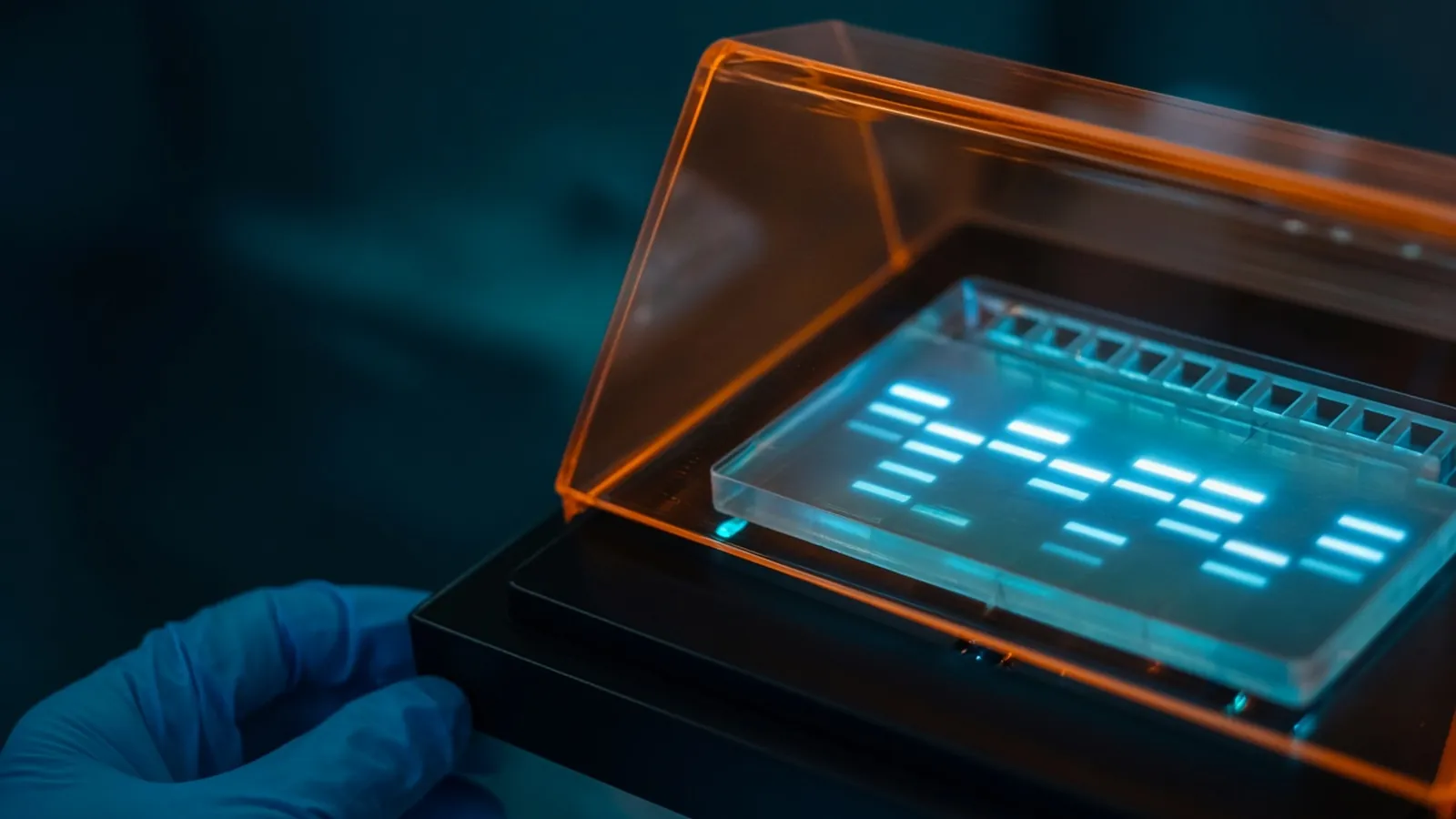
Ordering gel reagents goes wrong when the enquiry names a nickname and omits the decision the gel has to support. This page is the list of questions to answer before you send that enquiry. It is a selection guide, not a catalogue of lots and not a statement that any bottle is on a shelf. How a finished DNA gel is read, once the reagents arrive and match the specification, is agarose gel electrophoresis for DNA. How to write the enquiry so a quotation can be compared with the need is how to write a laboratory sourcing enquiry.
Agarose grade, including low-melt
Agarose is not one powder. Molecular-biology grade is the ordinary matrix for PCR products, plasmids, and digests. Low-electroendosmosis agarose has fewer fixed charges, so the backward flow of buffer that opposes DNA is smaller and bands stay more honest. Low-melt agarose softens at a lower temperature than standard agarose. Ask for it when the extraction or the in-gel step needs that behaviour, and ask the certificate for the melt range rather than inventing one in the email. High-strength or high-resolution grades exist for small fragments. Name the size window. A 10 kilobase plasmid check and a 100 base-pair separation are different powders, or at least different percentages of a stated grade.
Also say whether the gel will be stained in the pour or after, and whether the slice must be compatible with a later ligation. A dye the cleanup kit forbids is a bad standardisation, discovered after the order.
Acrylamide, as a hazard note and a format
Unpolymerised acrylamide is neurotoxic. Who may cast a gel is an institutional SOP, not a blog. The purchasing question is which physical form that SOP allows. A precast cassette avoids handling monomer and fixes you to that maker's percentage, buffer, and expiry. A premixed solution still needs the chemical controls for the liquid. A powder needs weighing controls and a waste path for the solid and the dust. Any of the three can be the right request. None of them should be accompanied by a homemade polymerisation recipe in the enquiry text.
If you do specify a gel you will cast under the SOP, the specification is the percentage class and the crosslinker ratio class the method already names, such as the families laboratories call 29:1 or 37.5:1, plus the buffer system. Those words identify a product class. They are not volumes, times, or initiator masses. Leave those in the SOP. Ask for the safety data sheet with the quotation. Polymerised gels are still chemical waste. Say so in the local rule, not as a claim that a supplier has approved your bin.
Membrane material and pore
A western transfer membrane is either nitrocellulose or PVDF in most research blots. Nitrocellulose wets in aqueous buffer. PVDF usually needs the activation solvent the maker names. PVDF is the tougher sheet when you will strip and reprobe. The pore is the second choice. A larger pore is the common request for many proteins. A tighter pore is the request when the target is a small protein or peptide that can pass through the larger sheet during transfer. Write the apparent mass. If you do not know it, the enquiry is early.
Also state the detection. A fluorescent blot and a chemiluminescent blot can share a membrane and still want different blockers and secondaries later. The membrane line of the enquiry can stop at material, pore, and format, cut sheet or roll, if that is all you have decided.
Ladder range
A ladder that does not bracket the band cannot support the size sentence. For DNA, state the shortest and longest fragment you must resolve and the agarose percentage. For protein, state the apparent mass and whether the marker must be prestained for watching a transfer, unstained for a fair size comparison, or fluorescent for a named imager channel. A prestained ladder alone is a weak sizing standard. If the figure will claim a mass, ask for the unstained class as well.
Loading dye is a separate line. Tracking dyes and a density agent are the basic class. A loading dye that also contains a nucleic-acid fluorophore is a different product and will fight a gel that is already stained. Say which habit your method uses.
Buffer class
Tris-acetate-EDTA and tris-borate-EDTA are the two DNA buffer families most benches standardise on. They heat differently, and borate can matter if DNA is later taken out of the gel. Name the family you already pour so the new agarose is not tested in a buffer you will not use. For protein gels, name tris-glycine, Bis-Tris, or the other system the tank uses. A ladder's apparent masses are quoted for a system. Buying the ladder for a system you do not run wastes the specification.
Ready-mixed buffer and a powder you dissolve are different requests. If you dissolve it, the water grade is part of the method, and the pH check belongs to your bench. Ask for the powder's specification, not for a promise that your pH meter will agree.
| Reagent | Question that makes the request specific | Question that is still too vague |
|---|---|---|
| Agarose | Grade, fragment window, extract or not | "Agarose for gels" |
| Acrylamide form | Precast, premix, or powder, as the SOP allows | A polymerisation recipe |
| Membrane | Material, pore class, protein mass | "Blotting paper" |
| Ladder | DNA or protein, bracket, prestain or not | A range in the title only |
| Buffer | TAE, TBE, or the protein system you run | "Running buffer" |
| Loading dye | Tracking only, or dye plus a DNA fluorophore | "Dye" |
Documents and the acceptance check
Ask for the safety data sheet for anything that is stained, monomeric, or solvent-based. Ask for a certificate when you need a stated specification, such as an electroendosmosis value or a ladder's band list, and say what you will compare on receipt. The acceptance check for a gel reagent is practical. The ladder brackets the target on your percentage. The agarose dissolves in your buffer family. The membrane wets as the class requires. The sheet matches the hazard controls you already have. A nickname on a box is not the check.
The photograph on this page is the kind of agarose result these reagents are bought to produce, bands under an orange shield. If your real endpoint is a protein gel or a blot, say that. A DNA-shaped order will not feed a western.
Safety stays with the institution
This page does not authorise a laboratory to cast acrylamide, to treat ethidium waste, or to choose a biosafety level. The WHO laboratory biosafety manual is public background. Your safety office decides. An enquiry can request a sheet. It cannot request permission to ignore one.
Heat, humidity, and the way the specification is written
Agarose powder takes up water if the container is left open in a humid store, and the percentage you think you poured drifts. Ask for a sealed container and write the storage condition you can actually provide. Markers and some stains ask for cold shipment. Say so, and name who receives the parcel, so a warm loading bay is not a surprise. The wording habit that makes this comparable across suppliers is the one in the sourcing-enquiry note: measurable performance, the document you need, and the check on receipt. A sentence that only says "good quality" cannot be quoted against.
Power cuts and hot afternoons affect the run, not the order form. They do affect storage. A reagent whose label says cold, left out after a weekend outage, fails the acceptance check even if the paperwork matched.
Where the enquiry goes
EVRINTH can take a sourcing question. Put the answers to the table above in the message, attach the safety constraint, and use the quote request. The molecular biology catalogue is the list those words can point at. The nucleic acid analysis pathway is the context when the gel is one step toward a clone or a sequence. Ask whether a quotation is possible. Do not read a quotation as a statement that a given lot is waiting, and do not send a polymerisation recipe in place of the form your SOP allows.
Questions from the bench
What agarose grade should the enquiry name?
Name the job. Standard molecular-biology agarose for ordinary DNA fragments, a low-electroendosmosis grade when you want DNA movement less opposed by charge in the matrix, and low-melt agarose when a protocol must soften the slice at a lower temperature. State the fragment sizes and whether DNA will be cut back out. A percentage is something you pour. It is not, by itself, a grade.
How do I mention acrylamide without writing a recipe?
Say whether your institution allows a precast cassette, a premixed solution, or a powder, and name the percentage and the crosslinker class only as a specification the SOP already uses. Unpolymerised acrylamide is a neurotoxic hazard. The enquiry asks for the form you are permitted to handle and for the safety data sheet. It does not include initiator volumes, catalyst amounts, or a pouring procedure.
Which membrane pore do I ask for?
Nitrocellulose and PVDF are the two material classes. Laboratories commonly choose between a larger pore, often discussed around 0.45 micrometres for general proteins, and a tighter pore, often around 0.2 micrometres, when the target is small enough to pass the larger one. The antibody note and the membrane maker's guidance decide. Write the protein's apparent mass next to the request so the choice can be checked.
What is an acceptance check for a ladder?
On the gel percentage you actually run, the ladder must show a mark above the target and a mark below it. Say whether you need prestained tracking, an unstained sizing standard, or a fluorescent channel, and whether the ladder is for DNA lengths or protein masses. A title that quotes a wide range is not that check. The check is the bracket on your gel.
References
Manufacturer names identify published method classes. Trademarks remain with their owners. Catalogue records on this site are independent references for enquiry. They are not a statement of inventory, distribution rights or a supply commitment. This page is educational. It is not medical advice, a diagnostic protocol or a biosafety approval.
Catalogue
Related products and categories
These links follow the subject of the article into published manufacturer references. A listing is a reference for an enquiry, not a statement of stock or distribution rights.
Continue in this cluster
Related reading
Agarose gel electrophoresis for DNAHow agarose percentage, buffer and a size ladder turn a DNA sample into a band, and what that band does and does not prove about identity.A glossary of electrophoresis termsDefine anode, cathode, sieving, mobility, stacking, resolving, electroendosmosis, Rf, and leading dye for an honest gel reading. Blocking buffers and background signalChoose milk or BSA and a wash that fits the antibody, then decide whether speckles are sample signal or block, secondary, or a dried membrane.