
application
Records a culture notebook should hold
The culture notebook fields that let someone else continue a line: identity, passage, medium lot, observations, contamination checks and the freezer location.
- Author
- EVRINTH Editorial Team
- Published
- 8 October 2026
- Updated
- 8 October 2026
- Reading time
- 7 min

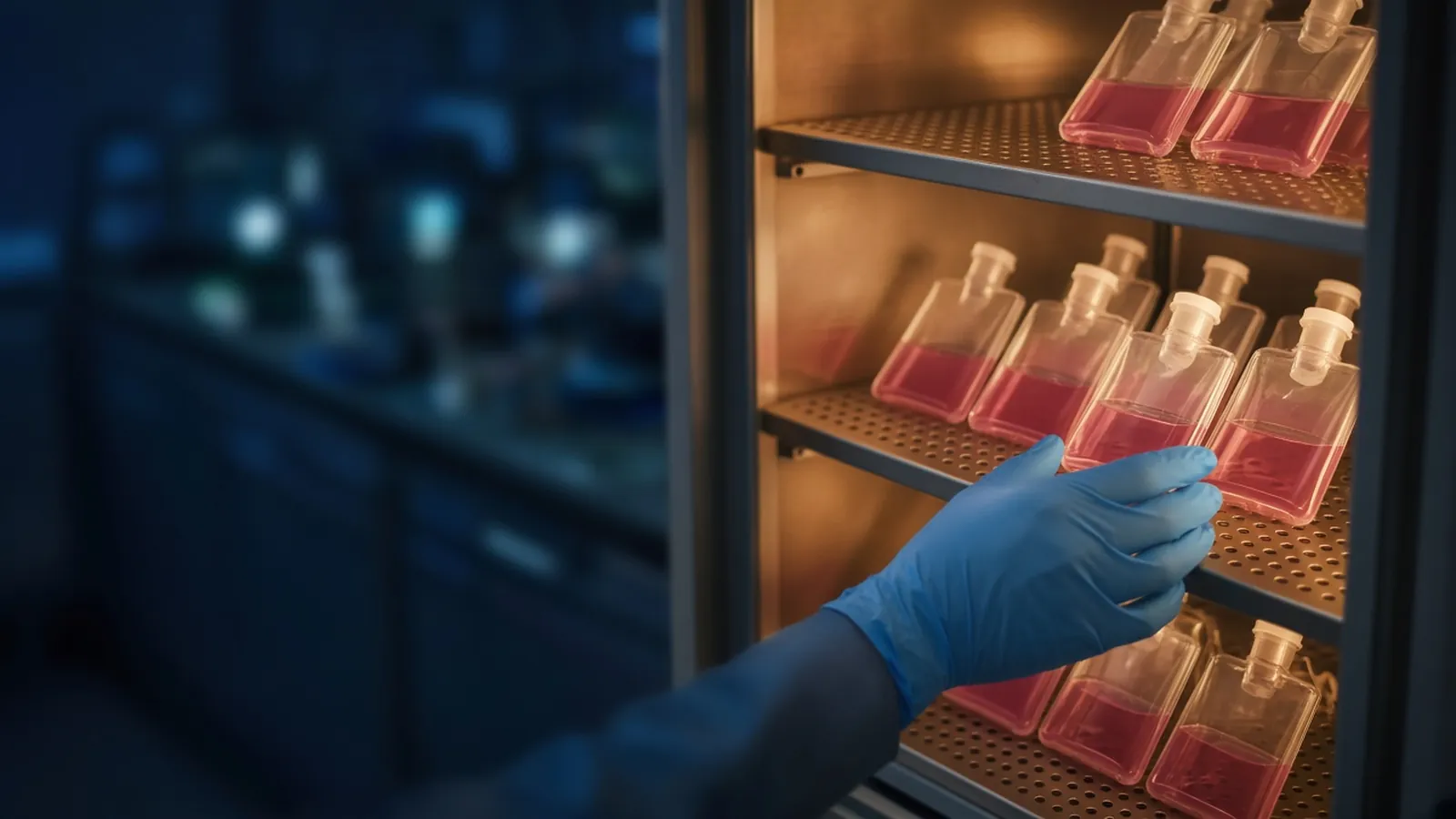
A culture notebook is how a line outlives the person who thawed it. The next user needs to know what the cells are, how many times they have been subcultured, what they were fed, what they looked like, whether anyone looked for contamination, and where a frozen backup sits. Without those fields the incubator still holds flasks. It does not hold a continuable experiment. The surrounding practice is in mammalian cell culture for research labs. This page is the record itself, applied to the moment someone else has to pick up the work. A photograph in the hero is a person writing. The writing is the data.
What another person has to be able to do
The test of a page is practical. Someone who did not seed the flask should be able to decide whether to passage, whether to treat, or whether to leave the vessel alone. That decision needs the line name as it appears on the vial, not only a nickname, the source, and the passage counted under a stated rule. It needs the date and either a split ratio or a seeding density. It needs the medium formulation and the serum lot if serum is in use. It needs a sentence of observation and the last contamination check. It needs a freezer location that a second person can find.
Public guides, including the ATCC culture guides and notes from the European Collection of Cell Cultures, are starting descriptions. They are not your page. If your vial's label and the public page disagree, the notebook should say which one you followed and why. Identity doubts belong with resources such as ICLAC resources, which explain why a name is not an authentication.
Fields, and the future question each one answers
Line name and source answer "are these the cells in the method section?" Source means the collection, the laboratory, or the tissue procedure, plus a catalogue identifier if one was printed on the vial you received. Do not invent an identifier the supplier did not provide. Authentication status answers "have we checked that name?" Record pending, passed against a named reference, or failed. A failed check takes the line out of the shared story. Do not leave the field blank and hope the morphology is distinctive. Morphology is a weak identity test.
Passage number answers "how far is this population from the stock we trust?" State the starting passage from the supplier and the rule: increment by one at each subculture, for example. Date answers "when was this row true?" A date without a passage, or a passage without a date, breaks the chain as soon as two people work on alternate days.
Split ratio or seeding density answers "what did we actually do?" Ratio is enough when you did not count, if you say you did not count. Density needs a count, a volume and the growth area. Confluence estimated by eye answers "why did we split today?" It does not replace the passage. Medium formulation and serum lot answer "can we buy or mix the same liquid?" Write the basal name, any supplement, the serum percentage and the lot code from the bottle. A lot that is smeared by condensation should be copied onto the page before the bottle goes into a humid fridge.
Observations answer "did the cells still look like themselves?" One sentence is enough: spread monolayer, more floaters than yesterday, clumps after dissociation. Contamination checks answer "are we pretending clarity is a test?" Record mycoplasma method and date, and any bacterial or fungal suspicion, including negative visual checks on a schedule. Freezer inventory location answers "where is the vial that saves us if this flask is lost?" Box, rack, and a label string that matches the page. A mental map of the tank is not an inventory.
| Entry on the page | Future question it answers |
|---|---|
| Line name and source | Which biological history does this flask claim? |
| Authentication status and date | Has that claim been checked, and against what? |
| Passage and the increment rule | How many subcultures from the trusted stock? |
| Date of this action | Which row is the latest truth? |
| Split ratio or seeding density | What concentration did the next flask start from? |
| Estimated confluence, if you used it | Why was today the day to split or treat? |
| Medium formulation and serum lot | Can the feed be repeated or reordered? |
| One-sentence observation | Did morphology drift before the assay? |
| Mycoplasma and visual contamination notes | What was tested, and what was only looked at? |
| Freezer location and label string | Where is the backup if this vessel crashes? |
How to fill the page when the day goes wrong
Start the row before you open the flask, with line, passage and intended action. Finish it before you leave the room, with what you actually did. If the count failed, write the ratio and the word estimated. If the serum lot code is unreadable, quarantine that bottle from the record and do not copy a code from a different bottle because the colour matches.
Branch when a required field has no honest value. Missing authentication on a newly arrived line means the status is pending and the line stays in whatever quarantine your institution set. It does not mean you write "looks right". Missing freezer location means you do not yet have a backup. Make a token freeze on the schedule you use, or say that no freeze exists, so nobody discovers the gap during a contamination. A mycoplasma test that was not run is recorded as not run. Clarity of the medium is not a substitute result.
If two people share the line, the page is the handover. A chat message that says "fed them" fails the test. The row needs the formulation. Templates on protocols.io are examples of structure. Your institution may already bind you to a particular notebook or electronic system. Use that system. The field list still applies inside it.
Gaps that strand the next user
The common gap is a passage that lives in one person's memory, with beautiful photos and no number. The next user either restarts the count at one, which erases age, or refuses to touch the flask. Another gap is a medium written as "the usual". Usual shifts when a lot changes and when a stand-in mixes the buffer from a different card. A third gap is a freezer box labelled with a nickname that matches nothing on the page. In a crash, that box is where time is lost.
A control that fails is a record, not a reason to skip the row. If cells were over-confluent because nobody wrote Friday's cover, Monday's note should say so. If a mycoplasma assay failed its own control, write that the assay is invalid and is being repeated. Do not write negative in the meantime.
The notebook is not a permit
Research records support research continuity. They do not authorise clinical use, a diagnostic claim or a biosafety level. The containment of the line, the consent status of primary material, and who may open the notebook are institutional decisions. Keep those approvals where your system requires them. This page does not replace a laboratory safety manual. Do not copy donor-identifying detail into a casual bench book if your rules forbid it. A culture record can name a de-identified sample code your institution issued.
Humidity, a warm shipment, and a specification
Humid incubators and humid storerooms lift ink and fog bottle labels. Copy lot codes onto the page while they are still legible, and note if a shipment arrived warm, who received the cold box, and whether that lot was kept off the main line. Heat does not change the fields. It makes delay expensive. When the record shows a repeated medium family, a vessel surface and a serum class, you have the bones of a sourcing note. How to turn a laboratory need into an enquiry is set out in how to write a laboratory sourcing enquiry. Point the note at the laboratory consumables catalogue for everyday classes and at the academic research reference if the work sits in a university brief. The quote request can carry the specification those fields already contain. A discussion of that specification does not mean someone else will keep your line, and it does not invent a stock position. The notebook remains yours to complete.
Questions from the bench
Is a photograph of the flask enough if the passage is in my head?
No. A photograph can show confluence and morphology on that day. It does not show the passage rule, the serum lot or where the backup vial sits. Write the passage number beside the image, or the image is an illustration the next person cannot continue.
What should the authentication field contain?
The method, the date, the result in words your quality system accepts, and the reference profile you compared against. Pending is an allowed entry. Blank is not, once the line is in use. A human short tandem repeat test is common. Other species need the method your system names, not a guess written as if it were the same test.
How do I record a split when I did not count?
Write the split ratio and say that you did not count. Inventing a seeding density from memory is worse than a gap you have labelled. If you counted, write the total, the volume and the vessel area printed by the manufacturer so the density can be rebuilt.
Who is the notebook for?
For the person who has to feed the line when you are away, and for you in six months when the figure is questioned. A record that only the author can interpret has already failed. Keep the legal and biosafety pages your institution requires as well. This article does not replace them.
References
Manufacturer names identify published method classes. Trademarks remain with their owners. Catalogue records on this site are independent references for enquiry. They are not a statement of inventory, distribution rights or a supply commitment. This page is educational. It is not medical advice, a diagnostic protocol or a biosafety approval.
Catalogue
Related products and categories
These links follow the subject of the article into published manufacturer references. A listing is a reference for an enquiry, not a statement of stock or distribution rights.
Continue in this cluster
Related reading
 Mammalian cell culture for research labsHow research labs keep mammalian cell culture workable: medium, aseptic technique, confluence, passage records and contamination checks.
 How to write a laboratory sourcing enquiryWrite a laboratory enquiry as measurable performance, documents and an acceptance check, so a quotation can be compared with the scientific need.A glossary of culture termsPairs of culture words that laboratories mix up, and the wrong next action each pair causes, from confluence versus density through to confluent versus