
protocol overview
Serum-free media as a concept
What serum-free and chemically defined media claim, why a sudden swap selects or kills cells, and how to adapt a line with a serum-grown backup.
- Author
- EVRINTH Editorial Team
- Published
- 8 October 2026
- Updated
- 8 October 2026
- Reading time
- 9 min
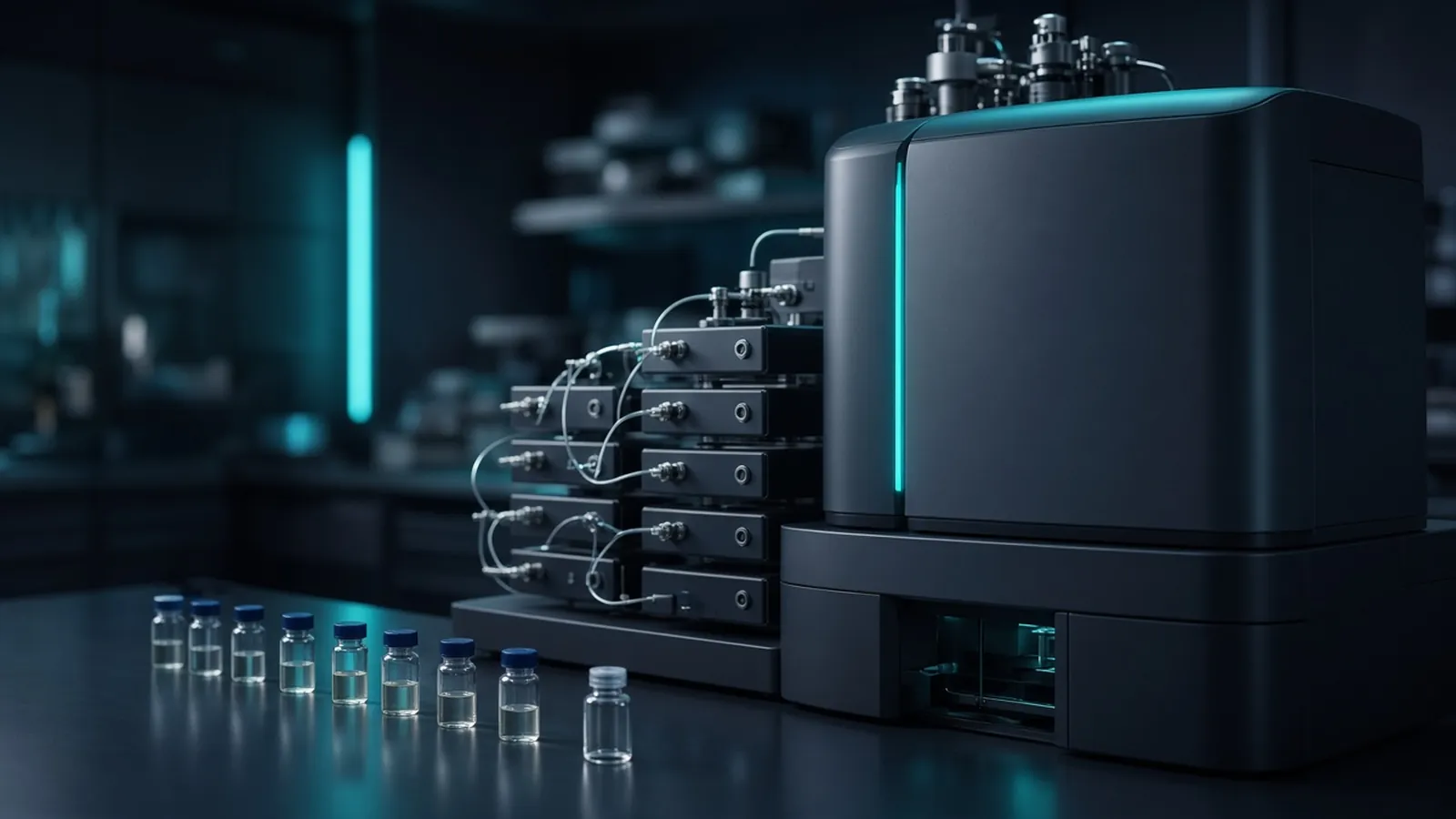
Serum-free medium is a claim about what you left out, not a claim that the cells will forgive you. Serum is an undefined mixture of growth factors, lipids and attachment proteins. Replacing it means those jobs must be done by a stated supplement list, a coating, or both. The decision this overview supports is whether you need serum-free, chemically defined, or merely serum-reduced conditions, and how to get there without pretending a sudden swap is adaptation. Routine culture context is in mammalian cell culture for research labs. The photograph at the top of this page is a mass spectrometer and sample vials. It is not a bottle of medium. The categories below are still the categories you have to specify.
Three phrases that are not interchangeable
Serum-free means the formulation contains no serum. It can still be biologically undefined. Plant hydrolysates, serum-derived albumin sold as a fraction, and other extracts are serum-free and not chemically defined. Chemically defined means you could, in principle, write every component as a chemical. Protein-free is a further restriction. Serum-reduced means the percentage is lower than the line's historical medium and is not zero. A paper that says "defined conditions" while still using albumin of undisclosed origin is using a looser word than the procurement office should use. When you enquire, use the strict phrase. When you read a protocol, ask which phrase they earned.
There is no universal serum-free recipe on this page, and there should not be one in your notebook copied from a different species. Hybridoma lines, insect lines, CHO derivatives and a human primary cell do not share a supplement list. Insulin, transferrin and selenium appear often, as a class, because they replace some of what serum was doing. Ethanolamine, fatty acids and line-specific factors appear beside them in particular formulae. The presence of a famous trio does not mean your line will grow. Follow a formulation published for that line, or a manufacturer's medium that names the line, and treat everything else as a pilot with a backup.
Adaptation is selection
Cells that have always seen ten percent serum are not waiting for you to purify their diet. A sudden replacement removes survival signals and attachment signals in one feed. Many cells die. The ones that do not may be a subpopulation with a different phenotype from the population you meant to study. That is adaptation in the evolutionary sense and a problem in the experimental sense. Stepwise reduction, when the protocol calls for it, gives the bulk population a chance to adjust and gives you a chance to notice a crisis while you still have serum-grown cells in the incubator.
A practical pattern, only where the line's method agrees, is to drop the serum fraction across two or three passages, or to mix increasing parts of the new medium with the old, and to watch doubling and morphology at each step. If growth collapses, step back to the last acceptable mix rather than pushing through on the survivors. Set, before you start, how many stable passages will count as success. "It looked fine on Thursday" is not that criterion. Confluence estimates, a note on granularity, and the passage number of each step are the record. Mycoplasma testing still belongs on the calendar. A slow adaptation is easy to blame on the medium when the culture is colonised.
Keep the serum-grown culture, or a frozen bank of it, until the new condition has met your criterion. The backup is not sentiment. It is the only way to know whether a later phenotype came from the medium or from a bottleneck you failed to notice.
Coatings and supplements are the rest of the system
Serum delivered attachment proteins. Serum-free adherent culture often needs collagen, fibronectin, laminin, poly-lysine or a mixture class on the plastic. Skipping the coat because the medium was expensive is how cells pellet in the middle of a "failed medium". The coat has its own protocol. It is not a growth factor and it will not rescue a missing insulin if insulin was the required signal. Rinse steps matter when the coating buffer is acidic or otherwise harsh.
Supplements that replace serum are chemically active. They have lot variation when they are still biological, and they have stability limits. Do not add the new supplement on top of residual serum "for safety" and then call the condition serum-free. Residual serum is serum. Wash or wean as the method says. pH and osmolality still have to match the cells. Preparing a buffer and checking pH is the measurement habit if you are checking an equilibrated aliquot rather than trusting colour. Bicarbonate and the incubator setpoint do not disappear because serum did.
Antibiotics are a separate decision. A stressful adaptation plus a routine antibiotic makes two variables. Prefer to see contamination if it happens, and do not use the antibiotic to plaster over a clumsy transfer.
A workflow with a way back
Confirm the medium's claim in writing against the line. If no serum-free formulation is specified for this line, you are inventing one, and the overview stops at a documented pilot rather than a methods sentence. Prepare the coating if the system needs it. Start from a healthy, subconfluent culture, not from an overgrown flask you were going to discard. Wean or transfer as the protocol says. At each passage, record growth and shape. If the culture thins, returns to the previous step or to the backup. If it changes morphology abruptly and then grows very fast, consider that you selected a minority, and do not silently rename it the parental line. When the pre-set number of stable passages is done, freeze a bank of the adapted cells and keep the parental bank labelled as parental.
Branch if the manufacturer describes a direct adaptation for this exact line. Follow that description, and still keep the backup until you have seen stability. Branch if the work only needed less serum, not none. Serum-reduced is an easier claim and an honest one. Do not write serum-free in the figure legend because it sounds cleaner.
| Approach | What the cells experience | What you should conclude |
|---|---|---|
| Sudden full swap | Loss of serum signals in one feed | Death, or a selected minority. Not a controlled adaptation |
| Stepwise wean with a backup | Gradual change, with a return path | A condition you can describe, if growth and shape stay acceptable |
| Serum-reduced and labelled as such | Some serum remains | A different, weaker claim than serum-free |
| Chemically defined, matched to the line | Known components, if the claim is true | The strictest research claim of the three, still not a clinical process |
| New medium, no coating, cells round | Attachment factors also left | A handling failure, not evidence the medium is toxic |
When the new condition lies
A culture that survives and loses the marker you cared about has adapted in the wrong direction. Bank the parental cells and say so. A culture that only grows in the centre of a coated well may be drying at the edges or seeing an uneven coat, not rejecting the medium. A culture that yellows very fast may be a selected high-metaboliser or a contaminant. Cloudy medium is contamination until proven otherwise. Do not filter it and continue the adaptation. Mycoplasma remains possible in clear medium. Test before you freeze the "successful" bank, or you will store the problem at the new passage number.
If two operators disagree, compare coatings and residual serum first. One of them may still be rinsing with the old medium.
Research limits
Serum-free research medium is still research medium. It is not a licence to make a therapeutic product, and it is not evidence a process is defined in a regulatory sense. Human lines keep the biosafety assignment they had. The WHO Laboratory Biosafety Manual is a reference for writing that assignment. Animal-component-free wording on a bottle is a sourcing claim you should read in the supplier's own definition. It does not, by itself, change containment.
Heat, light and a defined bottle
Chemically defined and serum-free liquids can be more transparent about their failures and more fragile in a hot dock. A growth factor that rode inside serum had some protection. A supplement shipped warm may be the reason an adaptation "does not work here" when it worked in the publishing laboratory. Hold a suspect lot out of the pilot. Store light-sensitive components as the label says. A power cut on the cold room is an excursion for those supplements even when basal medium looks unchanged. Write the travel and storage expectation into the specification: defined, serum-free, or serum-reduced, plus the line, plus any coating that is part of the system. Those are different purchases.
What the enquiry has to distinguish
Say which of the three claims you mean, which line it must suit, whether a coating is included in the question, and whether you are asking for a discussion of an adaptation plan or for consumables. Do not ask for "serum-free, defined, the usual one". The laboratory consumables catalogue is the vessel and everyday class list. The academic research reference frames a wider university conversation. Use the quote request to ask whether a quotation is possible. A medium strategy can be discussed from the line sheet. A catalogue family is not a chemically defined recipe, and it is not a culture run on your behalf.
Adapt a line without throwing away the serum-grown backup
- 01Confirm the medium is specified for that lineMatch the product's claim, serum-free or chemically defined or serum-reduced, to the line sheet. Do not treat a serum-free recipe published for a different line as universal.
- 02Adapt stepwise when the protocol says toReduce serum or introduce the new medium across passages if that is the written method. A sudden swap is a selection event, not a tidy switch.
- 03Keep a serum-grown backup until the new condition is stableBank or maintain the previous condition until growth rate and morphology have been acceptable for the number of passages you set in advance. The backup is the experiment's undo.
- 04Record growth, morphology and the passage of the switchWrite confluence estimates, any coating, and the supplements that belong to the system. A later reader should be able to see when serum stopped, not only that it did.
Questions from the bench
Are serum-free and chemically defined the same claim?
No. Serum-free means no serum. The bottle may still contain undefined proteins, hydrolysates or albumin fractions. Chemically defined means each component has a known identity. Serum-reduced means some serum remains. Buy the claim you write in the method, not the nearest adjective.
Can I move a line into serum-free medium in one feed?
Only when the protocol for that line says a direct transfer works. Many lines die or leave you with a minority subpopulation that happened to tolerate the shock. Stepwise adaptation, with a backup, is the conservative overview this page recommends when the sheet is silent.
Does serum-free medium remove the need for a coating?
Often it increases the need. Serum carried attachment factors. Without them, many adherent lines require a declared coating or they sit rounded and are called dead. The coating is part of the system, and it is still not a growth factor.
Will serum-free culture make the work clinically compliant?
No. Removing serum can reduce one source of undefined material in a research model. Therapeutic manufacturing is a separate quality and legal regime. This overview does not enter that regime.
References
Manufacturer names identify published method classes. Trademarks remain with their owners. Catalogue records on this site are independent references for enquiry. They are not a statement of inventory, distribution rights or a supply commitment. This page is educational. It is not medical advice, a diagnostic protocol or a biosafety approval.
Catalogue
Related products and categories
These links follow the subject of the article into published manufacturer references. A listing is a reference for an enquiry, not a statement of stock or distribution rights.
Continue in this cluster
Related reading
 Mammalian cell culture for research labsHow research labs keep mammalian cell culture workable: medium, aseptic technique, confluence, passage records and contamination checks.
 Preparing a buffer and checking pHPrepare a buffer at a stated pH and temperature, record the salt form, and treat a drifting electrode or a bad slope as a failed control.A glossary of culture termsPairs of culture words that laboratories mix up, and the wrong next action each pair causes, from confluence versus density through to confluent versus