
glossary
Smiling bands and uneven gels
Define smile, frown, smear, and diffusion, and trace each band shape to heat, salt, overload, pour, buffer level, or speed.
- Author
- EVRINTH Editorial Team
- Published
- 8 October 2026
- Updated
- 8 October 2026
- Reading time
- 7 min
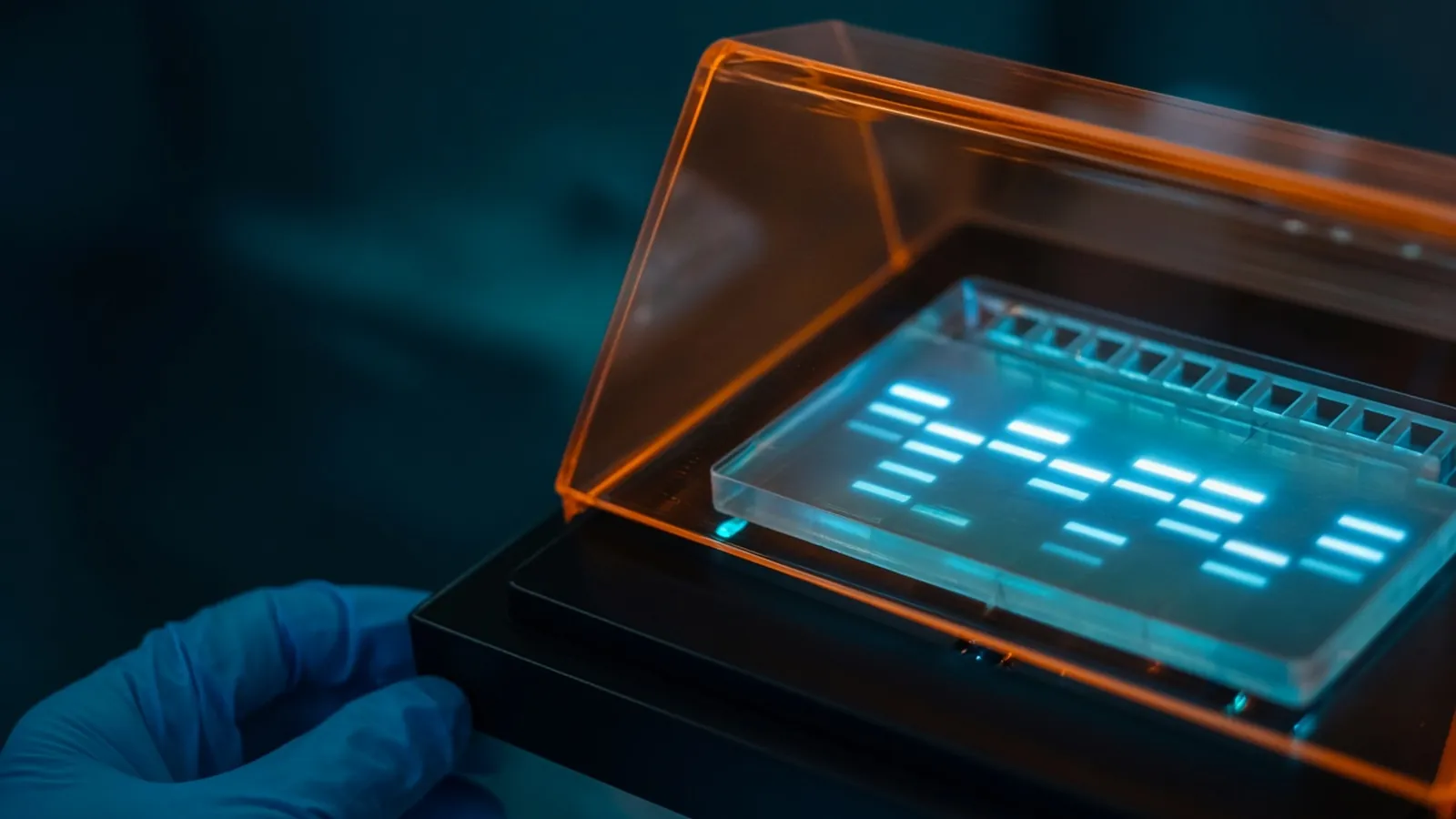
Smiling bands and uneven gels are shape problems. The lane is trying to tell you that mobility was not the same across the zone, or that the zone was never a tight packet of one length. This glossary names the shapes and gives the troubleshooting order that belongs to each one. The photograph is a finished agarose gel under an orange shield. The curves discussed here are what you look for in that kind of image, including when the picture in front of you happens to be straight. The size-reading habits that assume a straight ladder are in agarose gel electrophoresis for DNA.
Smile
A smile is a band that arcs so the centre is ahead of the two ends. On a vertical gel, with the anode at the bottom, the centre sits lower than the edges. On a horizontal gel the centre is simply farther from the well. People call it a smile because the arc opens toward the wells.
Heat is the classic cause. A field that is too high for the gel length warms the middle more than the edges, the warm mesh is looser or the buffer is less viscous, and the middle runs faster. High salt in one sample does a local version of the same thing. The ions around that well distort the field, the band fattens, and it can curve even while the molecular weight ladder in the next lane stays flat. Overload piles so much DNA or protein into the well that the zone cannot stay a line. A gel run too fast combines heat and a short time for the packet to stay stacked, and the smile appears together with fuzzy edges.
If the ladder smiles with the samples, change the run. Lower the voltage, refresh the buffer, and cool the room's contribution. If one lane smiles and the ladder is straight, change that sample. Dilute it, or remove salt, before you pour a new percentage.
Frown
A frown is the arc with the ends ahead of the centre. Mobility was higher at the edges than in the middle. The edges of a poured gel are often slightly thinner, especially if the tray was not level or the comb stood proud of the floor on one side. Thinner agarose has a shorter path and can run hotter. Buffer that is much deeper over the gel lets current sneak through the liquid above the slab, and the field inside the gel becomes uneven toward the sides. Buffer that barely covers the gel lets the surface dry and the edges misbehave in the other direction. The usual practice is a thin, even cover of the same buffer the gel was poured in.
A frown across every lane, ladder included, is a pour or a tank problem. A frown confined to lanes at the edge of the tray is often the fit of the gel in the tank. A gel that does not fill the width leaves a buffer path down the side, and the outer lanes bow. Remelt is the fix for a slanted pour. Chasing the biology first wastes the samples.
Smearing
Smearing is a vertical streak. The molecules that should have occupied one distance now occupy many. Three causes cover most streaks, and the order of the test matters.
Too much sample. The well is bright, the band is fat, neighbours pick up glow, and a dilution of the same tube tightens into a line. That was overload.
Too much salt or a crude load. The sample sinks badly, the band may leave the well as a fan, and a desalting or a cleaner prep sharpens it. Loading dye shows you the density. It does not remove salt.
Broken molecules. Nucleic acids that were nicked or sheared, and proteins that were proteolysed, smear from the well downward. The ladder beside them is sharp, which clears the gel. Dilution does not turn the streak into one band. For DNA, the upstream handling is the next question. For protein, heat, protease inhibitors, and a fresh reducing agent are the usual checks, at the decision level your gel method already states.
A partial restriction digest smears or multiplies bands for a different reason. The enzyme did not finish, so several species are present. That is a real mixture. It is not fixed by lowering the voltage.
Diffusion
Diffusion is spreading in place. Once the field is off, nothing keeps the zone thin, and the band widens upward, downward, and sideways. A power cut mid-run is a diffusion interval you did not schedule. A gel left on the bench until the afternoon photograph is another. Heat speeds the spread. A very slow run also lets diffusion compete with migration. Keep the field gentle enough to avoid a smile and strong enough that the zones stay tight.
If the size call is the point of the gel, a diffused ladder is a reason to repeat it. Measuring a fuzzy band against a fuzzy ladder doubles the uncertainty. The image can still show that a product existed.
Uneven gels
Uneven agarose is a pour defect with several faces. Grains that never dissolved leave bright flecks and local slow patches. Agarose swirled while it was setting leaves streaks of higher percentage, and bands kink as they cross the streak. Bubbles under a lane throw a distortion that looks biological if you only glance. A comb that touches the floor on one end makes wells of different depth, so equal volumes sit at different heights and the bands never line up. A tray that was not level is thicker at one end. The thick end lags.
Polyacrylamide has its own unevenness. A gel that polymerised in a draught, or with a leak, gives wavy lanes. If every lane, including the marker, shares the shape, the matrix and the field are guilty. If one lane is guilty alone, the sample is.
| Term | Shape you can point to | First physical suspect | First change |
|---|---|---|---|
| Smile | Centre of the band ahead of the ends | Heat, often from a fast field | Lower voltage, keep the buffer fresh |
| Frown | Ends ahead of the centre | Thin edges, deep buffer, side leak | Level the pour and cover the gel evenly |
| Smear | Streak along the lane | Overload, salt, or broken molecules | Dilute once, then judge integrity |
| Diffusion | Band widened in all directions | Time with the field off, or a crawl | Repeat when distance is the evidence |
| Uneven gel | Kinks, tilts, flecks, wells of mixed depth | Pour, comb, or polymerisation | Remake the matrix before the next sample |
How the shapes inherit a blot
A transfer membrane does not straighten a curve. Proteins leave the gel where they are. A smiled molecular weight ladder on the membrane means the size marks were already curved, and an antibody band beside them inherits the doubt. The transfer itself can add bubbles, which look like holes rather than smiles, and a flipped stack, which looks blank. Those are transfer failures, walked through in western blot from gel to membrane. Fix the smile on a new gel when the claim is the mass.
Safety and the room
Hot agarose is a burn. A tank that is painful to touch is also a smile in progress. Stop it. Ultraviolet documentation still goes through the orange shield. Curved bands are not a reason to lean closer to a bare lamp.
Afternoon heat is the seasonal version of this glossary. A voltage that gave straight ladders in a cool morning will smile when the room, the buffer, and the supply start warm. Drop the field before you reorder enzyme. A power cut turns a straight run into a diffuse one. Note the gap on the image, and repeat when you still need the distance.
What to say if you are replacing a tank
EVRINTH can take a sourcing question. If smiles are the reason you are asking, state the electrode gap, the voltage you have been using, the buffer family, and whether the curve hits the ladder or only the salty lanes. The molecular biology catalogue and the quote request are the enquiry path. The nucleic acid analysis pathway is the context when the gel is a step toward a clone. A new tank will not fix a sample that smears at every dilution. Say which shape you are actually seeing.
Questions from the bench
What is a smile on a gel, in one physical sentence?
A smile is a band whose middle has travelled farther than its ends, so the zone arcs with the centre ahead. The middle saw a higher effective mobility, and heat in the centre of a fast run is the usual reason. The molecular weight ladder will smile too when the gel, not the sample, is the cause.
How is a frown different from a smile?
A frown is the opposite arc. The ends of the band have travelled farther than the middle. The edges were thinner, hotter, or sitting in a stronger part of the field. Level the tray and the buffer, and look at the comb height, before you treat the curved mark as a second DNA species.
Does a smear mean the sample is degraded?
A smear means the zone stretched along the lane. Degradation does that, and so do overload and salt. Dilute the same sample and run it beside the original. A smear that tightens into a band was too much material. A smear that stays a smear at every dilution is broken molecules or a contaminant that travels with them.
Will a smiled gel still make a fair western blot?
The transfer membrane copies the pattern it is given. A smiled gel becomes a smiled blot, and a size call read against a curved ladder is already weak. Straighten the run, then transfer. A total-protein stain of the membrane will show the curve if you transfer first and hope.
References
Manufacturer names identify published method classes. Trademarks remain with their owners. Catalogue records on this site are independent references for enquiry. They are not a statement of inventory, distribution rights or a supply commitment. This page is educational. It is not medical advice, a diagnostic protocol or a biosafety approval.
Catalogue
Related products and categories
These links follow the subject of the article into published manufacturer references. A listing is a reference for an enquiry, not a statement of stock or distribution rights.
Continue in this cluster
Related reading
Agarose gel electrophoresis for DNAHow agarose percentage, buffer and a size ladder turn a DNA sample into a band, and what that band does and does not prove about identity.A glossary of electrophoresis termsDefine anode, cathode, sieving, mobility, stacking, resolving, electroendosmosis, Rf, and leading dye for an honest gel reading. Blocking buffers and background signalChoose milk or BSA and a wash that fits the antibody, then decide whether speckles are sample signal or block, secondary, or a dried membrane.