
comparison
Tris buffers and temperature
Compare Tris with HEPES by the temperature of use. Tris pH falls as it warms; specify that temperature before you raise a reagent enquiry.
- Author
- EVRINTH Editorial Team
- Published
- 8 October 2026
- Updated
- 8 October 2026
- Reading time
- 8 min
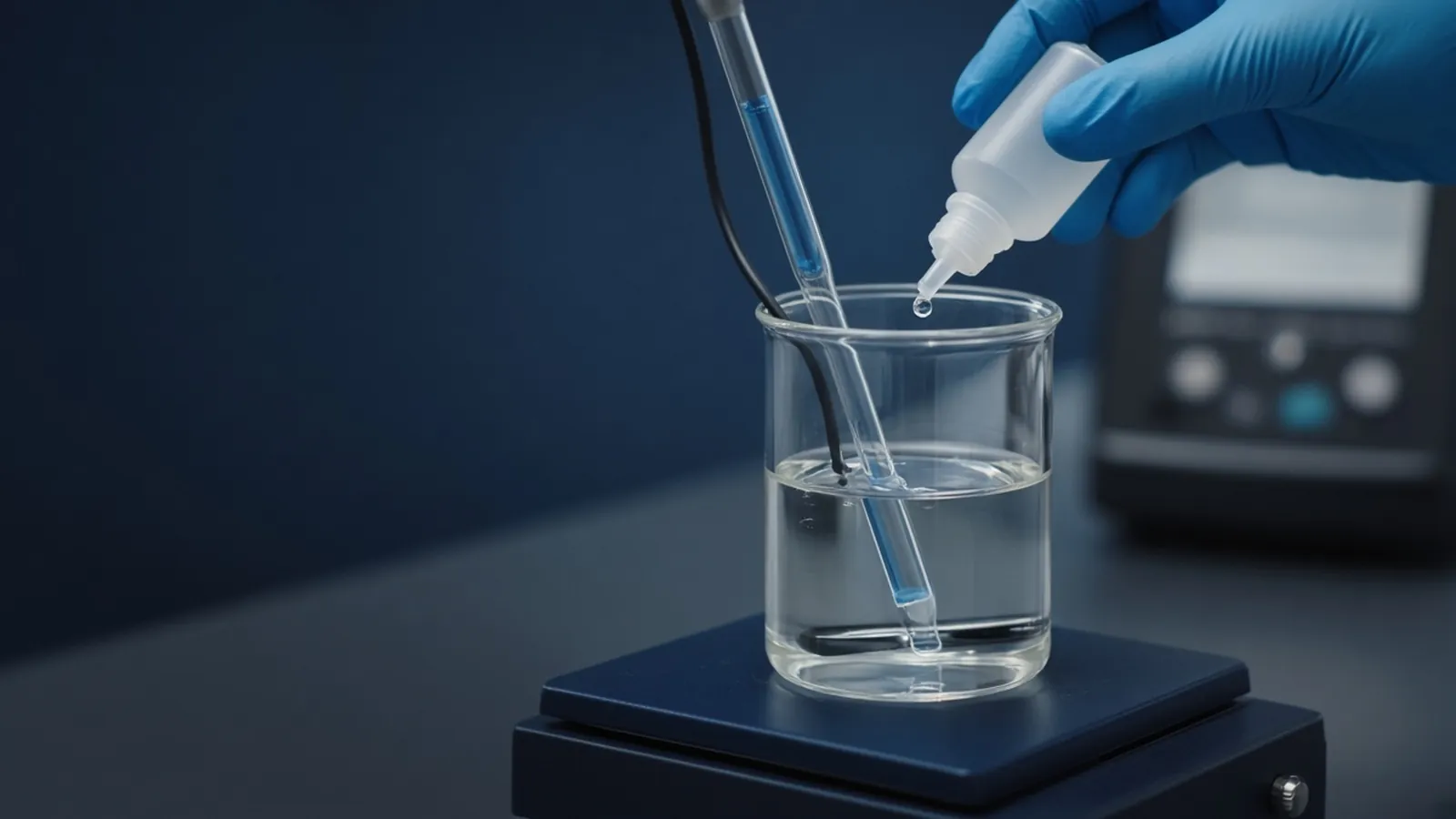
Tris and HEPES can both be adjusted to the same number on a cool bench and then describe different hydrogen-ion activities once the assay is warmed. The comparison that decides the purchase is the temperature of use, the pKa you need near that temperature, and the side effects you are willing to carry. This page is that comparison, written so a specification can be sent. It is not a gram table from a single vendor. Water that goes into either buffer is discussed in laboratory water types and where they fail. The order of dissolving, adjusting, and making to volume is preparing a buffer and checking pH.
Both chemicals are ordered as named salts from the reagents and chemicals catalogue. The adjustment happens in a vessel from beakers and flasks. The temperature, the salt form, and the pH belong on the quotation request.
What you are choosing
You are choosing which buffer name to write, and which temperature that pH refers to. Tris, properly tris(hydroxymethyl)aminomethane, is a primary amine with a pKa near 8.1 at 25 °C. That puts useful buffer capacity roughly from the mid-7s into the low-9s, best close to the pKa. HEPES is a zwitterionic sulfonate from the Good family, with a pKa near 7.5 at room temperature, so it is aimed at physiological windows. If your working pH is 7.4 at 37 °C, those two pKa values are not equally comfortable, and the temperature shift makes the gap wider for Tris.
The commercial decision is the line on the enquiry: chemical, hydrate or salt form, concentration, pH, temperature of that pH, and any nuclease or sterility requirement as a separate claim. "Tris pH 7.4" is not yet a line.
The temperature coefficient, with the arithmetic shown
Tris pH falls as temperature rises. The slope is on the order of 0.028 to 0.031 pH units per degree Celsius. Take a buffer adjusted to pH 8.00 at 25 °C and warm it to 37 °C. That is 12 degrees. Multiplying by the coefficient range gives a drop of about 0.34 to 0.37 pH units. The warm solution is near pH 7.6, not pH 8.00. Cool the same solution toward 4 °C, about 21 degrees below 25 °C, and the pH rises on the order of 0.6 units. The arithmetic is a planning sketch. Activity, concentration, and the meter still decide the batch you release. Set the pH at the temperature of use, or set it at one stated temperature and write both numbers down so the shift is expected.
HEPES has a smaller coefficient, commonly cited near 0.014 pH units per degree. Over the same 12 degree warming, the expected move is nearer 0.17 pH units. HEPES set at bench temperature therefore stays closer to its pH at 37 °C than Tris does. "Closer" is not "identical." You still equilibrate the solution, you still calibrate the electrode, and you still print the temperature on the label.
Automatic temperature compensation does not do this job. It corrects the Nernst slope of the glass electrode, about 59 millivolts per pH unit at 25 °C, so the meter converts millivolts properly at the temperature it senses. The chemistry of Tris continues underneath that conversion. A perfect electrode will report the shift. It is supposed to.
Salt form and the counter-ion you import
Tris base and Tris hydrochloride are different starting points. If you dissolve the base and titrate with hydrochloric acid, the counter-ion is chloride. If you dissolve the hydrochloride and titrate with sodium hydroxide, you import sodium. Those two solutions can share a pH and a nominal Tris concentration and still differ in ionic composition. For an enzyme or a nucleic-acid step that cares about ions, the titration choice is part of the recipe. Write it. HEPES is commonly the free acid or a sodium salt. Adjusting the free acid with sodium hydroxide or potassium hydroxide is the same class of decision: the cation remains in the buffer.
Concentration also moves Tris pH. Diluting a concentrated stock solution and assuming the pH survives is a second error stacked on temperature. Prepare the working concentration, or measure after dilution, at the temperature of use.
Neither comparison is a reason to copy a microlitre table from a supplier's insert. The supplier has a starting salt and a temperature in mind. Your assay has its own. Weigh the form on the label, dissolve below the final volume, equilibrate, measure, then make up.
Where the buffers misbehave differently
Tris coordinates several metals and is a primary amine, so it can participate in reactions that a sulfonate buffer will not. It is a poor choice when you need a metal activity that Tris will bind, and it reacts in chemistries that consume primary amines. HEPES binds metals less avidly in ordinary use, which is one reason it shows up in physiological media, but "less" is not a certificate of zero binding, and HEPES can form radicals in light when riboflavin is present. Cell-culture media left in bright light are a known place that side reaction matters. Follow the medium method on storage in the dark.
Tris penetrates membranes more readily than the zwitterionic Good buffers were designed to. For an intact-cell experiment that is trying not to buffer the interior, that difference can matter. For a lysate at a controlled pH, it may not. Say which experiment you are in.
Phosphate remains the comparator people reach for when they want a small temperature coefficient and then discover calcium precipitation. If the mixture contains divalent metals that must stay soluble, phosphate can be the wrong escape from Tris. The selection among those constraints is the point of comparing, not a ranking of virtues.
| Question | Tris | HEPES |
|---|---|---|
| pKa near 25 °C | About 8.1 | Near 7.5 |
| pH as temperature rises | Falls about 0.028 to 0.031 per °C | Smaller move, often cited near 0.014 per °C |
| Useful habit | Set or record pH at the temperature of use | Still record temperature; the shift is smaller, not absent |
| Titration residue | Chloride if you add HCl to the base; sodium if you add NaOH to the hydrochloride | Cation from the base you add, or the salt you bought |
| A reason to hesitate | Metal binding, primary-amine chemistry, large dpH/dT | Photo-radical chemistry with riboflavin; not a universal substitute |
| What ATC does | Reports the new pH faithfully if the electrode is fit | Same; compensation is electrical, not chemical |
A worked choice
Suppose the assay incubates at 37 °C and the paper says "pH 7.4" without a temperature. You have two defensible policies. Equilibrate the buffer at 37 °C and set pH 7.4 there, and label it that way. Or set pH 7.4 at 25 °C, label both temperatures, and accept that Tris will be several tenths lower in the incubator. The indefensible policy is to set Tris at whatever the bench happens to be, write only 7.4, and compare a January morning with a hot afternoon as if they were one buffer.
If the pKa window at 37 °C is no longer near 7.4 for Tris, HEPES may be the better specified choice, provided the enzyme supplier or the historical method allows it. Switching buffer identity can change metal availability and ionic composition. Treat a switch as a method change. Enzyme catalogues group buffers by method class; a catalogue such as the NEB product list shows that an enzyme arrives with a buffer identity. Use that as a signal to read the method, not as a recipe to copy in microlitres.
Conductivity can catch a gross salt difference after you titrate one batch with hydrochloric acid and another with sodium hydroxide. It will not catch the temperature coefficient. The pH meter at the right temperature is the control. If the slope fails, stop. Do not walk the set point to compensate for a tired electrode.
Safety and research limits
Tris and HEPES are ordinary laboratory chemicals and still deserve eye protection when you handle the dry solid and any concentrated acid or base used to adjust them. Do not autoclave a buffer and assume the pH survived. Tris in particular should be rechecked after it has cooled to the reporting temperature. Heat sterilisation is not a biosafety approval for infectious material that was added later, and a buffer identity is not a diagnostic claim. Institutional rules govern work with organisms. This comparison does not authorise a clinical interpretation of a pH.
Warm afternoons and the label
Where the bench sits well above 20 °C by afternoon, a Tris buffer adjusted at 9 in the morning is not the same solution the electrode sees at 4 in the afternoon, even if nobody added a drop. Write the temperature you measured in the notebook and on the bottle. If a power cut resets the meter, recalibrate before you sign the next bottle. Humidity does not change the pKa, but it does change how fast the solid picks up water while you weigh it. Keep the lid on, and record the form you opened.
What the enquiry must specify
Ask for Tris or HEPES by chemical name, salt form, and purity. For a ready solution, state concentration, pH, and the temperature at which that pH was set. State whether you need it sterile or nuclease-controlled as separate lines. Ask whether the certificate records the measurement temperature. Compare that paper with a reading on your calibrated meter before a critical set of samples depends on it. The quotation request is the place those fields live, beside the water grade you already decided.
Questions from the bench
How far does Tris pH move between room temperature and 37 °C?
The pKa of Tris is about 8.1 at 25 °C, and the pH falls as temperature rises, on the order of 0.028 to 0.031 pH units per degree. A rise of 12 degrees is roughly a third of a pH unit, so a buffer set to 7.40 at 25 °C is nearer 7.0 to 7.1 at 37 °C. Measure at the temperature of use rather than treating the estimate as the record.
Does HEPES remove the need to write a temperature?
HEPES has a smaller temperature coefficient, commonly cited near 0.014 pH units per degree, so the same warming moves it less than Tris. The pH is still a function of temperature. Record the temperature on the label and on the enquiry.
Will the meter's temperature compensation cancel the Tris shift?
Automatic temperature compensation corrects the electrode slope. The Tris molecule still changes pKa as it warms or cools. A meter that shows the right sample temperature can faithfully report a pH that is chemically different from the pH you set at another temperature.
References
Manufacturer names identify published method classes. Trademarks remain with their owners. Catalogue records on this site are independent references for enquiry. They are not a statement of inventory, distribution rights or a supply commitment. This page is educational. It is not medical advice, a diagnostic protocol or a biosafety approval.
Catalogue
Related products and categories
These links follow the subject of the article into published manufacturer references. A listing is a reference for an enquiry, not a statement of stock or distribution rights.
Continue in this cluster
Related reading
 Laboratory water types and where they failResistivity, organic carbon and endotoxin answer different questions. A water grade fails when the assay cares about a contaminant the meter cannot see.Preparing a buffer and checking pHPrepare a buffer at a stated pH and temperature, record the salt form, and treat a drifting electrode or a bad slope as a failed control.A glossary of solution termsDecide which number a recipe means before you weigh a salt: molarity or molality, which percent, normality, buffer capacity, osmolality, or hydrogen-ion