
comparison
Troubleshooting a lawn of colonies
A lawn on selective agar usually means the antibiotic failed or far too many cells were plated. Separate those causes before you treat the plate as a success.
- Author
- EVRINTH Editorial Team
- Published
- 8 October 2026
- Updated
- 8 October 2026
- Reading time
- 10 min
A plate that turns into a continuous film after you transform a non-pathogenic Escherichia coli cloning strain is a comparison, and the comparison decides your next move. Either selection never operated, or you delivered so many viable cells that colonies fused, or something that is not your clone occupied the agar. Those three readings call for different work. The culture, the competence step and the meaning of a discrete colony are set out in bacterial culture and transformation. How a marker and a drug are supposed to pair is in antibiotic selection and blue-white screening.
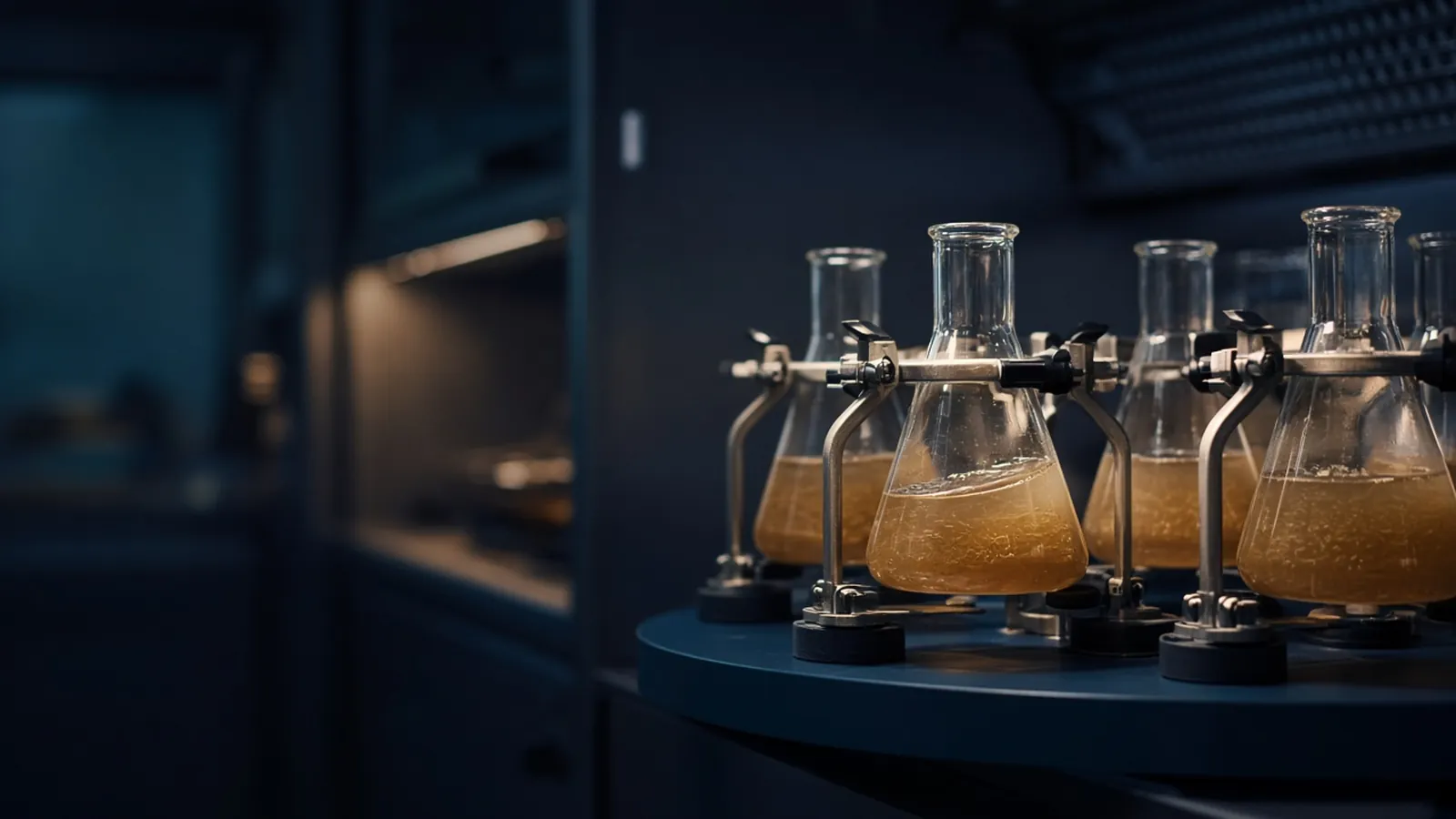
The flasks in the hero photograph are the usual source of a heavy inoculum: amber broth on a shaker, then a spreader. Medium, antibiotic and plate classes can be named from the reagents and chemicals catalogue. The surrounding cloning path is the molecular biology pathway. If the DNA itself is still a design question, the custom gene synthesis page is an enquiry reference, and it does not mean a synthesis run is already under way. A plate specification goes through the quote request.
When the film is the result
Read the plate at the time your method says colonies should be discrete, often the morning after a 37 Celsius incubation for routine K-12 work. A lawn here means growth covers the surface so that a loop cannot touch one mound without touching its neighbours. A crowded plate of separate circles is a different object. A haze that appears only after several extra days, especially around large colonies on a beta-lactam, is a third object. Photograph or sketch which of the three you have before you relabel the story as "lots of transformants".
The host in view is a laboratory cloning or expression strain already accepted by your institution, the K-12 and BL21-type organisms used to copy plasmids. A film of unknown morphology is a reason to stop, not a reason to broaden the organism. Public handling context for bona fide collection strains sits with the ATCC culture guides. The shape of a transformation workflow is summarised in the Addgene bacterial transformation protocol.
What has to be true for a colony to stay a colony
Selection works only when three facts coincide. The cell lacks a way to grow at the dose in the agar. The plasmid, if it is present, supplies that way. The drug in the agar is still the drug named on the base. Break any one of them and every viable cell can divide until the surface is full.
The drug fails in familiar ways. It was never added. It was added to molten agar that was still near autoclave temperature, so a heat-labile molecule was destroyed before the plate set. It was the wrong member of the set: a bla plasmid on kanamycin, or a kanamycin marker on ampicillin. The stock bottle contained water, an expired solution, or a suspension that had precipitated and was not redissolved. The plates were swapped with a stack of rich agar poured the same afternoon. Ampicillin plates that sat warm for days lost activity, and any resistant colony already on them accelerated that loss by secreting beta-lactamase.
The inoculum fails in a different direction. Recovery broth is rich and non-selective on purpose, so the cells are alive and numerous. Plating a large fraction of a high-efficiency recovery of a pure supercoiled plasmid can cover the agar with genuine transformants that fuse into a sheet. That sheet still has a clear no-DNA partner if the plates contain active drug. Dilution is the test. A ten-fold or hundred-fold plating of the same recovery should resolve into countable colonies if the cells are real transformants. If every dilution still films, including a dilution that should have shown tens of colonies, the drug on that plate is the prime suspect.
Contamination films as well. A resistant spore-former, a yeast film, or a second laboratory strain with a different colony texture will often appear on the no-DNA plate and on plates that never received your DNA. Texture, colour and smell that do not match the cloning strain are enough to retire the set. Do not chase an interesting contaminant to see what it is unless the institutional assessment already covers that work.
Branches when a control disagrees
Keep the no-DNA plate, a known intact plasmid, and the new DNA on plates poured together. Then branch.
If the no-DNA plate and the DNA plates are all films, stop picking. Selection did not happen on this pour. Streak a trusted colony of the empty host, one that has never held this plasmid, onto a plate from the same stack and onto a plate from a fresh pour or a different lot. Growth of the empty host means the agar is rich medium with a selective label. Check the notebook line that was supposed to record the antibiotic addition: volume class, stock name, and whether the agar had cooled to the warm-but-touchable range the antibiotic sheet allows. Many sheets describe that range as around 50 Celsius for agar. The sheet rules, not this sentence.
If the no-DNA plate is bare and the known plasmid formed discrete colonies, while the new DNA is a film, look at how much recovery you spread. Plate less of the new recovery. Also look at whether that one plate was from a different stack. A base labelled only with a ligation name, and not with the drug, is how a non-selective dish enters a selective series.
If large colonies sit in a field of tiny ones, treat the tiny ones as satellites or as late growth on a weakening beta-lactam, which is the pattern described alongside selection in the antibiotic-screening article. Pick only from the centre of a large, isolated colony, and restreak it on a plate poured recently. If the tiny colonies have a different colour or edge, treat the plate as mixed and do not inoculate.
If you still have the recovery culture cold, it is the cleanest material to replate. A lawn you already incubated is a poor source of single colonies. Restreaking from a film often carries a mixture of true transformants and cells that grew after the drug faded.
Lawn, crowded transformants, and a contaminant
| What you see | No-DNA plate | Reading you can defend |
|---|---|---|
| Featureless film on every dish | Film or dense growth | The pour is not selective, or the plates were swapped with non-selective agar. Do not pick. |
| Featureless film only where DNA was added | Bare agar | Either a very heavy plating of real transformants or a single plate that lost its drug. Dilute and replate. |
| Many separate colonies, edges not touching | Bare agar | True transformants plated densely. Pick only isolated mounds, or spread a smaller volume. |
| Film of tiny colonies around a few large ones | Bare, or a few satellites | Beta-lactam exhaustion local to resistant colonies. Restreak the large colony onto fresh plates. |
| Slimy, coloured, or late growth that does not match the strain | Same odd growth | Contamination. Retire the plates and the spreader. |
A commercial specification for plates should be able to support that table. State the antibiotic name, the nominal concentration class the marker requires, and the storage class (cold, and protected from light when the drug sheet says so). State the pour date or the use-by rule your laboratory assigns. Do not publish a house recipe, with its grams and its microlitres, as though it were the product. Buyers and receiving labs need the drug and the storage, and they follow the manufacturer for the working concentration. The Addgene molecular biology reference is a public place to see how marker and drug are discussed as classes.
How the causes come apart in practice
Start with the label on the base, not the lid. Lids move in a fridge. If the base does not name an antibiotic, the plate is already out of the comparison. If it names one, find the stock used that day and read the opened date and the storage. A working stock left on the bench through an afternoon in a warm room is a different reagent from the aliquot that stayed frozen.
Next, the empty host. A cloning strain that forms colonies on the "selective" batch, with no plasmid, ends the discussion about your ligation. The plates or the strain's existing resistances are the finding. Chromosomal resistance cassettes and resident plasmids are easy to forget when a genotype is copied incompletely into a notebook.
Then the plating density. Write down the recovery volume and the fraction spread. People repeat a "plate 100 microlitres" habit from a low-efficiency ligation on a pure plasmid prep and cover the agar. The fix is arithmetic and a fresh plate, once you know the drug is active.
Last, the age of beta-lactam plates. A lawn that was discrete colonies yesterday and a film today is the satellite path, not a new transformation. Pick from yesterday's large colony if you marked it, or retire the plate.
Research use, and a film you do not recognise
This comparison is for non-pathogenic laboratory cloning strains under the containment your institution already set. A lawn does not lower that duty. Spills of a film, and the spreader that made it, are biological waste the safety office has already classified. Do not open plates to smell them, and do not take an odd colony into a new risk class "to identify it" on a cloning bench. This page is not medical advice and not an approval to change containment.
Warm rooms, wet lids, and a dark fridge
Ampicillin plates stored in a warm drawer or on a bench overnight are a common reason a Monday transformation becomes a lawn. Humidity that drips from a lid can also drag cells across a surface that was merely crowded, so a plate that left the incubator as separate colonies returns from a sweaty cold room as a smear. Write the pour date on the base and keep selective plates at the storage temperature the drug sheet names. A power cut that leaves an incubator off does not by itself inactivate the drug, but a long warm hold of freshly transformed plates can let satellites fill gaps. If the building power fails, record the interval and read the plates against the no-DNA control before you trust a film that formed late.
What to ask for when plates or antibiotics are specified
Ask for the antibiotic identity, the concentration class, the storage class, and whether plates are supplied ready poured or as medium you will sterilise and dose yourself. Ask how the supplier expects a receiving lab to confirm that a sensitive host does not grow. The plating method can be discussed against that written specification. Use the quote request so the strain, the marker and the storage travel in one note. Sequence design, if the plasmid does not yet exist, stays a question on the custom gene synthesis reference rather than an assumption that DNA is already being made.
Questions from the bench
Does a lawn mean the competent cells were especially efficient?
A featureless film means you cannot pick a colony, so efficiency is not the claim the plate can support. A clear no-DNA plate plus a lawn only on the DNA plate can be a very heavy plating of real transformants, and it can also be one plate that never received drug. Dilute a saved recovery and replate before you treat the film as a clone collection.
Why do ampicillin plates fill in after a few days at room temperature?
Ampicillin is cleaved by beta-lactamase that resistant colonies secrete, and the drug also loses activity as plates age warm. Sensitive cells then grow in the exhausted agar until the gaps disappear and the dish looks like a lawn. Carbenicillin is a more stable member of a related class for many of the same markers. Follow the antibiotic sheet for storage rather than a habit copied from a neighbouring bench.
Can satellites become a lawn?
Yes, when several resistant colonies sit close together on a beta-lactam plate and the local destruction of the drug merges into one field. The large colonies in that field are the candidates. The filler between them is growth that selection no longer prevents. Restreak the centre of a large colony onto a freshly poured plate before you start a liquid culture.
What should a specification for selective plates include?
Name the antibiotic, the nominal concentration class the plasmid map calls for, the storage temperature class, and the date the plates were poured. Leave the house recipe out of the product description. A method for checking a sensitive host on that pour can be discussed from those fields through the quote request.
References
Manufacturer names identify published method classes. Trademarks remain with their owners. Catalogue records on this site are independent references for enquiry. They are not a statement of inventory, distribution rights or a supply commitment. This page is educational. It is not medical advice, a diagnostic protocol or a biosafety approval.
Catalogue
Related products and categories
These links follow the subject of the article into published manufacturer references. A listing is a reference for an enquiry, not a statement of stock or distribution rights.
Continue in this cluster
Related reading
Bacterial culture and transformationHow non-pathogenic E. coli cloning strains are grown and how plasmid DNA is introduced, with the controls that make a colony meaningful. Antibiotic selection and blue-white screeningHow antibiotic plates keep a plasmid in a cloning strain, and why a white colony on X-gal is a candidate rather than proof of the insert.A glossary of bench microbiology termsPlain definitions of colony, lawn, streak, pellet, transformant and the other bench words a cloning afternoon depends on.