
glossary
Troubleshooting sudden death of a culture
How to name an overnight culture crash: contamination, toxicity, or a temperature excursion, and the first question each appearance of the flask should force.
- Author
- EVRINTH Editorial Team
- Published
- 8 October 2026
- Updated
- 8 October 2026
- Reading time
- 8 min
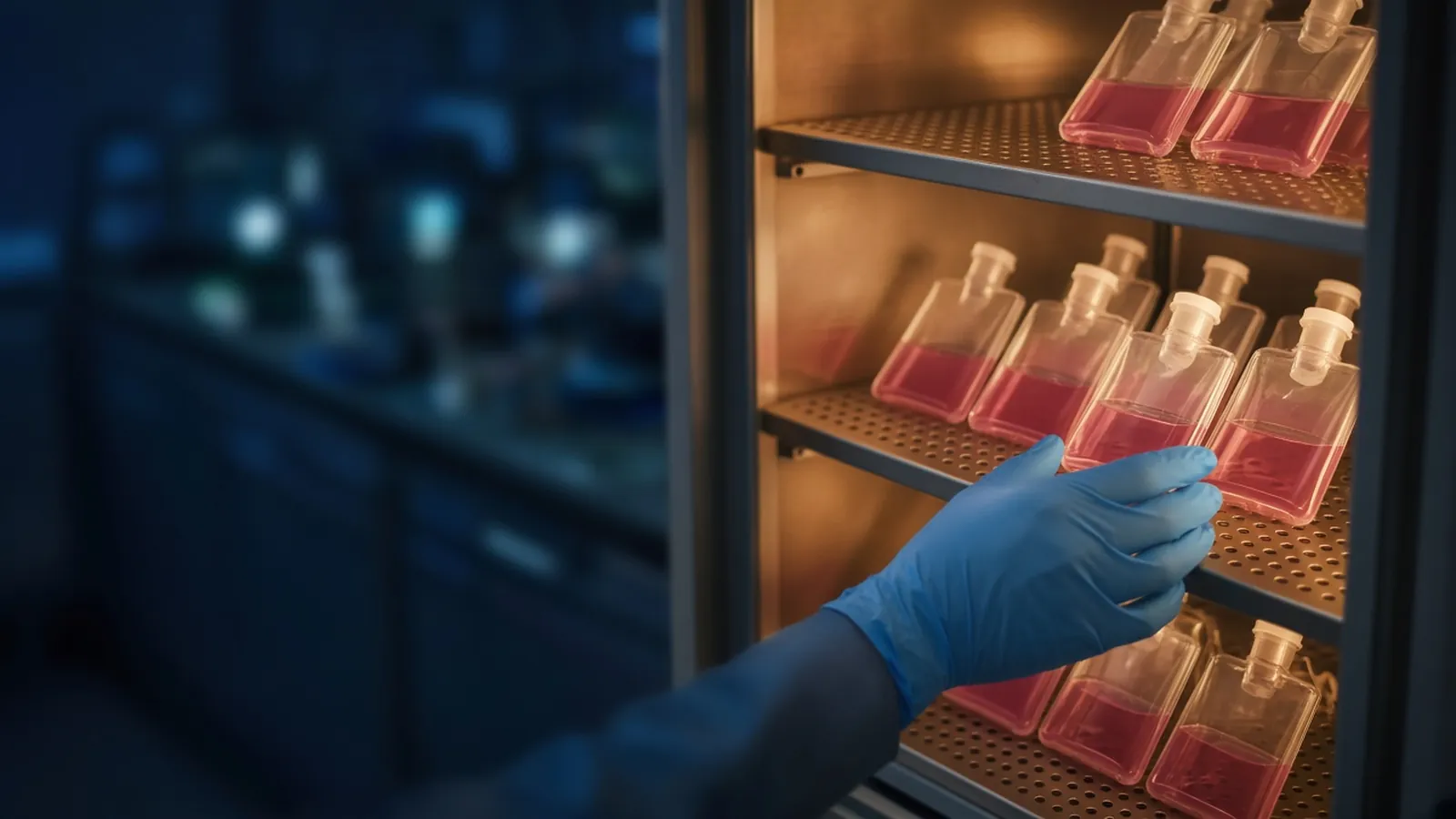
Sudden death of a culture is a morning problem with a small vocabulary. The flask that was a monolayer yesterday is acid, detached or full of debris, and the words people reach for — infected, cooked, poisoned — point at different next actions. Pick the word that matches the evidence before you add anything. The daily pattern of medium, confluence and contamination checks is in mammalian cell culture for research labs. This page defines the crash and uses the definitions as a diagnosis. It does not offer a survival time for cells in a failed incubator.
Four words that are not interchangeable
A crash is the abrupt loss of a culture that was acceptable at the previous inspection. Acceptable means the confluence or density you expected, a medium colour in the range you associate with that seed, and cells still attached if the line is adherent. A crash is an event. It is not yet a cause.
Contamination means microorganisms are growing in the culture. Bacteria and yeast often turn medium cloudy or sharply acid within a day. Fungi may appear as filaments or pellets. Mycoplasma is the awkward member of this list: it can injure a culture without clouding the medium, and it is a poor explanation for a single overnight disintegration unless you already know the line was positive. Do not sniff a suspect flask. Turbidity and the microscope are the observations. Opening it on an open bench to "check the smell" spreads the problem.
Toxicity means a chemical injury. The medium may stay clear. Cells round up, lift, or look shredded, and a sister flask that did not receive the new aliquot may be fine. Residual bleach or detergent in a bottle, an antifungal above the concentration the line sheet allows, and dimethyl sulphoxide left on warm cells after a thaw are typical members of this class. Dimethyl sulphoxide is a cryoprotectant in many freezing mixtures, often at a concentration the freezing protocol states. Once cells are warm and metabolically active it is harsh. Dilute it out promptly. A bottle that was autoclaved is not automatically free of detergent. Rinsing is a different step from a sterilisation cycle, which is why autoclaves and what sterilisation does not do belongs in this diagnosis.
A temperature excursion means the culture spent time outside the window it was being kept in. Incubator failure, a flask left in a hot anteroom, and a power cut are causes. High temperature can kill quickly. Low temperature may slow a culture or, if it is extreme or prolonged, kill it. You do not get to invent the duration the cells "should" have survived. You record the temperature you find.
What the morning flask is showing
Walk the definitions across the picture. Overnight acidity with cloudiness and dancing debris under the microscope is contamination until you have evidence otherwise. Isolate that flask under your biohazard rules. Neighbours in the same incubator are now part of the event. Antibiotics added after the bloom are not a clean-up.
Overnight acidity with a clear medium and an over-confluent sheet that is starting to lift is often the cells themselves. They were left too long. That is a passage-timing failure, not a new pathogen. If the same yellow, clear medium sits over a sparse, lifted monolayer, think about carbon dioxide set too high for the buffer, or a toxic acid, before you blame a bacterium you cannot see.
A purple or magenta medium with rounded cells usually means the bicarbonate buffer lost its carbon dioxide: the flask was sealed when it needed a vent, it sat out of the incubator, or the gas supply failed. Many bicarbonate media are formulated to equilibrate near five percent carbon dioxide, and some labels specify a different fraction. Follow the medium you used. Alkaline drift is a crash if the cells have already lifted. It is a recoverable handling error if you catch the colour while the monolayer is still spread.
Clear medium, yesterday's confluence gone, cells in clumps or as grit: toxicity or temperature. Ask what was new. A fresh aliquot of a supplement, a selection drug, a coating, an antifungal "just in case", or a wash bottle that last held hypochlorite. Then ask what the incubator did overnight. A water bath that wetted a thaw vial is a contamination route with a delayed crash: the flask can look fine for a day and then cloud. That timeline still counts as sudden relative to the experiment. Dry the outside of every warmed vessel before it enters the cabinet.
| Look of the flask | The word that fits first | First question |
|---|---|---|
| Yellow, cloudy, moving debris | Contamination | Who else shared this incubator, and is the flask still closed? |
| Yellow, clear, over-full monolayer lifting | Crash by overgrowth | When was confluence last scored against the line sheet? |
| Yellow, clear, sparse cells lifted | Gas or toxicity, not yet a named microbe | What carbon dioxide did the display show, and what was newly added? |
| Purple medium, rounded but intact cells | Excursion out of carbon dioxide | Was the cap sealed, or was the flask left out of the box? |
| Clear medium, grit or sheets detached | Toxicity or temperature | Which aliquot or residue touched only these flasks, and how hot or cold was the box? |
| Fine after thaw, cloudy next day | Contamination introduced at thaw | Did a water bath wet the vial thread? |
Branching the post-mortem
Keep one untouched sister flask if any flask of that passage is still normal. That flask is the control. If it dies the same night without sharing the new aliquot, move the suspicion to temperature, gas or a shared bottle. If it lives, the dead flask received something the sister did not: a supplement, a coating, a longer enzyme step, a wet thaw.
If every culture in the incubator crashed, stop thawing backups into that box. Read the temperature you find. A high reading is a different sentence from a reading that has already returned to the set point and tells you nothing about the night. Alarm logs, where the instrument keeps them, outrank memory. Do not calculate a survival window and then keep the cells because they "should have been fine".
If the only new event was a thaw dipped in a cloudy bath, treat the new culture as contaminated even before it clouds, and keep it out of the main incubator. If the only new event was an antifungal or a selection drug, check the concentration arithmetic against the line sheet before you mix a fresh batch. Arithmetic errors are toxicity with a clean medium.
What not to add
Do not rescue a cloudy flask with a heavier antibiotic. You will select resistant organisms and aerosolise the flask while you try. Do not split a detached monolayer into a new vessel "to see if they come back" inside a shared incubator. If the line is irreplaceable, the recovery attempt belongs in quarantine conditions your institution already accepts, with a record that the cells crashed. A token freeze made before the crash is the actual rescue. A freeze made from debris is a way to store the accident.
Safety when the flask is already lost
A dead culture is still waste under the assessment that covered the live one. Human and primate lines, viral work and primary material do not become harmless because the cells lysed. Disinfection, bagging and whether the incubator is taken out of service are local decisions. The WHO Laboratory Biosafety Manual is a reference for writing those rules, not a permit for your room. This description is not medical advice and not a method for handling a sample from a patient.
Power cuts, warm baths and the number you may write
A power cut is a real cause of a morning crash. The number you may write is the temperature you find and the clock time you find it. You may also write when the cut was reported if someone reliable noted it. You may not write a borrowed survival time. In a hot building the box can climb after cooling fails. In a cooled building it can fall. Both are excursions. A water bath left warm for days is a separate reservoir. If thaw vials were dipped, say so in the same note as the crash. When you ask about a supplement class after a toxicity suspect, name the solvent, the concentration you intended, and that a sister flask without it survived. Basal medium and vessel classes can be discussed from the laboratory consumables catalogue and the academic research reference. Use the quote request for that specification. A replacement bottle does not explain a cooker incubator, and no culture service is being offered in place of your post-mortem.
Questions from the bench
Is an overnight yellow flask always infected?
No. Acid medium means acid, which overgrown cells and some bacteria both produce, and which a carbon dioxide setting can also push. Cloudiness, debris and the microscope separate a bloom from a crowded monolayer. Do not open the flask on the open bench to decide, and do not sniff it.
What is the difference between a crash and contamination?
A crash is the abrupt loss of a culture that looked acceptable at the last inspection. Contamination is one cause, when microorganisms are growing in it. Toxicity and a temperature excursion are other causes and can leave the medium clear. Using one word for all three sends you to antibiotics when the incubator failed.
Can I estimate how long cells survive a power cut?
Not from this page, and not from a round number you heard in another laboratory. Record the clock time if you know when power failed, and record the temperature you actually find on the display or on a thermometer you are allowed to use. The decision to keep or discard those flasks belongs to the experiment's owner and to the local rules.
Does a crashed culture need a new supplement, or a post-mortem?
Start with the post-mortem. A new aliquot of a supplement is a suspect only if it entered the dead flasks and not the living neighbours. Residual detergent or bleach in a rinsed bottle is a vessel problem, not a reason to reorder the growth factor. Write the look of the flask before you ask anyone to discuss a reagent class.
References
Manufacturer names identify published method classes. Trademarks remain with their owners. Catalogue records on this site are independent references for enquiry. They are not a statement of inventory, distribution rights or a supply commitment. This page is educational. It is not medical advice, a diagnostic protocol or a biosafety approval.
Catalogue
Related products and categories
These links follow the subject of the article into published manufacturer references. A listing is a reference for an enquiry, not a statement of stock or distribution rights.
Continue in this cluster
Related reading
Mammalian cell culture for research labsHow research labs keep mammalian cell culture workable: medium, aseptic technique, confluence, passage records and contamination checks. Autoclaves and what sterilisation does not doSteam sterilisation holds a cleaned load at temperature. It does not wash, remove endotoxin, or prove sterility because the tape changed colour.A glossary of culture termsPairs of culture words that laboratories mix up, and the wrong next action each pair causes, from confluence versus density through to confluent versus