
protocol overview
Volumetric flasks and class A markings
How to use a Class A or Class B volumetric flask, including to contain or to deliver, the reference temperature, and the meniscus.
- Author
- EVRINTH Editorial Team
- Published
- 8 October 2026
- Updated
- 8 October 2026
- Reading time
- 8 min
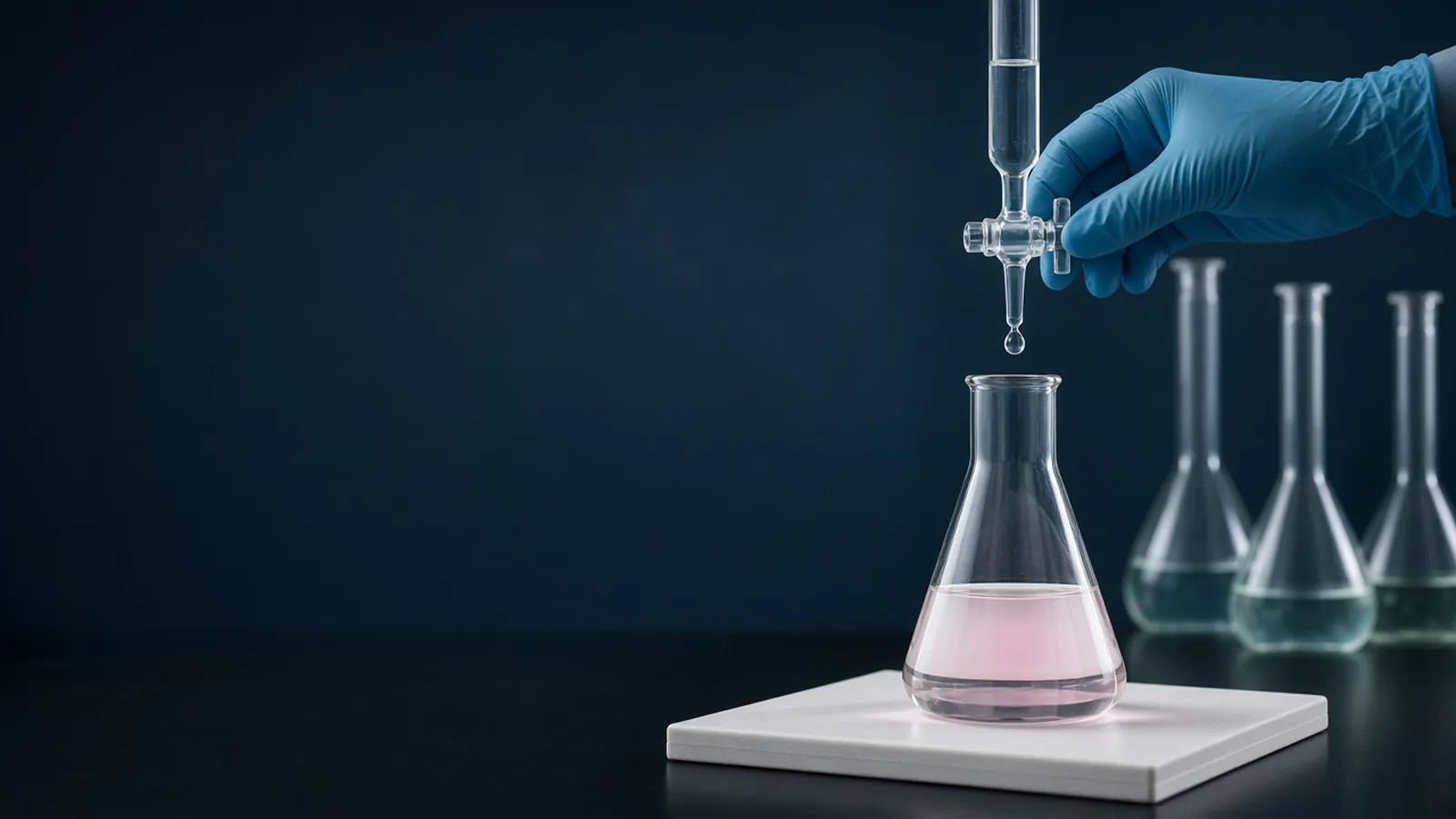
A volumetric flask has one job: to hold one stated volume when the meniscus and the temperature agree with the print. This overview is the order of work for preparing that volume in research, and the branch points when the flask, the temperature or the mix tells you to stop. It sits under choosing laboratory glassware, which separates this flask from beakers and cylinders.
What the marking is claiming
Around the neck you should find a capacity, a single line, a reference temperature, and usually a class. Class A is the tighter tolerance class. Class B is looser and still a real volumetric claim, unlike a beaker. The tolerance number lives in the standard and on a certificate. Copy it from those documents when the record needs it. Do not reconstruct it from memory.
To contain, marked In or TC, means the flask holds the stated volume. Emptying it leaves a film, so the poured volume is smaller. To deliver, marked Ex or TD, is the calibration of many pipettes and of some other ware: the delivered volume assumes a stated drain. One-mark flasks are almost always to contain. If you meet a flask marked to deliver, follow that mark and its drain time. Blowing out a pipette that was not calibrated to be blown out adds a drop the line excluded.
The glass is commonly borosilicate, in the low-expansion family described for laboratory apparatus in ASTM E438. The glass type keeps the shape stable through ordinary temperature change. It does not license you to heat a volumetric flask on a burner or to read the line while the wall is hot.
Piston pipettes are a different volumetric family. Their terminology and user recommendations sit in ISO 8655-1. A flask prepares a bulk solution. A pipette takes a portion from it. Mixing those duties is how stocks become folklore.
The order of a make-up
Weigh the solute into a beaker or a weighing boat as the method requires. Dissolve it in a portion of solvent, not in a flask already filled to the neck where a lump can sit above the line and never join the solution. Transfer into the flask. Rinse the beaker, the boat and the funnel into the flask. Those rinses are part of the solute, and they must fit below the line. If they do not, you chose too large a dissolve volume. Start again. Fishing excess out with a pipette destroys the point of the mark.
Bring the liquid close to the line, mix by swirling, then let the temperature settle. Add the last solvent dropwise until the bottom of the aqueous meniscus touches the line. The flask stands on a level surface. Your eye is level with the line. A reading taken looking down appears to meet the line early, and the flask is underfilled. For deeply coloured or opaque liquids, follow the reading convention the calibration states rather than guessing which edge of the shadow counts.
Stopper and invert repeatedly so the neck contents join the bulb. A flask that was only swirled can hide a dense layer. If you overshoot the line, the volume is no longer the marked volume. Discard according to the chemical's waste rule and repeat. Soaking solvent back out with a dropper is not a correction.
Branch points
If the flask is warm, from a wash, a dryer or an autoclave, the branch is to wait. The reference temperature is commonly 20 °C. Ware marked 27 °C is meant to be read at 27 °C. Using a 20 °C flask in a 27 °C liquid without letting it equilibrate is a systematic bias, small for some work and unacceptable for a primary standard. A water bath at the marked temperature is the honest fix when the room will not cooperate.
If the stopper is not the one ground for that flask, the branch is to stop. A mismatched stopper leaks when you invert, and the lost drops are an unknown volume. If the line is faded or the neck is etched, the branch is to retire the flask. Remembering "a bit above the frost" is not a calibration.
If the solute does not dissolve after patient mixing, the branch is the chemistry, not the glass. A suspension made up to the line is a suspension, and its concentration is not the clear-solution concentration the flask was asked for.
| Check before you call the volume done | Supports | Does not support |
|---|---|---|
| Meniscus on the line, eye level, flask vertical | The contained volume matches the mark at the reference temperature | That a pour-out equals that volume |
| Class A mark and a certificate on file | The tighter class was the one used | A tolerance you invented in the notebook |
| Several inversions after reaching the line | The neck and the bulb are one solution | That an undissolved solid has vanished |
| Temperature near the printed reference | The calibration assumption is plausible | Use of the flask as a storage bottle |
Failures that survive a careful pour
Detergent film changes how the wall drains and where the meniscus sits. A flask that beads unevenly needs a proper rinse, not a shrug. Alkaline detergent left in volumetric ware is also a chemical contaminant for the next trace analysis. Drying a flask so hot that you stress the glass, or baking it as if it were a beaker, is a good way to leave the calibration assumption behind. Drain and finish with the solvent you will use, unless the method demands a dry flask and names a gentle condition.
A shared stopper drawer guarantees mismatches. Hang the stopper with its flask. A seized stopper is not a challenge. Warm or cool only by a laboratory-approved method, or retire the pair. Forcing it snaps the neck in the hand.
NIST's Office of Weights and Measures is where a laboratory that must defend a tolerance starts reading. A working lab checks critical flasks on a schedule and after any repair that could change the volume. A crack, even a small one, ends the flask's career.
Safety and research limits
The solute may be toxic, flammable or biologically active when the flask is innocent. Make up in conditions the chemical requires, often a hood, and label the flask while it still holds the solution. Do not use a volumetric flask as a reactor under pressure. Biological reagents follow institutional biosafety, with the WHO laboratory biosafety manual as background. Nothing here is a diagnostic preparation method.
Rooms that never sit at 20 °C
Many laboratories run warmer than the 20 °C printed on classical European ware. The practical response is the temperature on the flask, not a correction factor invented at the bench. Let the solution equilibrate. Where a specification can be chosen, ware marked at 27 °C matches a warm room more closely, and that choice should be written down so the next batch uses the same reference. A power cut that stops air conditioning does not excuse reading a hot flask. It delays the reading.
What the enquiry should carry
Capacity, Class A or Class B, glass type, stopper style, and whether you need a calibration document. Say the reference temperature you can actually work at. Count the pieces. Browse volumetric glassware and send the note through the quote request. Ordinary beakers, if you need them for the dissolve step, belong on a separate line in the laboratory glassware catalogue.
Make up one stated volume in a volumetric flask
- 01Read the flask before you dissolve anythingConfirm capacity, Class A or Class B, to contain or to deliver, the reference temperature, and that the neck mark is sharp. Set aside a chipped or badly etched flask.
- 02Dissolve in a beaker, then transferDissolve the solute in a beaker with part of the solvent, transfer into the flask, and rinse the beaker into the flask several times with the same solvent.
- 03Bring the meniscus to the line at the marked temperatureLet the liquid approach the reference temperature printed on the flask. With the flask vertical, add solvent until the bottom of an aqueous meniscus sits on the line, viewed at eye level.
- 04Stop and remix if the temperature or the mix is wrongIf the flask was still warm from a dryer or an autoclave, wait. After you reach the line, invert and mix as the method requires. If you overshoot the line, discard and begin again rather than fishing solvent out.
Questions from the bench
What is the practical difference between Class A and Class B?
Both are volumetric flasks with a stated tolerance at a stated temperature. Class A is the tighter class defined by the standard that applies to that flask. Class B is wider. The number itself belongs on the certificate or in that standard, and this article will not invent it. If the work needs the tighter band, write Class A into the method and keep the certificate with the batch record.
Are volumetric flasks to contain or to deliver?
A one-mark volumetric flask is normally calibrated to contain. The letters or words for to contain, often In or TC, mean the line includes the liquid that wets the wall. Pouring the contents into another vessel does not deliver that entire volume, because a film stays behind. A to-deliver pipette is a different tool. Read the mark on the piece in your hand before you treat a pour as complete.
Why does the flask mention 20 degrees?
The volume printed on the flask is true at its reference temperature, commonly 20 °C. Some ware is marked 27 °C for warmer laboratories. A warm liquid or a warm flask occupies a different volume. Let both approach the temperature on the print, in a water bath if the method asks, and only then set the meniscus. A line read on a freshly autoclaved flask is a different experiment.
Can I store strong alkali in a volumetric flask?
Brief contact during preparation is ordinary. Weeks of storage etch the glass, shift the surface the calibration assumed, and can seize a stopper. Transfer the solution to a bottle suited to that chemical once the volume is made. Etched graduations are a reason to retire the flask, not a reason to remember where the line used to be.
References
Manufacturer names identify published method classes. Trademarks remain with their owners. Catalogue records on this site are independent references for enquiry. They are not a statement of inventory, distribution rights or a supply commitment. This page is educational. It is not medical advice, a diagnostic protocol or a biosafety approval.
Catalogue
Related products and categories
These links follow the subject of the article into published manufacturer references. A listing is a reference for an enquiry, not a statement of stock or distribution rights.
Continue in this cluster
Related reading
 Choosing laboratory glasswareHow to match borosilicate beakers, flasks and volumetric glass to the measurement you need, and when a printed line is only a guide.A glossary of labware termsDefinitions of the labware words that change a result: class marks, to contain and to deliver, joint size, resin, sterile and clean.Beakers are for handling not for accuracyWhy a beaker graduation is only a handling guide, and when a concentration other people will reuse belongs in a volumetric flask.