
explainer
Water baths as a contamination source
How a warm water bath seeds a culture: from the water, onto a vial thread, into the cabinet and then the flask, and which thaw classes avoid shared water.
- Author
- EVRINTH Editorial Team
- Published
- 8 October 2026
- Updated
- 8 October 2026
- Reading time
- 8 min
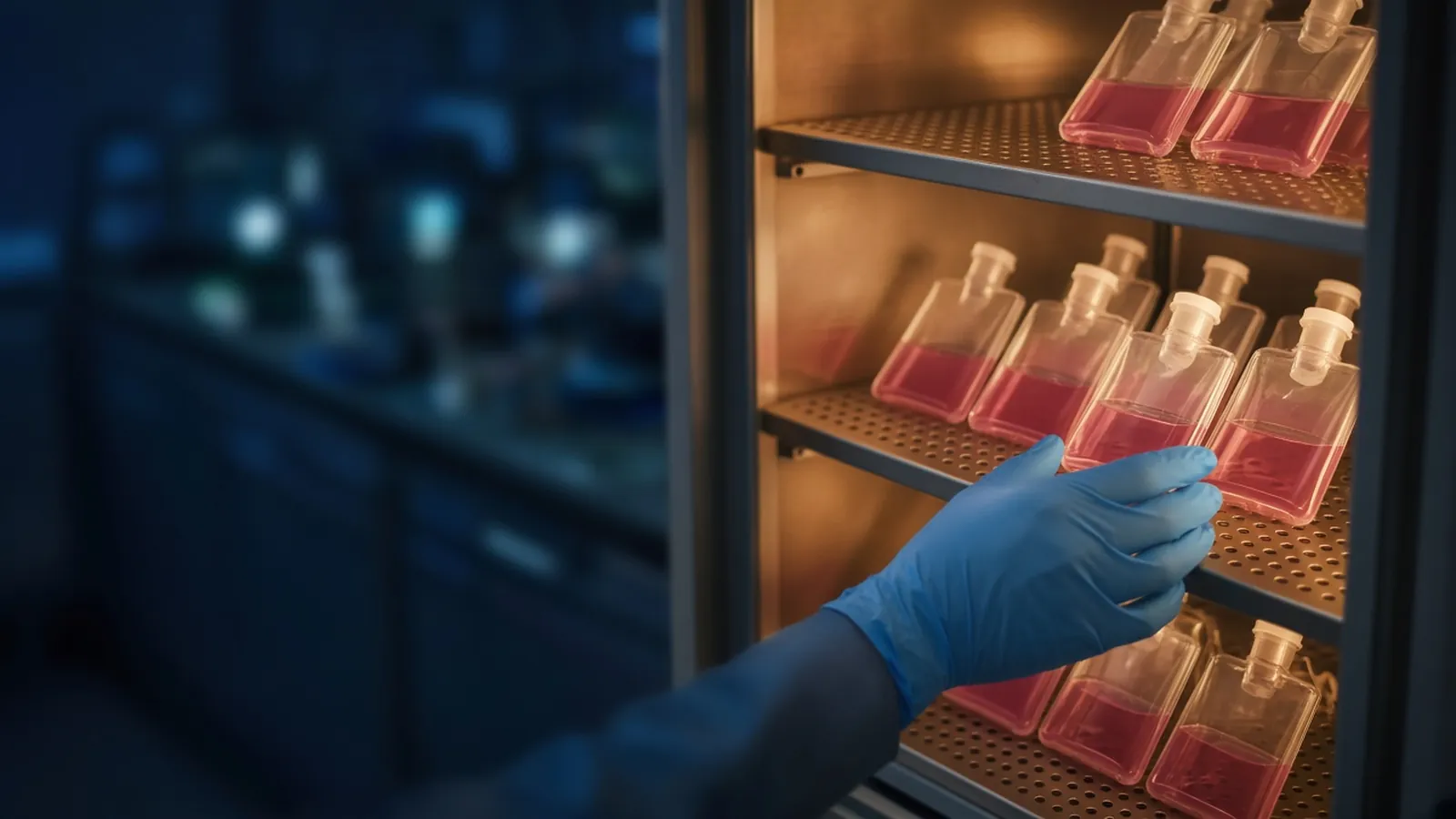
A water bath contaminates cultures by a short physical route, not by a mysterious property of warm glass. The bath is a shared puddle held near the temperature mammalian cells prefer. Bottles and vials are dipped into it. The water that wets the thread and the shoulder is then carried into the cabinet on the outside of a vessel that everyone treats as clean. From the thread it moves to a glove, a cap, or a pipette, and from there into the flask. The cabinet choreography that should interrupt that path is described in working inside a biosafety cabinet. The wider culture system is in mammalian cell culture for research labs. This page is the route itself, and the classes of thaw that do not use a shared puddle.
Why the bath is a culture of its own
Cell-culture baths are commonly set near 37 Celsius so medium and thaw vials approach incubator temperature. That is also a comfortable range for a long list of environmental bacteria and fungi. The water is rarely pure for long. Drips of medium, serum and dirty bottle shoulders add nutrients. A lid left open in a dusty room adds spores. The bath does not need to look like broth before it is hazardous to a clean flask. A visible film means the reservoir has been growing for a while. Absence of a film means you have not looked with a method that would detect a thin population.
The organisms in a bath are not automatically the organism you will see in the flask. A small inoculum on a thread can start a culture that becomes obvious only after the cells have been seeded and left overnight. That delay is why people blame the medium lot. The timeline often fits a wet thaw better than a sealed bottle that never touched the bath.
The route, step by step
Start in the reservoir. Water contacts the submerged plastic or glass. If the cap is dipped, water wicks into the thread, under a loose seal, and into the texture of a label. The vessel is lifted out. A droplet hangs at the neck. The operator, often in a hurry, carries that droplet across the room.
At the cabinet, the droplet meets gloves and the steel. A sleeve wiped with the wet bottle spreads the film across the area where caps are parked. The cap is opened. The thread crosses the opening. A pipette touches the neck. The inoculum is now in the medium, or it falls from the cap into the flask when the cap is replaced. None of these steps requires a torn glove or a dramatic splash. A film is enough.
A control that fails at any step is a reason to stop feeding other lines from that bottle. If the bath is cloudy, do not finish "just this rack" of vials. If a vial was submerged to the seal, do not wipe it and pretend the inside of the thread was untouched. Quarantine that thaw away from the main incubator until the culture has shown whether it stayed clear. Passage number does not reset because the vial was new to you. Record the wet thaw beside the passage you actually started.
Classes of practice that avoid a shared puddle
Three classes cover the honest options. They are classes, not a recipe you can mix from the stores cupboard.
The first class is a water bath that the institution has agreed to keep, using only a biocide that same institution has already approved, at the concentration and change-out interval written in that approval. This article will not invent a mixture, a household chemical dilution or a soak. If nobody has approved a biocide, you do not have this class. Emptying, scrubbing and refilling on a written schedule still belongs with it. A biocide does not replace emptying. Topping up with tap water replaces neither.
The second class is a bead bath: a dry metal or glass bead reservoir heated to the same working temperature. Bottles contact beads, not a broth. Beads can still get dusty and can still be contaminated by a leaky bottle. They do not grant permission to ignore spills. They remove the continuous aqueous culture.
The third class is a dry thaw. A dry block, a warming device specified for vials, or a brief thaw in a way your protocol already validates, brings the vial up without communal water. Mammalian thaws are often aimed at a quick transition to about 37 Celsius, then immediate dilution of the cryoprotectant. Follow the protocol for the line rather than a time copied from a neighbouring bath habit. Dry equipment still needs a clean surface. It does not need a community of bacteria living in a pan.
| Wet thaw class | Dry thaw class | What each still requires |
|---|---|---|
| Vial or bottle dipped in shared water | Vial warmed in a block or bead bed without free water | A temperature suited to the protocol |
| Waterline below the cap, if water is used at all | No waterline, so the thread stays dry | Hands that do not then wet the neck |
| Institution-approved biocide and a change-out log | Cleaning of beads or the block after spills | A written interval, not a memory |
| Ethanol wipe after a dunk | Wipe only if a splash occurred | A fresh wipe, not a shared towel |
| Higher chance the cabinet receives a droplet | Lower chance, unless gloves are already wet | Cabinet habits either way |
Where people break the route by accident
Dunking to the shoulder is the usual break. The second is drying a row of bottles with one cloth that started the morning dry and ended it as a wick. The third is returning a wet bottle to the fridge, so the thread contaminates the next person's gloves on a different day. The fourth is a bath that is never emptied because "we add disinfectant sometimes". Unapproved additions and forgotten intervals are how a reservoir becomes a standing culture. If the control is a visual check, write the date you actually looked. A bath nobody logged is not a clean bath.
Thawing several lines in one rack multiplies the route. One contaminated thread can wet the rack, and the rack can wet the next vial. Space vials so caps do not bathe each other. The passage you record for each line stays that line's passage. The contamination note may be shared across the rack if they shared the water.
Safety of the reservoir and of the flask
Bath water can contain environmental organisms and, if someone has been careless, splashes from cultures. Do not pipette bath water on the open bench to "see what grows" as a casual experiment. If your institution wants the bath investigated, that is a separate risk assessment. The flask you already seeded remains under the assessment of the line, which may be stricter than the assessment for ordinary water. Discarding a suspect culture, disinfecting a cabinet and taking an incubator out of use are local decisions. The WHO Laboratory Biosafety Manual is a reference for writing them. It does not declare your bath safe. This explainer is not medical advice. Culture-guide reminders that medium should be warmed with attention to contamination are consistent with public sheets such as the ATCC culture guides. Follow the sheet for the line, including how a thaw is meant to be warmed.
Heat, humidity and a bath that stays on
A bath left on in a hot, humid room is an invitation you can see without inventing a growth rate. Condensation, a skin on the surface and a sour room are operational signals to empty it. A power cut that lets the bath cool does not sterilise it. When power returns, the same water warms back into the growth range. Log the empty-and-refill, or switch the thaw to a dry class before the next vial. If you are specifying equipment, ask for a bead bath or a dry block sized to your vials, state the temperature the thaw protocol requires, and state that shared water is what you are trying to leave. Classes of ordinary labware sit in the laboratory consumables catalogue. A university brief can point at the academic research reference. Use the quote request to ask whether that equipment class can be discussed. No one is offering to run your thaws, and a dry block is not a claim that every vial you already wetted can be saved.
Questions from the bench
Why does a bath at cell-culture temperature grow microbes?
It is warm, wet and often fed by traces of medium that drip from bottles. Many bacteria and fungi that trouble cultures grow well in that range. A clear bath is not a sterile bath. Cloudiness, a film or a smell in the room are late signs, not the start of the problem.
Is it enough to wipe the vial with ethanol before the cabinet?
A wipe removes some of the film if the vial is then kept dry and the wipe is not a shared rag. It does not sterilise a thread that was submerged, and a soaked label can carry liquid under the wipe. Better practice is to keep water off the cap and the thread in the first place, then dry the outside.
What should we use instead of a homemade disinfectant mix?
Use a biocide your institution has already approved for that bath, at the concentration that approval states, or stop using shared water. This page does not give a kitchen recipe, a dilution or a soak time. Bead baths and dry-block thaws are equipment classes that avoid the reservoir. They still need a cleaning habit.
Does a contaminated bath change the passage number?
The passage number is a biological record of the line and stays whatever your rule says. The bath event is a contamination note beside it. Do not increment or reset passage to make the flask look new. If you discard the culture, the note should say why, and the backup vial should be thawed by a dry method.
References
Manufacturer names identify published method classes. Trademarks remain with their owners. Catalogue records on this site are independent references for enquiry. They are not a statement of inventory, distribution rights or a supply commitment. This page is educational. It is not medical advice, a diagnostic protocol or a biosafety approval.
Catalogue
Related products and categories
These links follow the subject of the article into published manufacturer references. A listing is a reference for an enquiry, not a statement of stock or distribution rights.
Continue in this cluster
Related reading
Mammalian cell culture for research labsHow research labs keep mammalian cell culture workable: medium, aseptic technique, confluence, passage records and contamination checks. Working inside a biosafety cabinetHow a Class II biosafety cabinet moves air, how that differs from a chemical fume hood, and which habits keep cultures and workers protected.A glossary of culture termsPairs of culture words that laboratories mix up, and the wrong next action each pair causes, from confluence versus density through to confluent versus