
guide
Weighing hygroscopic salts
Weigh the hydrate printed on the bottle. Humidity adds water to the pan, and an invented drying step can destroy the solid you meant to keep.
- Author
- EVRINTH Editorial Team
- Published
- 8 October 2026
- Updated
- 8 October 2026
- Reading time
- 9 min
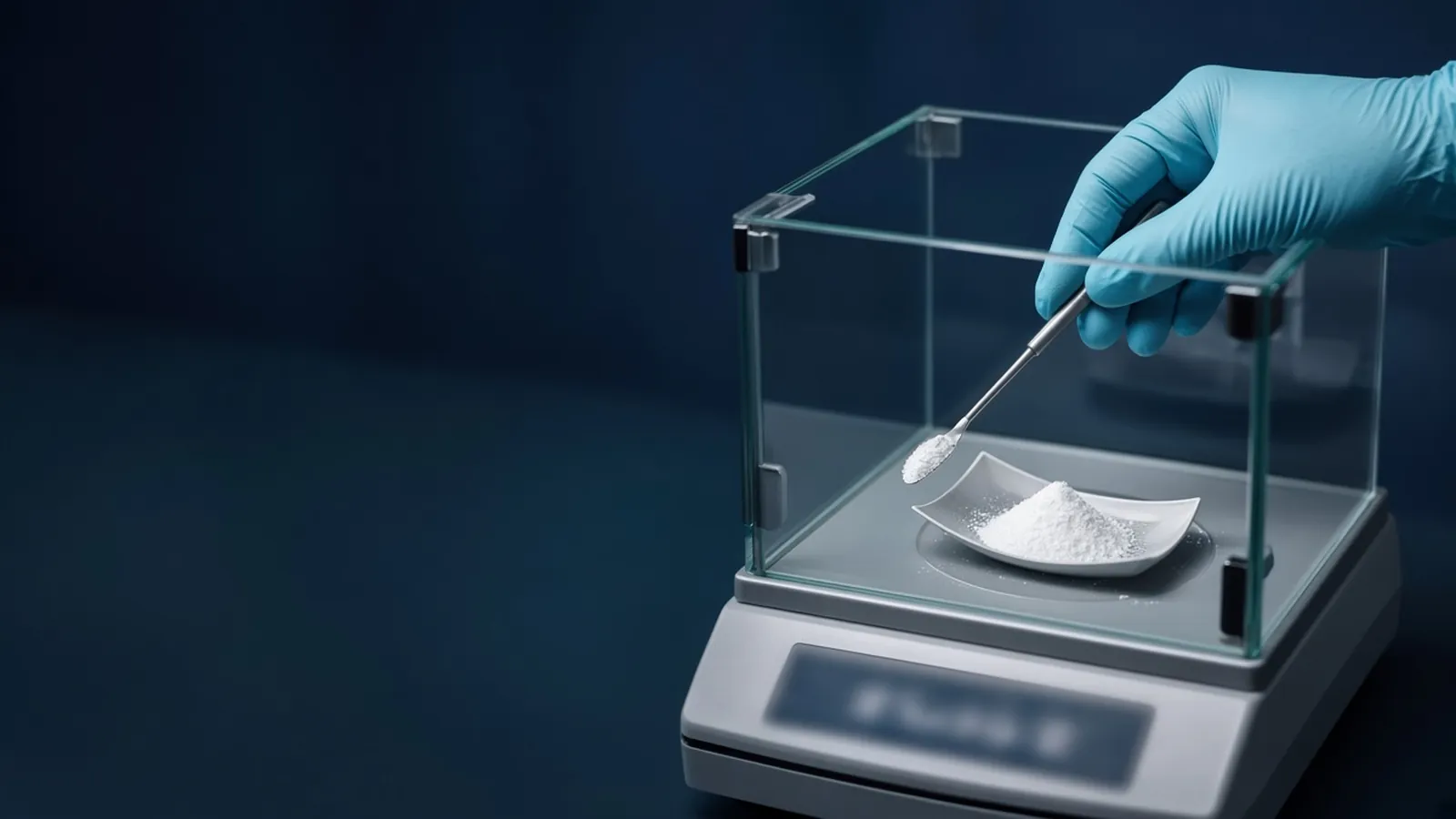
The balance reports the mass on the pan, including water the solid borrowed from the air while you looked for a spatula. For a hygroscopic salt or a hydrate, that extra water is a concentration error, and weighing the wrong hydrate is a larger one. This guide is the decision of which form the mass is allowed to represent. After the solid is in solution, pH is a separate control, described in preparing a buffer and checking pH. The water you dissolve into is laboratory water types and where they fail.
Order the named hydrate from the reagents and chemicals catalogue, not a family nickname. Dissolve in a vessel from beakers and flasks. Put the form, the grade, and the package on the quotation request so the bottle that arrives is the formula weight you used.
Who this is for
Use this when the recipe depends on a molarity: a magnesium-dependent enzyme, a calcium addition, a sodium hydroxide titrant, or a buffer salt that cakes in the store. The decision is whether this weighing may be entered in the batch record. If the solid has liquefied, or the label does not state the hydrate, the decision is to stop and obtain an identifiable portion. A "close enough" mass is acceptable only when the method says the concentration is not critical, and that waiver has to be written.
The form on the bottle is the formula weight
Magnesium chloride is the clearest pair. The anhydrous salt has a molar mass near 95 grams per mole. The hexahydrate, MgCl2·6H2O, includes six waters and has a molar mass near 203 grams per mole. For 0.100 moles, which is a litre of 0.100 molar solution, you weigh about 9.5 grams of the anhydrous salt or about 20.3 grams of the hexahydrate. Those are not interchangeable scoops. If you weigh 9.5 grams of hexahydrate because a recipe said "magnesium chloride" and you divided by the anhydrous mass, you have added about half the intended moles, nearer 0.047 moles. The enzyme sees less magnesium. The pH may still adjust. The notebook looks complete and is wrong.
Calcium chloride has the same trap in three costumes: anhydrous, dihydrate, and hexahydrate. The anhydrous solid is strongly hygroscopic. The hydrates are what many bottles actually contain. Read the label on the day you weigh, not the label you remember from a previous order. Sodium hydroxide is usually the anhydrous solid, molar mass near 40 grams per mole, and its failure mode is gain of water and carbon dioxide rather than a cryptic hydrate number. A pellet that has become a puddle on the watch glass has no interpretable mass. Discard it. Do not scrape it back.
Write the form into the recipe line: "MgCl2·6H2O, 20.3 g for 0.100 mol, dissolved and made to 1 L." A future reader can audit that sentence. "MgCl2, some grams" cannot.
Humidity is a handling constraint, not a moral failing
Hygroscopic means the solid takes up water vapour. In a warm, humid laboratory the rate is obvious: the mass on an open pan climbs while you watch, anhydrous calcium chloride cakes, sodium hydroxide pellets gloss over, and a magnesium chloride portion becomes damp at the edges. The balance is not drifting. The sample is changing. Work with the draft shield closed as the balance requires, the stock bottle capped between transfers, a dry spatula, and a portion sized so you are not leaving a heap to "use later." Weigh by difference from a closed vessel if the salt is bad enough that an open boat is dishonest.
Do not park a beaker of hot water in the balance chamber to "speed dissolution later." You are loading the chamber with vapour. Do not leave the stock open because you will weigh a second salt in a minute. The second salt can wait. The first bottle cannot.
Do not invent a drying protocol
It is tempting to bake a damp hydrate until the mass stops changing and then apply the anhydrous formula weight. That invention fails in two ways. First, you may not have reached the anhydrous composition. Second, heating can do chemistry. Magnesium chloride hydrates do not simply become clean anhydrous MgCl2 in an ordinary oven; they can hydrolyse, release hydrogen chloride, and leave a basic salt. You would have changed the substance and the fume load. Sodium hydroxide does not become a primary standard because it spent an hour in a drying oven. Carbonate remains, and hot caustic on a dish is a burn hazard.
If a validated analytical method tells you to dry a particular stable solid at a stated temperature, follow that method for that solid. Reference drying procedures belong to substances that tolerate them. They are not a universal prelude to buffer making. For the hydrates in this guide, weigh the form named on the bottle, keep it dry by closing the lid, and discard a portion that has already liquefied.
From the pan to a buffer you can trust
Dissolve the portion completely in less than the final volume. A slurry that clears after you have set the pH will shift both concentration and pH as the last crystals go. Then calibrate the electrode and adjust. The water grade does not correct the mass, and the mass does not correct a nuclease in the water. Sequential controls stay sequential.
If the recipe asks for a weight percent rather than a molarity, the hydrate still matters, because the recipe's percent refers to a named material. A 10 percent solution of the hexahydrate is not a 10 percent solution of magnesium ion. Say which percent you mean.
Branch when the control fails. If the mass will not stabilise because the reading climbs, close the operation, transfer by difference more quickly, or move to a less humid moment in the day. Do not average a climbing reading and call it the target. If the solution is cloudy with a solid that should have dissolved, you may have the wrong salt or a carbonate crust from sodium hydroxide. Do not adjust pH on a suspension and hope. If the assay fails and the pH is right, check the hydrate line in the notebook before you reorder the enzyme.
| Solid | What the label must decide | A handling failure |
|---|---|---|
| MgCl2·6H2O versus anhydrous | Which formula weight, near 203 or near 95 g/mol | A twofold molarity error from the wrong mass |
| CaCl2 anhydrous or a named hydrate | The water of crystallisation actually in the bottle | Caking and a climbing pan mass in humid air |
| NaOH pellets | The portion is still solid and recently taken | A liquefied, carbonated puddle weighed as if it were NaOH |
| Any damp hydrate | Discard or weigh honestly as an unknown | An oven step that decomposes or hydrolyses the salt |
| A stable salt with a real drying method | Follow that method's temperature | Importing the same oven step onto MgCl2 |
Failure modes that survive into the assay
A magnesium-dependent restriction or polymerase reaction that is sluggish, with a buffer pH that checks out, is a hydrate suspect as soon as the water and the enzyme lot are plausible. A calcium addition that precipitates in phosphate is a buffer-selection problem, and it is worse if the calcium mass was also the wrong hydrate, because you no longer know which ion ran out. A sodium hydroxide titrant that is weak was often carbonated or wet before it was dissolved. Standardise a titrant if the method requires a known normality. Do not standardise it by wishing the pellets had stayed dry.
Static and a spilled portion are ordinary balance problems. They matter more when you rush a hygroscopic solid and skip the shield. Level the balance, use a vessel the draft can tolerate, and record the mass you actually have, then compute the volume that mass justifies if you overshot slightly and the method allows. Pretending you hit the target exactly is how the twofold error hides.
Safety
Sodium hydroxide and calcium chloride are caustic or irritating, and anhydrous calcium chloride releases heat as it hydrates. Add solids to water in a vessel that can be stirred, not water onto a heap of solid in a narrow bottle. Eye protection is the minimum. Heating magnesium chloride hydrates can release acidic fumes. That is one more reason not to improvise a drying oven. Follow the safety data sheet and the laboratory chemical hygiene rules. OSHA's laboratory standard is one public statement of that duty for regulated workplaces. This guide is not a medical instruction if a solid reaches an eye, and it is not a biosafety approval. Infectious material follows institutional rules even when the salt was weighed perfectly.
A humid afternoon
Where the room is warm and the air is wet, weigh hygroscopic salts in a short campaign, not between meetings. A power cut that leaves the balance unlevelled or un-warmed is a reason to wait until the instrument is stable, not a reason to switch to a kitchen scale. Store the bottles closed, off the floor, and away from the steam from a nearby autoclave or water bath. None of that requires a statistic about a city. It requires the lid and the label.
What the enquiry should name
Ask for the chemical name, the hydrate or the word anhydrous, the grade, and the package size that matches how fast you will use a hygroscopic solid. A huge bottle that stays open for a year is a handling failure you can choose not to buy. Ask the certificate to state the form. On receipt, check the seal and the hydrate line before the bottle joins the "magnesium chloride" shelf with a different hydrate already there. Then weigh from that identity, and file the formula weight in the same note as the pH.
Weigh the salt form named on the label before the room rewrites the mass
- 01Copy the form from the bottle into the recipeWrite anhydrous, hexahydrate, or whatever the label states, and use that formula weight. Magnesium chloride hexahydrate and anhydrous magnesium chloride are different masses for one molarity.
- 02Keep the bottle closed and the portion movingOpen, transfer, and close. A hygroscopic solid left on the pan or on a watch glass gains water from humid air, so the balance reports mass that is not the salt.
- 03Refuse an improvised drying stepDo not bake a hydrate to 'constant weight' unless a validated method says that solid survives it. Magnesium chloride hydrate can lose water and hydrolyse. Weigh the form you have.
- 04Dissolve and record before you adjust pHA damp portion that finishes dissolving later changes both concentration and pH. Complete dissolution in less than the final volume, then calibrate and adjust as the buffer method requires.
Questions from the bench
How large is the mass error between magnesium chloride forms?
Anhydrous magnesium chloride is near 95 grams per mole. The hexahydrate is near 203 grams per mole, because six waters add about 108 grams. Weighing the hexahydrate mass of an anhydrous salt, or the reverse, is roughly a twofold concentration error, not a rounding error.
Can I dry sodium hydroxide pellets so the mass means something?
Pellets that have turned wet have taken up water and often carbon dioxide, and the mass is no longer the formula you wanted. Discard that portion and weigh a fresh one from a closed bottle. An oven protocol invented at the bench is not a purification, and hot caustic is a safety problem.
Does the water grade fix a bad weighing?
The water grade controls contaminants in the solvent. It does not correct a hydrate mistake. Use a suitable water as in the water-type guidance, and use the balance for the salt. They are sequential controls, not substitutes.
References
Manufacturer names identify published method classes. Trademarks remain with their owners. Catalogue records on this site are independent references for enquiry. They are not a statement of inventory, distribution rights or a supply commitment. This page is educational. It is not medical advice, a diagnostic protocol or a biosafety approval.
Catalogue
Related products and categories
These links follow the subject of the article into published manufacturer references. A listing is a reference for an enquiry, not a statement of stock or distribution rights.
Continue in this cluster
Related reading
 Laboratory water types and where they failResistivity, organic carbon and endotoxin answer different questions. A water grade fails when the assay cares about a contaminant the meter cannot see.
 Preparing a buffer and checking pHPrepare a buffer at a stated pH and temperature, record the salt form, and treat a drifting electrode or a bad slope as a failed control.A glossary of solution termsDecide which number a recipe means before you weigh a salt: molarity or molality, which percent, normality, buffer capacity, osmolality, or hydrogen-ion