
explainer
CO2 incubators humidity and pH of medium
Why bicarbonate medium, incubator carbon dioxide and the humidity pan set the pH and the salt concentration your cells actually experience.
- Author
- EVRINTH Editorial Team
- Published
- 8 October 2026
- Updated
- 8 October 2026
- Reading time
- 9 min
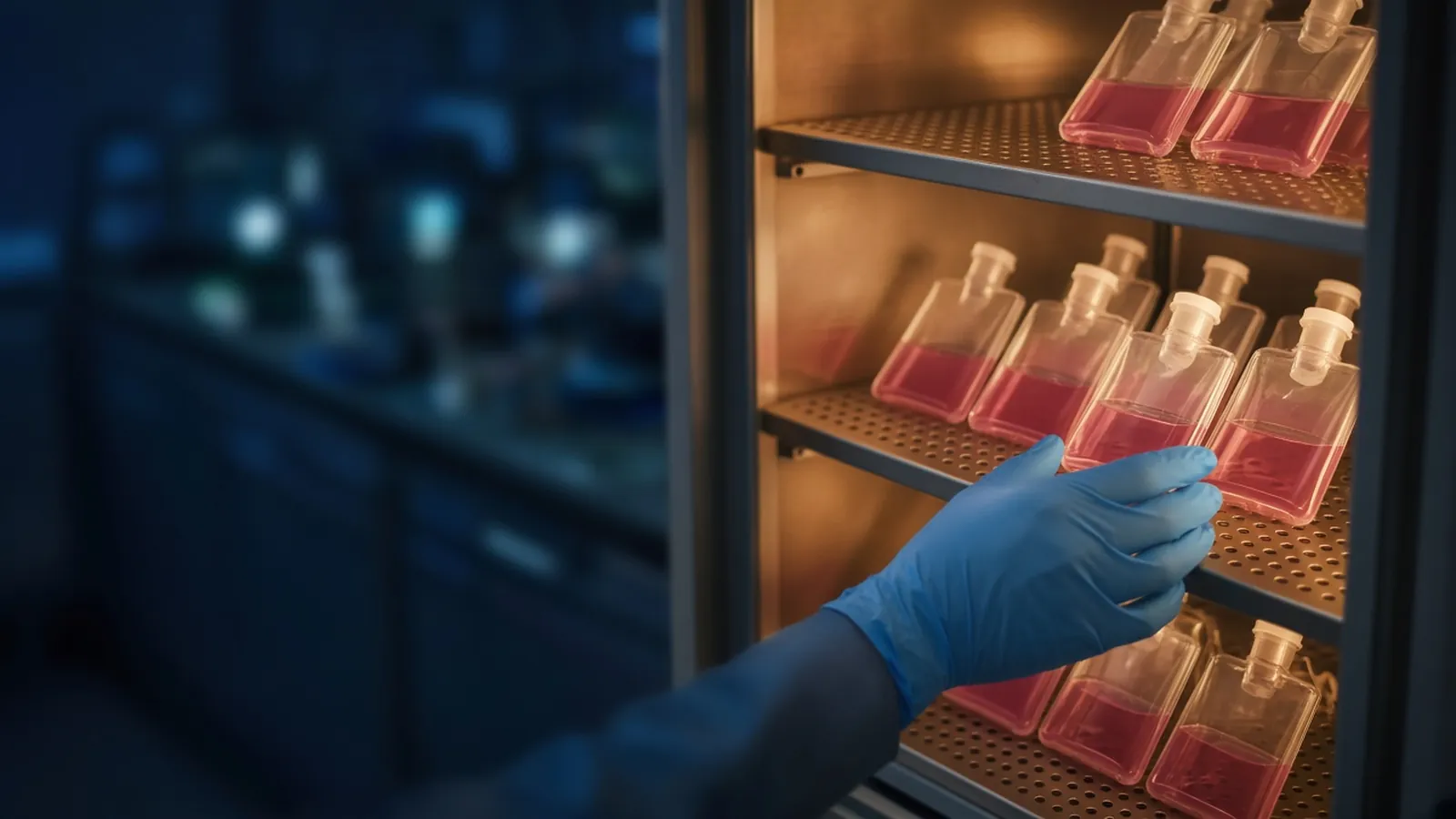
The incubator is not a warm cupboard. It is the other half of the buffer. Bicarbonate in the medium and carbon dioxide in the gas phase set the pH the cells actually sit in, and the water pan sets whether that medium stays at the salt concentration you mixed. The decision this page supports is what to check first when the colour shifts, the edges of a plate crust, or a run of slow growth appears after a weekend of door openings. How the culture is chosen and handled sits in mammalian cell culture for research labs. The photograph shows gloved hands and flasks of red medium in a carbon dioxide incubator. Red is a cue. It is not a pH value.
Bicarbonate is a gas-exchange buffer
Carbon dioxide dissolves in water, becomes carbonic acid, and that acid sits in equilibrium with bicarbonate. Raise the carbon dioxide over the liquid and the pH falls. Let the gas escape and the pH rises. Medium makers set the bicarbonate concentration for a stated carbon dioxide fraction, very often near five percent for contemporary DMEM and RPMI formulations, sometimes higher for older or specialised sheets. The exact setpoint belongs to the bottle in your hand. An incubator left at five percent because the previous laboratory used five percent will push a ten-percent formulation alkaline, and the reverse mistake pushes a five-percent formulation acid. Collection notes such as the ATCC culture guides state the atmosphere for lines they describe. Your medium sheet wins when the two were written for different catalogue numbers.
Phenol red rides along as a dye. Toward yellow means the liquid is more acid than the dye's midpoint. Toward pink and purple means it is more alkaline. A healthy, moderately dense culture at the right gas setpoint usually looks red to orange-red. That sentence is as far as a colour chart should go. Do not assign pH numbers to those colours from memory. Metabolic acid from crowded cells, lactic acid from bacteria, a flask left on the bench, a sparse culture that has made little acid, and a failed sensor can produce similar dyes for different reasons. When the number matters, equilibrate an aliquot under the same gas and read it with a meter, as you would any other buffer in preparing a buffer and checking pH. Do not dip a probe into the stock bottle.
What the chamber has to hold still
Three loops run at once: temperature, commonly near 37 Celsius for mammalian lines; carbon dioxide at the medium's setpoint; and relative humidity high enough that water does not leave the flask faster than the protocol allows. Temperature errors are obvious when the display is believed and checked. Gas errors are quieter because the display can be confident and wrong. Infrared sensors and thermal-conductivity sensors fail differently. Humidity changes the reading of some thermal-conductivity designs, which is one reason a dry pan and a flooded pan are not only evaporation problems. Calibrate on the schedule the instrument manual gives, with the method that manual names. A cylinder that has run out, a loose line, and a setpoint edited by the last user are more common than a mysterious cell death.
Every door opening dumps gas and moisture into the room. Recovery is not instantaneous. A person who loads eight plates one by one, chatting with the door ajar, delivers a long alkaline, drying excursion to every other culture in the chamber. Stage flasks on a tray, open once, close. The same discipline applies when you hunt for one dish at the back.
Humidity is a concentration control
The pan exists so the air is wet and the medium does not evaporate. Evaporation raises salts, raises drugs in the outer wells of a plate, and changes osmolality. A dry pan in a heated room does this by the next morning, especially in multiwell plates with a loose lid. A pan that has grown a film does the opposite kind of harm: it is a microbial reservoir next to every flask. Both are failures. Fill the pan with the water grade your SOP names. Laboratory water types and where they fail explains why a jug of tap water is a mineral and microbe delivery system. Some laboratories add a biocide to the pan. That is an institutional choice, because the vapour reaches the cultures. A film, a smell, or slime means the pan is already a culture. Empty it, clean it under the incubator SOP, and do not decide that the cells "have always been fine".
Condensation on the inner door is not proof the pan is right. It means a cold surface met wet air. It can also drip onto flask caps. Wipe it as the SOP allows, without spraying disinfectant into open vessels.
HEPES changes the gas requirement
HEPES is a zwitterionic buffer many media include so pH moves less while you are in the cabinet. Typical research levels are often in the range of about 10 to 25 millimolar. Follow the formulation. HEPES does not replace bicarbonate in most complete media, and it does not replace the humidity pan. A medium that lists both still needs the carbon dioxide its bicarbonate was calculated for, unless the manufacturer explicitly describes a closed, air-equilibrated use. Short handling on the bench is what HEPES is for. Overnight on the bench is a different experiment.
Light is the extra hazard. Illuminated HEPES solutions can generate hydrogen peroxide. Store those bottles dark, and do not leave a clear working bottle in a sunny transfer room. That photochemistry is independent of the incubator setpoint. If cells die only in the flask that sat by the window, check light before you indict the gas cylinder.
A colour change has a first check, not a single meaning
Read the microscope and the incubator together. A yellow cloudy flask is not a cue to raise the carbon dioxide. A purple flask that has stood capped on a trolley has lost dissolved gas and will often look better after it goes back, which can hide the fact that the pH was high during a drug incubation you cared about. A purple flask that never left the incubator is a gas, sensor, or cylinder problem until shown otherwise. A red flask with white salt rings at the edges of the wells is a humidity problem. Mycoplasma will not announce itself as a gas fault, and a gas fault will not produce the turbidity of a bacterial bloom. Passage number and confluence still matter: a very heavy culture turns medium acid even when the chamber is perfect.
| What you see | Direction of the clue | First check |
|---|---|---|
| Yellow and cloudy | Acid, and likely growth that is not the cell line | Microscope. Remove from the shared chamber under local rules |
| Yellow, clear, crowded monolayer | Metabolic acid from the cells | Confluence and the feeding interval |
| Purple after time on the bench | Carbon dioxide has left the liquid | How long it was out. Do not titrate it with acid |
| Purple while it stayed inside | Setpoint, empty gas, or a drifting sensor | Display, cylinder, lines, then a meter on an equilibrated aliquot |
| Red centre, crusted outer wells | Water left the wells | Pan volume, lid fit, how often the door stood open |
| Normal colour, suddenly slow growth | pH may be innocent | Temperature log, medium lot, mycoplasma schedule, passage |
When the display is not the atmosphere
If the colour and the cells disagree with a confident display, believe the cells enough to measure. Put medium without cells in a vented vessel, leave it long enough to equilibrate, and read the pH. A display at setpoint with an alkaline aliquot means the sensor or the plumbing is not doing what the screen says. If several users report slow growth in the same week, pull the temperature and gas logs before you start swapping serum. A mycoplasma-positive neighbour is a separate branch: clear medium and ordinary colour do not clear that line, and raising the carbon dioxide will not.
Do not "correct" a purple experimental plate by adding acid in the cabinet. You will overshoot, and you will have changed the drug concentration with the volume. Return the plate or start the incubation again from a fresh dilution. Do not prop the door open because the room feels hot. The chamber is supposed to be warmer than the room.
Safety stays with the institution
An incubator full of human lines is a containment box as well as a buffer box. Cleaning agents, who may open it, and how a contaminated flask leaves it are written in the local risk assessment. The WHO Laboratory Biosafety Manual is a reference for writing that assessment. It does not assign your room a level. Gas cylinders are a physical hazard: restraint, a regulator in good condition, and a plan for an empty cylinder before a weekend. This page is not a repair manual and not clinical guidance.
Heat, power cuts and a shared door
In a hot plant room the pan dries faster and people are tempted to leave the door ajar between users. Dryness concentrates outer wells. An open door drops carbon dioxide for everyone, including the flask you are not touching. A power cut stops temperature, gas control and humidity together. When power returns, the colour can look ordinary again because bicarbonate re-equilibrates. The temperature dip does not rewind. Write the clock times in the culture record, next to the passage number, before anyone treats those plates as an uninterrupted run. If the building's backup power does not cover the incubator, that fact belongs in the method, not in a surprise on Monday.
Alarms that only sound inside an empty laboratory do not help. The useful specification is who is called, and how long a chamber may be off setpoint before the work is marked as an excursion.
What an enquiry should name
Name the gas setpoint the medium requires, the vessel types that will sit in the chamber, whether humidity is pan-based, and whether you are asking about consumables for culture or about a monitoring habit. The laboratory consumables catalogue lists everyday classes. The academic research reference is a separate page for a university laboratory framing a wider conversation. The quote request is how you ask whether a quotation is possible. A method can be discussed from the medium sheet and the chamber log. A picture of a flask is not a setpoint, and a catalogue class is not a statement that a culture room is being run for you.
Questions from the bench
Is five percent carbon dioxide correct for every medium?
It is a common pairing with many bicarbonate formulations, and it is not a universal setpoint. Some media were built for a higher carbon dioxide fraction. Use the number on the medium sheet, then confirm that the incubator display and the sensor agree with it.
Can phenol red replace a pH measurement?
No. Phenol red is a rough cue: more yellow suggests more acid, more purple suggests more alkaline, and the working look is usually a red-orange. Overgrowth, contamination, a sparse culture and a gas fault can all move the colour. A meter on an equilibrated aliquot is the measurement.
Does HEPES mean the incubator can run without carbon dioxide?
HEPES reduces how fast pH drifts when a flask is outside the chamber. Many HEPES media still contain bicarbonate and still expect some carbon dioxide for ongoing culture. Read the formulation. Do not assume a sealed flask on the bench is an incubator.
A power cut ended and the colour looks normal. Is the culture unaffected?
The colour can return after gas flow resumes and still hide hours of alkaline or cold drift. Record the start and end of the excursion and treat those flasks as having a history. Whether they remain fit for the experiment is a decision for that protocol, not a guess from the dye.
References
Manufacturer names identify published method classes. Trademarks remain with their owners. Catalogue records on this site are independent references for enquiry. They are not a statement of inventory, distribution rights or a supply commitment. This page is educational. It is not medical advice, a diagnostic protocol or a biosafety approval.
Catalogue
Related products and categories
These links follow the subject of the article into published manufacturer references. A listing is a reference for an enquiry, not a statement of stock or distribution rights.
Continue in this cluster
Related reading
Mammalian cell culture for research labsHow research labs keep mammalian cell culture workable: medium, aseptic technique, confluence, passage records and contamination checks. Preparing a buffer and checking pHPrepare a buffer at a stated pH and temperature, record the salt form, and treat a drifting electrode or a bad slope as a failed control.A glossary of culture termsPairs of culture words that laboratories mix up, and the wrong next action each pair causes, from confluence versus density through to confluent versus