
troubleshooting
Coating plates for adherent cells
Why some adherent lines need a matrix coating, and how to tell a skipped coat, a dried coat, the wrong plastic or leftover enzyme from a growth problem.
- Author
- EVRINTH Editorial Team
- Published
- 8 October 2026
- Updated
- 8 October 2026
- Reading time
- 8 min
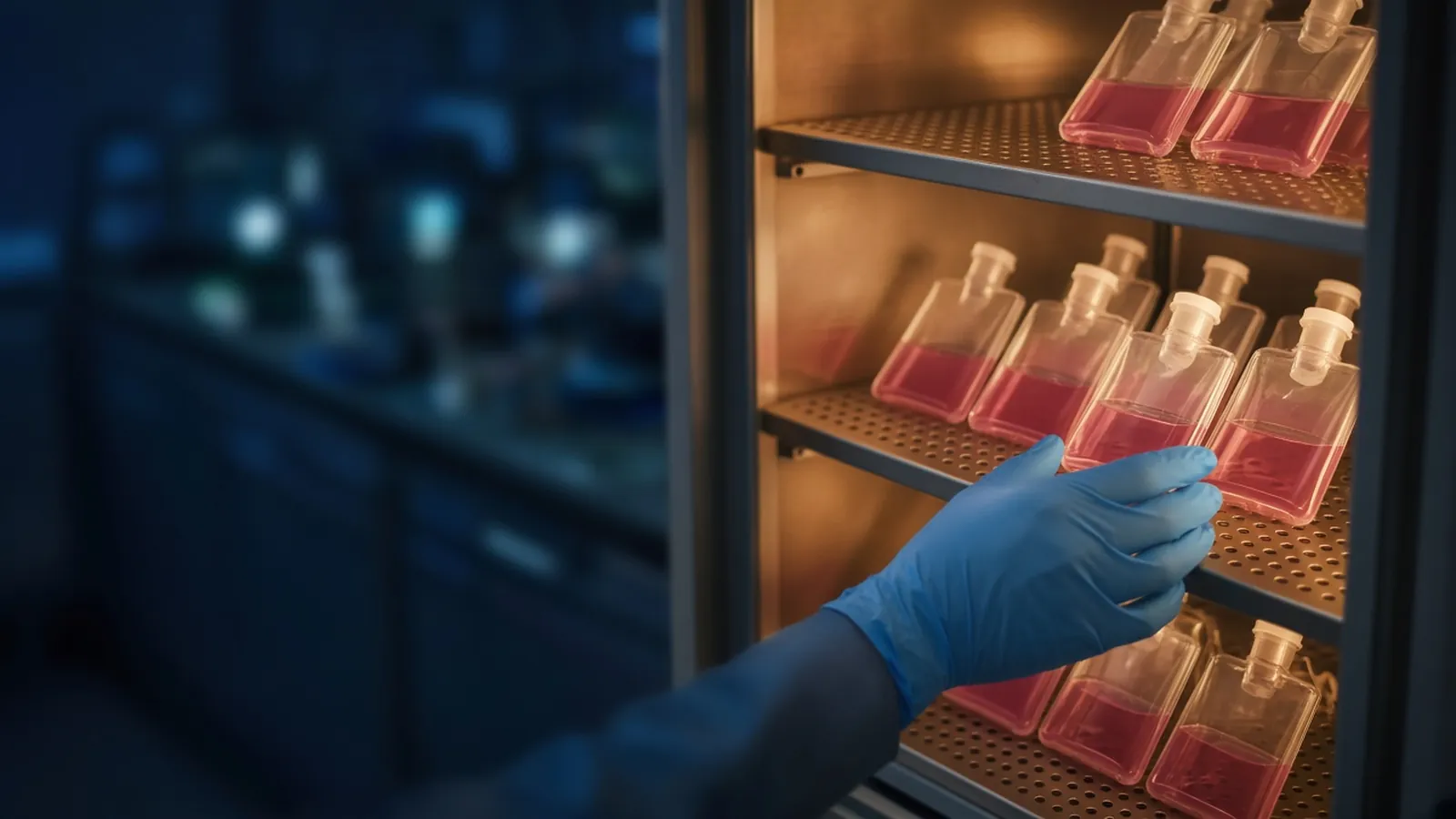
When adherent cells stay round and gather in the middle of a well, the reflex is to blame the medium or the thaw. Often the plastic never offered a surface they recognise. Some lines attach to tissue-culture-treated polystyrene with nothing more than the proteins in serum. Others need a declared extracellular-matrix coating: a collagen, fibronectin, laminin, a poly-lysine, gelatin, or a mixture class such as a basement-membrane extract. This page is a troubleshooting order for cells that will not attach. The culture around that order is in mammalian cell culture for research labs. Which plastic you are holding is in when to use plastic tubes, tips and plates.
What a coating is doing
Treated culture plastic is oxidised so that proteins adsorb and cells can form contacts. Untreated bacteriological plastic is a different surface, useful for suspension cultures that you do not want sticking, and a common cause of a "mysterious" attachment failure when the sleeves look similar. A coating is a layer you add on purpose. Collagens and fibronectin and laminins are matrix proteins cells bind through receptors. Poly-L-lysine and poly-D-lysine are polymers that change the charge of the surface. Poly-D-lysine is chosen in some protocols because cells do not digest the D form as readily. Neither polymer is a nutrient. A basement-membrane extract is an undefined mixture. It can work when a single protein does not, and it brings lot variation and a handling temperature the sheet will insist on. Call it a mixture, not a purified factor.
Concentrations are product-specific. Matrix proteins are commonly applied from dilute solutions in the microgram per millilitre range, sometimes specified per square centimetre, and poly-lysine is often applied from a stronger stock than those proteins. Those are class reminders so a tenfold mistake looks like a mistake. The sheet for the bottle and the protocol for the line win. Incubation is often a fraction of an hour to a few hours, in the cold or at a stated temperature. Do not invent a stronger coat because the first attempt failed. Find which step failed.
A diagnostic order, not a new coating
Look at the plastic first. If the plate is not tissue-culture treated and the line requires treated plastic, stop. Coating an untreated plate sometimes rescues attachment and sometimes does not, because the protein may not adsorb as the protocol assumed. Use the plastic the method names. Second, ask whether a coat was required and whether it was actually applied to this plate, this day. A stack of "pre-coated" plates from last month is not today's coat unless you recorded the date and the sheet says they keep. Third, ask whether the coat dried. Wells left open in a running cabinet dry from the edges. A dry film can be the intended finish for some poly-lysine methods and a ruined finish for a matrix protein that was supposed to stay wet until aspirated. Read the sheet before you standardise a drying habit.
Fourth, ask what buffer is left behind. Collagen stocks are often dissolved in acid. Poly-lysine protocols sometimes include a rinse. Residual acid or a harsh buffer is toxic. Cells die and look unattached, which you will record as a coating failure of the opposite kind. If the sheet says rinse, rinse with the solution it names, not with a random water. Fifth, ask how long the cells sat in enzyme before they met the coat. Trypsin and related enzymes cut the same surface proteins the cell needs in order to grab the matrix. An over-digested suspension will not attach to a perfect coat. Quench as the line requires, and do not park the pellet while you coat the plate you forgot to prepare yesterday. Coat first, then detach.
Sixth, separate attachment from growth. At a few hours, healthy cells on a good surface spread. If they are spread and then fail to divide for days, the coat did its job and the medium, the seeding density or the passage did not. Adding a thicker coat will not feed them. If they are still round and floating, stay on the attachment list. Mycoplasma and a bad passage can reduce attachment too. They are later on the list, after plastic, coat, buffer and enzyme, because those four are the usual bench errors and they are cheap to check.
Branching while you still have cells
If the first well of a plate fails and the flask you took the cells from looks normal, the plate is the suspect. Seed a known-good treated flask, without the experimental coat, as a same-day control. If that flask attaches, you have localised the problem to the plate or the coat. If nothing attaches anywhere, the cells left the enzyme already dead, or the thaw was the parent failure. Do not consume the whole vial proving the same point in twelve wells.
If only the outer wells fail, think drying and evaporation, not a mysterious matrix gradient. If only wells you rinsed with the wrong saline fail, believe the rinse. If a basement-membrane extract gelled in the pipette because it warmed, discard that attempt. Do not dilute a gel and call it a coat. Accurate micropipetting technique matters once the concentration is in the microgram range, where a dropped tip is a large fraction of the dose. It is not the first suspect ahead of "this plate was never treated".
| What you see | Likely cause | The check that distinguishes it |
|---|---|---|
| Round cells, every well, new plate lot | Untreated or non-culture plastic | Read the sleeve. Compare with a known treated flask |
| Round cells, coat "applied" yesterday and left open | Dried or denatured coat | Repeat, aspirate on the sheet's schedule, seed promptly |
| Cells die at the edges of an acid-smelling well | Residual coating buffer | Rinse as the sheet says, then reseed fresh cells |
| Debris, poor attach, long enzyme step | Surface proteins digested | Shorter enzyme, watch the monolayer, coat the plate first |
| Spread cells, no division | Attachment happened | Medium, density, passage. Not a thicker coat |
| One plate cloudy the next day | Contamination, including a plate from an open bag | Discard. Coating does not sterilise it |
| Attach in serum medium, float in serum-free | Serum had been the attachment factor | The serum-free system needs its declared coat |
Failures that survive a correct protein
A coat cannot repair over-confluence in the parent flask. Cells harvested from a lifting sheet attach badly on any surface. A coat cannot reverse a mycoplasma-heavy culture, and it should not be the moment you discover you never tested. Passage number belongs in the note when attachment changes suddenly at a high passage: some lines become fussier, and some "changes" are a swapped line. Do not keep raising the coating concentration across months to chase a culture that is no longer the culture you banked.
Uneven coats come from a bubble left in the well, a volume too small to cover the plastic, and a plate that was not level. Look at the liquid surface before you walk away. A well with a dry island in the centre was not coated. If the protocol uses a gel that must stay cold, work on the cold block the sheet implies. A warm gel is a different material.
Safety and research limits
Matrix proteins and extracts are research reagents. Some are animal-derived. They are not a clinical implant and not a wound dressing. Handle them under the chemical and biological rules that fit their origin. A basement-membrane extract from a tumour line is still a research mixture with an institutional risk assessment, not a harmless gel. Waste follows that assessment. The WHO Laboratory Biosafety Manual is a reference for the biological side of human and animal cell work sitting on these plates. It does not choose your coating. Do not scrape cells off a coat and present them as a diagnostic sample.
Open bags in a humid store
Culture plastic is sterile only while the packaging that made it sterile stays closed. In a humid room an open sleeve takes up moisture and whatever is in the air. Coating that sleeve later does not resterilise it. You will grow the contaminant on a very expensive protein layer and then blame the protein. Close the bag. Date it. Discard plates that were uncovered in the cabinet overnight. A power cut that warms a cold-stored extract is an excursion for that lot. Do not stretch a gelling aliquot with buffer to "use it up" and then interpret attachment. Write, on any specification, the plastic treatment, the coating class, the species of any matrix, and whether the work is serum-free and therefore dependent on the coat. Those words prevent a bacteriological plate arriving because it was cheaper and round.
What to ask for
Name the line, the vessel format, whether the plastic must be tissue-culture treated, the coating class the protocol already names, and whether you are troubleshooting a failure or specifying a first order. Ask for the concentration basis and the rinse requirement in writing. The laboratory consumables catalogue lists plates and related classes. The academic research reference is a separate page for a university laboratory framing the work. Use the quote request to ask whether a quotation is possible. A coating choice can be discussed from the line sheet. A catalogue picture of a plate is not a matrix, and it is not evidence the plate is tissue-culture treated unless the specification says so.
Questions from the bench
Is a coating a growth factor?
No. A coating gives the cell something to stick to and to read as matrix. It does not replace serum, a defined supplement or a growth factor the line requires. Cells that attach and then do not divide have a feeding problem. Cells that stay round have an attachment problem. Those are different branches.
Why did the cells attach in a flask and not in the new plate?
Flasks sold for culture are usually tissue-culture treated. A plate taken from a bacteriology sleeve may be untreated polystyrene, which many mammalian lines ignore. Check the bag, not the well shape. A coating on the wrong plastic can also fail if it never adsorbed.
Should the coating dry before I seed?
Only when that product's sheet says to dry it. Many matrix coats are incubated wet, aspirated, and used promptly, sometimes after a rinse. A well left to dry in the cabinet can denature the coat or leave a toxic film of buffer. Follow the sheet for this protein.
Can I coat a plate that was already used or left open?
A coating is not a sterilisation. An open bag in a humid store, or a plate that left the cabinet uncovered, is a contamination question first. Do not coat it back into service. Take a fresh sterile plate and start again.
References
Manufacturer names identify published method classes. Trademarks remain with their owners. Catalogue records on this site are independent references for enquiry. They are not a statement of inventory, distribution rights or a supply commitment. This page is educational. It is not medical advice, a diagnostic protocol or a biosafety approval.
Catalogue
Related products and categories
These links follow the subject of the article into published manufacturer references. A listing is a reference for an enquiry, not a statement of stock or distribution rights.
Continue in this cluster
Related reading
Mammalian cell culture for research labsHow research labs keep mammalian cell culture workable: medium, aseptic technique, confluence, passage records and contamination checks. When to use plastic tubes tips and platesWhen polypropylene tubes, pipette tips and polystyrene plates are the right vessel, and when solvent or volume still belongs in glass.A glossary of culture termsPairs of culture words that laboratories mix up, and the wrong next action each pair causes, from confluence versus density through to confluent versus