
explainer
Codon use and insoluble expression
Why rare codons can slow translation, and why a codon table still does not prove that insoluble expression is a coding problem.
- Author
- EVRINTH Editorial Team
- Published
- 8 October 2026
- Updated
- 8 October 2026
- Reading time
- 7 min
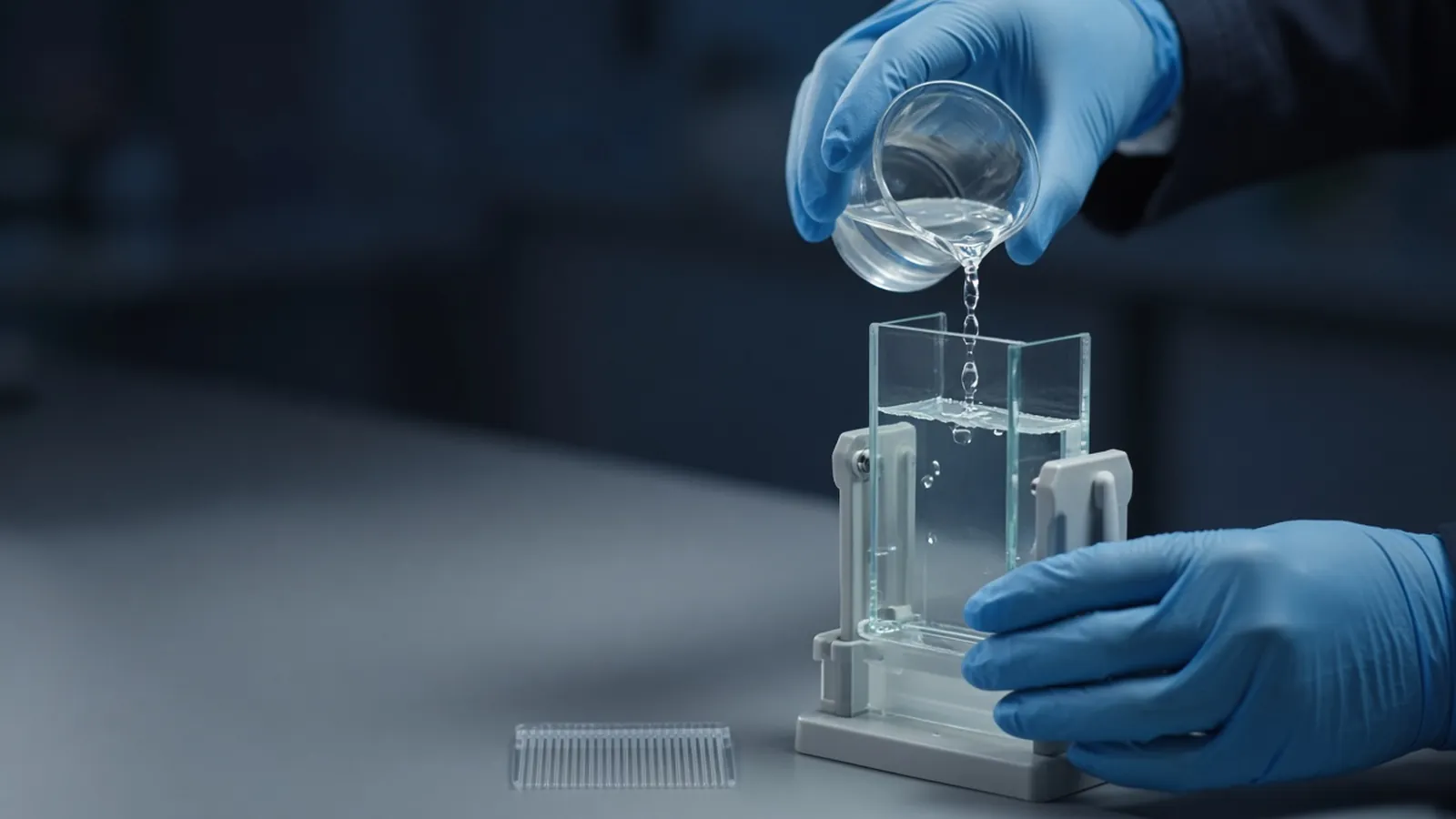
A codon-optimised gene can still pour into the pellet. Rare codons are real: a ribosome that meets a codon whose tRNA is scarce will pause. That pause is not, by itself, an inclusion body. Insoluble expression is what you see when polypeptide accumulates faster than it folds, or when the compartment cannot form the bonds the fold needs. This explainer separates those stories. It is research background, not a gene-synthesis protocol.
Host limits that no codon table can remove are in expression hosts in outline. The gel that shows where the protein went is read as in reading a protein gel. If you turn a dissolved pellet into a number, name the method as in how laboratories estimate protein concentration.
What a rare codon does to a ribosome
The genetic code is degenerate. Several codons can specify one amino acid, and organisms do not use them equally. In E. coli, some arginine and isoleucine codons, among others, are rarer than their synonyms and are served by less abundant tRNAs. A coding sequence from a human cDNA, or from a GC-rich genome, can be full of codons that are ordinary at home and uncommon in the bacterium. When a stretch of those codons arrives, ribosomes pause. Pauses can lower the yield of finished chains, trigger quality control, or, in some transcripts, drop the translation rate enough to change how the chain folds as it emerges.
That mechanism is physical and limited. A single rare codon in a long gene may be invisible. A cluster near the start can reduce initiation or early elongation more than a cluster in a loop that folds late. You cannot see the pause on a Coomassie gel. You see the consequences: less full-length protein, truncated products, or a change in how much of the full-length protein is soluble.
Commercial strains that overexpress rare tRNAs exist for this reason. They are a legitimate experimental branch. They are also a confound. A strain that "fixes" codons and a strain that does not are different hosts. Compare them on purpose, and record which one made the soluble protein.
Optimisation is a bundle of changes
Codon optimisation rewrites the coding sequence toward codons the host uses often, while trying to preserve the amino-acid sequence. Good algorithms also watch restriction sites and extreme GC stretches. The new DNA still differs from the old DNA in ways that are not "more soluble" by definition. Messenger RNA structure changes. Local translation speed changes. A slow stretch that used to give a domain time to fold can disappear, and the protein can become less soluble after a rewrite that looked ideal on a usage table.
Order the amino-acid sequence you intend, and keep the old and new DNA sequences in the file. Verify the synthetic clone by sequencing before a large expression. A frameshift from synthesis is an insoluble-looking failure only if you never checked the DNA. The protein you express should match the accession you think you are studying.
Call optimisation a hypothesis. Predict that rare-codon clusters were limiting, then test soluble versus insoluble fractions under matched temperature and inducer. If the optimised gene makes more pellet and no more supernatant, the hypothesis lost. If both fractions rise, you increased expression and still have a folding problem. If only the supernatant rises, you earned the new gene.
Insoluble protein is usually a folding story
Inclusion bodies are dense aggregates of recombinant polypeptide. They form in bacteria when folding, cofactor insertion, or disulfide formation cannot keep up. High inducer concentration and a temperature that favours speed over folding push chains into that aggregate. Missing chaperones, a protein that is toxic when soluble, and a domain that is hydrophobic when expressed alone do the same. None of those causes prints a rare codon onto the gel.
The decisive experiment is small. Lyse under the same buffer, spin, and load supernatant and pellet side by side, with matched cell equivalents so a thick pellet is not just "more cells". A band in the pellet and a faint band in the supernatant is insoluble expression. A faint band in both is low expression, which is where codon use and promoter strength belong as hypotheses. A band that appears only after you add urea to the pellet is still insoluble. It is not a secret soluble pool.
Lower temperature and slower induction are the empirical levers most laboratories try before they reorder the gene. Growth at the host's usual temperature, then induction cooler, is a common pattern. Set-points in the mid-teens to the mid-twenties Celsius appear often in bacterial methods. Use the range your vector and strain notes support, and the temperature your shaker can hold. Lower inducer, or a shorter induction, reduces the synthesis rate. Either lever can move protein into the supernatant, leave it in the pellet, or drop the yield of both. That is why they are experiments.
Disulfides complicate the picture. A protein that must oxidise its cysteines may be insoluble in the cytoplasm even with perfect codons. Moving it to the periplasm, or changing host, is then the branch. Codon work on a protein the compartment cannot fold spends the gene-synthesis budget on the wrong constraint.
What to change first
If expression is low in both fractions, check the clone sequence, the antibiotic and the inducer, then consider codon use or a stronger or weaker promoter. If expression is high and insoluble, change temperature and induction before you blame the codon table. If the soluble band is present and inactive, look at folding, cofactor and buffer, not at synonymous codons. If a human extracellular protein is in bacterial inclusion bodies, read the host outline before you optimise further.
| Observation on the gel | Lead hypothesis | Weak hypothesis |
|---|---|---|
| Little protein in supernatant or pellet | Expression level, clone, promoter | Inclusion-body refolding |
| Strong pellet, empty supernatant | Rate, temperature, compartment | A codon table alone |
| Both fractions rise after optimisation | More translation, folding still limited | Solubility was solved |
| Soluble band, no activity | Fold, cofactor, assay buffer | Rare codons |
| Insoluble only for a disulfide protein in the cytoplasm | Compartment | Another round of synonymous codons |
Failure modes in the interpretation
Blaming codons for every inclusion body delays the temperature trial that would have answered the question in a day. The opposite error is also common. A laboratory repeats cooler inductions on a gene full of rare codons, never sequences the clone, and never tries a tRNA-supplemented strain or a rewritten gene. Use the gel to choose the branch.
Truncated bands can come from paused translation, from proteolysis, or from an internal start. A codon story predicts truncation near the rare cluster only if you map the product. An anti-tag blot at one end of the protein, or intact mass later, is the check. A smear is not a codon.
Quantifying only the supernatant and writing "expression failed" erases a successful, insoluble synthesis. Quantifying a suspension of inclusion bodies with an assay the urea will ruin erases the number. Dissolve first, blank the denaturant, and name the assay.
Research limits
Rewriting a coding sequence for laboratory expression is ordinary molecular biology. It is not a licence to optimise a gene for use outside the project approval you already have. This page does not set a clinical manufacturing process. Aggregated protein can still be hazardous if the parent protein was. Handle lysates under the biosafety rules of the host you grew.
A shaker that warms up is a different induction
Cooler induction only happens if the shaker holds the set-point. In a hot room, a crowded incubator can run several degrees above the display. Check the temperature of a blank flask, not only the keypad. A power cut during an overnight induction lets the culture climb toward ambient and can move a partly soluble prep back toward the pellet. Mark that batch. Do not average it with a run that stayed cold.
What to say when you ask for a new gene or a new prep
Send the amino-acid sequence, the current DNA sequence if expression already failed, the soluble-versus-pellet gel result, the temperature and inducer you used, and whether disulfides are required. Ask for a rewritten coding sequence as a hypothesis, or for a host change, and say which evidence would count as success. Media and buffer chemicals are catalogue classes in the reagents and chemicals catalogue. Expression scope can be discussed through the custom protein expression enquiry reference. Put the gel result, not only the codon plot, in the quote request.
Questions from the bench
Does a run of rare codons prove the protein will form inclusion bodies?
A rare codon can slow a ribosome. Inclusion bodies are insoluble polypeptide, which can form because folding failed, because synthesis was too fast, or because the host lacked a disulfide compartment. The codon table is a hypothesis about speed. The gel of supernatant and pellet is the observation.
Will codon optimisation guarantee soluble protein?
Optimisation replaces rare codons and often changes mRNA structure and translation speed together. Any of those changes can help or hurt folding. Treat a new synthetic gene as a new construct and compare soluble and insoluble fractions against the old gene under the same induction.
What temperature drop is a reasonable empirical trial?
Many bacterial protocols induce at a lower temperature than the growth temperature, often somewhere in the mid-teens to the mid-twenties Celsius, and they follow the vector's own notes. There is no universal set-point. If the refrigerated shaker cannot hold the temperature you chose, you are running a different experiment.
Should I quantify the pellet with the same assay as the lysate?
Only after the pellet is dissolved in a buffer the assay tolerates. A Bradford number on a urea-insoluble clump is not a yield. If you report mass, name the assay and the standard, and still show the gel.
References
Manufacturer names identify published method classes. Trademarks remain with their owners. Catalogue records on this site are independent references for enquiry. They are not a statement of inventory, distribution rights or a supply commitment. This page is educational. It is not medical advice, a diagnostic protocol or a biosafety approval.
Catalogue
Related products and categories
These links follow the subject of the article into published manufacturer references. A listing is a reference for an enquiry, not a statement of stock or distribution rights.
Continue in this cluster
Related reading
Reading a protein gelHow to read a protein gel: what SDS-PAGE bands, smears, ladders and loading differences can support, and what they cannot identify.Expression hosts in outlineHow to choose E. coli, yeast, insect or mammalian expression from disulfide bonds, glycosylation and the yield the work needs. How laboratories estimate protein concentrationHow laboratories estimate protein concentration with absorbance, dye-binding and copper assays, and why the number depends on the standard.