
troubleshooting
Column binding capacity and overload
More lysate can lower recovery once a column is past capacity. Read slow flow, dirty ratios and a pellet that will not clear, then split the load.
- Author
- EVRINTH Editorial Team
- Published
- 8 October 2026
- Updated
- 8 October 2026
- Reading time
- 7 min
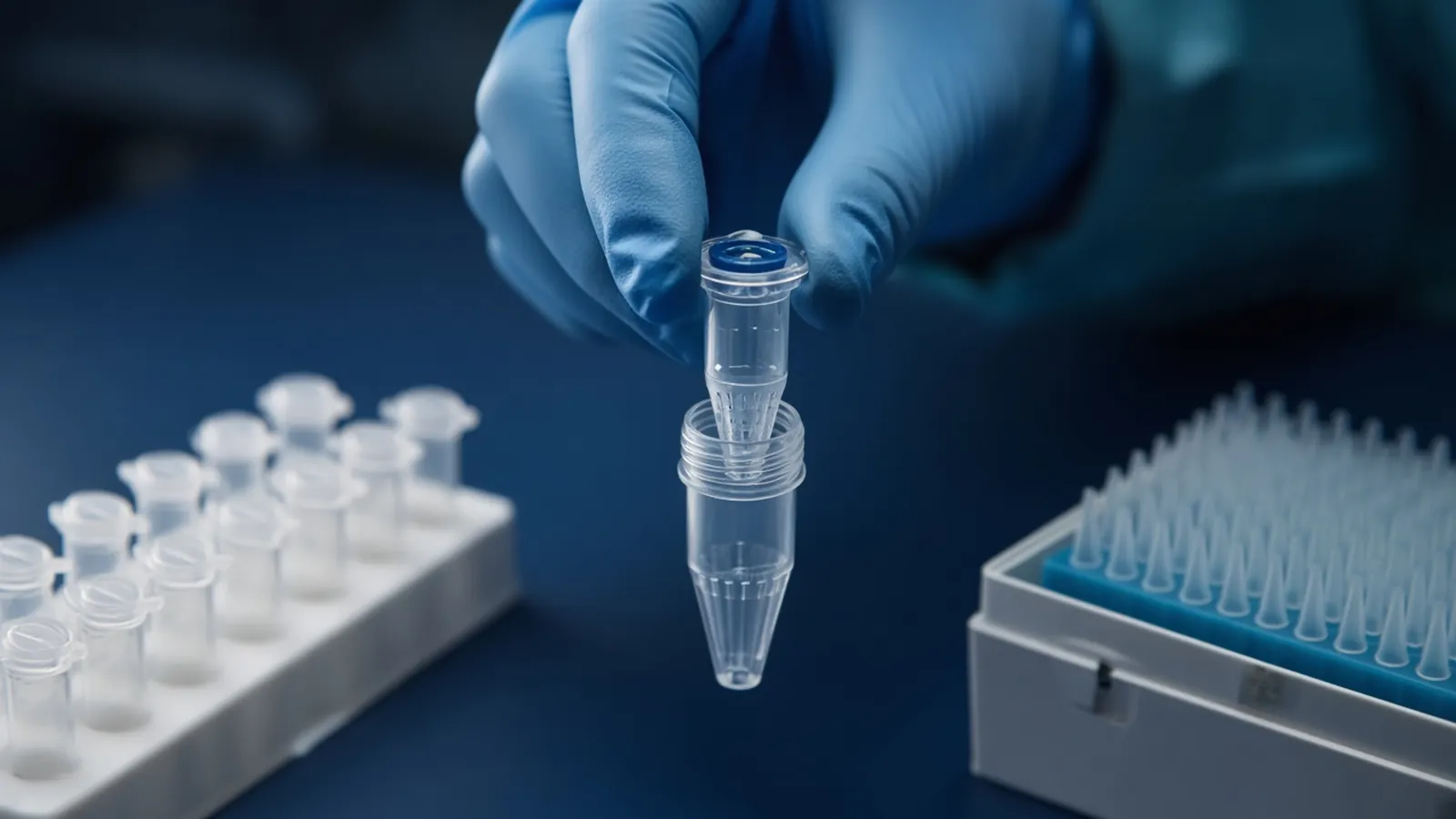
Column binding capacity is the amount of nucleic acid a given silica class can hold under the conditions its insert states. Overload is what you did when the lysate exceeded that hold. More lysate can then reduce recovery and purity. The extra material passes through, contaminants occupy the wash, and the eluate is a poor sample of a rich specimen. This troubleshooting note tells you how to recognise that pattern and when to split the load. It does not publish a microgram limit for every product. Capacity is a property of the column class in front of you.
Where columns sit among other extraction classes is in how DNA extraction methods differ.
What the matrix can hold
Silica binds nucleic acid in chaotropic salt. Binding sites and the physical space in the bed are finite. Within the window, more input gives more yield, with some loss that every method has. Past the window, the relationship bends. Additional DNA or RNA leaves in the flow-through. Protein, polysaccharide, and leftover lysate components compete, so the fraction that does stick is accompanied by more of what the wash was meant to remove.
A bead of the same chemistry has an analogous limit, scaled by bead mass rather than by a frit. This page stays with spin columns. The reasoning transfers only if you treat bead mass as the class property the insert names.
Read the input window as a class statement: this plasmid mini column, this blood column, this plant column, this RNA column. Units differ on purpose. Cells, milligrams of tissue, and micrograms of already-pure DNA are not interchangeable ceilings. An RNA column's window is still that class's window, not a DNA column's window with a new label. If the insert gives a range for cultured cells, do not translate it into a tissue mass by guesswork.
Symptoms that fit overload
Use more than one symptom. A single odd ratio has many causes.
Slow flow, or a column that will not clear in the spin the insert names, means something is blocking the bed. Overload is on the list. So is debris.
Dirty ratios after a heavy load fit overload. A260/A280 drifting away from the familiar DNA or RNA hint, and A260/A230 falling, suggest protein or chaotrope left behind because the wash was asked to do too much. Ratios remain hints, not integrity.
Downstream inhibition fits when contaminants came through with the nucleic acid. A polymerase or a ligation that dies on the concentrated eluate and recovers when you dilute it is compatible with overload leftovers. It is also compatible with ethanol. The heavy input is what points back at capacity.
A pellet that will not clear is the symptom people misfile as column magic. The lysate still holds debris. Forcing it onto the frit clogs the column and looks like overload. Clear it, within the tube and rotor limits you are allowed, before you blame binding sites.
The most specific pattern is a yield that falls, or stalls, when input rises on a split of the same lysate. One column receives the full load and returns less DNA than a sister column that received half. That paradox is capacity. A simple low number, with no comparison, is not yet that paradox.
| Symptom | Fits overload when | Look elsewhere when |
|---|---|---|
| Slow or stalled flow | Lysate was clear and input was high | A pellet or a viscous clump was loaded |
| Dirty A260 ratios | Heavy input, wash done as written | A wash was skipped, even at low input |
| Enzyme inhibition | Dilution rescues, input was high | Ethanol smell or a skipped dry spin |
| Yield down as input rises | A half-load column beats the full load | Input was never recorded |
| Pellet will not clear | You were about to load it anyway | The spin never reached speed |
Split the load
Divide a clear lysate across two columns of the same class, each within the insert's window, and elute them separately or pool them only after you see both worked. Do not stack two full loads onto one bed and call it a split. Do not switch column classes in the middle of the comparison and then interpret the difference as capacity alone.
If the insert allows a second pass of flow-through on a fresh column, that is a stated recovery of what failed to bind. Follow that page. If it does not, a homemade second pass is a new method. Record it as such, or discard the flow-through under the waste rules and repeat from less input.
Reduce input on the next specimen rather than hoping a longer spin creates new binding sites. A longer spin can help a slow but legitimate load finish. It does not raise capacity.
A reasoning path
Record input before you troubleshoot. Without it, overload is a story.
Ask whether the lysate cleared. If a pellet remains, you have a clarification problem. Spin again within limits, or load less volume of the supernatant only. Do not resuspend the pellet into the column.
Ask whether yield fell as input rose, using a split you planned. If the half load wins, stay at or below that input for this specimen class. If both are poor, look at lysis. Unopened tissue never reaches the silica, and no capacity discussion will create DNA that sample lysis did not release.
Ask whether ratios are dirty and the assay is inhibited. A cleanup of the eluate can remove leftovers from a load that was only mildly over. It cannot restore nucleic acid that left in the flow-through. If you need the lost mass, split a fresh prep. If you need a cleaner small mass, cleanup is the shorter path.
RNA integrity, if you measured it, separates a cut sample from a merely overloaded one. Do not expect a second column to repair RNase damage that happened before the bind.
Safety
Overloaded lysates are still the chemical and biological hazard of the specimen plus the chaotrope. A clogged column that you force with an unapproved rotor speed is a mechanical hazard. Stay inside the tube and centrifuge limits. Waste, including flow-through, follows institutional rules. The WHO laboratory biosafety manual is background for the biosafety decision. It does not set a binding capacity and it does not make the prep diagnostic.
A centrifuge that never reached speed
A power dip can stop a spin while the display still looks plausible afterwards. An uncleared pellet and a wet column then mimic overload. Check that the run finished at the speed and time the insert names before you split every sample you have left. In a building where cuts are common, do not start a load you cannot finish, and do not pool a half-spun column with a completed one.
What to put in an enquiry
Name the specimen, the input you need to process, and the column class you think is too small. Ask about a larger class or a protocol that expects a split, and say what the downstream assay needs for mass and cleanliness. Use the sample preparation catalogue and the sample preparation pathway, and send the numbers you do have with the quote request. The nucleic acid isolation enquiry reference is an enquiry reference. Ask whether a quotation is possible. Do not expect a universal capacity figure in the reply. Expect a class matched to the input window.
Questions from the bench
Why did a bigger input give me less DNA?
Once the silica is past its capacity, extra nucleic acid goes through instead of stacking higher. Contaminants compete for the same matrix, washes struggle, and what elutes can be both less and dirtier. Split the lysate across two columns of that class and compare. A rise in recovery after the split supports overload.
Can I look up one microgram limit for every mini column?
No. Capacity is a property of the column class you opened, stated for a matrix and an input window in that insert. A plasmid column, a blood column, and a genomic column are different classes even when the plastic looks similar. Use the window on the insert in your hand. Do not copy a number from a different product and call it universal.
Is a slow column always overloaded?
A slow flow means the matrix or the frit is obstructed. Overload of nucleic acid can do that. So can a pellet you never cleared, viscous lysate, or a centrifuge that never reached speed. Clear debris first. If the lysate is particle-free and still crawls, then split the load.
Will overload ruin an RNA integrity score by itself?
Overload mainly costs recovery and cleanliness. A poor A260/A280 or A260/A230 fits that story. RNA integrity falls when the RNA was cut by RNase or by delay before lysis, which is a different mechanism. A dirty ratio with a still-decent integrity trace is compatible with overload. A collapsed trace needs its own look at preservation.
References
Manufacturer names identify published method classes. Trademarks remain with their owners. Catalogue records on this site are independent references for enquiry. They are not a statement of inventory, distribution rights or a supply commitment. This page is educational. It is not medical advice, a diagnostic protocol or a biosafety approval.
Catalogue
Related products and categories
These links follow the subject of the article into published manufacturer references. A listing is a reference for an enquiry, not a statement of stock or distribution rights.
Continue in this cluster
Related reading
How DNA extraction methods differHow silica columns, beads, precipitation and organic extraction change DNA yield, length and inhibitors, and which class fits the assay you actually plan toA glossary of purification termsDefine chaotrope, bind-wash-elute, yield, purity ratios and RIN, then walk a purification so those words describe one real workflow.Blood saliva and tissue as starting materialExplain how EDTA blood, heparin blood, saliva and solid tissue behave as extraction inputs, and why a serum tube is not whole blood.