
application
Comparing agarose and polyacrylamide
Choose agarose or polyacrylamide from the molecule and the size, including tank geometry, resolution, and the monomer hazard.
- Author
- EVRINTH Editorial Team
- Published
- 8 October 2026
- Updated
- 8 October 2026
- Reading time
- 7 min
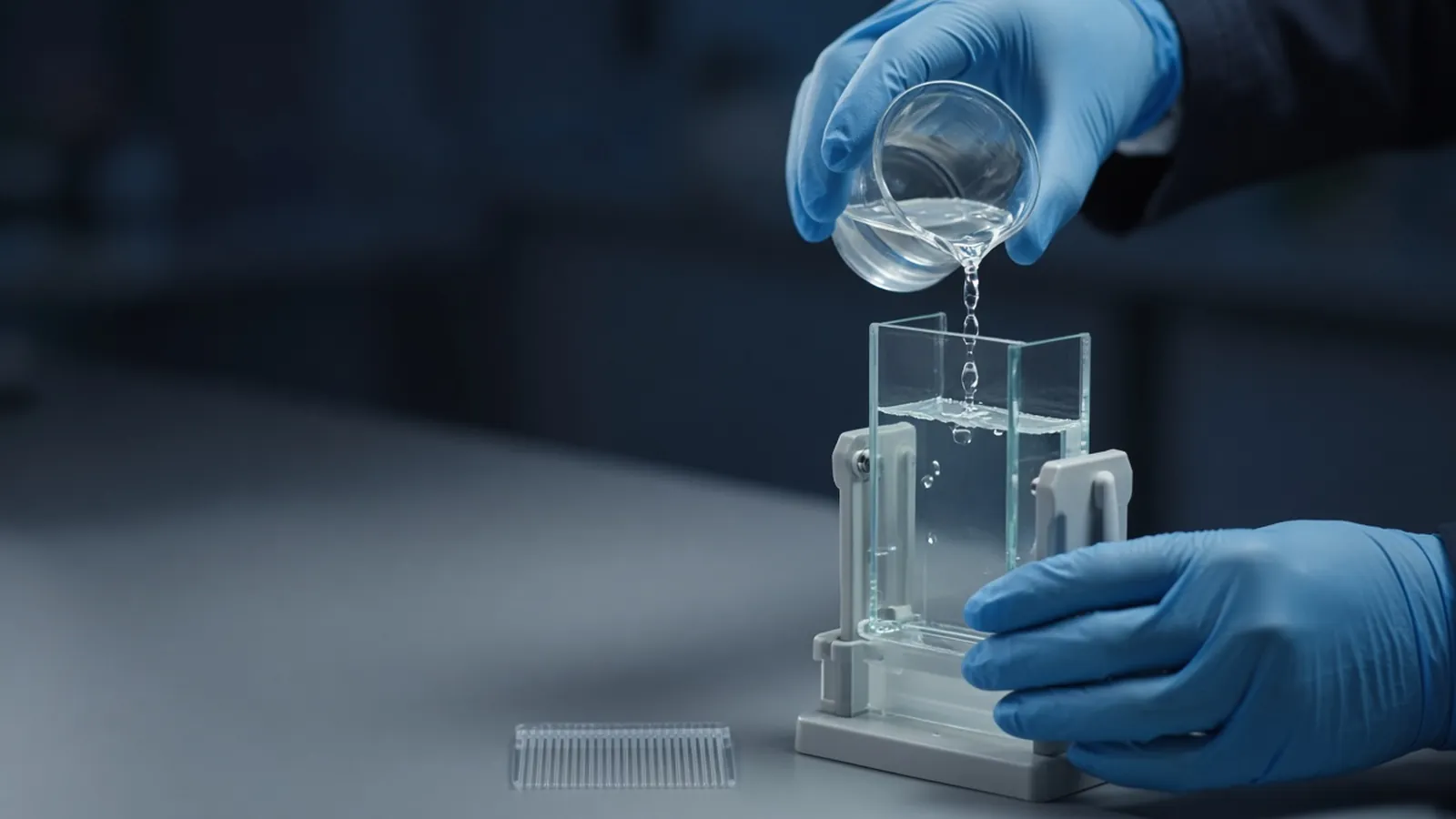
Agarose and polyacrylamide are both sieves in an electric field. They are not interchangeable. The choice follows the molecule and the size difference you must see, and it stops when the other matrix would answer the question with less hazard or a clearer band. The photograph is gloved hands pouring acrylamide solution between glass plates in a gel casting stand. That image is the polyacrylamide pour. It belongs under a chemical SOP. This page does not add the volumes, the initiator, or the catalyst. DNA gels poured from agarose are the other half of the comparison, read in agarose gel electrophoresis for DNA. Protein lanes poured this way are read in reading a protein gel.
What each matrix is
Agarose is a polysaccharide. You melt it in the running buffer, cool it enough to handle, and pour a horizontal slab. The mesh is relatively open. Fragments from a few hundred base pairs to many kilobases find a percentage, often in the window a DNA bench already uses, where they separate from their neighbours. Smaller differences pack into one glow. Very large chromosomal DNA needs a pulsed-field method, which is its own agarose class with switching fields. An ordinary tank will not become that method because you waited longer.
Polyacrylamide is a polymer of acrylamide crosslinked with a bis-acrylamide class reagent. The mesh can be much tighter, and the percentage plus the crosslinker ratio set the window. Proteins coated with SDS separate by apparent mass. Small DNA fragments and oligos separate by length when a few bases matter. A native protein gel, without SDS, reports shape and charge as well as size. A urea-containing polyacrylamide gel is a denaturing class for small nucleic acids. Those are named classes. The recipe that polymerises them stays in the SOP.
Geometry
Agarose is usually horizontal because the slab is thick, the wells are submerged, and the gel would slump if you stood it on edge without support. Polyacrylamide is usually vertical because the gel is a thin sheet held between glass plates, which is also what the photograph shows being filled. Vertical agarose exists for some large-DNA work. Horizontal polyacrylamide is uncommon on a research bench. Use the geometry your tank was built for. A power supply does not care about the name of the matrix, and it will happily overheat either one. The voltage still belongs to the electrode distance and to the tank's own note.
Resolution and the decision
Pick agarose when the analyte is DNA and the call is "about this many hundreds or thousands of bases", a restriction pattern, or a band you may cut out. The molecular weight ladder is a DNA ladder. The record is a photograph under a stain and, if the lamp is ultraviolet, an orange shield.
Pick polyacrylamide when the analyte is a protein and the call is apparent mass, or when the analyte is a small nucleic acid and agarose has already shown you one unresolved glow. The ladder is a protein marker or a low-range DNA marker that brackets the target. Estimating outside that ladder is not allowed by a finer matrix. Finer only helps inside the window.
Stop and switch if the fragment is multi-kilobase and you reached for polyacrylamide. Large DNA may never enter the tight mesh. Stop and switch if you need to separate fragments a few bases apart and you have only agarose. A longer run will not invent pores you did not cast. Stop if the question is sequence. Neither gel is a sequence. A capillary trace is a different record. Stop if the question is a western blot. That path starts with SDS-PAGE and continues as described in western blot from gel to membrane. Agarose is the DNA gel in that project, not the blot.
The buffers do not cross either. Tris-acetate or tris-borate belongs in the agarose tank. A tris-glycine or Bis-Tris system belongs with the protein plates. A DNA ladder in a protein tank, or a prestained protein marker on an agarose gel, gives you coloured marks and no scale. Write the matrix and the ladder class in the same line of the notebook. A project that needs both answers runs two gels. It does not load both molecules in one well and hope the stain will sort them. Nucleic-acid stains and protein stains are different baths, and a membrane transfer is a third step that only the protein gel was built to feed.
| Decision | Agarose | Polyacrylamide |
|---|---|---|
| Molecule | Larger DNA | Proteins, small DNA, oligos |
| Usual tank | Horizontal | Vertical, between plates |
| Resolution | Coarser, kilobase-scale work | Higher, within the percentage window |
| Casting hazard | Hot liquid | Monomer neurotoxicity until polymerised |
| Typical ladder | DNA fragments | Protein masses or a small-DNA ladder |
| Poor fit | A few bases of difference, a protein blot | Multi-kilobase DNA, a lab not set up for monomer |
The hazard is not symmetrical
Agarose casting is less toxic in a specific sense. You are not starting from a neurotoxic monomer. You are handling a hot liquid that burns, and later a stain and possibly an ultraviolet lamp. Polyacrylamide casting starts with monomer. Unpolymerised acrylamide can injure the nervous system. Residual monomer can remain in a fresh gel. Gloves in the photograph are necessary and not sufficient. The SOP decides who pours, what the waste is, and whether a precast gel replaces the pour. Polymerised scraps are chemical waste either way. This article does not authorise the pour.
If the laboratory is not set up to handle monomer, stay with agarose for every DNA question agarose can answer, and obtain precast protein gels when the question is a protein. Do not let a missing SOP become an improvised cast because the plates are already on the bench.
Failure modes that come from the wrong matrix
A protein sample on agarose gives a smear or a useless band and cannot feed a standard western. An 8 kilobase fragment on a high-percentage polyacrylamide gel sits in the well and looks like aggregation. A 50 base-pair difference on a 1 percent agarose gel is one band. Read the molecule, then the size, then the tank. A molecular weight ladder of the wrong kind, DNA marks beside a protein, will not rescue the choice.
Heat smiles both matrices. In a hot room a polyacrylamide gel can also polymerise unevenly if it is cast at all, which is another reason the SOP's temperature note matters. That is a casting fact, not a formula to adjust from this page. A power cut mid-run diffuses bands on either gel. Repeat when the distance is the evidence.
What to put in the enquiry
EVRINTH can take a sourcing question. State DNA or protein, the size you must resolve, whether you need a horizontal agarose tank or a vertical cassette, and whether the format must be precast because monomer is outside your SOP. The molecular biology catalogue is the list, and the quote request is where the specification goes. The nucleic acid analysis pathway is the context when the agarose gel is a step in a nucleic-acid workflow. Ask whether a quotation is possible. A request for "gel powder" without the molecule and the hazard form will come back as this same choice.
Questions from the bench
When is agarose the matrix to choose?
Choose agarose when the molecule is DNA in the ordinary PCR, plasmid, or digest range, from a few hundred bases up through many kilobases, and a horizontal gel will show the length beside a molecular weight ladder. Casting is a melt and a pour. The hazards are heat and, later, the stain and the lamp. Agarose will not resolve a few bases of difference, and it is the wrong start for a routine protein blot.
When is polyacrylamide the matrix to choose?
Choose polyacrylamide for proteins, where SDS-PAGE reports apparent mass, and for small DNA or oligonucleotides when a tighter size difference matters. The gel is usually vertical, cast between plates. Resolution is higher because the mesh can be made much tighter. The monomer is a neurotoxic hazard until it polymerises, so who may cast is an institutional SOP. A precast cassette is the format when that SOP says you do not handle monomer.
The photograph shows a pour. Is that an agarose gel?
No. The photograph is gloved hands pouring acrylamide solution between glass plates in a gel casting stand. That is the polyacrylamide casting step, and it is the hazardous moment this comparison refuses to turn into a recipe. An agarose gel is poured as a molten polysaccharide into an open tray. The two pours should not share a waste beaker or a casual name.
Can I start a western blot from an agarose gel?
A routine western blot starts from an SDS polyacrylamide gel, then a transfer membrane. Agarose does not sieve proteins the way that gel does, and the transfer conditions you know are written for polyacrylamide. Run the protein gel, with a ladder that brackets the mass, and follow the blot path from there. Use agarose for the DNA question in the same project, as its own gel.
References
Manufacturer names identify published method classes. Trademarks remain with their owners. Catalogue records on this site are independent references for enquiry. They are not a statement of inventory, distribution rights or a supply commitment. This page is educational. It is not medical advice, a diagnostic protocol or a biosafety approval.
Catalogue
Related products and categories
These links follow the subject of the article into published manufacturer references. A listing is a reference for an enquiry, not a statement of stock or distribution rights.
Continue in this cluster
Related reading
 Agarose gel electrophoresis for DNAHow agarose percentage, buffer and a size ladder turn a DNA sample into a band, and what that band does and does not prove about identity.A glossary of electrophoresis termsDefine anode, cathode, sieving, mobility, stacking, resolving, electroendosmosis, Rf, and leading dye for an honest gel reading.
 Blocking buffers and background signalChoose milk or BSA and a wash that fits the antibody, then decide whether speckles are sample signal or block, secondary, or a dried membrane.