
application
Comparing storage temperatures for nucleic acids
DNA often tolerates minus 20 better than RNA. Compare fridge, minus 20, and minus 80 against the kit and the sample SOP.
- Author
- EVRINTH Editorial Team
- Published
- 8 October 2026
- Updated
- 8 October 2026
- Reading time
- 8 min
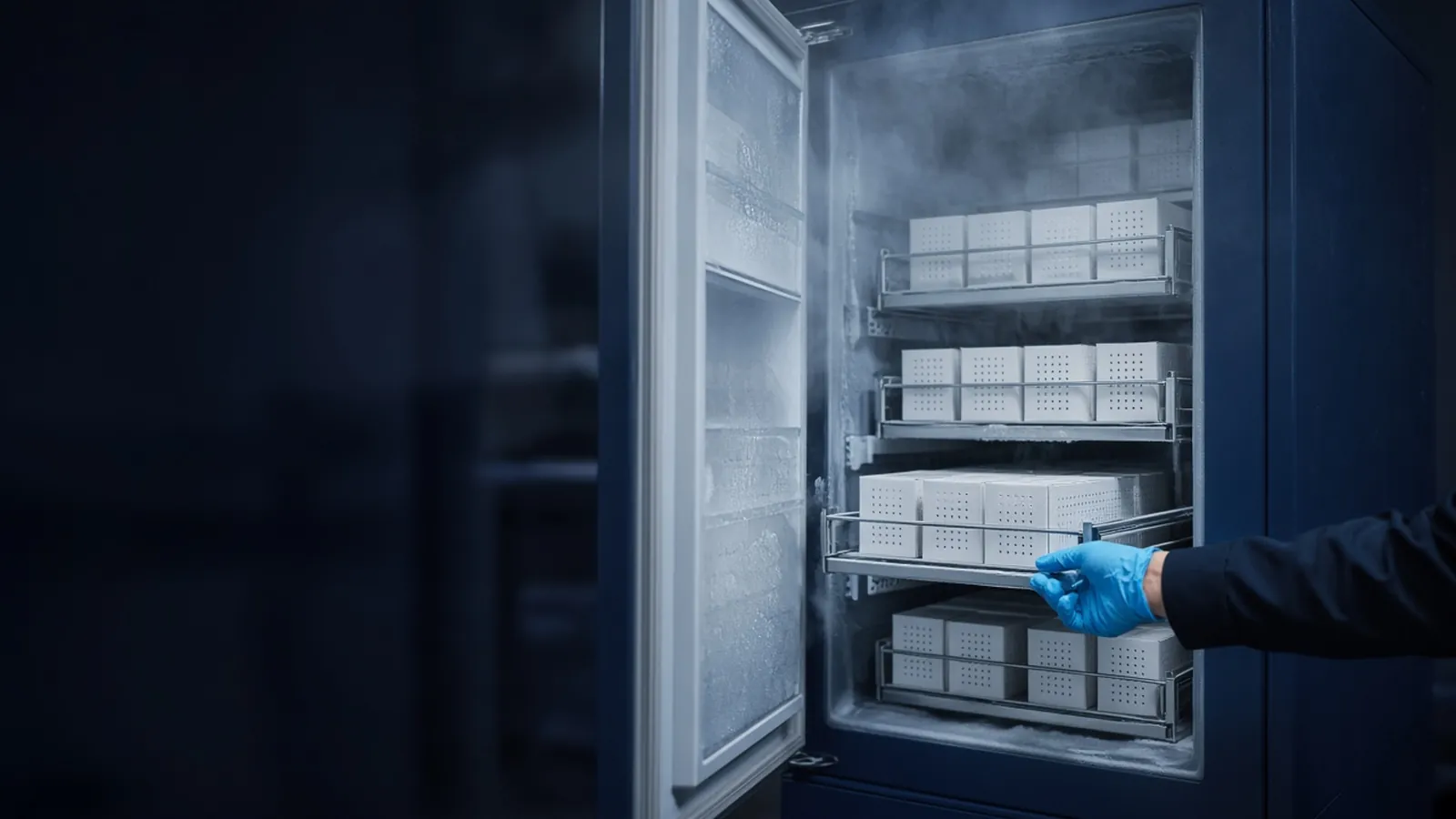
You finish one extraction afternoon with two eluates that share a sample identifier: a DNA tube and an RNA tube. They will not share a shelf merely because they share a name. DNA is generally more tolerant of minus 20 than RNA. RNA is often stored at minus 80 and protected from RNase. The comparison below is that pair of habits, applied to this extraction, not a universal law for every nucleic acid in every buffer. Extraction choices sit in how DNA extraction methods differ and protecting RNA during extraction. The freezer classes around them are in storing biological samples from fridge to freezer.
Nuclease-controlled tubes are a plasticware choice in the laboratory plasticware catalogue. A cabinet at the class you actually need can be specified through laboratory procurement and a quotation request. Downstream reading of the nucleic acid belongs with nucleic acid analysis.
The task this comparison serves
The DNA will be genotyped next month. The RNA will become a library, or a reverse-transcription reaction, on Monday. You have to choose a temperature for the weekend without pretending one rule covers both tubes. You also have to choose whether the stock is aliquoted before Friday evening, because Monday's thaw is a handling step, not a storage temperature.
The decision is: which cabinet, which tube, which protection, for each eluate, matching the kit insert and the sample SOP. If those two disagree, you stop and resolve the disagreement. You do not average them.
What the temperatures slow, and what they do not
Lower temperature slows hydrolysis and most enzyme activity. It does not extract nucleic acid, and it does not remove RNase that you already mixed in. A dirty elution left at minus 80 is still a dirty elution. It thaws dirty.
Purified DNA in a buffer the kit names, often one that chelates metals that would help nucleases, is chemically patient compared with RNA. Many laboratories keep working DNA at minus 20 and archive DNA at minus 80. Some keep high-molecular-weight DNA at refrigerator temperature for a short period so that freeze-thaw does not shear long strands. Those are all real practices. Which one is yours is the sentence in the SOP, not the coldest cabinet with a gap.
RNA is less patient. The backbone is more prone to hydrolysis, and ribonucleases are widespread and stable. The common long-term class is minus 80, in tubes and water the kit calls nuclease-free, with gloves and a bench discipline that the extraction page already describes. Minus 20 appears in some short holds, and in some ethanol precipitates, because a specific method said so. It is a weaker default for RNA in aqueous buffer. Refrigerator storage of aqueous RNA overnight is a risk you take only when the SOP has already accepted it.
Fridge, minus 20, minus 80, and a dry-ice shipper are four different intervals. Dry ice is a transport condition near the sublimation temperature of solid carbon dioxide, not a shelf you assign for the month. A DNA tube and an RNA tube can share a dry-ice shipper for a journey and still split at the destination into different cabinets.
Liquid nitrogen is a fifth class. Use it when the method is about viable cells or another material the document places there. Do not dunk nucleic-acid microtubes into liquid nitrogen because the ultra-low freezer is full.
Apply the comparison to Friday's two tubes
Read the DNA kit's storage line and the sample SOP. If both say purified DNA at minus 20, label a minus 20 box and put the DNA there. If the SOP asks for an archive aliquot at minus 80 as well, make that aliquot now, while the tube is still the elution you just made, and give the archive its own identifier linked to the parent. Do not call both tubes by the parent name alone.
Read the RNA kit's storage line. If it says minus 80, the RNA does not go into the DNA box "until Monday" unless the kit explicitly allows that delay at minus 20. A weekend is long enough for a bad habit to become the method. Aliquot the RNA to the volume Monday's reaction will consume, plus the dead volume your pipette will not recover. The rest stays unopened. RNase protection is the kit chemistry, nuclease-free plastic, and the handling rules on the extraction page. The freezer does not replace them.
If the kit and the SOP name different temperatures, the branch is a conversation, not a compromise shelf. The kit describes the reagent as the maker characterised it. The SOP describes the sample as your laboratory validated it. The owner of the SOP chooses, and writes the choice on the box. A silent average is how the next person cannot tell which rule was followed.
Temperature classes side by side
| Class | Typical research use for nucleic acids | What people over-claim | What to follow |
|---|---|---|---|
| Refrigerator | Short hold of some high-molecular-weight DNA, if the SOP says so | That all DNA is stable there, or that RNA is | The kit and the SOP, including the maximum time they state |
| Minus 20 | Working stocks of many purified DNAs; only those RNAs a method explicitly parks there | That one cabinet can serve both eluates | Split by molecule. Watch frost-free cycles |
| Minus 80 | Archive DNA, and the usual home for aqueous RNA | That cold cancels RNase and dirty handling | Still use nuclease-free tubes and a short thaw |
| Dry ice in a shipper | Transit | That the shipper is storage | Unpack to the document temperature. See the packing page |
| Liquid nitrogen | Rarely the right class for purified nucleic acids | That colder is always safer | Tube rating and the actual method |
Monday's branch, if the RNA tube was left on the DNA shelf
You find the RNA tube in the minus 20 box on Monday morning. Do not hide it in the minus 80 and start the library as if the weekend matched the kit. Write the deviation: temperature class, duration, and that RNase protection during the original extraction was or was not witnessed. Then apply the SOP's rule for a temperature deviation. If the SOP says discard and re-extract, re-extract. If the SOP says a quality check on a sacrificial portion can clear short deviations, run that check and keep the rest unused until it is read.
A passed check on one portion does not rewrite the kit. It clears this tube to the extent the SOP allows. The next extraction still goes to the temperature the kit and the SOP agreed.
If the DNA tube was instead left in a frost-free kitchen freezer, treat the cycle as a series of thaws you did not count. High-molecular-weight DNA is the preparation most likely to have been harmed by that particular abuse. The genotyping SOP says whether a fragment-length check is required before the tube is trusted.
Failure modes that look like a storage success
The tube is cold, so the elution is called pure. Cold does not change a bad A260 ratio or a degraded profile. Those checks belong to the extraction and the assay, not to the cabinet.
The RNA aliquot is at minus 80 in a tube that was autoclaved in a room that also processes lysates, with no nuclease control. The temperature is right and the tube is the wrong class. Move future aliquots to the plastic the SOP names.
Both eluates are labelled with the same string, "sample 14". One will be analysed twice under two stories, or the RNA will be pipetted as DNA. Identifiers need a molecule tag before they go into different freezers.
The shipper of a collaborator's RNA arrives on dry ice that has vanished. That is a receiving question: quarantine, then the document. Do not file it straight into the minus 80 as if the empty shipper were a logger.
Safety and research limits
Nucleic acids from a pathogen, a clinical remnant, or a recombinant system are a biosafety classification before they are a freezer classification. The WHO laboratory biosafety manual describes that programme. Your institution decides the containment. This page does not approve diagnostic storage, and it does not declare a sample fit to report to a patient.
Kits may use solvents and chaotropes at the extraction step. Storage of the eluate does not retire those hazards for the waste you already generated. Follow the kit's waste rule.
Warm rooms and the enquiry
A warm laboratory makes a slow transfer from the extraction bench to the freezer more expensive, especially for RNA. Stage a cold block the SOP allows, and walk the tube to the cabinet the same afternoon. You do not need a climate statistic to justify that habit.
When you enquire for tubes or a cabinet, state the temperature class for DNA working stocks and the class for RNA separately. State that you need nuclease-controlled plastic, not a generic microtube. Put that in the quotation request. Ask for the cabinet's defrost behaviour if you are specifying a minus 20, because a frost-free cycle is a different machine. Do not ask a seller to promise that every nucleic acid will survive either shelf.
Questions from the bench
Can DNA and RNA from the same extraction share a minus 20 box?
They can share a freezer only if both product documents and the sample SOP allow that temperature. RNA is commonly stored at minus 80 because it is more vulnerable to hydrolysis and to RNase than purified DNA. Putting both on the DNA shelf for convenience is how an RNA tube inherits the wrong class. Give each nucleic acid the class its own instruction names.
Does minus 80 make RNase irrelevant?
Freezing slows reactions. It does not licence dirty tubes, bare hands, or a bench that also handles crude lysates. RNase is hard to wish away and can act whenever the tube is warm enough for the enzyme to work, including during a thaw. Protection is the kit's chemistry plus the handling SOP, not the freezer setpoint alone.
Should every nucleic acid go into liquid nitrogen?
No. Nitrogen is for material that must stay at cryogenic temperature, often viable cells, and it brings tube and asphyxiation hazards. Purified DNA and RNA are ordinarily stored in mechanical freezers. A tube that is safe at minus 80 may crack or take in liquid nitrogen if it is immersed. Follow the tube rating.
Is a frost-free household freezer acceptable for RNA aliquots?
It is a poor default. Frost-free cabinets warm-cycle to clear ice, so the tube can thaw and refreeze even when the door stays shut. Use a laboratory cabinet that holds a set temperature without that cycle, at the class the SOP names, and aliquot so the stock is not thawed for every run.
References
Manufacturer names identify published method classes. Trademarks remain with their owners. Catalogue records on this site are independent references for enquiry. They are not a statement of inventory, distribution rights or a supply commitment. This page is educational. It is not medical advice, a diagnostic protocol or a biosafety approval.
Catalogue
Related products and categories
These links follow the subject of the article into published manufacturer references. A listing is a reference for an enquiry, not a statement of stock or distribution rights.
Continue in this cluster
Related reading
Storing biological samples from fridge to freezerFridge, minus-20, minus-80 and nitrogen storage slow different kinds of damage. A warm box is a quarantine decision, not a hope. Protecting RNA during extractionHow to keep RNA intact from lysis to elution: RNase control, what A260 ratios do not prove, and the checks that show whether the preparation is still usable.
 How DNA extraction methods differHow silica columns, beads, precipitation and organic extraction change DNA yield, length and inhibitors, and which class fits the assay you actually plan to