
troubleshooting
Counting cells and viability dyes
Why a haemocytometer or an automated counter can mislead, and how trypan blue, clumps and debris bias a viability count you will seed from.
- Author
- EVRINTH Editorial Team
- Published
- 8 October 2026
- Updated
- 8 October 2026
- Reading time
- 8 min
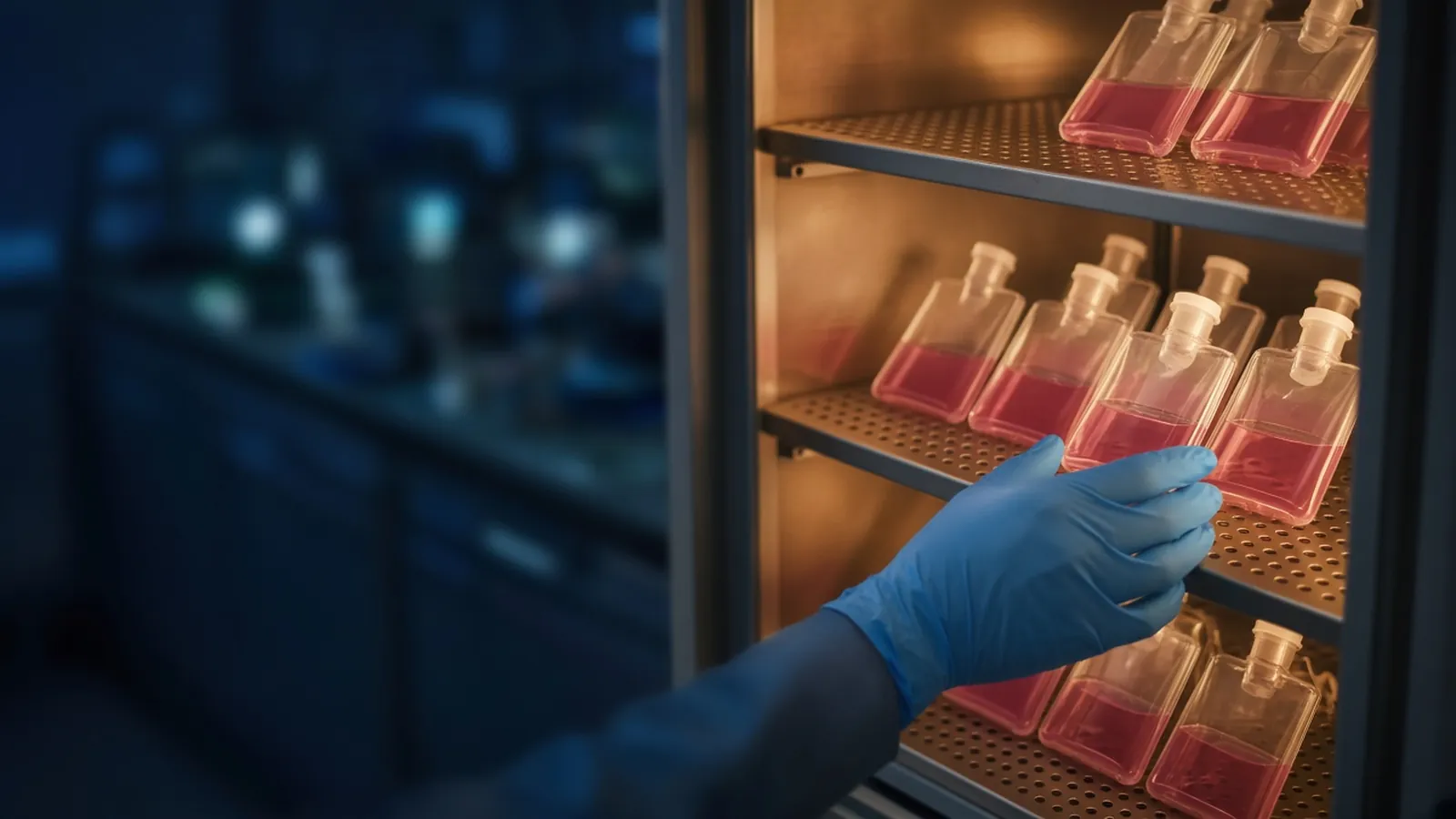
A cell count is a seeding decision wearing a number. If the number is high for the wrong reason, tomorrow's flask looks sparse and you will blame the medium. If it is low, the flask overgrows and you will blame the passage schedule. This page is a troubleshooting guide for haemocytometers, automated counters and membrane-exclusion dyes, especially trypan blue. The culture decisions around the count are in mammalian cell culture for research labs. The volume you actually deliver is in accurate micropipetting technique.
What the dye is allowed to claim
Trypan blue and similar dyes are membrane-impermeant. A cell with an intact membrane stays clear. A cell with a compromised membrane lets the dye in and looks blue. That is a physical statement about the membrane at that minute. It is not a specific marker of apoptosis, necrosis or any named pathway. Early dying cells often still exclude dye. A culture can be biologically doomed and still post a cheerful viability if you only score colour.
The dye is also toxic. A common research pattern is a 0.4 percent stock mixed one-to-one with the suspension, giving a dilution factor of two, scored within a few minutes. Leave the mixture and more cells turn blue because of the dye, not because of the flask. Follow the dye sheet for concentration and for how long the count remains meaningful. Write that window on the local method so two people do not score the same tube an hour apart.
Other exclusion dyes exist. They share the same logic and the same blind spot. Switching dye does not create an apoptosis assay.
Two instruments, two familiar lies
A glass haemocytometer, used as a Neubauer-style chamber, has a stated depth, classically 0.1 millimetre, so that one large square of one millimetre on a side represents a fixed volume. The usual conversion, when that depth is real, is cells per millilitre equals the average count per large square, times the dilution factor, times 10,000. Confirm the chamber you are holding before you trust the ten-thousand. A cracked coverslip, a wet rim, or a coverslip that is not seated changes the depth and scales every number. Count several squares. If the four corners disagree wildly, the suspension was not mixed, and no amount of averaging repairs a gradient.
An automated counter is a gate plus a sensor. It may use the same dye, an electrical aperture, or imaging. It will call a clump one event or many, depending on the gate. It will call debris a cell if the debris sits in the size window. It will under-count a small line if yesterday's gate was built for a large one. Bubbles and a half-mixed vial become confident printouts. The instrument is useful when the gate is written down for this line and checked against the microscope often enough that a drift is visible.
Neither instrument fixes clumps. A clump scored as one object under-counts the true cell number and then seeds as a colony. The right branch is to improve dissociation, not to negotiate with the clump. Debris scored as cells inflates the count and deflates the viability if the debris is blue, or inflates both if your rule is careless. Agree, in writing, what a cell looks like: size, a visible membrane, not a crystal of dye, not a shred of plastic.
Troubleshooting a count that will not match the flask
Mix the suspension immediately before you take the aliquot. Cells settle in the minute you spend labelling a tube. Take the aliquot from the middle of a freshly mixed volume, not from the last drop at the bottom. Dilute so that the squares are busy but not paved. A chamber so crowded that objects touch is not a precise count. A chamber with three cells in it will be dominated by chance. Resuspend and dilute again rather than counting harder.
Do the arithmetic on paper once, including the dye dilution. Forgetting the one-to-one mix is the classic twofold error. Seeding from the cell-per-square number without the 10,000 factor is the classic thousand-fold error, usually caught because it is absurd, and sometimes not caught when both the count and the seed are wrong in compensating ways. Accurate micropipetting technique matters at the dilution step and again at the seed. A method that is perfect on the chamber and sloppy in the pipette still misses tomorrow's confluence.
If the flask is much denser than the count predicted, you under-counted. Typical causes: debris excluded when it was actually cells, a dilution factor applied twice, clumps that later spread into many attached cells, or a pipette that delivered more than the dial. If the flask is much sparser, you over-counted. Typical causes: debris and dye crystals scored as cells, a clump scored optimistically as many cells without then breaking it up, a dilution factor forgotten, or a pipette that delivered less. Confluence is a coarse check, not a second count. Use it as a direction, then fix the rule.
If viability collapses only on the counter and the cells look fine in the flask, suspect dye contact time, a harsh mix, or a gate. If viability collapses in the flask as well, suspect the parent culture, the enzyme, or contamination, and return to the passage record rather than averaging three more chambers.
| Error | What you did | Which way the count moves |
|---|---|---|
| Clumps scored as one | Dissociation was incomplete | Total count too low, seed patchy |
| Debris or crystals scored as cells | No written object rule | Total count too high |
| Dye left on the bench | Scored after the dye became the toxin | Viability too low |
| Forgot the one-to-one dilution | Treated the mix as neat suspension | Count too high by about twofold |
| Applied the dilution twice | Corrected a factor that was already in the dilution | Count too low |
| Unseated coverslip | Chamber deeper or shallower than assumed | Scales the whole haemocytometer result |
| Gate from another line | Size window does not match | Automated count drifts high or low |
| Cells settled before sampling | Aliquot from a gradient | Random, and it will not repeat |
A worked branch for a sceptical count
Suppose the chamber says the suspension is dense and highly viable, and the next afternoon the flask is half empty with floaters. Do not repeat the count on the leftover tube that has been blue for an hour. Go back to a fresh resuspension of what was actually seeded, if any remains, and look for clumps you called single. Check the dilution arithmetic in the notebook, not in your head. Look at whether the pipette tip was pre-wetted or was dripping down the outside of the well. If the parent flask was overgrown, the count may have included cells that were never going to attach. The number was not fake. The interpretation was.
Suppose the automated counter and the chamber disagree by twofold every time on this line, and both are internally consistent. Believe neither until you know which object rule matches the microscope. Adjust the gate or the chamber rule until they describe the same objects, then lock that pair in the method. Chasing the higher number because it flatters the yield is how doses drift between operators.
Chemical hazard and research limits
Trypan blue is a toxic dye and is handled as a chemical hazard. Gloves, a defined waste path, and no mouth pipetting are the minimum local rules, not optional manners. Do not tip dye into the biological waste stream your institution has separated from chemical waste. The count is a research operation. It does not dose a patient, release a batch, or diagnose viability of a clinical specimen. Biosafety of the cells being counted remains the institutional assignment described in biosafety basics for research benches.
Humidity on the chamber and the bench
In a humid room a cold haemocytometer fogs, and a fogged coverslip is a depth error you cannot see as a depth error. Let the glass come to the bench, seat the coverslip, and load the chamber without trapping bubbles. Do not count through condensation. Dye stocks left open gather water and change concentration. Cap them. An automated counter parked in a steamy wash-up area will fog optics the same way. None of this requires a climate statistic. It requires a dry enough stage that the volume you assume is the volume you loaded.
What to specify if you are sourcing counting plastic or dye
State the line's approximate size range, whether you need a haemocytometer or an instrument-compatible consumable, the dye class, and the waste constraint. Ask for the concentration and the scoring window in writing. The laboratory consumables catalogue is the everyday class list. The academic research reference is a separate page for a wider university conversation. Use the quote request to ask whether a quotation is possible. A counting method can be discussed from your written object rule. A catalogue line is not a viability result and not a counting service.
Questions from the bench
Does trypan blue measure apoptosis?
No. It is a membrane-exclusion dye. Cells with a broken membrane take it up and look blue. Cells early in death can still exclude it, and healthy cells left too long in the dye start to take it up because the dye itself is harsh. Use a different assay when the question is a death pathway.
Why does tomorrow's flask disagree with today's count?
Usually the suspension that was counted was not the suspension that was seeded. Clumps counted as one, debris counted as cells, a forgotten dilution factor, or a pipette that delivered a different volume will all do it. Confluence the next day is a blunt audit of that arithmetic.
Can two counters be used interchangeably?
Only after you have compared them on this line. An automated gate set for a large cell will miscount a small one, and a haemocytometer rule that ignores doublets will not match a gate that includes them. Write the rule and keep it.
Is a viability percentage a clinical result?
No. A research count supports a research seed. It is not a diagnosis and not a dose for a person. The dye is a chemical hazard handled under your local chemical rules.
References
Manufacturer names identify published method classes. Trademarks remain with their owners. Catalogue records on this site are independent references for enquiry. They are not a statement of inventory, distribution rights or a supply commitment. This page is educational. It is not medical advice, a diagnostic protocol or a biosafety approval.
Catalogue
Related products and categories
These links follow the subject of the article into published manufacturer references. A listing is a reference for an enquiry, not a statement of stock or distribution rights.
Continue in this cluster
Related reading
Mammalian cell culture for research labsHow research labs keep mammalian cell culture workable: medium, aseptic technique, confluence, passage records and contamination checks. Accurate micropipetting techniqueHow an air-displacement micropipette delivers a volume, how forward pipetting uses the two stops, and why temperature belongs in the result.A glossary of culture termsPairs of culture words that laboratories mix up, and the wrong next action each pair causes, from confluence versus density through to confluent versus