
explainer
Cryovials and seal design
How internal thread, external thread and an O-ring relate to a manufacturer's limit of nitrogen vapour or liquid-phase storage.
- Author
- EVRINTH Editorial Team
- Published
- 8 October 2026
- Updated
- 8 October 2026
- Reading time
- 7 min
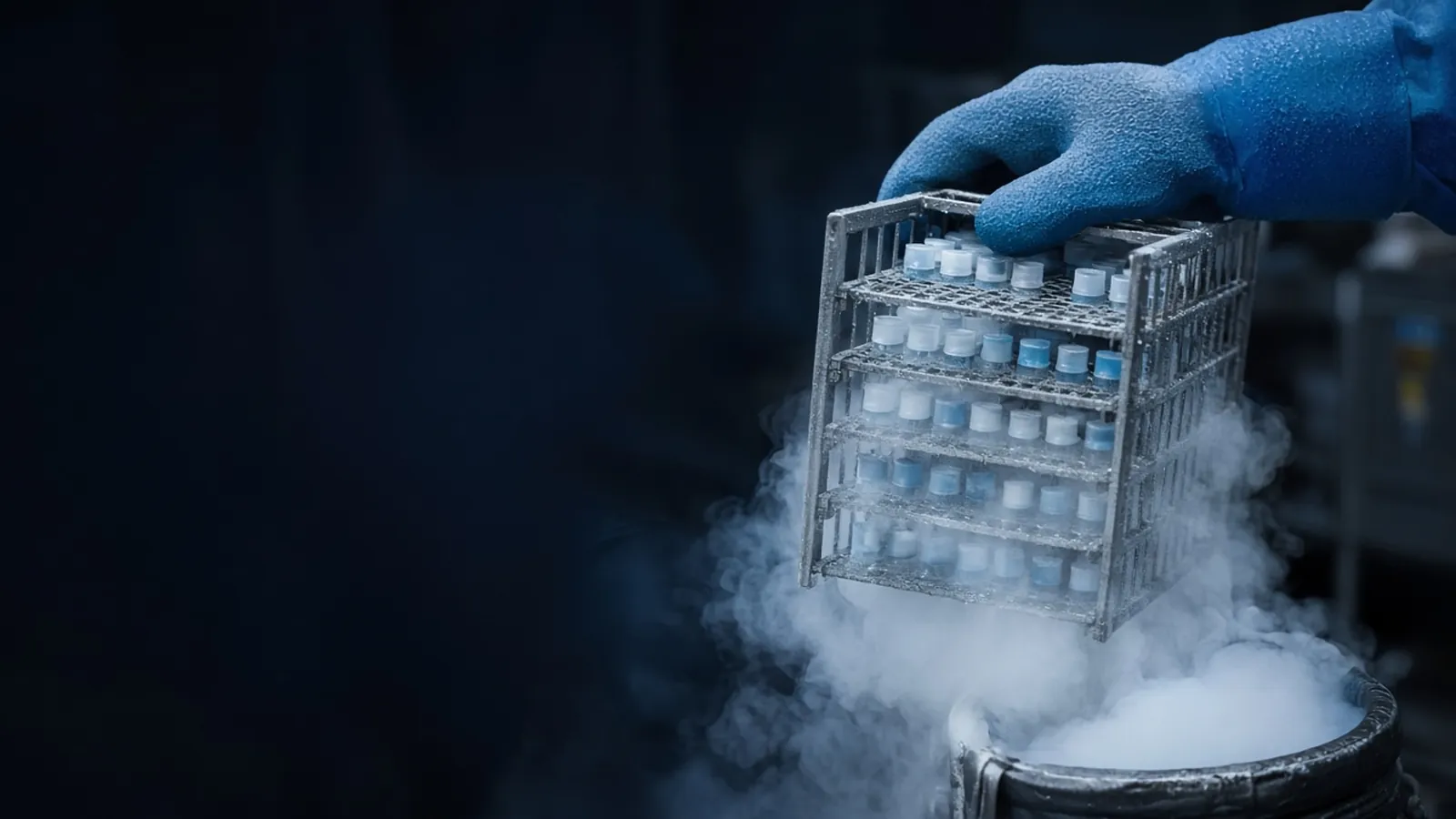
The dangerous moment is not always the dip into nitrogen. It is the warming, when liquid that entered a poorly sealed vial becomes gas. This explainer is about how cryovial seals are built and how that construction meets vapour-phase or liquid-phase storage. Temperature choices for the sample itself are the subject of storing biological samples from fridge to freezer. Glassware choices elsewhere on the bench are in choosing laboratory glassware. A cryovial is a plastic tool. It does not inherit a borosilicate bottle's autoclave habits.
What the seal has to resist
A cryovial has to keep the sample in and keep nitrogen, moisture and other people's aerosols out, across a temperature drop that stiffens the polymer and the elastomer. The cap thread is the mechanical lock. The O-ring, when the design uses one, is the compressible seal. Internal-thread vials hide the thread inside the neck and typically seat the O-ring as the cap descends. External-thread vials put the thread outside, sometimes with a different gasket geometry, and are often chosen because a gloved hand can start the cap without cross-threading quite so easily. Both can be excellent vapour-phase vials. Both can be the wrong vial in liquid nitrogen if the insert does not allow liquid-phase storage.
Liquid nitrogen in the liquid phase is very cold and it wets a leak. A path past a damaged O-ring, a hair on the seat, or a cap short of fully closed is enough for liquid to enter. The vial then holds a cryogenic liquid under a cap that was tightened against an aqueous sample, not against a boiling gas. Warming in a water bath, in a pocket, or on the bench lets that nitrogen expand. The failure is a burst. People nearby are at risk from fragments and from the biological material that was in the vial. The institutional rule exists because the physics is unforgiving.
Vapour phase is a location, not a mood
Vapour-phase storage means the vial lives in the cold gas above the liquid, in a dewar or freezer designed and filled so that the boxes do not sit in liquid. Overfilling a dewar, or a rack that is too tall for the current liquid level, converts a vapour rule into an accidental liquid soak. Underfilling changes the temperature the sample actually sees. Neither is solved by the thread style. The insert on the vial and the operating rule for that vessel have to be read together.
Some vials are explicitly rated for liquid-phase storage. Use those if your institution allows liquid phase at all, close them as the insert shows, and still discard a vial that contains unexpected liquid when you lift it. Do not warm a suspect vial in your hand to "see what happens". Follow the local emergency practice for a nitrogen-filled vial, which is a safety procedure this article is not entitled to invent.
Freezer storage at −80 °C is a third case. The burst mechanism from liquid nitrogen does not apply. Leakage, frost, labels falling off, and freeze-thaw of a loose cap still do. A vial chosen for nitrogen is often acceptable in a mechanical freezer. A random microtube with a snap cap is a poor nitrogen vial even if it has survived a domestic freezer.
Glass, marks, and what not to freeze
Volumetric glass and borosilicate bottles are the wrong objects to plunge into nitrogen. Their job is measurement and ordinary heating, not cryogenic sealing. A sample that must have a declared concentration is made in volumetric glass first, at the flask's reference temperature, with the metrology background described by NIST, and only then aliquoted into cryovials with headspace. The cryovial graduation, if it has one, is a fill guide. It is not a Class A mark.
| Design point | What it can show | What remains to read |
|---|---|---|
| Internal thread and O-ring | A defined seat for the cap | Whether liquid phase is allowed at all |
| External thread | Handling with gloves, a stated seal geometry | The same liquid-phase sentence on the insert |
| Vapour-phase rating | Storage in cold gas above liquid | That the dewar fill keeps the box out of liquid |
| Liquid-phase rating | Immersion is within the maker's claim | Your institution may still forbid it |
| Nominal capacity | The size of the tube | Headspace for expansion; do not fill to the brim |
Failures to reason about before you change brands
A cap that will not start has a damaged thread or the wrong cap. Forcing it cracks the neck. An O-ring that is flat, cut or missing is a retired cap, not a candidate for liquid phase. Condensation and frost on the thread, closed in a humid room, become ice in the seal. Dry the seat the way the insert allows, or close the vial before it has frosted. A vial that whistles, weeps, or contains more liquid than you added has already told you the seal failed. Quarantine it under your safety rule.
Labels that fall off at low temperature create a different loss, of identity rather than of containment. Use a marking method meant for the temperature. Do not rely on tape that stiffens and lets go. The sample can be perfectly sealed and scientifically useless if nobody can defend its name.
Safety is the institution's rule
Cryogenic liquid, oxygen displacement in a small room, and biological content are a combined hazard. The WHO laboratory biosafety manual and the CDC BMBL frame the biological side. They do not choose your dewar. Face and hand protection for nitrogen is whatever your safety office specifies. This page is research-use explanation. It is not a clinical biobank protocol and not permission to store an organism at a containment level you have not been assigned.
Do not fill a vial to the brim. Do not carry an unrated vial into liquid because the rack was already cold. Do not warm a swollen or rattling vial as a curiosity.
Nitrogen supply and warm anterooms
Dewars run out, and a warm anteroom wets every cold rack you pull. If the liquid level is not checked, a vapour-phase box becomes a liquid-phase box without a meeting. Write the check into the local routine. If a shipment of vials arrives warm, that is a logistics fact about the plastic, not a sample thaw. Sample thaw is a different emergency, handled under the storage rules for that material. Inspect new vials for cracked rims and missing O-rings before they enter the dewar set. A defective seal is cheapest to find at room temperature.
What to ask for
Internal or external thread, whether an O-ring is part of the seal, the manufacturer's statement on vapour phase versus liquid phase, nominal capacity and recommended fill, sterile or non-sterile as separate words, and the quantity. Put that specification on the quote request and browse formats in the laboratory plasticware catalogue. Do not describe a cryovial as laboratory glassware because it is cold.
Questions from the bench
What is the difference between an internal and an external thread?
On an internal-thread cryovial the cap screws down inside the neck, and the seal is often an O-ring on the cap. On an external-thread vial the thread is on the outside of the neck, which some people find easier to handle with gloved hands. Neither geometry, by itself, authorises immersion in liquid nitrogen. The manufacturer states vapour phase, liquid phase, or a prohibition. The institutional cryostorage rule can be stricter than that statement and should be followed when it is.
Why can a vial burst when it warms?
If liquid nitrogen enters a poorly sealed vial during liquid-phase storage, the nitrogen is trapped as a cold liquid. On warming it boils and the volume of gas is far larger than the vial. The cap or the wall then fails, sometimes violently, and the contents spray. The prevention is a seal the maker rates for the storage you use, a dry thread, an intact O-ring, and a rule that keeps unrated vials in the vapour.
Does an O-ring mean the vial is sealed for liquid nitrogen?
An O-ring is a sealing element, not a storage certificate. It has to be present, undamaged, and seated, and the cap has to be closed as the insert describes. Cold makes plastics and elastomers less forgiving, so a cap that felt tight on the bench can be wrong after a hurried close. Read the insert. If it limits the vial to vapour-phase storage, the O-ring does not overrule that sentence.
How full should a cryovial be?
Leave headspace. Aqueous samples expand as they freeze, and a vial filled to the brim stresses the seal and the wall even in a mechanical freezer. The insert gives the usable volume. Do not treat the nominal capacity as the fill volume. Headspace also makes an ingress of liquid nitrogen more obvious as extra cold liquid you did not pipette, which is a reason to discard that vial under your safety rule rather than to warm it in your hand.
References
Manufacturer names identify published method classes. Trademarks remain with their owners. Catalogue records on this site are independent references for enquiry. They are not a statement of inventory, distribution rights or a supply commitment. This page is educational. It is not medical advice, a diagnostic protocol or a biosafety approval.
Catalogue
Related products and categories
These links follow the subject of the article into published manufacturer references. A listing is a reference for an enquiry, not a statement of stock or distribution rights.
Continue in this cluster
Related reading
 Choosing laboratory glasswareHow to match borosilicate beakers, flasks and volumetric glass to the measurement you need, and when a printed line is only a guide.A glossary of labware termsDefinitions of the labware words that change a result: class marks, to contain and to deliver, joint size, resin, sterile and clean.Beakers are for handling not for accuracyWhy a beaker graduation is only a handling guide, and when a concentration other people will reuse belongs in a volumetric flask.