
protocol overview
Data loggers and what a temperature trace shows
A data logger draws a trace, not a verdict. Probe placement changes the meaning. Judge time out of range, not one pretty number.
- Author
- EVRINTH Editorial Team
- Published
- 8 October 2026
- Updated
- 8 October 2026
- Reading time
- 9 min
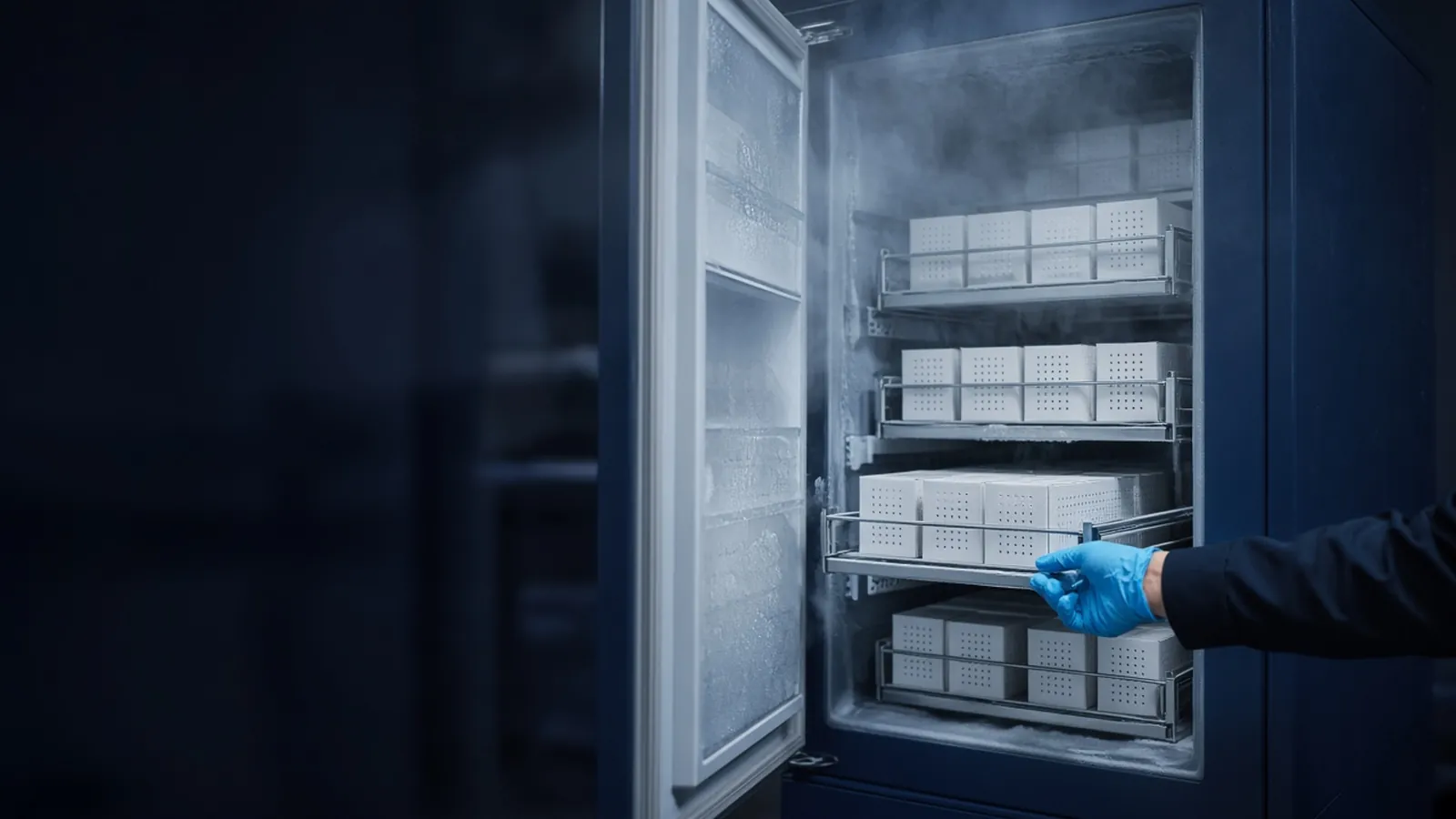
A data logger shows a trace: temperature against time, at the place the probe actually was. It does not show a verdict on the sample. The verdict is a comparison you make afterwards, between that trace and an acceptance window, and only once you know whether the probe was against a tube or in the air of the shipper. This protocol is how you place, start, and read the record. It is not a product ranking. Storage classes for the material itself are in storing biological samples from fridge to freezer. Dry-ice shipments that a logger often rides with are in dry ice packing for sample shipments.
Loggers are specified from scientific instruments. The shipper and the tubes they accompany are laboratory plasticware. Labels that state probe placement are laboratory consumables. The set is a laboratory procurement specification and a quotation request.
What the instrument is allowed to claim
A recording logger stores a series of readings from a sensor. The series has a start time, an interval, and an end. A display that only keeps the minimum and the maximum has thrown away the duration. A chemical spot that changes colour has thrown away almost everything except a threshold. Know which of those you bought before you ask it to clear a reagent.
The sensor reports its own temperature, not the temperature of a tube two centimetres away. Air, cardboard, a gel pack, a pellet of dry ice, and a filled cryovial do not move together. Dry ice sits near minus 78.5 °C while it is present, at atmospheric pressure. A probe resting in the pellets will proudly record that cold and say nothing honest about a tube strapped to the lid. A probe in the air will jump every time the shipper is opened, while the liquid in a tube lags. Both traces can be accurate and still be the wrong evidence.
Calibration is the other limit. A logger that has never been checked can be precise and wrong. NIST's laboratory metrology resources describe the measurement culture this sits in. Know whether the device has a current statement, and whether that statement covers dry ice as well as a freezer. Write the range in the enquiry.
Place the probe on purpose
Decide the question first. If the question is "did this tube leave the window?", put the sensor in thermal contact with a representative tube, or inside a dummy vial of similar fill in the same pack position. If the question is "how warm does the air get when the shipper is opened?", put the sensor in the air and say so. Do not place it one way and interpret it the other.
Fix the probe so it cannot migrate. Vibration in a vehicle moves a loose logger onto the dry ice. Tape that fails when cold is how a careful placement becomes an unknown one. Note the position on the shipment record in words: "probe taped to the secondary container, not in the pellets." Future you will not remember.
The same rule holds in a cabinet. A door probe reports the door. A probe in a bottle on the middle shelf is closer to the samples. One flattering spot at the back is not a map.
Start, interval, and the window
Arm the logger before the segment you will judge. If the interesting risk is the last mile, a trace that starts at the receiving desk is the wrong file. If the device has a start delay, write the delay down so the first quiet points are not mistaken for a controlled warehouse.
Choose an interval that can see the excursion you care about. A coarse interval can miss a short opening and still catch a morning on a hot dock. A very fine interval may fill memory and stop before the journey ends. Stopping early is a failed protocol.
The acceptance window comes from the product document or from an SOP that cites it. A refrigerated reagent may be judged on time outside about 2 to 8 °C. A frozen enzyme may be judged on time above the frozen condition the label names. This page will not supply those limits, and it will not let a logger's default alarm threshold stand in for them. Default thresholds are someone else's product, not your reagent.
How to read the file
Open the file before the tubes go into general use. Check that the clock covers the journey. Mark every interval outside the window and add the duration. One excursion of a few minutes and one excursion of an afternoon are not the same event, even if both crossed the same line. The afternoon is the one that threatens sample integrity.
Look at the shape. A trace that sits on the dry-ice temperature and then climbs in a smooth ramp is a coolant that ran out. A trace that spikes and recovers may be a door or a probe that saw air. You can tell those apart only if you know placement. If the probe was in air, a spike may overstate the tube. If the probe was in pellets, a long cold plateau may hide a warm tube. When placement and shape disagree with the story the courier told, believe the placement you wrote down and quarantine while you think.
Do not edit the file to make it tidy. The raw record is the evidence. A screenshot of the pretty region is not. File the placement sentence next to the file. A trace without that sentence is a number in search of a meaning.
| What you have | What it can support | What it cannot support |
|---|---|---|
| Probe on a representative tube, full time base, known window | Time out of range for that position | A claim about every tube if the pack-out is uneven |
| Probe in the air of the shipper | Air excursions, door openings | A direct claim that the liquid matched the air |
| Probe in dry-ice pellets | That the pellets were there and cold | The temperature of a tube packed elsewhere |
| Min and max only | That a threshold was hit | How long the goods stayed out |
| Colour-change indicator | A threshold, if you trust that indicator | A duration or a gentle drift |
| Unreadable file or dead battery | That the logger failed | Any clearance of the shipment |
The branch when the record is incomplete
The file will not open, the battery died at an unknown time, or nobody wrote where the probe was. Quarantine the material. Inspect the coolant. Absence of dry ice, or a fully melted gel pack, is supporting evidence that the clock ran out. Presence of coolant does not clear the tubes, because you still lack duration. Decide using the product document's excursion rule if it has one. If it does not, the owner and the SOP decide in daylight. They do not average a remembered number.
If two probes disagree, report both, with placements. The sample follows the probe that was placed to represent it. The air probe explains the handling. Picking the colder file because it is convenient is how a trace becomes an argument. A cabinet logger is the same rule at rest: read time outside a limit the laboratory set in advance, and do not invent that limit from the shape of the curve.
A worked disagreement
A frozen oligonucleotide arrives with two loggers. One was taped to the tube bag. One was dropped among the dry-ice pellets by a packer in a hurry. The pellet logger shows a flat line near the dry-ice temperature and then a rise in the last part of the file. The tube logger shows a warmer trace that crosses the SOP's frozen limit for a long stretch of the vehicle segment and then cools again when fresh pellets were added at a depot. Someone proposes to archive only the colder file.
The protocol forbids the edit. The tube placement is the sample question. Time out of range on that file is the result you report. The pellet file explains that dry ice was present somewhere in the box, which is useful and insufficient. Quarantine the oligos if the window was missed. Order the next shipment with one placement, written on the lid, so a hurried packer has nowhere ambiguous to drop the device.
Public methods on protocols.io often stop at "store at" a temperature. The logger protocol is what makes that sentence checkable on the journey. It does not replace the sentence.
Safety and the record
Retrieving a logger from dry ice still needs insulated gloves and a ventilated room. Do not seal a shipper to protect the electronics. Biological samples keep their classification. A trace does not decontaminate anything. The WHO laboratory biosafety manual frames transport as risk management, and the IATA dangerous goods programme is the carrier context for dry ice. This protocol is not a shipping approval. A beep in an empty building, with no named person, is not a response plan.
What to specify
Ask for the sensor range, the interval, the memory or the stop behaviour, the file format, the battery life at the cold you will use, and a calibration statement. State the placement in the same request so clips or tape rated for that cold are included. Say that you will judge time out of range against a window you supply from the product document. Refuse a quotation that offers only a minimum and maximum if you need duration. On the first live shipment, compare a dummy tube probe with an air probe once, before a precious aliquot depends on the colder story.
Read a temperature trace against probe placement and time out of range
- 01Write where the probe is before the logger startsState whether the sensor is against a tube, inside a representative vial, or in the air of the shipper or cabinet. Those placements answer different questions. A trace without a placement sentence is incomplete.
- 02Start the record for the interval you mean to judgeArm the logger before the handoff you care about, and note any start delay the device applies. A file that begins after the van was loaded does not describe the van.
- 03On receipt, mark time outside the acceptance windowUse the window from the product document or the SOP. Sum how long the trace stayed outside it. Do not clear a shipment because the minimum or the average looks impressive.
- 04If placement or the file is missing, quarantineAn unreadable file, a dead battery, or an unknown probe position means you do not have a verdict. Hold the material and decide from the coolant condition and the document, not from a single number someone remembers.
Questions from the bench
Why can two probes in one shipper disagree?
They are often measuring different things. Air warms and cools faster than a filled tube. A probe taped to a gel pack reports the pack. A probe in the lid reports the air that rushed in when someone opened the box. Neither is false. Each is only meaningful if you know what it touched. Placement is part of the result.
Is the lowest temperature on the graph the result that matters?
No. A deep minimum can be the dry ice itself, sitting next to the probe, while the sample spent hours warmer. The useful reading is the time the sample's placement spent outside the acceptance window. A single pretty number hides that duration. If the window is not written down, the graph cannot clear the goods.
Can a chemical indicator replace a logger?
It answers a narrower question. A dye window or a melt indicator can show that some threshold was crossed, and it may not show for how long or how far. Use it when the SOP says that threshold is enough. Do not describe it as a trace. If you need duration, you need a recording logger and a placement.
What should a logger enquiry specify?
Ask for the temperature range, the recording interval, how the file is read, whether the clock and the sensor have a calibration statement, and how the device behaves when the battery dies. State the placement you will use. Send that as a quotation request alongside the shipper or the freezer, not as an afterthought.
References
Manufacturer names identify published method classes. Trademarks remain with their owners. Catalogue records on this site are independent references for enquiry. They are not a statement of inventory, distribution rights or a supply commitment. This page is educational. It is not medical advice, a diagnostic protocol or a biosafety approval.
Catalogue
Related products and categories
These links follow the subject of the article into published manufacturer references. A listing is a reference for an enquiry, not a statement of stock or distribution rights.
Continue in this cluster
Related reading
Storing biological samples from fridge to freezerFridge, minus-20, minus-80 and nitrogen storage slow different kinds of damage. A warm box is a quarantine decision, not a hope.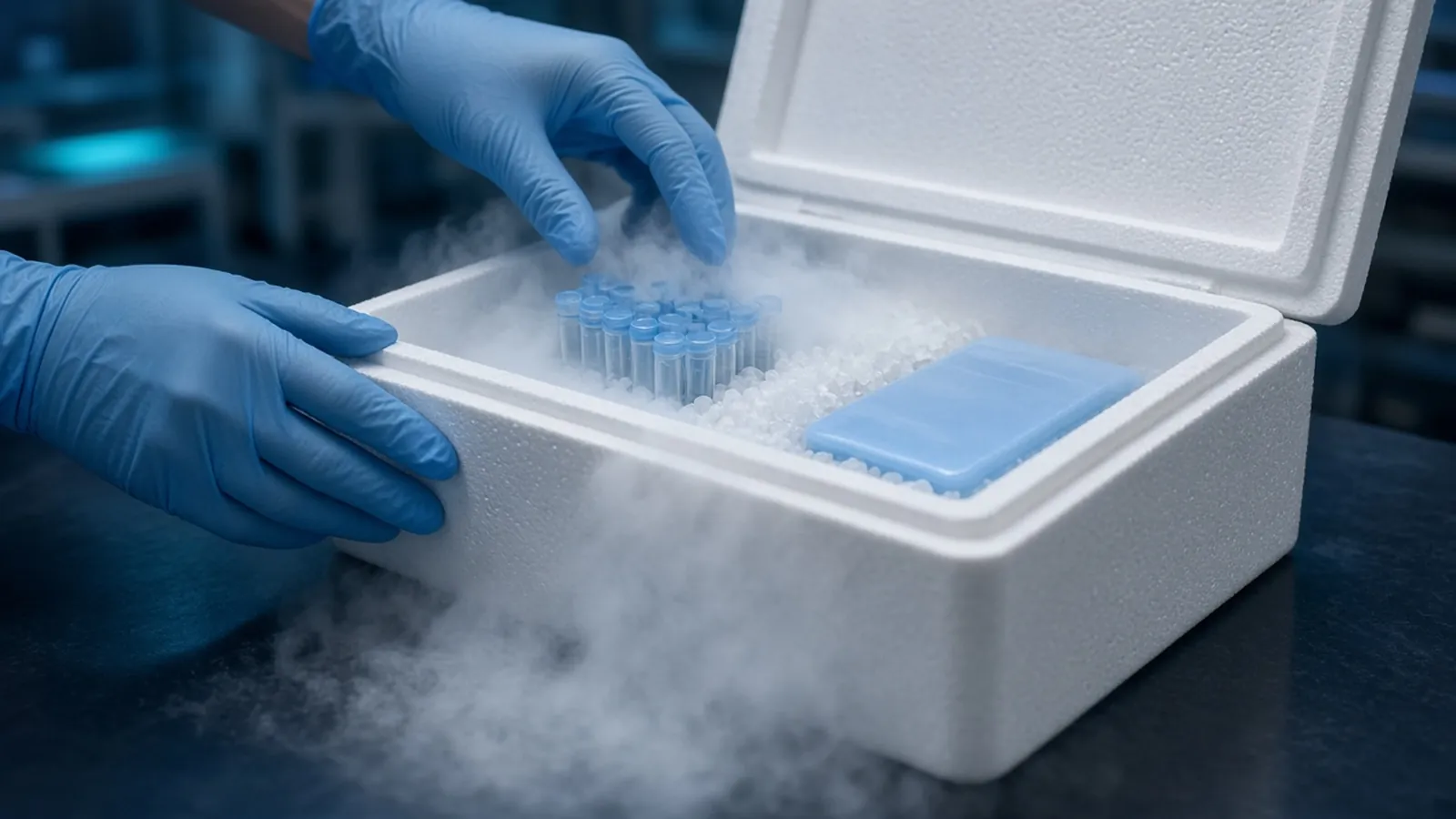 Dry ice packing for sample shipmentsDry ice keeps non-infectious research samples cold and can burn skin or displace air. Carrier rules and infectious-substance law still govern shipping.A glossary of cold-chain termsSetpoint is not air temperature, and a phase-change pack is not every coolant. Compare the cold-chain pairs labs treat as one word.