
glossary
Dishwasher residues and enzyme assays
How detergent film from a washer inhibits enzymes and cells, and which rinse and dedicated-glass terms belong in a method.
- Author
- EVRINTH Editorial Team
- Published
- 8 October 2026
- Updated
- 8 October 2026
- Reading time
- 7 min
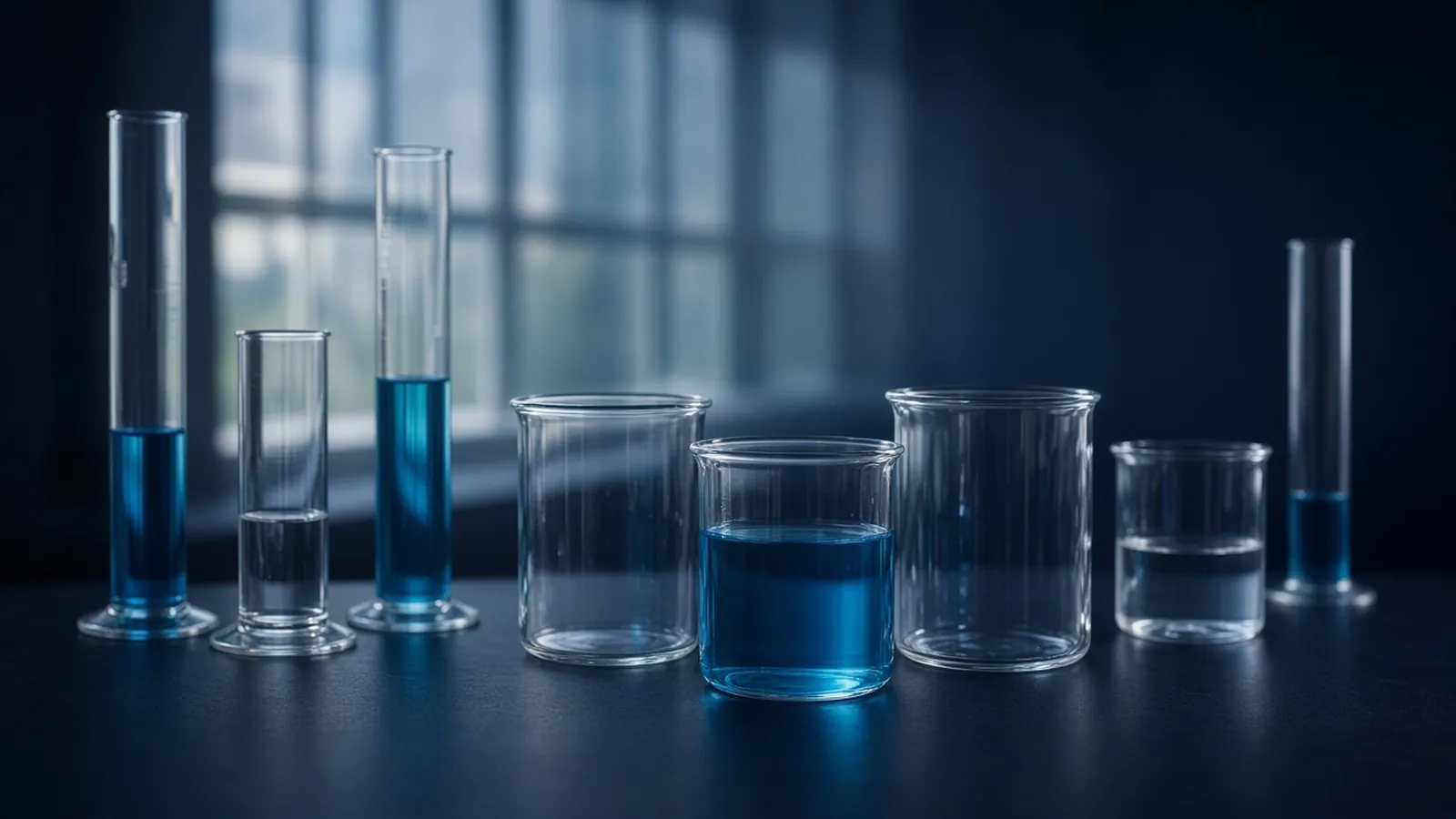
An enzyme assay that fails in every washed tube and succeeds in a fresh one is often a film, not a dead enzyme. This glossary names the washing words that belong in that investigation. Vessel choice around the sink is still choosing laboratory glassware. What a steam cycle cannot remove is also autoclaves and what sterilisation does not do.
Detergent film
A laboratory washer uses a detergent, often alkaline, to lift protein, grease and salts. The chemistry is chosen to cling long enough to work. A rinse that is too short, too cold, or poorly exchanged in a crowded rack leaves a film. On glass the film is sometimes visible as a water break: clean glass holds a continuous sheet of water, while an oily or detergent-laden surface beads or pulls back. The water-break view is a classical qualitative clue, not a number this article will assign. On plastic the same residue hides in moulded corners and in cap threads.
Film matters because it is concentrated exactly where the next small reaction sits. A restriction digest, a polymerase reaction or a cell-culture well has little volume and a lot of wall. The enzyme or the cell meets the residue before it meets the substrate you intended.
Enzyme inhibition
Enzyme inhibition here means loss of activity caused by something other than the experimental variable. Detergent residue is a standing member of that set. The symptom pattern is informative. Every reaction in washed glass fails, including a positive control. The same reagents in a new tube or a dedicated vessel work. A single failed sample among working controls points elsewhere, at the sample. If only the washed set fails, stop changing the enzyme lot and start changing the wash.
Inhibition is not the same as absence of enzyme. Adding more enzyme sometimes overcomes a mild film and teaches the laboratory the wrong lesson, that the recipe wants a double dose. A blank of buffer from the washed vessel, compared with buffer from a fresh vessel, is a cleaner branch. Recovery of activity in the fresh vessel localises the problem.
Cell-culture toxicity
Cells report residue as poor attachment, vacuoles, or death that tracks the washed bottle rather than the medium recipe. A medium made in a dedicated bottle and the same medium made in a general-wash bottle is the comparison. Glass for culture medium is typically borosilicate if it will be autoclaved, in the sense of ASTM E438. The glass type does not rinse itself. Caps and pour rings carry film too. A perfect bottle with a detergent-laden cap still doses the medium.
Rinse validation
Rinse validation is the institutional practice of showing that this washer, this detergent, this racking and this water leave a surface the method can tolerate. It may be a water-break look, a meter on the rinse water, or a functional enzyme or cell check on a schedule. The point of the term is that "we ran the rinse cycle" is a button, not a validation. If the washer has no separate acid-rinse or neutralising step and the method needs one, that is a specification gap for the institution, not a reason to invent a home recipe in a beaker. Follow the washer and detergent instructions your laboratory has already accepted.
Volumetric glass adds a metrology reason to care. Detergent film changes drainage and the meniscus. A flask can be the right class and the wrong surface. NIST calibration thinking assumes a clean, intact vessel used at its reference temperature. Harsh alkali over many cycles also etches glass, which is damage rather than film. Etch does not rinse off.
Dedicated glass
Dedicated nucleic-acid glass, or dedicated enzyme glass, is a common pattern because it shrinks the problem. Those vessels never enter the general protein wash, never hold a random organic, and are rinsed in a way the assay has survived before. Mark them so a helpful colleague does not return them to the common rack. Dedication fails when the mark is a rumour. Write it on the tray.
Single-use plastic is the other pattern. It removes washer film and introduces extractables, binding, and a waste decision. For a small enzyme reaction it is often the calmer surface. For a litre of medium it may be impractical, and then dedicated borosilicate plus a proven rinse is the pattern to specify.
| Term | What it names | What people wrongly hear |
|---|---|---|
| Detergent film | Residue that survives a poor rinse | Suds you would see in the well |
| Enzyme inhibition | Loss of activity from that residue or another contaminant | A bad lot of enzyme, automatically |
| Water break | A qualitative wetting clue on a cleaned surface | A calibrated assay |
| Rinse validation | An institutional check that the rinse worked | The existence of a rinse button |
| Dedicated glass | A set reserved for one sensitive method | A different chemical element |
| Sterile | No viable organisms after a valid process | Chemically clean |
How the words change the next step
If the positive control fails only in washer glass, the next step is a dedicated or new vessel, not a new enzyme shipment. If dedicated glass also fails, the residue hypothesis weakens and you look at water, buffer salts, and the enzyme itself. If volumetric results drift after a washer change, inspect rinse and etch before you send flasks for recalibration. Recalibrating a filmed flask measures the film.
Acid, bleach and enzyme-cleaner steps have their own residues. Use the sequence your laboratory has approved. Biological soil on the glass is a biosafety matter before it is a detergent matter. The WHO laboratory biosafety manual and the CDC BMBL are background. This glossary is not a decontamination procedure and not a clinical assay.
Water quality in the rinse
Hard water leaves scale that looks a little like etch and that shelters detergent. If the method's final rinse is purified water, a purified-water outage is a reason to pause the enzyme glass, not a reason to finish the load on tap water and hope. Humidity and a warm washer room bake a film on if the drying temperature is high. Dry dedicated volumetric ware gently.
What to specify
If you are buying glass for this problem, specify borosilicate vessels of the form the method uses, and state in the enquiry that they will be reserved for enzyme or nucleic-acid work and washed apart from the general load. Specify volumetric class separately if the piece must still declare a volume. Quantity is a count of that dedicated set. Use the laboratory glassware catalogue, volumetric glassware where a line matters, and the quote request. Single-use alternatives belong in the laboratory plasticware catalogue and should be named as such.
Questions from the bench
What is detergent film in this sense?
Detergent film is the thin residue of a washing agent left on glass or plastic after a cycle that did not rinse it away. Alkaline laboratory detergents are good at lifting soil and persistent on surfaces, in stopcock bores, and in tube corners. The film changes surface tension, so volumetric ware drains differently, and it is chemically active toward enzymes and cells. You often cannot see it. A beading pattern under clean water, or an assay that fails only in washed vessels, is the practical clue.
Why do enzymes and cell cultures notice a film that looks clean?
Many enzymes are inhibited or denatured by traces of detergent that would never register as suds. Polymerases, restriction enzymes and some proteases are frequent complainers. Cultured cells see the same residue as a toxic surface. The vessel can be sterile, because steam killed any organisms, and still be unfit. Sterility and the absence of residue are different words. An autoclave does not volatilise a non-volatile detergent.
What is rinse validation, without turning it into a slogan?
Rinse validation is whatever your institution does to show the washer's rinse actually removes the detergent it dispensed. That might include a water-break observation, a conductivity or pH check on the final rinse, or a functional check with the assay that matters. This glossary does not set a pass number. It says the check has to exist if washed ware touches sensitive enzymes or cells, and that a dedicated set of glass is a common way to make the check easier to trust.
Does dedicated nucleic-acid glass mean a special product?
It means a set of vessels that only see the nucleic-acid or enzyme method, washed by a rinse those methods tolerate, and not mixed with the general alkaline load or with glass that has held plasmids and amplicons indiscriminately. The glass itself may be ordinary borosilicate. The dedication is a handling rule. New single-use plastic is the alternative when washing cannot be kept honest, and that alternative brings its own extractable and binding questions.
References
Manufacturer names identify published method classes. Trademarks remain with their owners. Catalogue records on this site are independent references for enquiry. They are not a statement of inventory, distribution rights or a supply commitment. This page is educational. It is not medical advice, a diagnostic protocol or a biosafety approval.
Catalogue
Related products and categories
These links follow the subject of the article into published manufacturer references. A listing is a reference for an enquiry, not a statement of stock or distribution rights.
Continue in this cluster
Related reading
Choosing laboratory glasswareHow to match borosilicate beakers, flasks and volumetric glass to the measurement you need, and when a printed line is only a guide.A glossary of labware termsDefinitions of the labware words that change a result: class marks, to contain and to deliver, joint size, resin, sterile and clean.Beakers are for handling not for accuracyWhy a beaker graduation is only a handling guide, and when a concentration other people will reuse belongs in a volumetric flask.