
comparison
DNA cleanup before a sensitive assay
Compare PCR cleanup, gel extraction, alcohol precipitation and bead cleanup by which leftovers each removes and which losses each accepts.
- Author
- EVRINTH Editorial Team
- Published
- 8 October 2026
- Updated
- 8 October 2026
- Reading time
- 10 min
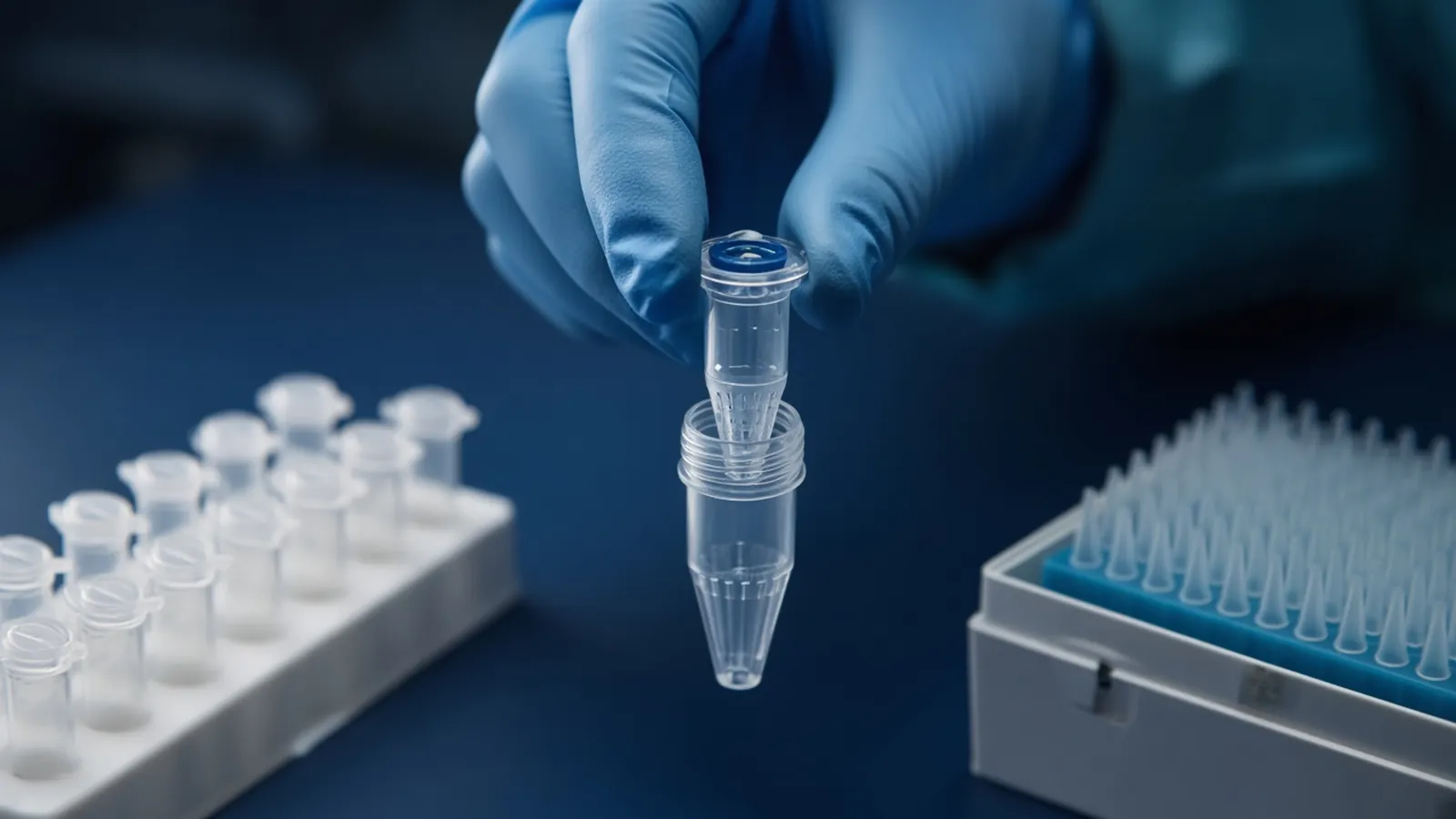
A sensitive assay fails on leftovers that a sturdy PCR might ignore. Ligase, a Gibson-style assembly, Sanger sequencing and a long-read library each have a short list of molecules they will not tolerate: unused primers, dNTPs, salt, agarose, ethanol, phenol, or a nick you introduced while staring at a gel. Cleanup is the choice of which of those you will remove, and which loss you will accept in return. The loss is usually yield. Sometimes it is ultraviolet damage. Sometimes it is the short fragment you actually wanted.
This comparison starts after you already have DNA. How that DNA was extracted is a different decision, set out in how DNA extraction methods differ. The gel you may cut is described in agarose gel electrophoresis for DNA. What follows is which cleanup matches which contaminant.
Four classes, and the physical idea behind each
PCR cleanup, in the silica-column sense, binds DNA in chaotropic salt and washes away small molecules. Primers, dNTPs, many salts and a good share of the polymerase flow through or leave in the wash, as long as they are below the kit's size habit. The product comes off in a small volume of low-salt buffer. Anything the same length as your product stays. A wrong band of 400 bases will be purified just as proudly as the right band of 400 bases. Very short products can fall below the cutoff and disappear, which is a feature when they were primer-dimer and a disaster when they were the assay.
Gel extraction adds a size separation before a similar bind. You run agarose, cut the band you want, dissolve the matrix, and bind the DNA. Other sizes stay in other slices. Agarose itself is the new contaminant: if dissolution or washing is incomplete, carry-over inhibits ligation and sequencing. Yield is the other bill. A large fraction of the DNA never returns. Ultraviolet light used to see the band nicks DNA and is hard on eyes and skin. A blue-light transilluminator is the lower-damage viewing class when the stain allows it. Limit the time the slice spends on any UV box, and use the shield the instrument has. Do not look into a bare UV source to "get the band".
Alcohol precipitation uses salt plus ethanol or isopropanol to crowd nucleic acid into a pellet. A subsequent ethanol wash is what actually reduces salt. The method concentrates dilute DNA and can leave short oligonucleotides behind more often than a long product, though the cutoff is softer than a column's. It does not remove a same-sized wrong product. It does not remove agarose you forgot to digest. Isopropanol pellets DNA from a smaller volume and co-precipitates salt and polysaccharide more readily, so it is a poor default for a plant extract that is already carbohydrate-heavy. Residual alcohol is a quiet inhibitor. An invisible pellet is easy to pour out with the supernatant. Over-drying the pellet makes resuspension slow, and a harsh vortex on high-molecular-weight DNA shears the molecule you precipitated in order to keep.
Bead cleanup, in the crowding-agent class, mixes DNA with carboxyl magnetic beads, a crowding polymer and salt. The crowding sets a size threshold: more of it captures shorter fragments. Washes remove primers, dNTPs, salts and many enzymes. Elution in water or Tris releases the DNA that bound. You never view the DNA on a UV box, so you skip that particular damage. You can run the method in a plate. You cannot pick one of two close, long bands the way a gel can. Beads that escape into the eluate inhibit some assays and confuse absorbance. Polyethylene glycol left behind is its own inhibitor. The threshold you chose is a scientific decision: write it down, because a "cleanup" that was actually a strict size selection will look like a lost sample when the DNA was shorter than you thought.
A260/A280 after any of these can sit near 1.8 and still hide nicks, ethanol, agarose or beads. Use the ratio as a protein hint. Use the assay, or a small pilot of the assay, as the proof.
What each method removes, and what it spends
Match the contaminant you actually have.
If the tube is a finished PCR with one band of the expected size, remove primers and dNTPs with a PCR cleanup column or with beads. You spend some yield. You do not spend a UV exposure. If a second band is present and would confuse the clone or the read, spend the yield and accept a careful gel slice, or redesign the PCR so the second band is not made. Redesign is often cheaper than rescuing a bad gel.
If the DNA is dilute and salty, precipitation or beads can concentrate it. Precipitation needs a visible handling discipline so the pellet is not lost. Beads need a magnet that matches the tube. If the DNA is genomic and very long, precipitation with gentle mixing often preserves length better than forcing the liquid through a silica frit. Beads can do the same when the mixing is slow and wide-bore.
If the contaminant is agarose, only a gel-extraction chemistry aimed at dissolved agarose is the right tool. A PCR cleanup column used on a chunk of gel does nothing useful. If the contaminant is a primer-dimer and the product is long, beads at a modest cutoff or a PCR cleanup both work. If the product itself is very short, check the cutoff before you bind, or you will clean the tube by throwing away the result.
RNA integrity is not improved by any cell in this table. These buffers and these gels are DNA workflows. A tube that still needs intact RNA should not take a detour through ethidium and ultraviolet light.
| Cleanup class | What it tends to remove | What you tend to lose | When it is the right spend |
|---|---|---|---|
| PCR cleanup column | Primers, dNTPs, many salts, much of the enzyme | Yield, products below the cutoff, no size selection | One band, and a ligase or sequencer is next |
| Gel extraction | Other sizes, and agarose if the dissolve works | More yield, plus UV nicks if you cut on a UV box | A wrong band would be worse than a smaller recovery |
| Ethanol or isopropanol precipitation | Some salt after a real wash, some soluble small molecules | Pellet, short fragments, time; residual alcohol if wet | Dilute or very long DNA, and you can see or trust the pellet |
| Crowding-agent beads | Primers, dNTPs, salts, fragments below the cutoff | The short fraction, some yield, plus bead or PEG carry-over | Plates, size selection, or avoiding a UV box |
Branches when the sensitive step is still silent
If a ligation fails after PCR cleanup, check residual ethanol and the elution buffer before you blame the insert. Tris-EDTA chelates the magnesium some ligases want. Water or a Tris buffer without EDTA is often the elution class for an immediate enzyme step, with a separate stored aliquot in EDTA if you must keep DNA for weeks. Follow the enzyme card. A second cleanup of an already clean product mostly spends yield.
If a ligation fails after gel extraction, assume ultraviolet damage and agarose until a control insert that never saw the box ligates. Cut faster, on a blue-light box if the stain permits, and dissolve the slice completely. A band that sat under UV while you found a scalpel has already paid.
If precipitation "gave no DNA", the pellet may be on the wall or in the waste beaker. Mark the tube before you spin so you know where to look. A glassy polysaccharide pellet from a dirty extract can look like DNA and dissolve into an inhibitor. A260/A280 will not always expose it. A 260/230 depression hints at salt or carbohydrate. The sensitive assay is the final judge.
If beads gave a tiny eluate and the supernatant still contains your product, the cutoff was too strict or the beads never mixed. Save supernatants until a pilot says the DNA bound. If the eluate is speckled, the magnet step is unfinished.
A no-template control that becomes positive after cleanup means the cleanup reagents or the open tube brought in DNA. That is contamination, not a successful purification. Retire the open buffers.
Safety and the limit of the claim
Ethanol and isopropanol are flammable. Chaotropic salts used with silica are harmful. Ethidium bromide and the alternative stains still need the safety data for the bottle in hand. Ultraviolet light damages eyes, skin and DNA. Use the orange shield if the box has one, prefer a blue-light class when you can, and do not disable interlocks. Agarose melts hot. None of these hazards becomes minor because the assay is "only a cleanup".
This comparison is research education. A cleaned amplicon is not a diagnostic result and not a forensic exhibit. Institutional biosafety rules decide whether the DNA's parent specimen may be handled on that bench. The WHO laboratory biosafety manual is background for that decision, not a permit.
Humid air and a shared UV box
Alcohol pellets and column membranes both stay wet longer when the room is humid. A pellet that looks dry can still put ethanol into a 10-microlitre ligation and stop it. Give the drying the time the protocol states, out of direct sun and out of a dust draft, then dissolve. Do not bake the tube until the DNA is a film that will not go back into solution.
A shared UV transilluminator with a cracked shield or a missing shield is a reason to postpone the slice, not a reason to lean in. The nick you put in the DNA and the exposure to your eyes are the same decision. If the laboratory has a blue-light box, use it for excision and keep UV for the photograph the method actually requires, with the shield down and the exposure short.
What to put in the enquiry
Name the assay that must work next: ligation, assembly, Sanger, a library, or a PCR that has already been failing. Name the contaminant you suspect: primers, a second band, salt, agarose, or a dilute volume. Say whether the DNA must stay long, because that pushes you away from vigorous frits and vortexes. Say whether ultraviolet excision is acceptable in your room.
Those facts select among the four classes better than a catalogue adjective does. Look through the sample preparation catalogue and the sample preparation pathway. Send the requirement with the quote request. The nucleic acid isolation enquiry reference is a way to frame the question. It is an enquiry reference. It does not mean a cleanup is run for you. Ask whether a quotation is possible. The acceptance check is the sensitive assay on a known control substrate, not a ratio alone.
Questions from the bench
I have one bright PCR band. Do I still need a gel extraction?
Usually you need a PCR cleanup or a bead cleanup, not a gel slice. Those methods remove primers, dNTPs and salts, which is what a ligation or a Sanger reaction complains about. A gel extraction also removes other sizes, and you pay in yield and in ultraviolet damage if you excise on a UV box. Use the gel when a second band would be cloned or sequenced by mistake.
Why did my cleanup ratio look perfect and the ligation still fail?
A260/A280 near 1.8 hints that protein is not the main absorber. It does not show nicks from ultraviolet light, residual ethanol, leftover agarose, or bead carry-over. Sensitive assays fail on those while the spectrum stays flattering. Elute in the buffer the ligase accepts, dry the wash properly, and keep UV exposure short if a gel was involved.
Ethanol precipitation or isopropanol precipitation?
Both crowd DNA out of a salty solution. Isopropanol does it in a smaller volume and tends to drag more salt and polysaccharide with the pellet. Ethanol is the usual wash afterwards because it leaves less salt behind if the wash is real. Short fragments precipitate less willingly than long ones. Residual alcohol inhibits polymerases and ligases either way, so the pellet has to be free of liquid before you dissolve it.
Will a DNA cleanup protect RNA integrity in the same tube?
No. These methods are aimed at DNA reactions such as ligation, cloning and sequencing. RNA integrity is a separate handling problem, and a DNA cleanup buffer can be full of RNase or divalent metal. If the tube must stay an RNA tube, use an RNA method. Do not pass RNA through a DNA gel extraction and expect the trace to survive.
References
Manufacturer names identify published method classes. Trademarks remain with their owners. Catalogue records on this site are independent references for enquiry. They are not a statement of inventory, distribution rights or a supply commitment. This page is educational. It is not medical advice, a diagnostic protocol or a biosafety approval.
Catalogue
Related products and categories
These links follow the subject of the article into published manufacturer references. A listing is a reference for an enquiry, not a statement of stock or distribution rights.
Continue in this cluster
Related reading
How DNA extraction methods differHow silica columns, beads, precipitation and organic extraction change DNA yield, length and inhibitors, and which class fits the assay you actually plan toA glossary of purification termsDefine chaotrope, bind-wash-elute, yield, purity ratios and RIN, then walk a purification so those words describe one real workflow.Blood saliva and tissue as starting materialExplain how EDTA blood, heparin blood, saliva and solid tissue behave as extraction inputs, and why a serum tube is not whole blood.