
glossary
Documenting a buffer recipe with the salt form
Define every term a buffer record needs: salt form, hydrate, formula weight, pH, temperature, water grade, order of addition, and how the solution was
- Author
- EVRINTH Editorial Team
- Published
- 8 October 2026
- Updated
- 8 October 2026
- Reading time
- 9 min
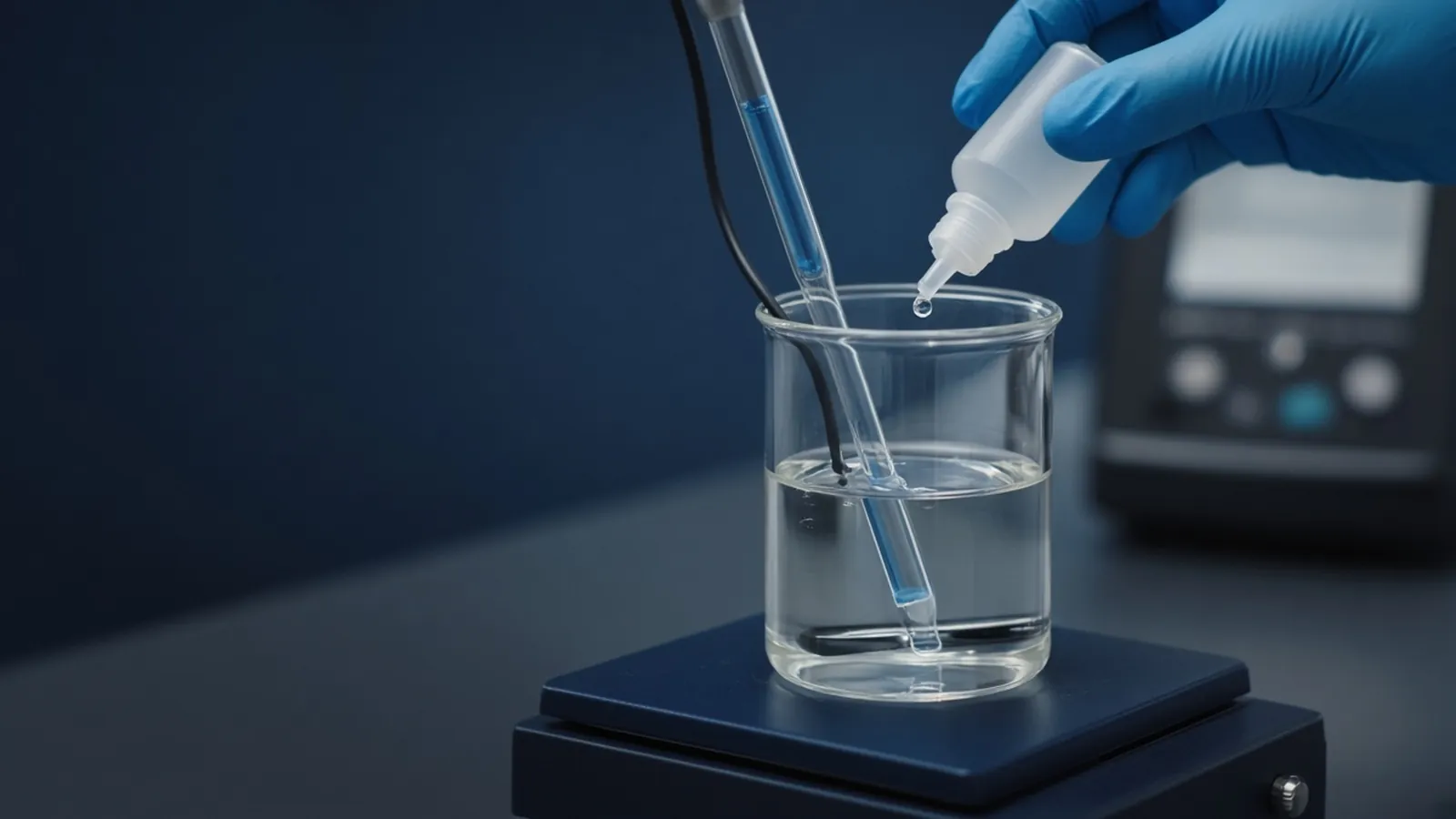
A line that says only "phosphate, 100 millimolar, pH 7.4" cannot be repeated. The missing words are the salt form, the hydrate, the formula weight you actually divided by, the temperature of that pH, the water, the order you added things, and whether steam or a membrane made the bottle ready. This glossary defines those words at the depth a batch record needs. The decision is whether next month's buffer is the same object.
The meter half of that record is demonstrated in preparing a buffer and checking pH. The water half is laboratory water types and where they fail. Solids are chosen from the reagents and chemicals catalogue. The volumetric vessel is in beakers and flasks. A purchase that names the hydrate can be checked against the record; that naming is what a quotation request is for.
Salt form
The salt form is which ion accompanies the molecule you meant. Tris base and Tris hydrochloride are both Tris, and they are not the same starting point. Adjusting Tris base with hydrochloric acid fills the buffer with chloride. Adjusting it with some other acid fills it with a different anion. Starting from the hydrochloride and adding sodium hydroxide imports sodium. A nucleic-acid method or an ion-exchange buffer can care which of those you did even when the pH matches.
Sodium phosphate monobasic and dibasic are the two sides of a phosphate pair. A recipe that says "sodium phosphate" has not chosen a side, and a recipe that says "PBS" has not said whether potassium, calcium, or magnesium is in the family. The confusion is to treat the common name as the composition. Write the salt the way the catalogue writes it, including the cation. If you adjusted pH with an acid or a base, name that too, because the adjustment is part of the salt form by the time you finish.
Hydrate
A hydrate is the water built into the crystal. Anhydrous means you intended none. A heptahydrate brings seven waters with every formula unit, and those waters are mass you weigh that is not salt. The confusion is to copy last year's gram amount onto this year's bottle after someone reordered the other hydrate. The molarity moves, the ionic strength moves, and the pH you then adjust hides the mistake because pH is not a concentration.
On the record, the hydrate is a word, not a guess from how the powder looked. Powders cake in humid air. Caking is not proof of a hydrate, and a free-flowing powder is not proof of an anhydrous salt. Read the label at the time you weigh, and write it before the bottle goes back into the cupboard.
Formula weight actually used
The formula weight is the grams per mole you used to turn a molarity into a mass. It includes the hydrate. It is the number on the container or the certificate for that container, not a round number from memory and not the anhydrous value copied from a table when you are holding the hydrate. Two reputable sources can print slightly different formula weights for the same hydrate because of how they round. The one you used is the one that makes the arithmetic reconstructable. Write it next to the mass.
The confusion is to "correct" a colleague's mass using a formula weight they did not use. You will make their buffer worse while feeling precise. If the recorded formula weight and the bottle in the cupboard disagree, the buffer is not yet documented. Find out which was weighed.
pH
pH on a record is the value you measured after calibration, not only the value you aimed at. Both belong. "Target 7.40, measured 7.36" is a record. "pH 7.4" might be either, and next month nobody knows. The measurement is meaningless if the electrode slope was outside the laboratory window. A failed slope means you do not write a pH. You fix the meter, as the buffer preparation page says, and you do not titrate the solution to flatter a dead electrode.
Also record the direction of adjustment if you overshot and came back. Each reversal adds the counter-ion of the acid and the base. A buffer that took five swings is not the buffer the masses describe.
Temperature of that pH
The temperature is the temperature of the solution when you accepted the reading, measured rather than assumed. Tris moves by a few hundredths of a pH unit per degree. A target written as 7.4 at 25 degrees is a different chemical state from 7.4 at 37 degrees. The confusion is to calibrate with temperature compensation and believe compensation has cancelled the buffer's own chemistry. Compensation helps the electrode. It does not rewrite the pKa. Good and colleagues built buffers partly so workers would have pKa values in useful places. Those pKa values are still temperature-dependent. Write the degree next to the pH every time.
If the assay runs at a different temperature from the bench, the record should say which one is the recipe's intention. Either policy can be defended. An unwritten policy cannot.
Water grade
Water grade is the specification you actually dispensed: the polisher and the reading you require, or the bottled grade and the certificate line you care about. "Deionised" is a weak sentence if the assay cares about organic carbon or endotoxin, because those are not the ionic measurement. The water pillar is the vocabulary. On the buffer record, name the grade in that vocabulary and say whether the water was fresh or stored. Stored polished water is a different ingredient.
The confusion is to write the grade the system can produce on its best day, rather than the water this batch received. If you filled the flask from a carboy, write the carboy. A later failure will look at that line first.
Order of addition
Order of addition is the sequence that keeps the concentration and the solubility true. Salts dissolve in a volume short of the mark. pH is adjusted before the final make-up, not after, or the molarity is no longer the one you calculated. Acid is added to water when a concentrate is diluted. Magnesium meets phosphate only after both are dilute enough to stay dissolved, if the recipe contains both. SDS does not meet potassium. Heat-labile components go in after sterilisation, not before, when the method splits the process that way.
The confusion is a sentence that lists ingredients as if they were poured in together. Two people following that sentence will not pour in the same order. Write the order as steps if the order can precipitate, overshoot, or change a mole count.
How it was sterilised
Sterilisation on a buffer record means the method, not the adjective. Autoclave, with the pH rechecked after the solution returned to the recipe temperature. Or membrane filtration, with the pore rating, the polymer if binding matters, and the vessel the filtrate entered. Or not sterilised, which is an honest state for a buffer that will never touch a culture. Components added after the sterilisation step are listed after it, so nobody thinks the antibiotic saw steam.
The confusion is a tick box. Filtration does not remove endotoxin or viruses as a bacterial filter's side effect, and autoclaving does not remove endotoxin. The method word keeps those limits visible. "Sterile PBS" does not.
| Term on the record | A complete entry | The confusion it prevents |
|---|---|---|
| Salt form | Sodium phosphate dibasic, adjusted with hydrochloric acid, or the pair of salts named | Tris base and Tris-HCl treated as identical |
| Hydrate | Heptahydrate, copied from the bottle | Last year's anhydrous mass reused |
| Formula weight | The grams per mole you actually divided by | A table value for a different hydrate |
| pH | Target and measured value, slope accepted | An aim written as if it were a result |
| Temperature | Degrees of the solution at that reading | A Tris pH that will not repeat in a hotter room |
| Water grade | Fresh polisher specification, or bottled grade, this batch | Stored carboy water described as the system's best day |
| Order of addition | Dissolve, adjust, make up; additives after sterilisation | Precipitation, or a molarity changed after the mark |
| Sterilisation | Autoclave plus pH recheck, or filter rating, or none | A tick that hides the method |
A record that another person can make
Read this as a model of completeness, not as masses to copy. Sodium phosphate dibasic heptahydrate, formula weight taken from the bottle in your hand, dissolved with the monobasic salt the recipe names, in fresh water of the grade the assay uses, in a volume below the mark. pH adjusted with the named acid, measured at a stated temperature after the slope passed, then brought to volume in a volumetric flask. Not sterilised, or filtered at 0.22 micrometres into a sterile bottle, or autoclaved and rechecked at the same temperature. The label repeats the measured pH, the temperature, the date, and the water. Someone who was not in the room can buy the same hydrate and follow the same order.
If their result disagrees, the record tells you where to look. A different formula weight, a stored carboy, a pH taken at a different temperature, or an autoclave step nobody rechecked. Without those words you will remake the buffer on superstition.
Humidity and a shared notebook
In a humid laboratory the hydrate line matters twice: once because the catalogue hydrate may not match the clumped solid, and once because a slow weigh adds airborne water that no formula weight includes. Write the hydrate and weigh with the lid on the stock between scoops. A power cut that reboots the balance means a new calibration check before the mass on the record can be trusted. NIST's metrology notes are about that class of trust. The notebook is the buffer's certificate. A verbal recipe in a group chat is how salt forms drift.
Safety
Documenting a recipe does not make the acids used to adjust it harmless. Follow the safety data sheet when you handle concentrates, and add acid to water. If the buffer is for work with infectious material, the biosafety decision is the laboratory's, and a complete label is not a decontamination. Do not write "sterile" on a bottle that was only mixed cleanly.
What the enquiry repeats
The purchase line should be able to stand next to the record: chemical name, salt form, hydrate, grade, and package. If you are buying a ready solution, add concentration, pH, temperature of that pH, water claim, and sterilisation method as separate fields. Ask for a certificate that states them. On receipt, check the hydrate against the recipe before you update the notebook. A mismatch caught at the cupboard is cheaper than the same mismatch caught in the assay.
Questions from the bench
Is phosphate buffered saline one recipe?
Only when both laboratories name the same salts, hydrates, and concentrations, including whether calcium or magnesium is present. The phrase alone hides those choices. Two bottles labelled PBS can differ in ionic strength and in whether they precipitate with a later additive. Write the salt form or expect the argument.
Can I look up a formula weight instead of reading the bottle?
You can look up a candidate, and you still have to match it to the hydrate in your hand. Anhydrous sodium phosphate dibasic and the heptahydrate differ by the mass of the water of crystallisation. The formula weight you divide by is the one printed for the container you opened. A remembered number from a different hydrate is a different molarity.
Why record the temperature beside the pH?
Buffer pKa values move with temperature, Tris more than most. A pH written without a temperature is a number the next bench cannot repeat, because their room may not be your room. Record the temperature you measured, and say whether the recipe's target was meant at that temperature or at the temperature of use.
Does sterilised mean autoclaved?
Not by itself. Autoclaving and filtration remove different things and shift different buffers. The record should say which one you did, whether heat-labile pieces were added afterwards, and whether pH was rechecked after the bottle returned to the recipe temperature. A tick in a sterilised box is not a method.
References
Manufacturer names identify published method classes. Trademarks remain with their owners. Catalogue records on this site are independent references for enquiry. They are not a statement of inventory, distribution rights or a supply commitment. This page is educational. It is not medical advice, a diagnostic protocol or a biosafety approval.
Catalogue
Related products and categories
These links follow the subject of the article into published manufacturer references. A listing is a reference for an enquiry, not a statement of stock or distribution rights.
Continue in this cluster
Related reading
 Laboratory water types and where they failResistivity, organic carbon and endotoxin answer different questions. A water grade fails when the assay cares about a contaminant the meter cannot see.Preparing a buffer and checking pHPrepare a buffer at a stated pH and temperature, record the salt form, and treat a drifting electrode or a bad slope as a failed control.A glossary of solution termsDecide which number a recipe means before you weigh a salt: molarity or molality, which percent, normality, buffer capacity, osmolality, or hydrogen-ion