
application
Dry ice is cold carbon dioxide not a magic gel
Dry ice is solid carbon dioxide that sublimes near minus 78.5 °C. It is not a gel pack, and it does not cool by melting into a liquid.
- Author
- EVRINTH Editorial Team
- Published
- 8 October 2026
- Updated
- 8 October 2026
- Reading time
- 9 min
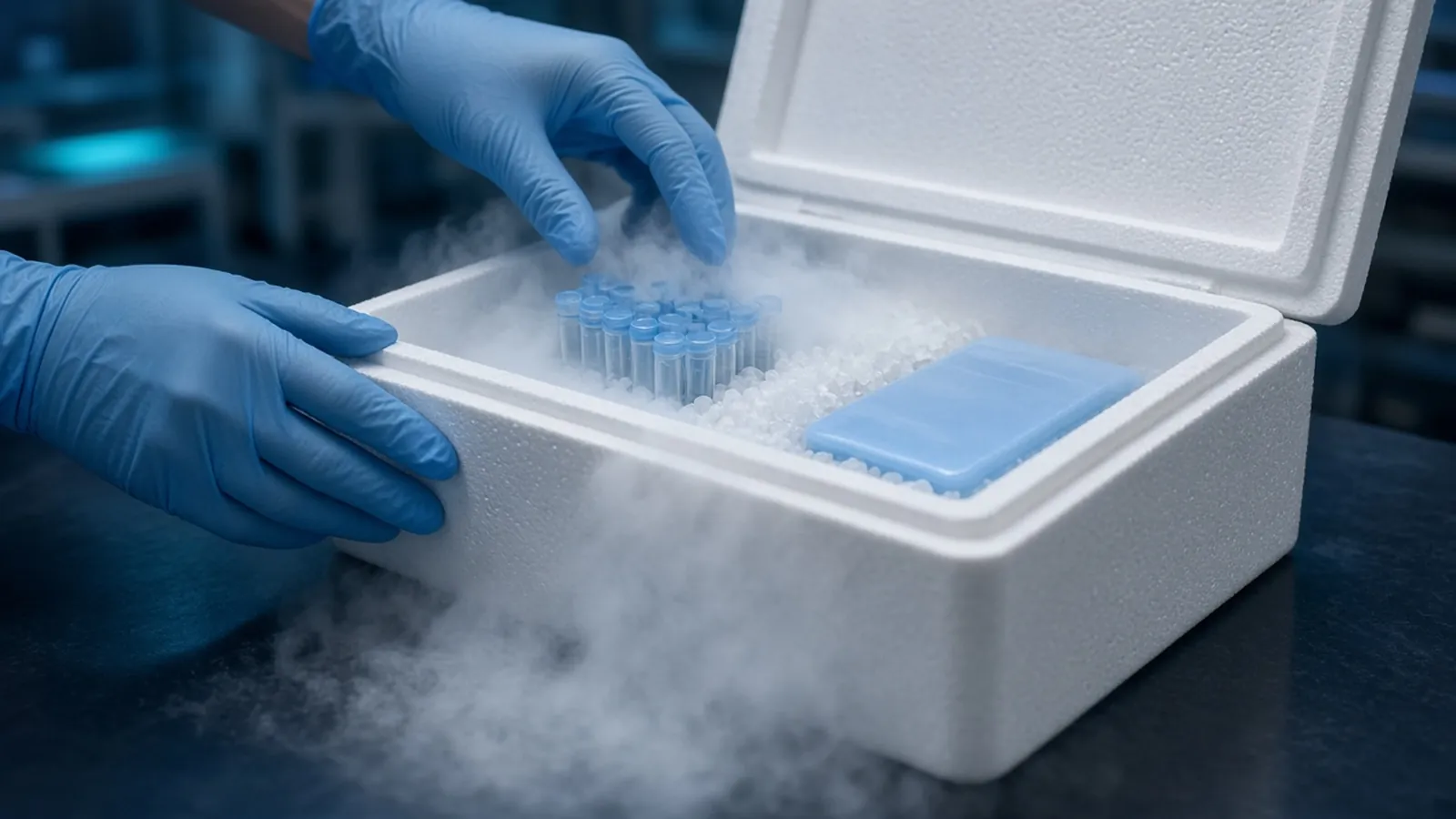
You open an insulated shipper and expect a gel pack. What you find is a white solid that does not wet your glove and does not collapse into a puddle as it spends itself. That solid is dry ice: carbon dioxide, frozen, subliming at about minus 78.5 °C at atmospheric pressure. This application walks one ordinary receiving task so the distinction becomes a set of actions. The shipment rules and the decision to use dry ice at all are in dry ice packing for sample shipments. Where the tubes should live afterwards is storing biological samples from fridge to freezer.
Tubes and vented shippers are discussed as laboratory plasticware. Insulated gloves and labels are laboratory consumables. A receiving specification is a laboratory procurement question and a quotation request.
The task
A non-infectious research enzyme, already classified by your biosafety office as ordinary research material, is due before noon. The product document says to store it at minus 20 °C on arrival and names a frozen shipping condition. You are the person who opens parcels. The task is to move the tubes from the shipper into the correct cabinet without treating the coolant as a gel pack, without sealing the gas in, and without leaving the solid in a closed office.
If the office has not classified the material, you do not open it under this article. Infectious substances and many patient specimens are a different legal object. The WHO laboratory biosafety manual and the CDC BMBL are educational reminders that transport sits inside biological risk management. They are not a packing licence.
What you should see, and what a gel would have been
A gel pack is water and polymer, conditioned in a refrigerator or a freezer, then packed as a cold brick. It absorbs heat and, if it was frozen, it melts toward a liquid you could in principle pour. Its useful temperature is the temperature you conditioned it to, not a law of nature. Dry ice is not that brick. It is solid CO2. At ordinary pressure it never passes through a liquid you can pour off. It shrinks as gas leaves it. The temperature of the remaining solid, sitting in open air, is about minus 78.5 °C. That number is a property of the substance at atmospheric pressure. It is not a promise about how long a particular box stays cold. Insulation, fill, openings, and the room decide the lifetime. This walkthrough will not invent a lifetime.
The cold is deep enough to keep many frozen research goods below thawing while the solid remains, and deep enough to freeze a refrigerated reagent that should have stayed liquid. Look at the shipping condition before you congratulate the courier. If the label said 2 to 8 °C and the shipper is full of dry ice, the coolant class is wrong even though the box feels impressively cold. Quarantine those tubes and tell the sender. Frozen is not a bonus.
Pellets, slices, and blocks are formats of the same substance. Pellets settle into gaps and also sublime faster because they have more surface. None of them become water. If you see a puddle, look for a gel pack, a cold drink someone added, condensate, or a leaked sample. Do not log it as "melted dry ice."
The sequence at the bench
Put the shipper in a ventilated room, not a small closed office. Wear insulated gloves or use tongs, and eye protection. Open the lid and leave it so the gas can keep leaving. Lift the secondary container, not a bare tube buried in pellets. Confirm the label against the document: identity, storage class, and that the material is the non-infectious shipment you expected.
Move the tubes promptly into the cabinet the document names. For this enzyme that is the steady minus-20 freezer, not the refrigerator and not a frost-free domestic unit. Brush pellets off the secondary container before it comes to the bench so you are not carrying solid CO2 in your pocket. Do not pour "spent coolant" down a sink. There is nothing to pour, and chasing imaginary meltwater is how caps get wet and labels dissolve.
If the document required minus 80 on arrival, the dry ice was only the journey. It is not an ultra-low freezer, and a cardboard shipper in the corner is not an address. The storage ladder is where that tube goes next. Dry ice left overnight as "close enough to minus 80" will be gone on a schedule you did not measure, and the tubes will wake up at room temperature.
The branch when the solid is already gone
You open the shipper and find no pellets, only tubes and a warm interior. The coolant has finished. Sample integrity is no longer a dry-ice claim. Quarantine the tubes. Note the time, the shipper type, and that the coolant was absent. Do not put them into the freezer and hope the cold they meet now erases the warm hours. Tell the owner. A functional check on something expendable may support release if the product document allows use after an excursion. Silence does not.
If a gel pack is present and still frozen, you received a different coolant class from the one the frozen shipping condition implied. Read the logger if one was packed, and judge time out of range rather than the fact that the pack still feels cool. Placement of that probe matters. A pretty single number is not a verdict.
If the shipper was taped shut all around the lid, the sender created a pressure hazard. Carbon dioxide gas must vent. A bulging box is a reason to stop and let a person who knows the emergency rule manage it, not a reason to lean on the lid. Purpose-built dry-ice shippers leak gas on purpose. That leak is also why the room matters.
| What you find | What it means | What you do |
|---|---|---|
| Solid pellets, no puddle, tubes frozen, label says ship frozen | Dry ice behaved as dry ice | Transfer to the document's cabinet. Vent the shipper. Do not look for meltwater |
| A cold wet brick | A gel pack, a different class | Check whether the label allowed that class. Read any logger |
| A puddle and no pellets | Not spent dry ice. Condensate, a leak, or a melted gel | Treat a leaked sample as a spill. Do not call the puddle CO2 |
| No coolant, warm tubes | The clock finished | Quarantine. Record the absence. Do not quietly freeze and forget |
| Dry ice on a 2–8 °C reagent | The wrong cold | Quarantine. The product may have frozen. Tell the sender |
| Lid taped airtight | Gas had nowhere to go | Stop. Do not force a bulging lid. Use the emergency rule |
Burns and the air in the room
The pellet injures skin on contact. The injury is a cold burn. Do not test dryness with a fingertip. Do not hand a pellet to a colleague as a demonstration. Tongs exist for this. If a glove is wet, it can freeze to the solid and hold the cold against the hand. Take the gloves off only when you are away from the shipper.
The gas is the second injury. Carbon dioxide is heavier than air and accumulates low, in a cold room, a walk-in, a car, or a small office with the door shut. The shipper vents because it must. That vent is doing the right thing for the box and the wrong thing for an unventilated room. Finish the transfer and let leftover solid sit only where the institution allows, with air that actually exchanges with a larger volume. A comfort air conditioner that recirculates the same room is not that exchange.
The IATA dangerous goods programme is where carriers treat solid carbon dioxide as a regulated article in transport. Your receiving task does not replace that regime, and it does not authorise you to ship anything. The OSHA laboratory standard is a chemical-hygiene framework, not a carbon-dioxide exposure calculation. Local rules set monitors and training. This walkthrough is not medical advice if someone has already inhaled a concentrated cloud or burned a hand.
After the tubes are safe
Empty remaining dry ice by the laboratory's disposal habit: a ventilated place where the gas can disperse, never a sealed bin, never a sink, never a cold room that people lock. Record the arrival condition in the same note as the storage address. If a logger was in the box, file the trace with a sentence about where the probe sat. The owner should be able to see that the enzyme moved from a subliming coolant into a named minus-20 cabinet, and that the cabinet is not frost-free.
Then tell the next person what the solid was. The recurring failure in this task is cultural. Someone calls every cold brick gel, pours a condensate puddle into the sink as if it were the coolant, and tapes the next outgoing box shut because a gel pack would have allowed it. The application is finished only when those three mistakes are harder to repeat than to avoid.
What to ask for before the next parcel
Ask for a vented insulated shipper, a secondary container that survives a leak, and tube caps rated for the cold the dry ice will impose. State the product's shipping condition in the same sentence as the coolant class, so a refrigerated reagent is not paired with solid CO2. Ask who checks the logger on receipt. Leave biological classification to your institution. The quotation compares hardware with that sentence. It does not replace the product document, and it does not make dry ice into a gel that happens to be colder.
Questions from the bench
Why is there no meltwater to pour out of a dry-ice shipper?
At atmospheric pressure, solid carbon dioxide does not melt to a liquid. It sublimes, turning directly to gas, at about minus 78.5 °C. A puddle in the shipper is from condensation, a leaked sample, or a gel pack that was packed as well. It is not spent dry ice. Do not seal the box to 'keep the melt in.' The gas has to leave.
Can I treat dry ice as a colder gel pack for any reagent?
No. A gel pack holds roughly the refrigerated or frozen temperature it was conditioned to, then warms as it absorbs heat. Dry ice holds a much colder window while it lasts. A reagent labelled for 2 to 8 °C can freeze and be ruined by dry ice. Match the coolant to the shipping condition on the label. The packing page is where that shipment decision is worked through.
What are the injuries to the person opening the box?
Cold burn from the solid, and oxygen displacement from the gas, which is heavier than air and pools low. Insulated gloves or tongs, eye protection, and a ventilated room are the controls. A wet glove freezes to the pellet. This page is not a first-aid protocol. Follow the laboratory emergency procedure if someone is hurt.
What should a receiving laboratory ask for in an enquiry?
Ask for an insulated shipper that vents, secondary containment for the tubes, and labels that survive this cold. State that dry ice is a coolant class, not a gel, and that classification of any biological hazard stays with your institution. Send the specification as a quotation request.
References
Manufacturer names identify published method classes. Trademarks remain with their owners. Catalogue records on this site are independent references for enquiry. They are not a statement of inventory, distribution rights or a supply commitment. This page is educational. It is not medical advice, a diagnostic protocol or a biosafety approval.
Catalogue
Related products and categories
These links follow the subject of the article into published manufacturer references. A listing is a reference for an enquiry, not a statement of stock or distribution rights.
Continue in this cluster
Related reading
Dry ice packing for sample shipmentsDry ice keeps non-infectious research samples cold and can burn skin or displace air. Carrier rules and infectious-substance law still govern shipping. Storing biological samples from fridge to freezerFridge, minus-20, minus-80 and nitrogen storage slow different kinds of damage. A warm box is a quarantine decision, not a hope.A glossary of cold-chain termsSetpoint is not air temperature, and a phase-change pack is not every coolant. Compare the cold-chain pairs labs treat as one word.