
glossary
Enzymes shipped on ice and what to do on arrival
On arrival, name the coolant and move the enzyme to the temperature on its document. A foam shipper is not a place to wait out a meeting.
- Author
- EVRINTH Editorial Team
- Published
- 8 October 2026
- Updated
- 8 October 2026
- Reading time
- 9 min
The enzyme box arrives while a meeting is about to start. The foam shipper looks cold enough to wait. It is not a storage address, and the words people use for the coolant are easy to mix up. This page defines wet ice, gel pack, dry ice, cold-pack conditioning, and the arrival check by staying with that one parcel. After the enzyme is in the right cabinet, storage classes are the subject of storing biological samples from fridge to freezer. Dry ice hazards and venting are in dry ice packing for sample shipments.
Tubes you will aliquot into are in the laboratory plasticware catalogue. A freezer that holds the temperature the document names, without a frost-free cycle, can be specified through laboratory procurement and a quotation request. The enzyme itself is used in the way molecular biology work already assumes: follow the product document.
Wet ice: a melting point, and then only water
Wet ice means frozen water packed around the goods. While solid ice and liquid water are both present, the mixture sits near the melting point of water, about 0 degrees Celsius, at ordinary pressure. That plateau is the useful part. When the last ice disappears, the bag is meltwater and the temperature climbs toward the room. A receipt that says "on ice" after the ice is gone is using the word for a history, not for the present state.
Wet ice is a common coolant for short, cool shipments of reagents that tolerate that temperature. It is a poor way to hold something that must stay near minus 20, and it wets cartons and labels. On arrival you look for remaining ice, not for a cold feeling. All meltwater means the plateau is spent. Whether that is an excursion is the product document's window, not the word ice.
Gel pack: a sealed gel, not automatically a plateau at 2 to 8
A gel pack is a sealed pouch of gel, often water plus a thickener. People say ice when they mean a gel pack, and they say phase-change pack when they mean any gel. If the pack is a true phase-change product, it is formulated to hold a stated temperature while it changes phase, after it has been conditioned. A generic gel frozen hard in a minus 20 cabinet can start well below 0 and then warm smoothly through the range you care about, spending little time on a plateau.
On arrival, write hard, slush, or liquid. Hard does not mean the enzyme never saw a colder temperature than it likes. Liquid means the pack's capacity is spent. Slush means you are in the melt, which is reassuring only if this pack was specified to melt at the right temperature. Compare that observation with the ship condition printed for the enzyme. Then move the vial. Do not leave the decision inside the foam.
Dry ice: much colder, and a hazard with its own page
Dry ice is solid carbon dioxide. It sublimates near minus 78 degrees Celsius and does not leave a puddle. It is a transport coolant for many frozen reagents, and it is the wrong storage temperature for enzymes whose document says minus 20 in glycerol. A vial that arrives buried in dry ice may be far colder than its storage class. Follow the document about whether that transit condition is expected. If the document says ship on dry ice and store at minus 20, the arrival action is to move it to minus 20, not to park it in the ultra-low "because it came that way".
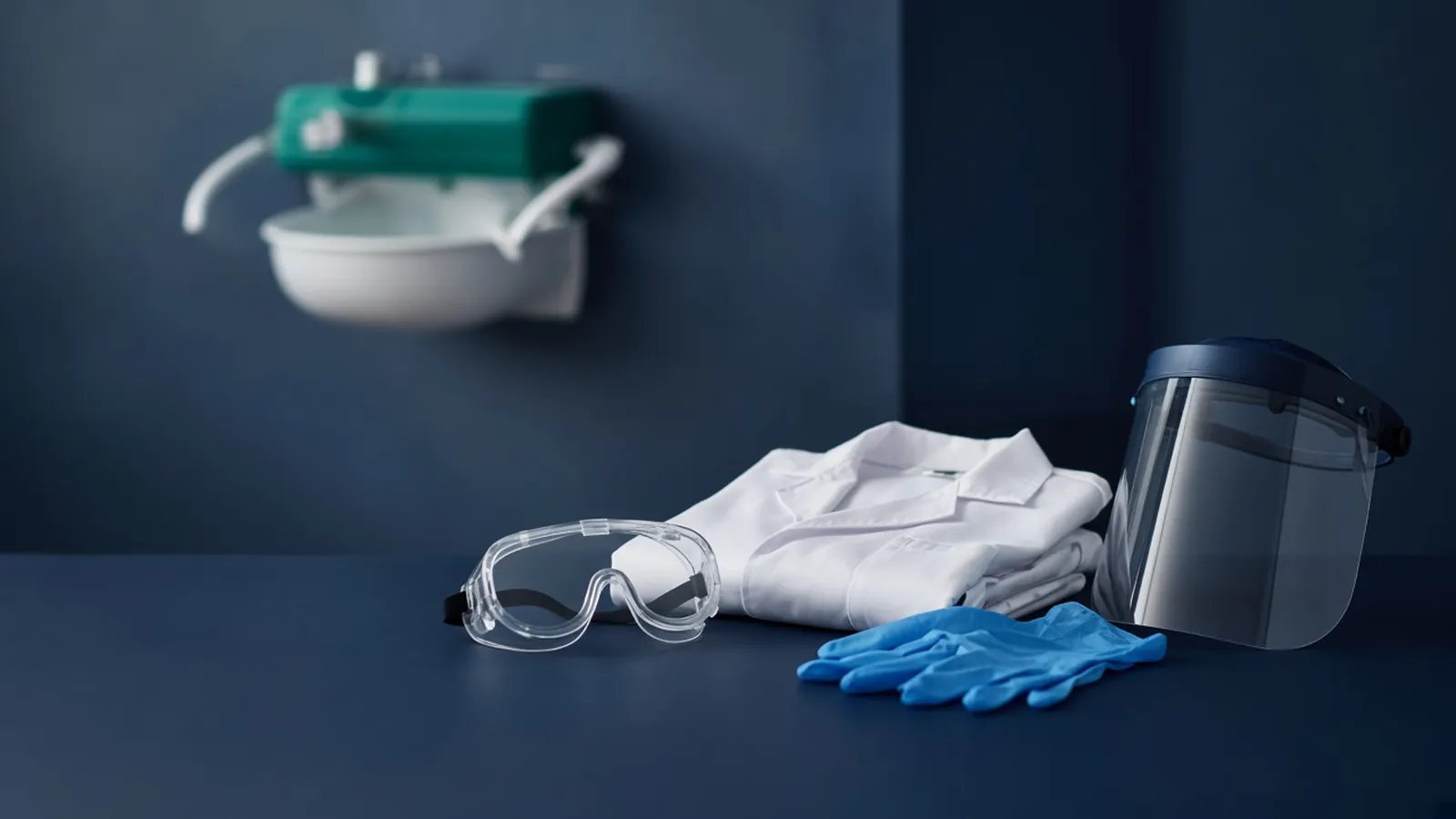
Dry ice burns skin and displaces oxygen. The photograph of goggles, a coat, gloves, and a face shield beside an eyewash is the class of bench protection your institution specifies for chemical and cold work. Match the protection to the task: insulated gloves and eye protection when you handle dry ice, in a room that can ventilate, not a sealed office. The packing page is the procedure-level hazard discussion. Air transport of dry ice is a dangerous-goods question for a trained shipper under the IATA Dangerous Goods Regulations. This glossary does not approve a shipment.
If the dry ice is gone, write that the coolant is absent. An empty cavity is not "still on dry ice". Quarantine the enzyme until the document's rule for a spent coolant is applied. Do not guess activity from the brand name.
Cold-pack conditioning: the step before the pack deserves its name
Conditioning means the pack is brought to the starting state the pack-out was built for. A 2-to-8 pack may need to be frozen, then tempered, or refrigerated but not frozen, for a time the pack sheet states. A pack pulled from a freezer five minutes before the courier arrives is not conditioned. A pack that lives in a refrigerator and is called frozen is not conditioned either.
You will not always see the sender's conditioning log. You can see the arrival state, and you can refuse to call a lukewarm gel "conditioned" out of politeness. If you pack enzymes yourself, conditioning is a line in your own SOP with a clock, and an unconditioned pack is a reason to delay the pickup. Do not invent the hours. Read the pack sheet.
The arrival check: coolant, document, move
The arrival check is a sequence, not a feeling.
Confirm what coolant is in the shipper and what state it is in. Confirm whether a logger is present and whether it was started. Read the storage temperature and the ship condition on the product document that belongs to this enzyme, not the document for a different polymerase in the same box. Move the enzyme to that storage temperature now. If the state and the document disagree, move it to a hold position at the safest temperature the document allows and mark it quarantined until the owner applies the deviation rule.
Avoid a second harm while you do this. Do not thaw the vial to read a tiny label and then refreeze it because the meeting started. Do not aliquot in a rush on the receiving bench without the SOP. Do avoid repeated thawing later: when the document allows the first opening, split the volume into one-use tubes so the stock is not cycled for every PCR. A frost-free household freezer will cycle the enzyme even if you never open the door. Use a laboratory cabinet that holds the set temperature.
| Term | What it actually is | The confusion at the bench |
|---|---|---|
| Wet ice | Water ice, near 0 degrees while ice remains | Meltwater still called ice |
| Gel pack | A sealed gel that may or may not have a designed plateau | Called a phase-change pack without a stated temperature |
| Dry ice | Solid carbon dioxide, far colder, becomes gas | Treated as a storage shelf, or ignored as a hazard |
| Conditioning | The pack brought to the specified starting phase for a stated time | Any pack that once lived in a freezer |
| Arrival check | State, logger, document temperature, move or quarantine | Left in the foam shipper through a meeting |
The meeting that must not own the enzyme
You open the shipper at 10:50. The document says this ligase ships on gel packs and is stored at minus 20. The packs are slush. There is no logger. You write slush, no logger, 10:50, and you put the vial in the minus 20 hold tray before you walk to the seminar. That is the arrival check. After the seminar the owner compares slush plus the elapsed shipping time with the document. If the document is satisfied, the vial joins the working box. If it is not, the vial stays on hold. Nobody thaws it "to see".
The branch you refuse: the shipper sits on a sunny bench until 16:00 because the meeting ran long. The packs are liquid. The enzyme has had an unrecorded warm afternoon. You are now in a deviation, and the only honest step is quarantine plus the document, not a quiet placement in the freezer as if the morning had gone well.
A second vial in the same shipper is a restriction enzyme whose sheet says dry ice in transit and minus 20 in storage. It was packed beside gel packs by mistake. You do not give both vials the same verdict. You record the actual coolant each one touched, if you can see it, and you follow each sheet. If they shared one environment, say so, and let each document speak.
Safety and research use
Enzymes are research reagents. A storage choice here is not a clinical assay approval. Coolants are the acute hazard at receipt: cold burns, wet floors from meltwater, and carbon dioxide in a small room. Use the protective equipment your laboratory specifies. An eyewash station, as in the photograph, is part of the room for chemical splashes. Know where it is before you handle a damaged vial of anything dissolved in a solvent. Institutional biosafety rules still apply if the enzyme is part of a kit that includes a biological component. The WHO laboratory biosafety manual is the programme frame, not a receiving stamp.
What to specify next time
Ask for the ship condition and the storage temperature as two separate lines in any reagent enquiry, and ask for a laboratory minus 20 that does not frost-free cycle if that is the class your enzymes use. Ask for vials you can aliquot into. Put the lines on the quotation request. Do not ask a sender to promise that a foam box will survive a meeting on a warm bench. Open it, name the coolant, and move it.
Questions from the bench
The gel packs are still frozen solid. Does that mean the enzyme is fine?
It means the packs have not finished melting. It does not by itself prove the enzyme stayed inside the window on its product document, and a pack that started far too cold can have frozen an enzyme that was meant to stay liquid in glycerol. Read the ship condition and the storage temperature on the document, then move the vial. Quarantine it if the document and the coolant state disagree.
May I leave the foam shipper on the bench until after the seminar?
No. The shipper is a slowing of heat leak, not a storage address. Wet ice becomes water, gel packs finish their plateau, and dry ice sublimates and fills a small room with gas. Move the enzyme to the temperature the document names before you go to the meeting. If you cannot, hand the shipper to someone who will, or keep it in a planned cold hold the SOP already allows.
What is conditioning of a cold pack?
Conditioning is bringing the pack to the starting phase the pack-out requires, for the time the pack instructions state, before it goes into the shipper. A pack taken from a refrigerator and called cold may be only a few degrees below the room an hour later. A pack frozen when it should have been refrigerated starts too cold. Conditioning is a step with a clock. It is not a word printed on the carton.
Should every enzyme go to minus 80 because that is colder?
No. Many enzymes in glycerol are stored at minus 20 so they remain liquid or soft, and the product document says so. Minus 80 can be the wrong class even though it is colder. Repeated thawing is a separate harm. Aliquot at the first thaw the document allows, and do not cycle the stock for every reaction.
References
Manufacturer names identify published method classes. Trademarks remain with their owners. Catalogue records on this site are independent references for enquiry. They are not a statement of inventory, distribution rights or a supply commitment. This page is educational. It is not medical advice, a diagnostic protocol or a biosafety approval.
Catalogue
Related products and categories
These links follow the subject of the article into published manufacturer references. A listing is a reference for an enquiry, not a statement of stock or distribution rights.
Continue in this cluster
Related reading
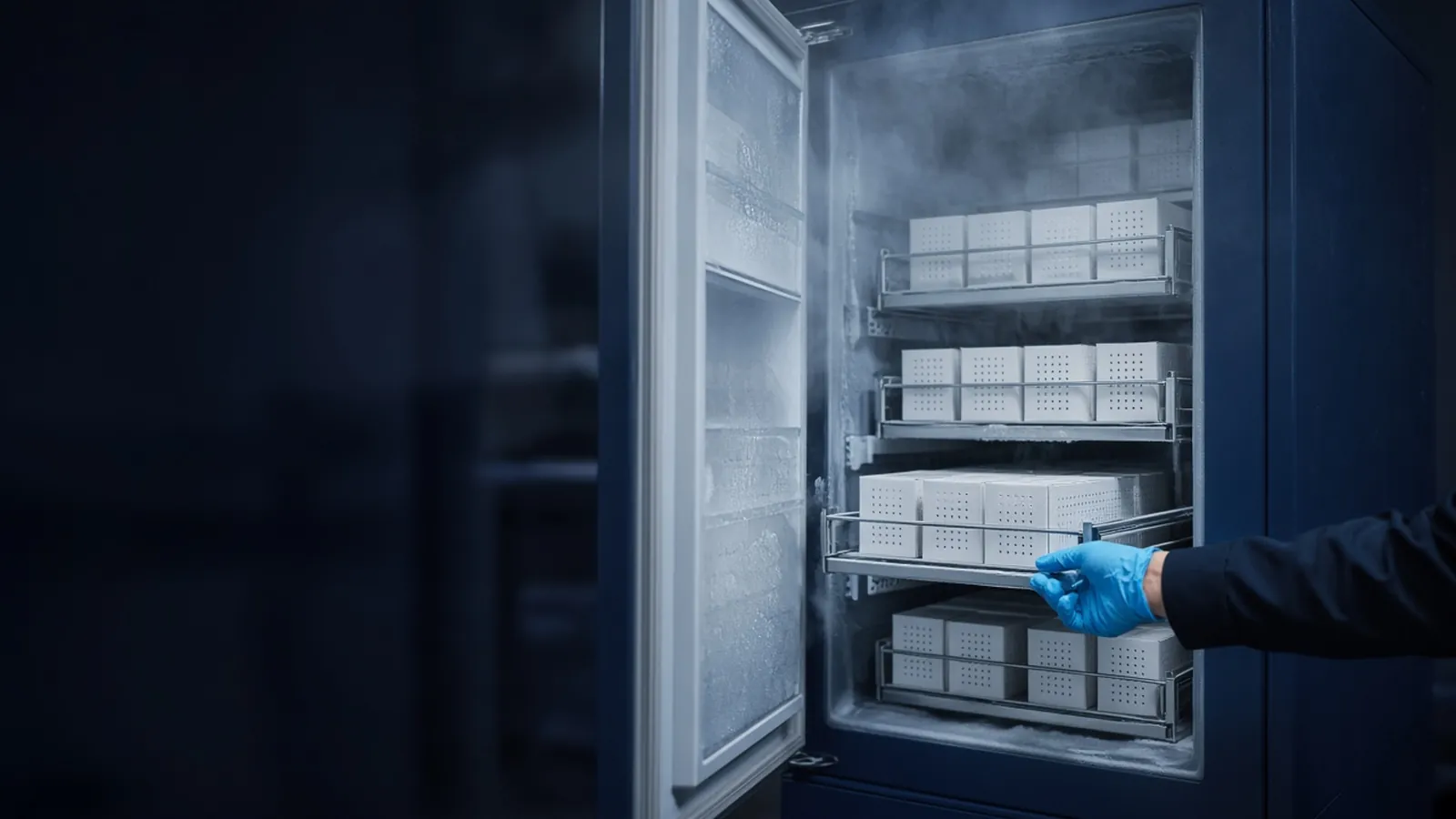 Storing biological samples from fridge to freezerFridge, minus-20, minus-80 and nitrogen storage slow different kinds of damage. A warm box is a quarantine decision, not a hope.
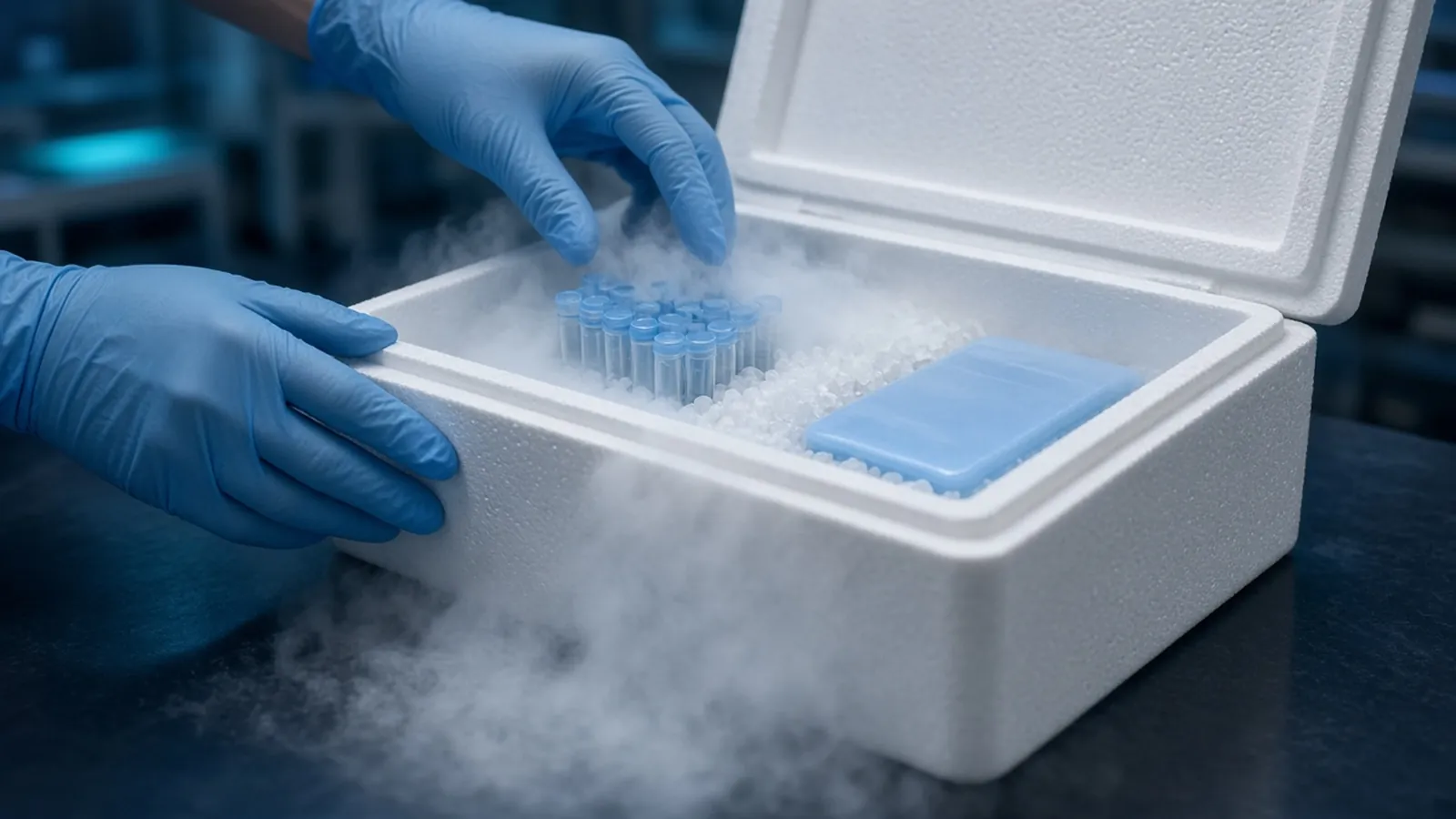 Dry ice packing for sample shipmentsDry ice keeps non-infectious research samples cold and can burn skin or displace air. Carrier rules and infectious-substance law still govern shipping.A glossary of cold-chain termsSetpoint is not air temperature, and a phase-change pack is not every coolant. Compare the cold-chain pairs labs treat as one word.