
comparison
Erlenmeyer flasks for culture and mixing
What an Erlenmeyer flask is for in mixing and shake culture, and how baffles, closure and headspace change gas exchange.
- Author
- EVRINTH Editorial Team
- Published
- 8 October 2026
- Updated
- 8 October 2026
- Reading time
- 7 min
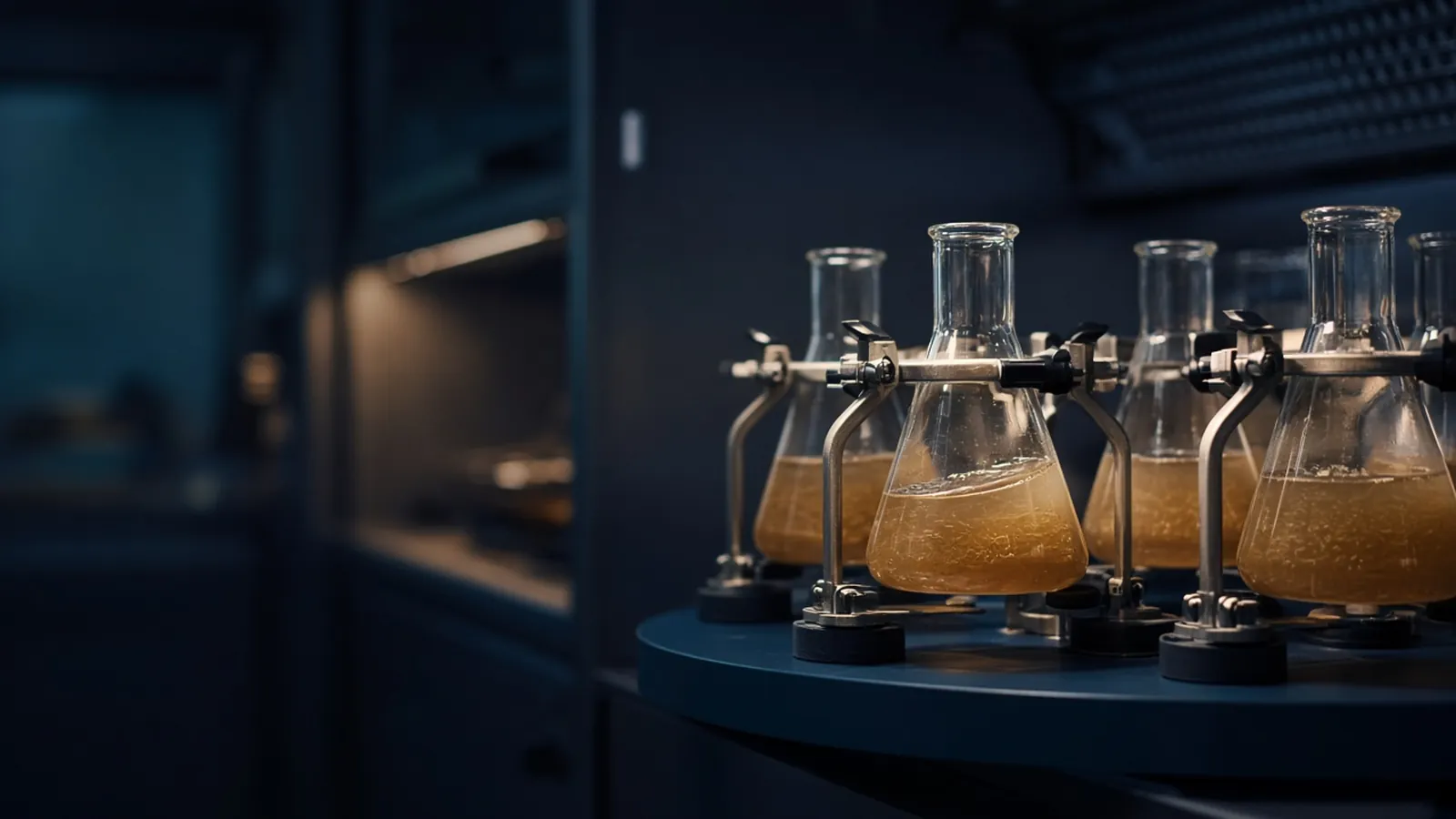
Shake culture fails in quiet ways. The medium looks full, the cap looks tidy, and the cells have already run out of useful gas exchange. An Erlenmeyer flask is a cone with a flat base and a narrow mouth, good for swirling without throwing liquid across the bench. That shape serves two different jobs, mixing a chemical and growing a research culture, and they do not share a fill level. The vessel's place among beakers and volumetric ware is set out in choosing laboratory glassware.
What the cone can show, and what it cannot
For mixing, the cone lets you swirl a solution with the mouth still above the wave. A powder dissolves, a titration sample stays in the flask, a stain does not splash the way it would in a full beaker. The graduation, if there is one, tells you whether you are about to overfill. It does not carry a volumetric tolerance. NIST weights and measures practice is the background for why a declared volume lives elsewhere, in a volumetric flask read at its reference temperature.
For culture, the same cone is a small bioreactor with no controls except the ones you add: temperature from the room or shaker, mixing from the orbit, and gas from whatever the closure allows. Oxygen enters and carbon dioxide leaves only as fast as the headspace and the closure permit. Fill the flask toward the neck and you shrink that headspace, wet the plug, and slow transfer. A common planning habit for aerobic shake flasks is a modest fraction of nominal capacity, often around a fifth, but the paper or the strain protocol you follow is the authority. Do not paste a universal fill table into a notebook and call it physiology.
Baffles, closures, and plain cones
An unbaffled flask swirls as a smooth wave. Shear is lower. Oxygen transfer is whatever the surface renewal of that wave provides. A baffled flask adds ridges that trip the liquid into turbulence. Transfer often rises. So does foam, and so does the chance that medium soaks the closure and becomes a contamination path. If a method was developed in an unbaffled flask, moving it to a baffled flask of the same nominal size is a new method. Compare a growth curve or the metabolite you care about before you standardise on the ridge.
Closures are part of the gas path. A cotton or foam plug, a filter cap, or a lid parked loose allows exchange and keeps dust out to the degree that design claims. A clamped, unvented cap does not. Metal caps and foil can look protective while sealing more than the method assumed. Plastic caps on glass media bottles are a different product from a shake-flask closure. Match the closure to the flask mouth the manufacturer named.
Glass for reusable culture flasks is typically borosilicate, the low-expansion type in ASTM E438, because the flask will see an autoclave. Single-use plastic shake flasks exist, often polycarbonate or polypropylene, with their own sterile claim and their own solvent limits. They remove dishwashing residue, which matters for sensitive cultures, and they add a waste stream your institution has to accept. The comparison is operational, not moral.
| Option | What it changes | What it does not guarantee |
|---|---|---|
| Plain Erlenmeyer | Swirl with limited splash, simple autoclave geometry | A volumetric concentration, or high oxygen transfer |
| Baffled flask | More turbulence and often more oxygen transfer | The same growth as an unbaffled method, or less foam |
| Gas-permeable closure | Exchange while excluding some dust and aerosol | Sterility of a flooded plug, or a medical-device claim |
| Tight unvented cap | A closed headspace | Aerobic conditions the strain may have needed |
| Single-use plastic flask | Less wash residue, a stated sterile format if so labelled | Solvent duty, or performance identical to glass |
How to branch when a culture looks wrong
If growth is slow and the plug is wet, reduce the fill or the shake throw before you blame the medium recipe. If the method used baffles and you removed them, put them back before you change the carbon source. If the cap was tightened for a walk across the corridor and left tight in the shaker, loosen it or replace it with the vent the method names, then start a fresh flask. A culture that sat sealed is not repaired by opening it later and hoping.
If the flask is chemically etched or the neck is chipped, retire it. A chip at the mouth cuts gloves and prevents a plug from seating. If detergent from a shared washer is your suspect, compare a dedicated flask. Residue inhibits more cultures than people enjoy admitting, and an autoclave cycle does not remove that film. The sterilisation limits are discussed in autoclaves and what sterilisation does not do.
Contamination that appears in every flask points at medium preparation, the closure, or the inoculum. Contamination in one flask points at handling of that flask. Do not "save" a research culture by subculturing past a contaminant and renaming the strain.
A mixing fill is not a culture fill
When the flask is only mixing a reagent, fill it so the swirl stays below the neck and the closure does not become a contaminant. There is no oxygen-transfer target. Baffles usually hurt this job, because they splash chemical onto the stopper. A plain borosilicate cone, if you will heat it, is the comparison that fits.
When the flask is growing cells, that same plain cone is a low-transfer vessel unless the method was built on it. Do not inherit a mixing fill, often a large share of the nominal volume, and use it for an aerobic strain. Compare headspace and closure before you compare the number painted on the wall. Two flasks of the same nominal size, one baffled and one plain, are not replicates of one method.
Safety and the limit of the claim
Research culture of microorganisms is an institutional biosafety decision. The WHO laboratory biosafety manual and the CDC BMBL describe the background. They do not, via this article, assign a containment level or turn a flask into a medical device. Non-pathogenic teaching strains and risk-group organisms are not interchangeable because the glass looks the same. Spills on a shaker travel further than spills on a bench. Secure the flask with the clamp the platform uses, and do not leave an orbital shaker running unbalanced.
Chemical mixing in the same shape inherits the chemical's hazards. A solvent Erlenmeyer on a stirrer still needs a tray and a hood when the liquid requires one. Do not put a volumetric duty on the culture flask to save a wash.
Shakers, heat, and interrupted power
An incubator that lost power and restarted is not the same growth curve. Note the gap, and do not report the hour count as if the temperature held. In a warm building, a shaker parked in direct sun or against a poorly ventilated wall can run above its set point. Check the flask temperature when a result depends on it, not only the display. Borosilicate flasks from the autoclave should cool before they are clamped onto a cold platform with cold medium poured in a rush. Thermal shock cracks the base you cannot see once the culture is amber.
What to ask for
Nominal capacity, baffled or plain, mouth and closure style, borosilicate if the flask will be autoclaved, and whether single-use plastic flasks are a separate line. Working volume is your method, not a slogan on the box. Count the pieces. Look through beakers and flasks and send the specification with the quote request.
Questions from the bench
Does the graduation on an Erlenmeyer flask define the culture volume?
No. Those marks are a filling guide, in the same sense as a beaker. Shake-flask working volume is chosen for gas exchange and mixing, often a modest fraction of the nominal capacity, and the organism's method decides the fraction. A concentration you must declare is still made in volumetric glass and then transferred. The cone is for swirling, not for metrology.
When do baffles help, and when do they hurt?
Baffles break the swirl into turbulence and usually raise oxygen transfer for aerobic cultures, at the cost of more splashing into the closure and sometimes more foam. A baffled flask is the wrong default for a fragile shear-sensitive culture or for a method that was written on an unbaffled flask. Compare growth, not just how busy the liquid looks. Change one variable at a time.
What closure lets gas through?
Cotton, foam plugs, loose caps and filter caps are used because they allow exchange while limiting dust and larger contaminants. A fully tightened, unvented screw cap is a closed system and will change both oxygen and carbon dioxide. Follow the method and the cap maker's note. A closure that looks tidy can still be the reason an aerobic culture stalled.
Is a culture flask a medical device because cells grew in it?
Not on the strength of this page. An Erlenmeyer flask in a research incubator is laboratory apparatus used under your institutional biosafety rules. Growth of a research strain is not a diagnostic claim and not a therapeutic claim. Pathogen work follows the containment your safety office assigns, with national and institutional rules in front of any catalogue description.
References
Manufacturer names identify published method classes. Trademarks remain with their owners. Catalogue records on this site are independent references for enquiry. They are not a statement of inventory, distribution rights or a supply commitment. This page is educational. It is not medical advice, a diagnostic protocol or a biosafety approval.
Catalogue
Related products and categories
These links follow the subject of the article into published manufacturer references. A listing is a reference for an enquiry, not a statement of stock or distribution rights.
Continue in this cluster
Related reading
 Choosing laboratory glasswareHow to match borosilicate beakers, flasks and volumetric glass to the measurement you need, and when a printed line is only a guide.A glossary of labware termsDefinitions of the labware words that change a result: class marks, to contain and to deliver, joint size, resin, sterile and clean.Beakers are for handling not for accuracyWhy a beaker graduation is only a handling guide, and when a concentration other people will reuse belongs in a volumetric flask.