
glossary
Ethanol carryover and failed downstream assays
Define wash buffer, residual alcohol, overdrying and elution, then see why leftover ethanol stops a ligation, a PCR or a restriction digest.
- Author
- EVRINTH Editorial Team
- Published
- 8 October 2026
- Updated
- 8 October 2026
- Reading time
- 7 min
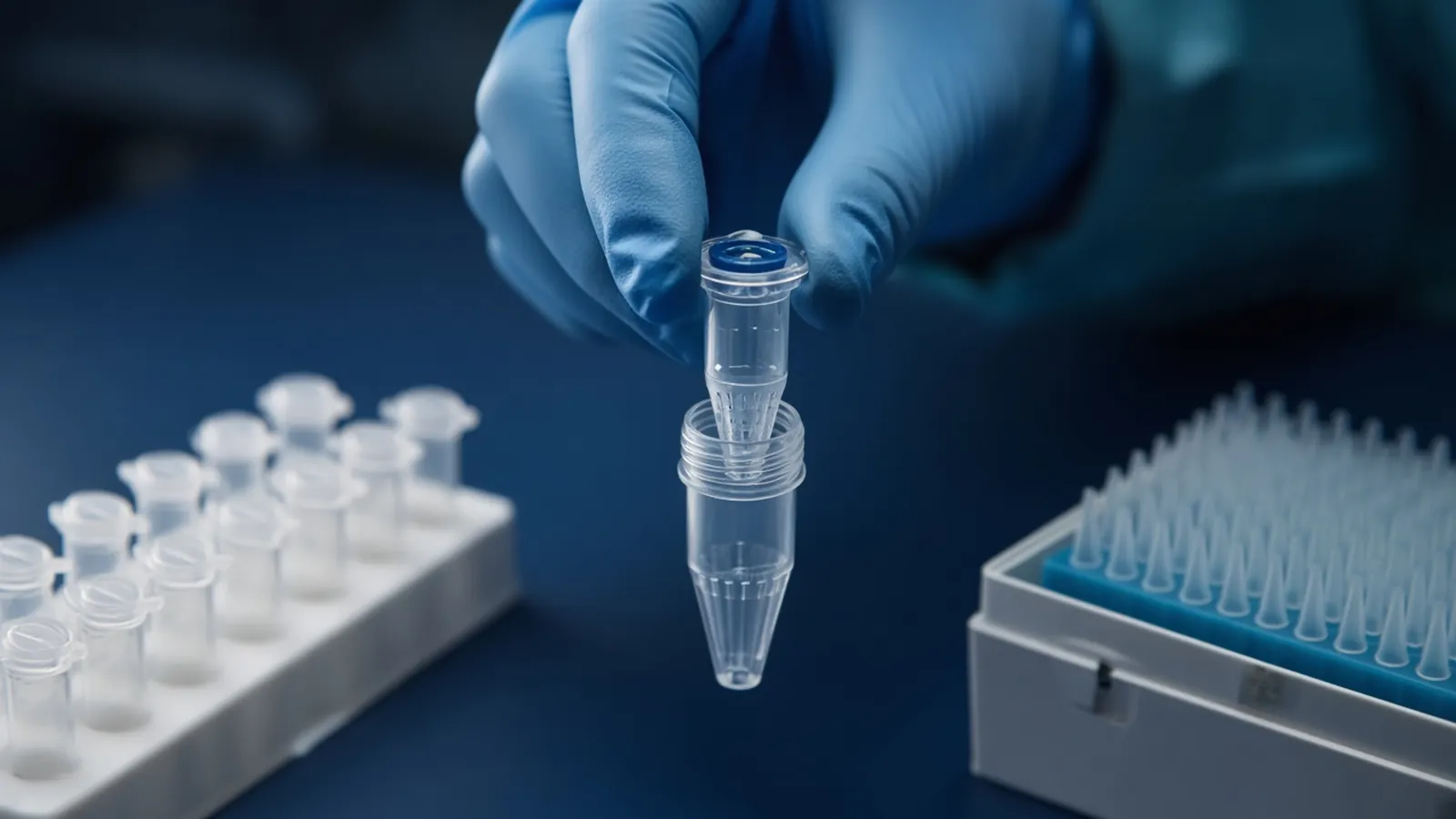
Ethanol carryover is why a later ligation, PCR, or restriction digest dies after a prep that looked successful. The nucleic acid is often in the tube. The alcohol from the wash is in there with it, and the enzyme was never formulated to work in that mixture. This glossary names the four words that keep the failure straight: wash buffer, residual alcohol, overdrying, and elution. It is research vocabulary for a silica column or a bead wash, and it is not a rewritten kit insert.
How those washes fit among extraction classes is in how DNA extraction methods differ. When the dead enzyme is a ligase in a cloning workflow, the assembly choices sit in restriction, ligation, and Gibson assembly. Carryover is one reason a join fails. It is not the only one.
Wash buffer
Wash buffer, in a silica or bead bind-wash-elute method, is the liquid that is supposed to let contaminants leave while nucleic acid stays bound. After a chaotropic bind, the first wash is often still salty. A later wash is rich in ethanol or isopropanol so proteins, chaotrope, and small molecules move on and the nucleic acid does not. The alcohol is doing a job. It is not an accident in the bottle.
The buffer belongs to the kit you opened. A wash borrowed from another kit changes the salt and the alcohol the matrix sees, and a failed enzyme is then hard to interpret.
Residual alcohol
Residual alcohol is ethanol or isopropanol left on the membrane, in a bead pellet, or in the eluate. It hides in the frit, on the column rim, and in a pellet that looked dry. Polymerases, ligases, and many restriction enzymes lose activity when that alcohol reaches the reaction. A trusted template that works alone and fails when spiked into the new eluate shows inhibition. Ethanol is a common cause after a column wash. Chaotrope from a skipped wash more often pulls A260/A230 down. Ethanol can leave A260/A280 looking ordinary, so a fine ratio does not clear the enzyme. The insert, not a guessed percent, says how dry that matrix should be.
Overdrying
Overdrying is what happens when the matrix loses so much moisture that elution becomes poor. Silica that has been left open too long can bind nucleic acid more tightly, wet unevenly, or give back a weak yield when the elution buffer finally goes on. People reach this state by trying to solve residual alcohol with extra waiting. The two problems are neighbours. The fixes point in different directions.
A column that is still wet fails the next enzyme and may also elute oddly. A column that was dried far past the insert fails by keeping the DNA. If yield collapsed after a long open dry, and a repeat prep eluted promptly works, overdrying is the better explanation. If yield looks normal and the enzyme dies, residual alcohol or another inhibitor fits better than overdrying.
Elution
Elution is the low-salt step that releases nucleic acid from the matrix into water or buffer, and it is also the liquid you take away. Elution buffer has to wet the membrane. If wash alcohol is still pooled on the silica, the elution buffer mixes with that alcohol and the eluate becomes a diluted wash. If the membrane was overdried, the same buffer may sit on top and come off nearly empty.
Apply elution as the insert describes, usually to the centre of the membrane, at the volume that page names. A second elution can rescue a reluctant membrane and can also carry more alcohol and more volume. Decide which failure you are correcting.
RNA integrity is a different claim. A gel or an integrity score asks whether the RNA is still long. Elution asks whether it left the matrix in a buffer the next enzyme accepts. An intact trace can still refuse reverse transcription if the eluate is alcoholic.
| Term | What it is | What goes wrong when it is ignored |
|---|---|---|
| Wash buffer | Alcohol-containing rinse that keeps nucleic acid bound | Salt and chaotrope stay, or the wrong alcohol is substituted |
| Residual alcohol | Wash liquid left in the matrix or the eluate | Ligation, PCR, or a restriction digest stalls |
| Overdrying | Matrix dried so far that release suffers | Yield drops even though inhibitors may be gone |
| Elution | Low-salt release, and the liquid that results | Alcohol comes with the DNA, or DNA stays behind |
Dry spin and a longer dry are different moves
An extra dry spin is a centrifuge step after the wash has been discarded. The column or the bead tube is spun again so liquid trapped in the membrane, the rim, or the pellet is pulled away into waste. It removes bulk residual alcohol without asking the room air to evaporate it. If the insert includes that spin, do the spin. Skipping it to save a minute leaves the droplet the enzyme will meet.
A longer dry is open time, or a stated air-dry, during which alcohol evaporates. It addresses vapour and a thin film. It does not pull a visible droplet out of a frit as effectively as a spin. In humid air, evaporation is slow, so a time copied from a temperate laboratory's habit can still leave alcohol even when you followed the spirit of "let it dry." That is a reason to prefer the mechanical spin the insert already gives you, not a reason to invent a longer minute and write it over the page.
Do not replace the insert's dry spin with a guessed wait. Do not add a long open dry on top of a completed dry spin as if every column class needed the same extra minutes. Overdrying is how that kindness becomes a low yield. If a batch fails and you suspect carryover, repeat one change: the dry spin the insert names, done for the speed and time that insert prints. Change a second variable only after that repeat has told you something.
How to tell carryover from the neighbours
Too little DNA, a bad enzyme, and inhibition can all leave an empty gel. Spike a trusted template into the eluate. If the spike fails, the tube is inhibitory. Ethanol, chaotrope, phenol, and salt are candidates. A260/A230 hints at chaotrope and phenol more than at ethanol. A blank that also inhibits means the reagents brought the problem.
If the spike works, ask whether template was ever there. A low yield only after a long open dry points at overdrying. A normal yield and a dead enzyme points at residual alcohol. Poor RNA integrity is a preservation problem. Alcohol will not restore a broken trace. On beads, liquid beading on the pellet is residual wash, and a cracked pellet after a long dry is overdrying. Elute when the insert says the pellet is ready.
Safety
Ethanol and isopropanol are flammable. A normal column dry is not a heating step. Chaotropic washes remain chemical hazards. Follow the safety data and the waste path for the bottle you opened. This page does not set a biosafety level or authorise clinical use. The WHO laboratory biosafety manual is background for the institutional decision.
Humid air and the page you opened
In humid weather an open column dries more slowly than the same plastic in a dry room. The insert's dry spin still means the same thing: remove liquid mechanically. If you work where the air is wet, trust that spin and the drying instruction printed for the kit, and do not "correct" them with a personal extra quarter-hour that the page does not contain. A centrifuge that stops in a power cut has not finished a dry spin. Restart only if the wash tube and the column are still the pair you think they are.
What to say in an enquiry
Name the matrix, the column or bead class, the downstream enzyme that failed, and whether a spike of trusted template also failed. Say whether the insert's dry spin was done. That is enough for a sourcing conversation about a different wash class or a cleanup column. Start from the sample preparation catalogue and the sample preparation pathway, and send the notes with the quote request. The nucleic acid isolation enquiry reference is an enquiry reference for the prep itself. Ask whether a quotation is possible.
Questions from the bench
Why did my PCR fail when A260/A280 looked fine?
A260/A280 is a cleanliness hint about protein, and ethanol does not move it the way protein does. Residual alcohol can sit in an eluate that still shows a familiar ratio and a believable concentration. A failed polymerase, ligase, or restriction enzyme is the clue. Dilute the eluate or repeat the dry step the insert names, then retry a small reaction.
Should I dry the column longer if I can still smell ethanol?
Smell is a late and crude signal, and a longer open dry is not automatically the fix. An extra dry spin removes liquid the membrane is still holding. Extending the air dry past the insert can overdry the matrix so elution suffers. Follow the dry spin and the drying line on the insert you opened.
Does the same problem happen with magnetic beads?
Yes, when the bead chemistry uses an alcohol wash. Residual alcohol stays in the bead pellet if the wash is not fully removed before elution. The words are the same: wash buffer, residual alcohol, overdrying, elution. A magnet replaces the spin, and the insert still sets the timing.
Can ethanol carryover shear RNA or change an integrity score?
Residual alcohol is an inhibitor and an elution problem, not a nuclease. It does not by itself explain a collapsed RNA integrity trace. A failed reverse transcription with an intact trace is the pattern that fits carryover. A degraded trace needs a separate look at RNase and sample handling.
References
Manufacturer names identify published method classes. Trademarks remain with their owners. Catalogue records on this site are independent references for enquiry. They are not a statement of inventory, distribution rights or a supply commitment. This page is educational. It is not medical advice, a diagnostic protocol or a biosafety approval.
Catalogue
Related products and categories
These links follow the subject of the article into published manufacturer references. A listing is a reference for an enquiry, not a statement of stock or distribution rights.
Continue in this cluster
Related reading
How DNA extraction methods differHow silica columns, beads, precipitation and organic extraction change DNA yield, length and inhibitors, and which class fits the assay you actually plan toA glossary of purification termsDefine chaotrope, bind-wash-elute, yield, purity ratios and RIN, then walk a purification so those words describe one real workflow.Blood saliva and tissue as starting materialExplain how EDTA blood, heparin blood, saliva and solid tissue behave as extraction inputs, and why a serum tube is not whole blood.