
troubleshooting
FFPE samples and fragmented nucleic acid
Troubleshoot short nucleic acid from FFPE tissue: formalin crosslinks, fragmentation, and why a failed long amplicon does not mean the block was empty.
- Author
- EVRINTH Editorial Team
- Published
- 8 October 2026
- Updated
- 8 October 2026
- Reading time
- 9 min
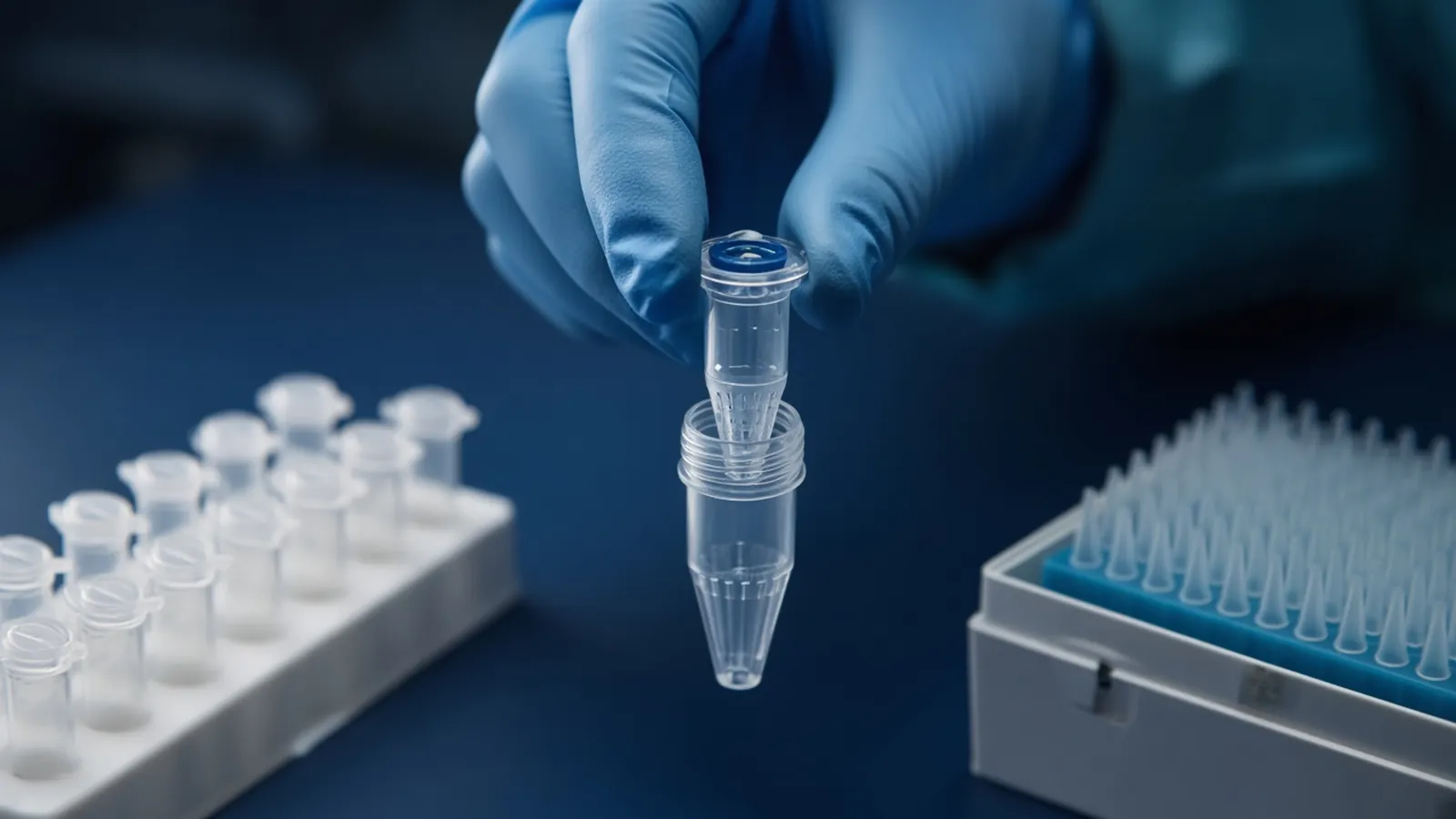
FFPE means formalin-fixed, paraffin-embedded tissue. The nucleic acid inside has already been crosslinked and broken before anyone calls it an extraction. Troubleshooting starts from that fact. A failed long amplicon is often the fragment length doing what fragment length does, not a column that returned an empty tube. This page is a reasoning path for research extracts. It is not a clinical test, not a pathology report, and not a solvent recipe.
How extraction classes behave on easier specimens is in how DNA extraction methods differ. How an endpoint PCR reports presence and size, rather than a starting copy number, is in how polymerase chain reaction works. Both limits apply twice as hard to a block.
What formalin and wax did before you arrived
Formalin, an aqueous formaldehyde preparation, crosslinks proteins to each other and proteins to nucleic acids. Those bridges lock tissue into a sliceable state and leave DNA and RNA chemically tangled. Over the fixation, and over the years of storage, strands also break. The molecules that a careful nucleic acid extraction can release are short. How short depends on how the block was fixed and kept, which you often do not know. Plan research amplicons on the short side of what you would attempt from fresh tissue, commonly well under a few hundred base pairs, and follow an assay you have actually tried on this material. A multi-hundred-base product that was easy on a blood extract can be the wrong question here.
Paraffin is the wax that makes the block cuttable. It is not a preservative for long DNA. Until it is removed, enzyme and lysis buffer mostly see wax. Deparaffinisation uses a solvent class. Xylene is the historical one. Some SOPs use a different organic solvent or a method built to avoid it. Which solvent is allowed is an institutional chemical decision, because these liquids are hazardous and the waste stream has to exist before the bottle does. This page does not give volumes, shake times, or a homemade substitute. If the SOP you are authorised to run names a solvent, that is the solvent. If your laboratory cannot host it, you are not ready to extract that block.
After the wax is gone, sample lysis of FFPE tissue is mostly a long proteinase K digestion. The crosslinked protein is what still holds the nucleic acid. Many protocols then use a separate heat step to reverse a portion of the crosslinks. That heat is not the same as the proteinase temperature. A widely used proteinase incubation is warm, often near 56 Celsius, while reversal steps are often hotter. Both numbers belong to the protocol in front of you. Guessing a hotter, longer bake is how you either do nothing to the wax or cook away what little length you had.
A260/A280 on the eluate can look like ordinary nucleic acid and still come from fragments of a hundred bases with proteins and solvent beside them. The ratio does not measure length and does not prove the crosslinks are gone. A gel or a fragment trace does the length job. It should show a short smear if the extraction worked. A high-molecular-weight band would be surprising and worth suspecting as contamination from fresh tissue processed nearby.
A reasoning path from the symptom
Write down what failed. "PCR failed" is not a symptom. "The 80-base amplicon worked, the 600-base amplicon did not" is a symptom. "Neither worked, and the spike also failed" is a different symptom.
If a short amplicon succeeds and a long one fails, the sample is not empty. The fragments cannot host the long product. Shorten the assay. Do not re-extract the block ten times to chase a length formalin already removed. Endpoint PCR will not tell you how many copies of a full gene were in the cell. It will tell you that a short target was present at a level this reaction could see.
If both lengths fail, run a spike of a short template that you know amplifies in a clean well. Spike failure means the eluate is inhibitory: residual solvent, residual proteinase, leftover formalin chemistry, or too much dirty DNA. A cleanup or a dilution is the branch, and the spike has to be repeated after it. Spike success with a continued sample failure means this reaction did not see the target. Then look at the section. Wax, fat, necrosis, or a curl that missed the tissue all produce a real elution of almost nothing. That is a sampling problem. Stain or examine a sister section if your histology practice allows it. Do not code "negative specimen" from a curl of paraffin.
If the yield is tiny and the proteinase step was short, the crosslinked protein never released the nucleic acid. Follow the digestion the FFPE protocol states, which is often longer than a fresh-tissue digest. Stopping early because the tube looks clear is how yield stays on the tissue flake.
If the eluate smells of solvent or the PCR dies at every dilution until the spike is almost alone, carry-over from deparaffinisation is the leading guess. The reasoning path is the wash or the drying step that SOP already contains. Adding a new solvent at the bench to "chase the wax" is not troubleshooting. It is an unassessed chemical exposure.
If RNA was the target and the integrity trace looks destroyed, compare it with the claim. Short RNA assays can still be honest on FFPE. A method that assumes intact ribosomal RNA, the way a fresh-tissue RNA integrity cutoff does, will reject the tube for being what it is. Say "fragmented, as expected for this fixation" in the notebook when that is the pattern, and keep the assay inside what those fragments can support. A no-RT control still matters, because FFPE DNA is also there and is also short enough to amplify.
If A260 is high and the fragment trace is flat, you may be measuring anything that absorbs, including leftover reagent, or you may have lost the DNA in a wash sized for long fragments. Short DNA does not always behave on a column the way genomic DNA does. Use an FFPE-specified method rather than a fresh-blood silica protocol, and confirm with a short PCR or a dye the protocol trusts.
| Symptom | The fragmentation-aware reading | The other reading you must still rule out |
|---|---|---|
| Long amplicon fails, short works | Fragments are too short for the long product | A long spike in the same eluate, if length must be proved |
| Short and long both fail, spike fails | Inhibition or overload | Solvent, proteinase, or a dirty concentrated eluate |
| Short and long both fail, spike works | Target not seen by this assay | Section missed the tissue, or the target is truly absent |
| Trace shows only a short smear | Expected FFPE length | Contamination would have looked long; a blank section checks the method |
| RNA integrity score looks poor | Often expected after formalin | A fresh control processed in parallel, if you claim the bench was at fault |
| Good A260/A280, no amplification | Ratio never measured length or crosslinks | Spike, then a short amplicon, before you discard the block |
| Yield collapses when sections increase | Overload or wax overload | Stay inside the method's input class for curls, not for fresh milligrams |
What a repeat will not fix
Re-extracting with the same long amplicon will not lengthen the DNA. Redesign, or accept that this block cannot support that assay. Re-cutting many sections into a method sized for two can clog a silica column with wax. A blank curl beside the samples catches fresh DNA from the microtome or the water bath. If the blank amplifies, the sample result is not interpretable. Do not invent a fixation time or a clinical threshold. You may say the length is what FFPE chemistry predicts, and show the short-versus-long result.
Safety, solvent, and the research limit
Formaldehyde chemistry and deparaffinisation solvents are the chemical hazards. Proteinase K is an enzyme dust hazard if you handle the powder. The tissue itself may be infectious depending on what was fixed, and fixation is not a universal sterilisation you get to declare. Institutional biosafety and ethics rules decide whether these sections may be cut and extracted. The WHO laboratory biosafety manual is background for that conversation, not approval and not a clinical licence.
A band from an FFPE extract is a research observation about that amplicon. It is not a diagnosis, not a margin, and not a forensic identification. Say so in any note that leaves the laboratory.
Archives, heat, and a specification that names the block
Blocks stored for years in a hot, humid room can be harder to extract than blocks stored cool and dry. You will rarely have a number for that effect. You can record where the archive lives and stop treating a warped, sweating block as equivalent to one that stayed in a controlled cabinet. Do not invent a half-life. Do mark the storage history when you know it, and do not pool eluates from a damp archive box with eluates from a controlled one.
When you enquire about FFPE extraction reagents, write that the input is fixed and paraffin-embedded, that the DNA or RNA is already fragmented, and that the amplicons you need are short. Ask whether the method class includes a deparaffinisation solvent and, if it does, say whether your laboratory is allowed to use that solvent. A fresh-tissue kit quoted against an FFPE block is the wrong capacity class and the wrong length assumption.
What to send
State the number and thickness of sections if you know them, DNA or RNA, the amplicon lengths you actually need, and whether a short control already worked. Mention solvent constraints plainly. Mention that you need a spike-compatible elution, not a maximum A260.
The sample preparation catalogue and the sample preparation pathway are where FFPE-capable classes can be compared with ordinary tissue classes. Send the block description with the quote request. The nucleic acid isolation enquiry reference is a place to frame the fixed-tissue question. It is an enquiry reference. It does not mean an FFPE extraction is performed for you. Ask whether a quotation is possible. The acceptance check is a short amplicon or a short spike, interpreted as research presence, not as a clinical result.
Questions from the bench
A 700-base PCR failed and a 100-base PCR worked. Is the block empty?
No. FFPE nucleic acid is short because formalin crosslinks and time have already broken it. A long amplicon needs two primers to land on the same surviving fragment, and many fragments will be too short for that. Endpoint PCR reports presence and size for the amplicon you chose, not a copy count of an intact gene. Design the research assay around short products, and treat the short success as evidence the tube was not empty.
Both the short and the long amplicon failed. Now what?
Then emptiness, inhibition, or a missed section are all still possible. A spike of a short, known template into the eluate separates inhibition from absence. A section that was mostly wax or necrosis can yield almost nothing, which is a histology problem. Residual solvent or an unfinished proteinase step can inhibit a tube that did contain tissue. Do not call the block negative until the spike has had its say.
Why is the RNA integrity number terrible when the extraction followed the card?
Because the RNA was fragmented by fixation before you started. A ribosomal trace from FFPE often looks degraded, and that pattern can be the expected one rather than a bench failure. Match the assay to short targets. A260/A280 can look ordinary on those short pieces and still say nothing about crosslinks or length. Compare the trace with what FFPE material from this protocol usually gives, not with fresh frozen tissue.
Can I skip deparaffinisation if I heat the section longer?
Wax still physically holds the tissue. Removing it is a solvent decision, historically xylene and now sometimes a different solvent class, and that choice belongs to the institutional chemical assessment and the SOP. Extra heat is a crosslink step, not a wax step. Do not invent a solvent or a volume. If your laboratory is not set up for the solvent the SOP names, stop and use a method the institution has already accepted.
References
Manufacturer names identify published method classes. Trademarks remain with their owners. Catalogue records on this site are independent references for enquiry. They are not a statement of inventory, distribution rights or a supply commitment. This page is educational. It is not medical advice, a diagnostic protocol or a biosafety approval.
Catalogue
Related products and categories
These links follow the subject of the article into published manufacturer references. A listing is a reference for an enquiry, not a statement of stock or distribution rights.
Continue in this cluster
Related reading
How DNA extraction methods differHow silica columns, beads, precipitation and organic extraction change DNA yield, length and inhibitors, and which class fits the assay you actually plan toA glossary of purification termsDefine chaotrope, bind-wash-elute, yield, purity ratios and RIN, then walk a purification so those words describe one real workflow.Blood saliva and tissue as starting materialExplain how EDTA blood, heparin blood, saliva and solid tissue behave as extraction inputs, and why a serum tube is not whole blood.