
guide
Fixation and antigen retrieval concepts
How formaldehyde and alcohol fixation change epitopes, and how to test one retrieval class against morphology before you lock a method.
- Author
- EVRINTH Editorial Team
- Published
- 8 October 2026
- Updated
- 8 October 2026
- Reading time
- 10 min
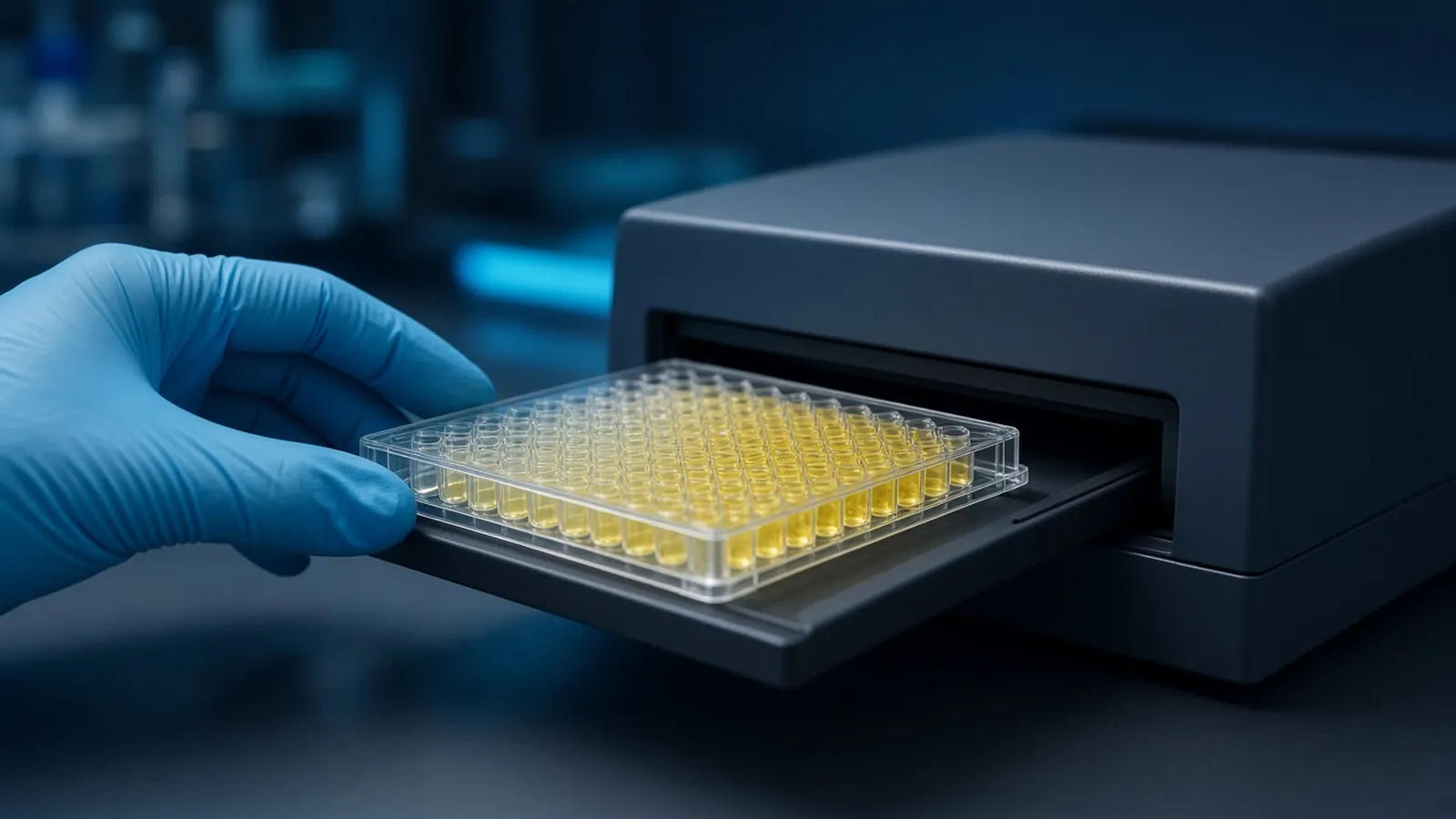
Fixation makes a specimen hold its shape, and it changes the epitope while it does so. Antigen retrieval is the family of attempts to make that epitope bindable again without erasing the shape you fixed the tissue to protect. This guide is how to choose a retrieval class as an experiment with controls. It is not a single recipe, and it is not a diagnostic staining instruction. The header image on this page is a developed plate going into a reader, the photograph assigned to this cluster. It does not show a tissue processor or a retrieval bath. Plate methods remain in ELISA formats, controls and readout. Tissue is a different matrix from a well, and retrieval is one reason.
Who is about to fix something, and what they may conclude
You are here if a research section or cell pellet stained poorly, or if you are writing the method before the first sample is committed. The decision is which fixative class the specimen will see, and whether a retrieval class will be part of the stain. Once study samples are fixed, you cannot unfix them. Get the class right on pilot material.
What you may conclude is that this antibody stains this compartment in this fixation when this retrieval is used, and that the no-retrieval arm behaved as you required. You may not conclude that the same antibody is thereby validated for ELISA.
Cross-links and precipitation are different chemistries
Formaldehyde, usually deployed as a dilute buffered formalin, cross-links proteins. Morphology is the benefit. Masked epitopes are the cost. A short fixation can leave the epitope more available and may be unacceptable for the biosafety or the morphology the study needs. A long fixation can bury epitopes so deeply that retrieval becomes mandatory or futile. Many research tissues see a formalin class for a period on the order of hours. The interval that counts is the one in your protocol and your safety rule. Do not copy a time from this paragraph into a notebook as if it were that protocol.
Alcohol fixation, including ethanol and methanol, and acetone used as a precipitating fixative, work by removing the water shell and precipitating proteins. Soluble antigens can be lost. Lipid-rich structures are extracted. Cross-linking is minimal, so retrieval of the formaldehyde type is often irrelevant and sometimes harmful. Frozen sections fixed briefly in acetone or alcohol are a different method from paraffin sections that saw formalin and heat. Write which one you did. A paper that says "fixed" and nothing else has not told you enough to copy.
The antibody sees whatever surface survived. A linear peptide epitope may tolerate denaturation and fail when cross-linked. A conformational epitope may survive gentle fixation and vanish on a blot. That is why an ELISA dilution is not a retrieval method. Public background on antibodies as reagents is on the NCBI Bookshelf. The section in front of you is the test.
Retrieval classes, treated as experiments
Heat-induced epitope retrieval places the dewaxed section in a buffer and heats it. Citrate buffers near mildly acidic pH, and other classes such as Tris with EDTA near alkaline pH, are both widely used. They do not do the same thing to every epitope. pH is part of the class. How to make and check a buffer is preparing a buffer and checking pH. Heat sources include water baths near simmering temperature, steamers, microwave devices and pressure devices. The temperature and the minutes belong to a protocol you can reproduce. A "hot until it looks done" setting is not a method. Many published heat steps sit near 95 to 100 Celsius for a period on the order of minutes, or use pressure to go higher for a shorter time. Follow the sheet you have adopted, including the cooling step. Pulling a slide straight from boiling buffer into cold water can lift the tissue off the glass.
Enzymatic retrieval uses a protease to nick surrounding protein. Proteinase K, trypsin and pepsin are the usual classes. They are not interchangeable unit for unit. Enzyme retrieval can succeed when heat fails, especially on some heavily fixed epitopes, and it can digest the morphology into mush. Concentration, time and temperature are the whole experiment. Start from the enzyme supplier's window. Promega protocols are one public set of enzyme notes. Use the product you actually have.
Choose one class per pilot. A slide that saw heat and then protease has two explanations for every change. The no-retrieval arm is the control that tells you the antibody was capable of staining without help, or that it was not. Method sketches from other laboratories live on protocols.io. Treat them as designs to test, not as conditions already true for your tissue.
Over-retrieval is a bright, ragged section: nuclei blown, cytoplasm grainy, stain in the wrong compartment, tissue missing from the centre of the piece. Under-retrieval is intact morphology and no signal, including on the positive control that should have stained. Both are results. Neither is fixed by a longer chromogen development. More substrate on an under-retrieved slide raises background. More substrate on an over-retrieved slide makes the damage easier to see and no more specific.
Lock the method, then touch the sample set
Pilot on material you can spare, with a positive specimen and a negative specimen if you have them. When one condition gives signal in the expected compartment and morphology a collaborator can still read, write it down to the level of buffer identity, pH, device, time and antibody dilution. That written condition is the method. Study sections see that method only.
If the positive control fails on a later day, you may troubleshoot. You may not quietly raise the retrieval time for the treated group and not the control group. The retrieval would become the treatment.
| What the slide shows | Likely reading | What to change next |
|---|---|---|
| No signal, morphology still good, positive control also blank | Under-retrieval, a dead antibody, or a fixation that this epitope cannot survive | Try one retrieval class against the no-retrieval arm. Do not lengthen chromogen first |
| Strong signal, architecture destroyed, stain in unexpected places | Over-retrieval or tissue lifted and refolded | Shorten or cool the retrieval. Judge the negative tissue again |
| Signal in the wrong compartment, morphology acceptable | Possible true biology, or an epitope exposed on the wrong protein | Compare with a negative specimen through the same retrieval before you rewrite the cell biology |
| No-retrieval arm already perfect | Retrieval is unnecessary for this epitope | Leave it out. Extra heat is a new variable |
| Positive control works, study section blank, morphology good | The study specimen may lack the target, or it was fixed differently | Confirm fixation history before you intensify retrieval on that slide alone |
Failure modes that look like biology
A retrieval that is harsher on the treated slides than on the controls invents a treatment effect. Bake the retrieval device's temperature map into the pilot. Slides at the edge of a rack can run cooler than slides in the middle. Rotate positions across a study or pack the rack the same way every time.
A buffer made at the wrong pH is a different retrieval class wearing the old name. Check pH at the temperature your protocol cares about, and do not top up an evaporated retrieval vessel with water and keep going. Evaporation concentrates the buffer and shifts pH.
Enzyme retrieval that continues while you answer a phone digests the section. The stain may look excitingly strong in the debris. Stop the enzyme the way the protocol says, often by a wash or a temperature change, and do not score debris.
If the compartment changes when you change retrieval class, believe that the method is unstable before you believe that the protein moved. Proteins do have isoforms in different compartments. You earn that claim by a method that stays put and an antibody that has already survived a specificity check.
Formaldehyde is a hazardous chemical
Formaldehyde and formalin are toxic and sensitising. Alcohols and acetone are flammable. Retrieval buffers are hot enough to burn, and pressure devices add a mechanical hazard. The institution decides the cabinet, the waste stream and the training. Fixation also sits inside biosafety: it is one control for some specimens and an inadequate control for others. The WHO Laboratory Biosafety Manual is a public reference your safety office may already use. It does not authorise a diagnostic stain. A research retrieval method stays a research method.
Heat, pressure and a bath that lost power
In a warm laboratory a retrieval bath set near boiling can overshoot if the thermostat is crude. Check the device with a thermometer you trust before the first study day. Pressure vessels must be the ones your institution allows. If a power cut interrupts a heat retrieval, those slides received an unknown thermal dose. Do not pair them with slides that finished. A partial enzymatic digestion is the same broken method. You cannot add the missing minutes the next day and call it one exposure.
A citrate bottle that has sat for a month is not the buffer you piloted. Make retrieval buffer in a volume you will finish, and record the date.
What an enquiry about retrieval reagents should contain
State the fixative the specimens have already seen, the species, the antibody host, and whether morphology of a named compartment has to survive. Say whether you are choosing a heat class or an enzyme class, and what positive and negative material you can run. Do not ask for a universal retrieval that works for every antibody. The reagents and chemicals catalogue is where buffer and related reagent classes can be browsed. The molecular biology pathway is the methods context. A retrieval approach can be discussed through the quote request. Ask the reply to name the buffer class and the hazard notes. Test the class against a no-retrieval control before any study section depends on it.
Lock a retrieval class only after morphology and signal agree
- 01Fix the specimen the way that specimen requiresUse the fixative class, time and temperature the tissue or cell-pellet protocol already demands for morphology and biosafety. Do not shorten fixation only to chase an epitope, and do not switch from formaldehyde to alcohol in the middle of a sample set.
- 02Run one retrieval class beside a no-retrieval controlPick heat-induced retrieval in one buffer class, or one enzymatic class, and compare it with sections that skip retrieval. Change a single class per experiment so you know what moved the stain.
- 03Judge the signal and the morphology togetherAccept a condition only when the positive control stains in the expected compartment and the nuclei, membranes or architecture you need are still recognisable. A strong stain on a ruined section is not a method.
- 04Lock the condition before the study sectionsWrite the fixative, the retrieval class, the buffer, the heat or enzyme setting and the time into the method. Then stain the sample set. Tuning retrieval on each interesting slide makes the comparison the retrieval, not the biology.
Questions from the bench
What does formaldehyde do to an epitope?
It cross-links proteins, largely through methylene bridges that involve reactive side chains. The tissue hardens and the architecture holds, and the epitope the antibody needs can be buried or chemically changed. That is why a formalin section can be silent with an antibody that worked on fresh or denatured protein, and why a retrieval step is sometimes tried afterwards.
How is alcohol fixation different?
Alcohol and acetone precipitate proteins and remove water, and they extract many lipids. They cross-link far less than formaldehyde, so some epitopes stay easier to bind, while some soluble antigens simply leave the section. A method that works after alcohol fixation is not evidence about a formalin archive, and the reverse is also true.
What is the difference between heat retrieval and enzyme retrieval?
Heat-induced retrieval warms the section in a buffer, commonly a citrate class or another buffer class near a stated pH, to reverse or loosen formaldehyde cross-links. Enzymatic retrieval uses a protease such as proteinase K, trypsin or pepsin to cut nearby protein and expose an epitope. Both can uncover signal and both can destroy the section if they are pushed too far.
Should every antibody be retrieved?
No. Some epitopes are damaged by retrieval, and some frozen sections need no retrieval at all. The no-retrieval control exists so you can see whether the step helped, did nothing, or made the stain worse. Follow the antibody sheet as a starting hypothesis and keep the control anyway.
References
Manufacturer names identify published method classes. Trademarks remain with their owners. Catalogue records on this site are independent references for enquiry. They are not a statement of inventory, distribution rights or a supply commitment. This page is educational. It is not medical advice, a diagnostic protocol or a biosafety approval.
Catalogue
Related products and categories
These links follow the subject of the article into published manufacturer references. A listing is a reference for an enquiry, not a statement of stock or distribution rights.
Continue in this cluster
Related reading
ELISA formats controls and readoutELISA formats, controls and readout: how direct, sandwich and competitive assays turn a binding event into a number that stays inside the curve. Preparing a buffer and checking pHPrepare a buffer at a stated pH and temperature, record the salt form, and treat a drifting electrode or a bad slope as a failed control.
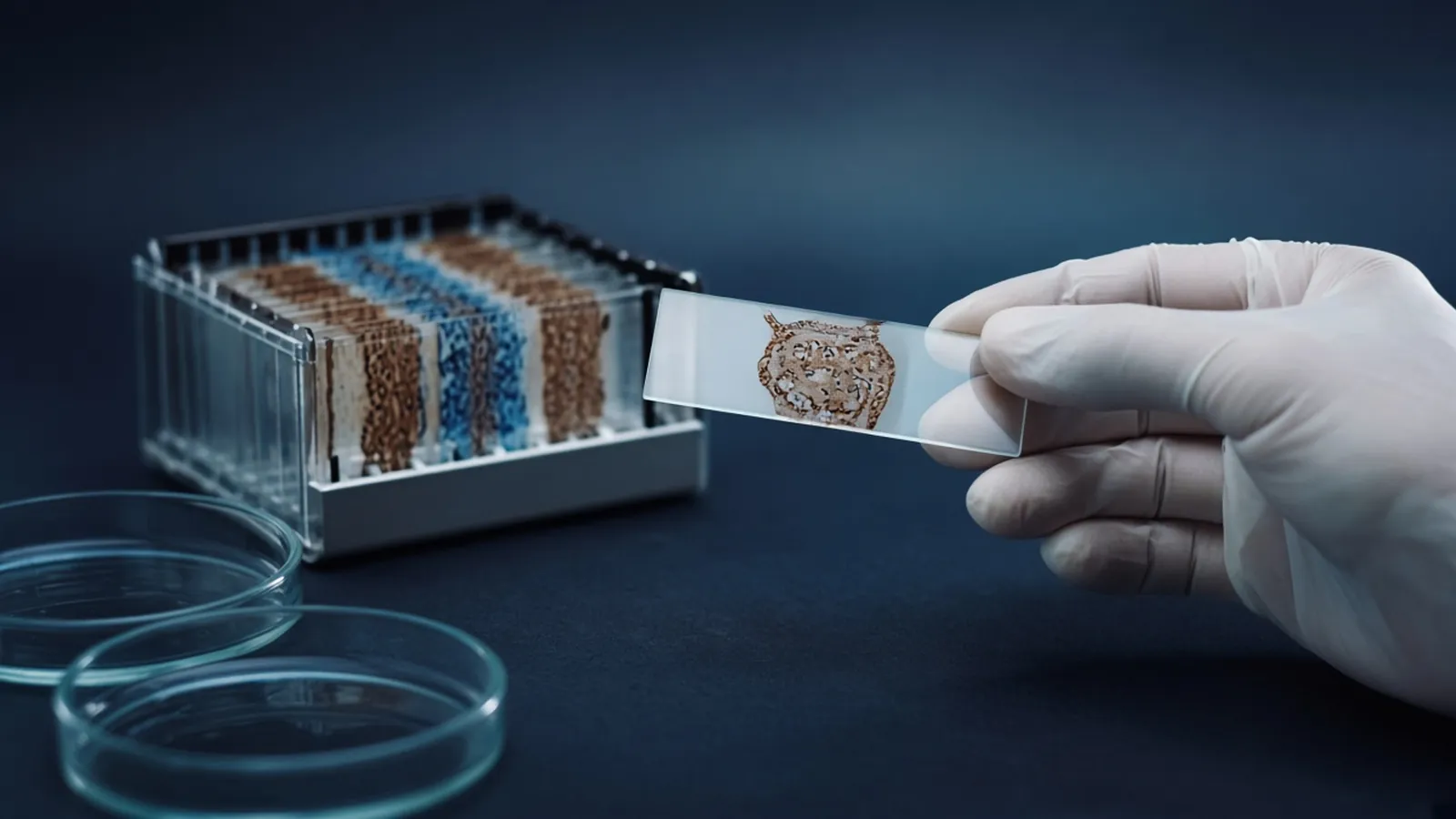 Immunohistochemistry is a different matrixWhy an antibody that works in an ELISA can fail on fixed tissue, and which controls make an immunohistochemistry result a research observation.