
guide
Forward and reverse pipetting
Choose forward pipetting for aqueous liquids and reverse pipetting when the liquid foams, clings, or evaporates, and do not mix the strokes in one check.
- Author
- EVRINTH Editorial Team
- Published
- 8 October 2026
- Updated
- 8 October 2026
- Reading time
- 8 min
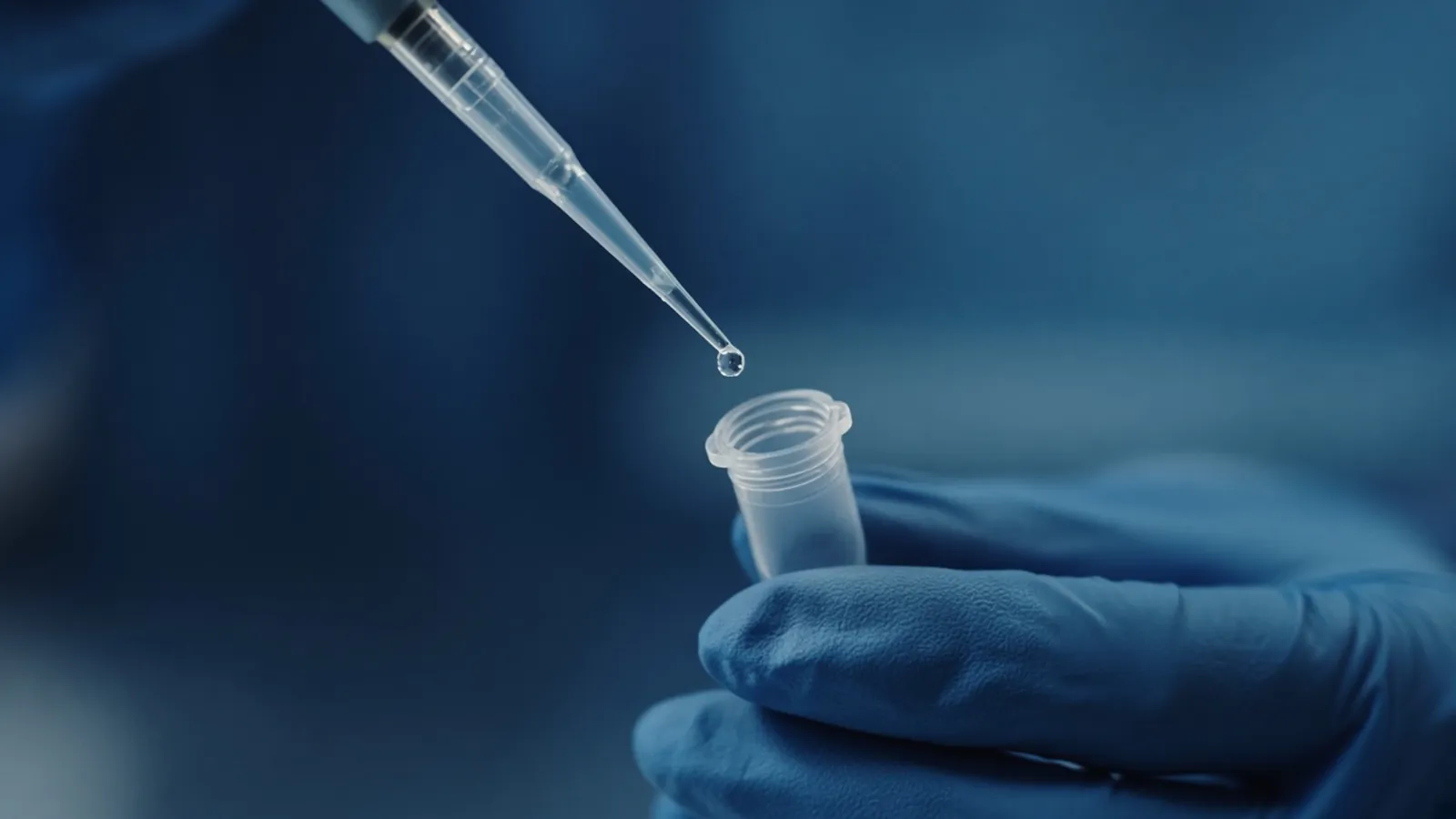
Forward and reverse pipetting are two ways to spend the same two stops on an air-displacement pipette. The decision is which stroke matches the liquid, not which gesture feels faster. Ordinary aqueous buffers, dilute standards, and most enzyme diluents belong on the forward stroke. Liquids that foam, cling to plastic, or throw vapour belong on the reverse stroke, or they belong on a positive-displacement pipette. How to hold the instrument, pre-wet an aqueous tip, and recognise a drip is the companion habit in accurate micropipetting technique.
Pipettes live with the scientific instruments catalogue. Tips live with the laboratory consumables catalogue. A family name does not tell you which stop a particular method used.
What the two stops are for
The first stop is the end of the calibrated stroke. The second stop is further down and exists to push out a small extra volume of air, the blow-out. On a forward stroke you aspirate by pressing only to the first stop, dipping the tip a few millimetres into the liquid, and letting the plunger rise smoothly. You deliver by pressing to the first stop, pausing so the liquid can finish leaving, and only then pressing to the second stop. You withdraw the tip while the plunger is still down. Releasing it inside the destination pulls the aliquot back up.
Reverse pipetting spends the blow-out on the way in. You press past the first stop, toward the second, before the tip enters the liquid. The rise of the plunger then draws the set volume plus that extra. At the destination you press only to the first stop. The remainder stays in the tip and is discarded, not blown into the tube. The leftover is a buffer against a film that would otherwise change from tube to tube.
ISO 8655-1:2022 is the terminology and user-recommendation part of the piston-operated volumetric apparatus series. It does not certify that the pipette in your hand is inside its error limits today. The numerical tolerances for pipettes live in ISO 8655-2:2022 and in the manufacturer specification. A laboratory compares its own check with the specification it claims.
Which liquids ask for which stroke
Water-like reagents wet a polypropylene tip, drain when the blow-out arrives, and do not fill the air cushion with a heavy vapour. Forward pipetting is the technique those liquids were usually calibrated against. If you reverse-pipette a simple buffer out of habit, you leave a deliberate remainder behind and the tube is short of what the dial suggested to anyone who assumed a full blow-out.
Viscous liquids, concentrated protein, glycerol mixes, and many detergents do the opposite. They climb the tip late, leave a film, and sometimes foam if the plunger snaps. Reverse pipetting makes the retained film part of the discarded remainder, so the delivered volume repeats more closely. The plunger still has to move slowly. Reverse mode is not a licence to flick the thumb.
Volatile solvents are a third case. Ethanol, acetone, and acetonitrile classes evaporate into the air cushion, pressure in the tip rises, and the liquid drips or under-delivers. Reverse pipetting can steady the amount that leaves, and pre-wetting is still required, but positive displacement is often the better class because there is no air cushion to saturate. If the tip drips while it is parked, stop and change class or change the physical condition of the liquid. Do not average the drips into the result.
A workflow with a branch when the tip misbehaves
Set the volume inside the pipette's stated range. Seat a tip that actually seals on that cone. A universal claim on a box is not a seal. Pre-wet when the method is aqueous or volatile: draw and expel the working liquid so the first measured stroke is not the one that fills a dry cushion with vapour. Then commit to one mode for the whole series.
Branch as soon as the tip argues with you. A bubble means the aspirate was too fast, the tip broke the surface, or the liquid is a detergent that needs a slower reverse stroke. Expel and repeat. A drip before dispensing means a poor seal, a damaged shaft, a volatile liquid, or liquid that has already entered the nose. Reseat once. If it drips again with a fresh tip, take the pipette out of quantitative service. A film that stays after a forward blow-out means the liquid wanted reverse mode or positive displacement. Do not spin the tube and call the film recovered. The film was never in the calibrated delivery.
Keep the two modes out of one gravimetric series. An interim water check, as in checking a pipette between calibrations, is a forward-water comparison unless your procedure says otherwise. A reverse-mode result answers a different question.
| Liquid class | Stroke to write down | What remains in the tip |
|---|---|---|
| Aqueous buffer or standard | Forward: first stop to aspirate, second stop to expel | The blow-out air, after the aliquot has left |
| Foaming detergent or protein | Reverse: aspirate past the first stop, dispense only to the first | The extra volume, discarded away from the sample |
| Glycerol-rich or oily mix | Reverse and slow, or positive displacement | A deliberate remainder, or none if a piston tip is used |
| Ethanol, acetone, acetonitrile class | Pre-wet, work promptly; prefer positive displacement if drips persist | Whatever reverse mode retained, if you stayed with air displacement |
When the result looks like a reagent failure
People reverse-pipette the last of a standard they believe they measured by the dial, then blow the remainder in to be complete. That last push delivers the blow-out volume the reverse stroke was designed to withhold. The tube is no longer the set volume. Discard the remainder into waste. If half the tubes in a master mix were blown out and half were not, the enzyme will look intermittent. Watch one tip and one mode into a weigh boat before you open a new kit.
Safety and the limit of this page
The liquid decides the hazard. A smaller stroke does not make solvent, acid, or culture mild. Blow-out of a culture is an aerosol. Follow the containment your institutional assessment already named, and use a filter tip when that assessment asks for one. This page is a research technique note. It is not a dosing instruction and not a diagnostic method.
What to put in an enquiry
State the volume range, whether the work is aqueous, viscous, foaming, or volatile, and whether you need air displacement or positive displacement. Name single channel or multichannel, and the tip family the cone must seal. If a calibration document is required, say so, and say which volumes. Send that with a quotation request. Ask for the written range and the recommended tip.
Choose the stroke that matches the liquid and keep it for the whole series
- 01Name the liquid before you choose the stopWrite whether the liquid is aqueous, foaming, viscous, or volatile. The stroke follows that class. A dial setting does not choose the stroke for you.
- 02Use the forward stroke for ordinary aqueous liquidsPress to the first stop, aspirate by releasing smoothly, deliver to the first stop, pause, then use the second stop only as the blow-out. Withdraw before you let the plunger rise.
- 03Use the reverse stroke when the liquid will not leave the tip cleanlyPress past the first stop, aspirate the extra volume, and dispense only back to the first stop so the remainder stays in the tip. Discard that remainder. Do not blow it into the sample.
- 04Stop the series if the mode and the check disagreeIf a gravimetric check was defined for forward pipetting of water, do not interpret a reverse-mode series against that same limit. Repeat in one mode, with a tip that seals, or change pipette class.
Questions from the bench
What is the blow-out volume on a forward stroke?
The blow-out volume is the extra travel between the first stop and the second stop. On a forward stroke it is empty during aspiration and is used only at the end of dispensing to push the last of an aqueous aliquot out of the tip. It is not a second calibrated sample. If you aspirate from the second stop, you have left forward mode and started a reverse stroke, and the dial no longer means what a forward calibration assumed.
When should reverse pipetting replace the forward stroke?
Use reverse pipetting for liquids that foam, cling, or evaporate, including many detergent solutions, glycerol-rich mixes, and solvent classes such as ethanol. You aspirate past the first stop and dispense only to the first stop, leaving the remainder in the tip so the retained film is more repeatable. Precious standards that must be delivered in full are a poor match for reverse mode, because the tip is supposed to keep liquid at the end.
Can both strokes be used in one calibration series?
They should not. A calibration or an interim check is defined for one technique, almost always forward pipetting of water for an air-displacement pipette. Mixing reverse dispenses into that series changes the delivered volume on purpose and then makes the mean look like an instrument fault. Finish the series in one mode. If the liquid truly needs reverse pipetting, write that mode into the method and compare it with a limit that was set for that mode.
Does a firm click mean the tip is suitable for either stroke?
A click is a sound, not a seal. Forward and reverse pipetting both depend on the tip matching the cone, because any leak changes the air cushion before the stops can do their job. Seat the tip firmly, watch for a drip before you dispense, and change family if the same pipette drips with one brand and holds with another. The tip you use for a quantitative series should be the family named in the method.
References
Manufacturer names identify published method classes. Trademarks remain with their owners. Catalogue records on this site are independent references for enquiry. They are not a statement of inventory, distribution rights or a supply commitment. This page is educational. It is not medical advice, a diagnostic protocol or a biosafety approval.
Continue in this cluster
Related reading
Accurate micropipetting techniqueHow an air-displacement micropipette delivers a volume, how forward pipetting uses the two stops, and why temperature belongs in the result.A glossary of liquid-handling termsSeparate the liquid-handling terms people mix up, from blow-out and pre-wetting to systematic error, tip fit, and the Z-factor.Air displacement versus positive displacementTrace under-delivery and dripping to the air cushion or the piston, and choose the pipette class that matches the liquid.