
glossary
Freeze-thaw cycles and aliquots
Freeze-thaw damage comes from ice, concentrated solutes, and interfaces. Aliquots cut cycles. No single cycle count fits every sample.
- Author
- EVRINTH Editorial Team
- Published
- 8 October 2026
- Updated
- 8 October 2026
- Reading time
- 9 min
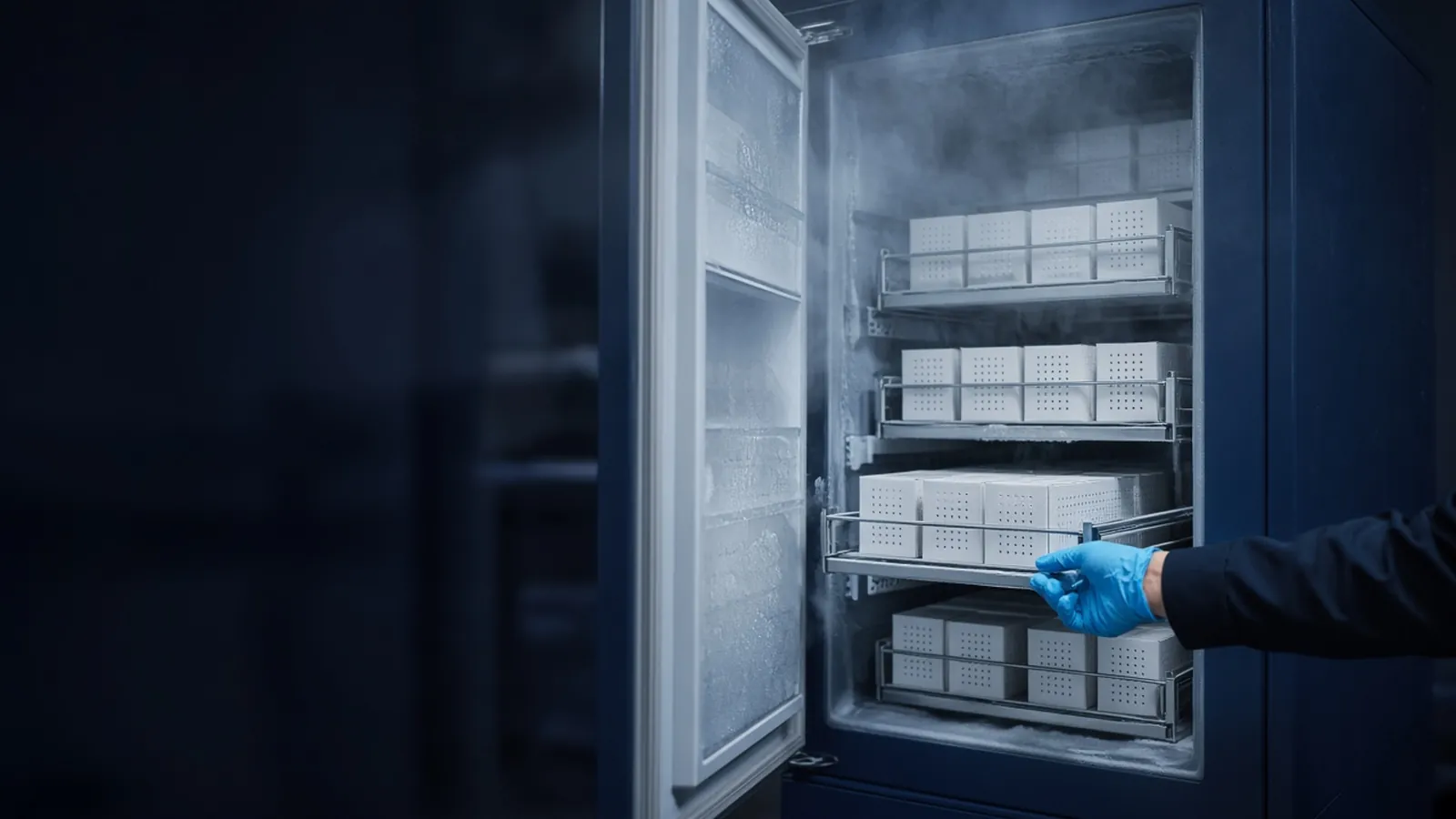
People say "freeze-thaw" as if it were a single villain and "aliquot" as if it were a single cure. The words hide three injuries — ice, concentrated solutes, and interfaces — and a practical control that only reduces how often those injuries repeat. This glossary fixes the terms so a storage decision can use them precisely. It does not offer a universal cycle limit. Where the cabinet fits in the wider cold ladder is storing biological samples from fridge to freezer.
Small tubes for single-use portions are laboratory plasticware. Labels are laboratory consumables. Specifying them is a laboratory procurement note and a quotation request. The tube has to be rated for the temperature, which when to use plastic tubes, tips, and plates treats as its own choice.
Freeze-thaw cycle
A freeze-thaw cycle is one trip from a frozen state to a thawed state, or through a partial thaw that lets ice and liquid reorganise, and back. The count belongs to a particular tube, not to a project. If you thaw a stock, remove a portion, and refreeze the stock, the stock has gained a cycle and the portion has its own history.
The confusion is to count only complete, deliberate thaws at the bench. A tube that softened at the edge during a long door search has cycled even though nobody meant it. A frost-free cabinet can cycle the contents on a defrost pulse while the building is empty. Record the excursions you know about, and do not pretend the unknown ones were zero. Do not, either, invent a maximum. The product document or a functional test sets the limit for that material.
Aliquot
An aliquot here means a portion divided off so that it can be used without disturbing the rest. In cold storage the useful size is one experimental use: one digest, one transformation, one blot, one extraction. A tube that still contains ten uses will be thawed ten times, which means it was not an aliquot. It was a smaller stock.
The confusion is to aliquot by a round volume that does not match the method. Fifty microlitres looks tidy and still invites a second dip. Divide by the protocol's real consumption, plus the dead volume your pipette actually leaves, and label the tube with what it is for. Aliquots are made before the first long freeze whenever you can. Dividing a tube that has already been thawed five times produces five tired portions, not five fresh ones.
Aliquoting is not sterilising, not removing nucleases, and not a cryoprotectant. It is a bookkeeping of damage. Do it with tubes and tips that match the cleanliness the sample needs.
Ice
Ice is water leaving the liquid as crystals. Crystals exclude solutes and can puncture membranes. Slow freezing and fast freezing do not make the same crystals. That is why cell methods specify a freezing rate and a cryoprotectant, and why this glossary will not tell you to "just put it in the freezer" for anything that must stay viable. Viable-cell freezing is a method of its own. Follow it or follow the collection that sent the strain. The ATCC culture guides are an example of recovery instructions that belong to the material.
The confusion is to treat ice as either always fatal or always irrelevant. A plasmid in a simple buffer often survives freezing that would kill a mammalian cell stock. An enzyme formulation built to stay liquid at minus 20 may be designed so that a solid block of ice is not the normal condition. If you freeze that formulation much colder than the document allows, you may create the ice the formulation was avoiding. Read the storage class before you congratulate yourself for being colder.
Thawing injures as well. Crystals can grow during a slow warm. Methods that say thaw quickly on ice, or in the hand, or in a water bath of a stated kind, are controlling that growth. Follow them. A tube forgotten in a coat pocket is not a method.
The unfrozen fraction and concentrated solutes
As ice forms, the remaining liquid holds the salts, buffers, proteins, and other solutes in a smaller volume. Concentrations rise. pH can shift. Proteins that were stable in the original buffer meet a brine. This freeze concentration is a large part of what people blame vaguely on "thawing." It happens during the freeze.
The confusion is to look only at the thawed liquid, which looks like the original solution once the ice has melted back. The stress already occurred. Adding glycerol, sucrose, or another excipient is one way manufacturers reduce that stress for proteins and enzymes. The fraction and the identity of the excipient are part of the product, not a kitchen improvement. Do not spike a commercial enzyme with extra glycerol because a glossary mentioned the word. You would be changing a formulation you did not measure.
Dimethyl sulfoxide appears in many cell-freezing methods as a cryoprotectant class. It also carries dissolved substances across skin and has its own safety data sheet. Use it only as the method and the laboratory chemical rules describe. This glossary is not a freezing recipe and not a volume table.
Interfaces
An interface is a boundary: ice against liquid, liquid against the tube wall, liquid against air, or the surface of a bubble. Proteins adsorb and unfold at interfaces. A small aliquot in a large tube has more wall and more air per microlitre than the same aliquot in a filled small tube. That is a reason to match tube size to volume, not only a reason to own many caps.
The confusion is to ignore the headspace. A half-empty cryovial of a delicate protein is a different object from a nearly full one. Avoid bubbles if the method says so. Avoid vigorous vortexing of a protein that the document says to swirl. The freeze did not create your handling, but the next thaw is when handling meets a population of molecules that already saw an interface.
Labels and caps are interfaces of another kind. A cap that leaks loses volume and invites frost and contamination. The cycle count is then the least of the problems.
| Term | What it actually is | The confusion to retire |
|---|---|---|
| Freeze-thaw cycle | One freeze and one thaw, including a partial thaw | Counting only deliberate bench thaws, or using one maximum for every sample |
| Aliquot | A portion sized so the rest of the stock is not opened | A tidy volume that still contains many future uses |
| Ice damage | Crystals that exclude solutes and can break membranes | Assuming every frozen reagent froze solid, or that ice is always the whole story |
| Freeze concentration | Solutes crowded into the unfrozen liquid | Judging the sample only after it looks normal again |
| Interface | Walls, air, ice, and bubbles where molecules stick and unfold | Aliquoting into a tube that is mostly air |
| Cryoprotectant | An additive the method names to change freezing behaviour | A universal spike you add without the document |
A plasmid prep and an antibody, side by side
You purify a plasmid and you freeze it in one large tube out of habit. Over a season the tube is thawed, a few microlitres are taken, and it is frozen again. The DNA still transforms at the end of the season. Someone concludes that freeze-thaw is a myth. Next door, an antibody aliquot from a supplier who said to avoid repeat freeze-thaw is treated the same way. The blot weakens. Someone concludes that the antibody "does not work."
Both conclusions skip the glossary. The plasmid was a forgiving molecule in a simple buffer, and even that luck is not a law you can export. The antibody was a protein at an interface, with a document you did not follow. The repair for the antibody is new aliquots from a fresh vial, each sized to one blot, stored in the class the supplier names. The repair for the plasmid is still aliquots, because the next insert may be less forgiving and because contamination risk rises every time the stock is opened. Addgene's protocols and public methods on protocols.io show storage sentences that differ by material. Believe the sentence attached to the thing in your hand.
Enzyme catalogues such as the NEB product list similarly attach a storage condition to a named enzyme. Many of those formulations are meant to be sampled cold without a full thaw. That is a third pattern: not "aliquot everything into single digests," and not "thaw the stock daily," but "keep it liquid at the stated temperature and do not impose extra cycles." If your freezer cycles, the glossary term for what the enzyme feels is still a cycle.
How to reason when the assay has already drifted
Ask which tube was opened, how many times you know about, and whether a cabinet could have added silent cycles. Then ask which mechanism fits the molecule. Cells point you at ice and cryoprotectant. Proteins point you at concentration and interfaces. Nucleic acids often point you at nucleases and contamination admitted during the thaw, which is a handling failure wearing a freeze-thaw costume.
The branch is a fresh aliquot from material that has not lived in the suspect tube. If the fresh portion works, retire the cycled tube. If it fails too, look elsewhere. Do not average the two results and keep going. And do not adopt the neighbour's cycle limit as a house number. Write limits per material class, citing the document, and leave a blank where you have no evidence.
Safety and research use
Thawed samples are still the biological agents they were when frozen. A cycle is not a decontamination. Spills of thawing material follow the biosafety rule for that material. Cryoprotectants are chemicals. This glossary is not medical advice, not a diagnostic storage rule, and not permission to freeze human specimens outside the system that governs them.
Cold tubes also injure skin. Let a rack temper only as the method allows, with gloves appropriate to the cabinet you opened.
What the enquiry contains
Ask for a range of tube volumes so aliquots can match real uses, caps rated to the storage class, and labels that remain readable after frost. State that you will set cycle limits from product documents and your own checks, and that you do not want a seller to invent one. If you are buying enzymes or antibodies, ask for the storage sentence and whether the formulation is intended to stay liquid. Those sentences are the glossary applied to a purchase.
Questions from the bench
How many freeze-thaw cycles is too many?
There is no universal number. An antibody, a polymerase, a competent-cell stock, and a plasmid prep do not share a limit. Some documents allow a few cycles and some say the vial is single-use. If the document is silent, your own functional assay is the evidence. A rule copied from a neighbouring project is not.
Does an aliquot prevent damage, or only limit how often damage happens?
Aliquoting limits how many times a given portion is frozen and thawed. The first freeze still happens, and that freeze can itself injure cells or proteins. Smaller portions also change surface-to-volume ratio, which can matter. The gain is that you stop thawing the whole stock to steal a microlitre. Size the aliquot to one real use, not to an imagined year of maybes.
Is a partial thaw on the bench a cycle?
Treat it as one if the material softened, even if you put it back before it felt warm. Ice recrystallised, solutes moved, and the clock advanced. A frost-free freezer can deliver the same partial thaw with the door shut. The glossary counts the thermal excursion, not the intention.
What should we ask for when the aliquot is the point of the purchase?
Ask for tube sizes that match one use, caps that seal at the storage temperature, and labels that survive frost. State the storage class from the product document. Do not ask a seller to certify a cycle limit they have not measured. Send the specification as a quotation request.
References
Manufacturer names identify published method classes. Trademarks remain with their owners. Catalogue records on this site are independent references for enquiry. They are not a statement of inventory, distribution rights or a supply commitment. This page is educational. It is not medical advice, a diagnostic protocol or a biosafety approval.
Catalogue
Related products and categories
These links follow the subject of the article into published manufacturer references. A listing is a reference for an enquiry, not a statement of stock or distribution rights.
Continue in this cluster
Related reading
Storing biological samples from fridge to freezerFridge, minus-20, minus-80 and nitrogen storage slow different kinds of damage. A warm box is a quarantine decision, not a hope. When to use plastic tubes tips and platesWhen polypropylene tubes, pipette tips and polystyrene plates are the right vessel, and when solvent or volume still belongs in glass.A glossary of cold-chain termsSetpoint is not air temperature, and a phase-change pack is not every coolant. Compare the cold-chain pairs labs treat as one word.