
protocol overview
Freezer maps and the box you cannot find
A freezer map records rack, box, and position so you can retrieve a sample without a long search with the door open.
- Author
- EVRINTH Editorial Team
- Published
- 8 October 2026
- Updated
- 8 October 2026
- Reading time
- 9 min
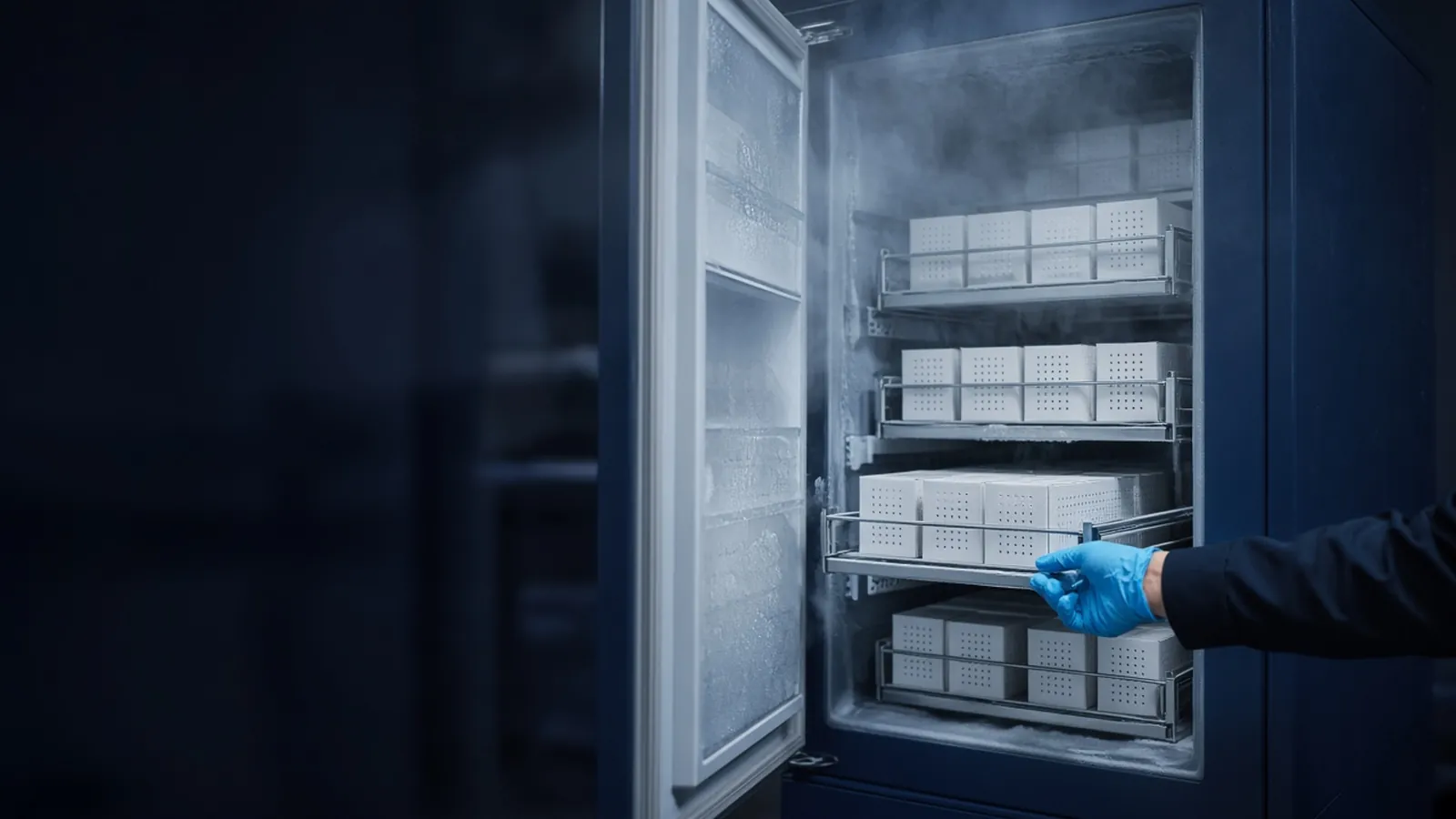
The box you cannot find is not a memory problem. It is a door-open problem. A freezer map is an inventory of rack, box, and position, written so that one person can remove one box and leave. The failure mode is an unlabelled box that forces a long search while every neighbouring sample warms. This protocol is how you build the map and what you do when it lies. Temperature classes themselves are set out in storing biological samples from fridge to freezer.
Boxes, racks, and tubes are specified from the laboratory plasticware catalogue. Labels and markers are laboratory consumables. The cabinet that holds them is an instrument in scientific instruments. Fit and format are a laboratory procurement discussion and a quotation request. Tube choice, including what is actually rated for the cold, is also covered in when to use plastic tubes, tips, and plates.
Who the map is for
Use this workflow when more than one person shares a freezer, and when a search would mean standing in front of an open minus-80 or a frost-heavy minus-20. A single user with one box on one shelf can keep the habit small. The moment a second project arrives, the absence of a map starts charging everyone else in warm air, in frost, and in lost tubes.
The decision the protocol supports is whether you may open the door, and what you must write before you close it. It is not a database project. A paper card on the outer door can be a valid map if it carries rack, box, and position and if people update it. An elaborate system that nobody updates is worse than the card, because it creates false confidence.
What the record must contain
A useful line identifies the freezer by a name painted on the cabinet, not "the freezer near the sink," which moves. It identifies the shelf or inner compartment, the rack, the box, and the cell in the box if tubes share a grid. It names the contents in words a stranger can read, the owner, the date in, and the storage class. Hazard and biosafety notes belong there when the institutional rule says they do. A freezer is not a hiding place from those rules.
Position means a coordinate you can check without unpacking the box onto a warm tray. "Box 12, cell B3" is a position. "Somewhere in the plasmid rack" is a rumour. Rack labels should face the door so you read them in seconds. Box labels should face the same way. If the rack hides the label, the rack is part of the failure.
Keep one authoritative list. A photograph of a shelf, a private notebook, and a shared sheet will diverge by Friday. Pick the shared sheet or the card, and make the others point at it. When you do use software, the fields stay the same. Software does not forgive a box that went in unlabelled.
The session in which a tube enters
Before you leave the bench, label the tube and the box. Include a short identity, the date, and your name or a project code the group recognises. Use a label stock that stays on at the temperature of that cabinet. Ordinary tape and ordinary ink fail when they freeze, when they collect frost, and when that frost later melts and wets the adhesive. Pencil on a frosted card can outlast a fancy label that falls off. Test your combination once, on an empty box, before you trust it with a unique aliquot.
Carry the map line with you. Open only the inner door you need. Put the box in the recorded rack. Confirm the label faces out. Close. Then, immediately, make the electronic or paper row match what you just did. People who "update the sheet at the end of the day" are describing a different freezer from the one now running.
Removal is the same session in reverse. Read the coordinate at the bench. Open once. Remove the tube or the box. Mark the position empty before you answer a question in the corridor. A tube that leaves in a pocket and a map that still lists it will send a colleague on a search tomorrow.
The branch when the coordinate is wrong
You open the named rack and the box is not there. Close the door. Look again at the identifier. Ask whether someone moved that project during a defrost. Check the quarantine shelf in the record. Only after the record is exhausted do you plan a second opening, and that opening should be aimed at one likely rack, not a tour.
If you meet an unlabelled box, do not stand and thaw it in your hands while you squint. Note the coordinate, close up, and quarantine it at the same temperature class on the next short opening. Unlabelled means the map cannot be repaired from memory without a cost to every other sample. The laboratory retention rule decides how long an orphan may sit. Hope is not a field in the table.
If two boxes claim the same coordinate, believe neither until labels and the owner sort them out. Do not "tidy" by merging boxes at the mouth of the freezer. Merging is a bench task done on material that can tolerate the temperature, with the map edited afterwards.
| Field | What good looks like | What forces a door-open search |
|---|---|---|
| Freezer | A name fixed on the cabinet | "The tall one" |
| Shelf and rack | A coordinate visible with the outer door open | Racks swapped and not edited |
| Box | A label you can read without removing neighbours | A lid with no writing |
| Position | A grid cell for shared boxes | Loose tubes in a bag |
| Owner and date | Someone to ask, and a retention clock | A reagent nobody will defend |
| Storage class | The document's temperature, written down | A box that migrated to a warmer cabinet |
Temperature records are a different map. A probe trace says whether the cabinet stayed in band. It does not say which box holds the RNA. NIST's laboratory metrology pages are a reminder that a temperature measurement wants a procedure. Your inventory wants a procedure too. They meet when an excursion forces you to find every box that was inside.
A second failure: the map is pretty and the plastic does not fit
You buy a rack that holds square boxes, and the group owns round cryoboxes. People stop using the coordinate system because the boxes live on the bottom, stacked, where no label faces out. The spreadsheet still says R4. The repair is physical. Specify boxes that match the rack and a grid that matches the tube, as a set. A cryovial that does not sit in the cell will be bagged, and bags do not have positions.
Defrost day is the other stress test. Boxes leave for a same-class backup. If the backup has no temporary coordinates, half the boxes return to the wrong racks and the map becomes fiction in an afternoon. Write temporary addresses before the move. Count boxes out and boxes in. A missing box is a search you do in the backup cabinet's record, not a rummage through both freezers with both doors open.
Labels, humidity, and frost
Humid air plus a cold box produces frost, then a wet lid when that frost melts at the bench. Adhesive that was acceptable in a dry cold room lets go. In a warm laboratory this cycle is harsher because each opening carries more moisture. Keep the retrieval short, and choose label materials for that abuse. Write in a pigment that does not dissolve in condensate. Do not rely on a marker that beads on polypropylene unless you have watched it survive one freeze.
Cardboard boxes soak up moisture and collapse. Plastic boxes with a grid cost a specification line and save a search. They are still the wrong tool if the sample's biosafety rule requires a different containment. The map does not override containment.
Safety while you are looking
An open ultra-low cabinet is a cold-burn hazard and a sample hazard. Gloves appropriate to the temperature, eye protection where racks can shed ice, and a habit of not kneeling into the vapour are part of the method. Biological hazards do not relax because you are in a hurry. If the missing box may contain infectious material, stop and use the institutional rule rather than a faster search. The WHO laboratory biosafety manual frames storage and labelling as risk controls. This protocol is not an approval to store any particular organism.
Do not use a knife to free a frosted box while tubes are still in the rack. Move what the map allows you to move, or defrost under the SOP. Cutting a box to read a label is how unlabelled tubes are born.
What the enquiry should carry
State the cabinet class, the rack footprint, the box grid, and the tube format as one set. Ask for labels rated to that temperature. Ask whether inner doors exist so a map can correspond to a single opening. Mention that the laboratory will keep a rack-box-position record and that orphan boxes are quarantined. Culture collections such as those described in the ATCC culture guides ship material that deserves an address the day it arrives. Your map is that address. The quotation should buy parts that make the address possible, not a pile of mismatched plastic.
File a sample by rack, box, and position before the door is opened for a search
- 01Give the cabinet an address scheme that fits the hardwareName the freezer, the shelf or inner door, the rack, the box, and the position in the box. Use the same words on the paper map and on the electronic list so two people do not invent two languages.
- 02Label the box and the tube before either one is frozen in placeWrite contents, owner, date, and storage class on a label that tolerates frost. An unlabelled box is already a failed map, even if the spreadsheet has a row for it.
- 03Update the map in the same session as the moveWhen a tube leaves, mark the position empty before you close the door. A map that describes last month is a story, and stories produce searches.
- 04If the box is not where the map says, close the doorSearch the record and ask the owner before you tour the cabinet. An orphan box with no label is quarantined, not thawed on the bench while you guess.
Questions from the bench
Is a spreadsheet enough, or do I also need a label on the box?
You need both. The spreadsheet is how you plan the visit. The label is how you confirm you have the right box when frost and similar lids make the shelf ambiguous. A perfect row that points at an unlabelled box still forces a search with the door open, which is the failure mode this protocol exists to prevent.
What is the minimum position detail that counts as a map?
Freezer, rack, box, and position. Shelf or compartment belongs in that chain when the cabinet has more than one. Owner and date belong on the record so a departure does not leave a mystery tube. A note that only says 'minus-80, Anna's box' is not a map.
How should we handle a box that is in the freezer and not on the map?
Close the door after you have noted where it sat. Quarantine it in a marked holding location of the same temperature class if you can move it in one short opening. Do not stand and inventory the whole cabinet by eye. Ask the group. If nobody claims it under the laboratory retention rule, disposal follows that rule, not a hunch.
Which plasticware details belong in the enquiry for a mapped freezer?
Ask for boxes that fit the rack, tubes that fit the box grid, and labels rated for the coldest cabinet. State the address fields you will print. A rack that almost fits will be left on the floor, and the map will rot. Send the format as a quotation request.
References
Manufacturer names identify published method classes. Trademarks remain with their owners. Catalogue records on this site are independent references for enquiry. They are not a statement of inventory, distribution rights or a supply commitment. This page is educational. It is not medical advice, a diagnostic protocol or a biosafety approval.
Catalogue
Related products and categories
These links follow the subject of the article into published manufacturer references. A listing is a reference for an enquiry, not a statement of stock or distribution rights.
Continue in this cluster
Related reading
Storing biological samples from fridge to freezerFridge, minus-20, minus-80 and nitrogen storage slow different kinds of damage. A warm box is a quarantine decision, not a hope. When to use plastic tubes tips and platesWhen polypropylene tubes, pipette tips and polystyrene plates are the right vessel, and when solvent or volume still belongs in glass.A glossary of cold-chain termsSetpoint is not air temperature, and a phase-change pack is not every coolant. Compare the cold-chain pairs labs treat as one word.