
guide
Fridge minus-20 and minus-80 storage are different tools
A fridge, a minus-20 freezer, and a minus-80 freezer slow different damage. Put each reagent in the class its own document names.
- Author
- EVRINTH Editorial Team
- Published
- 8 October 2026
- Updated
- 8 October 2026
- Reading time
- 9 min
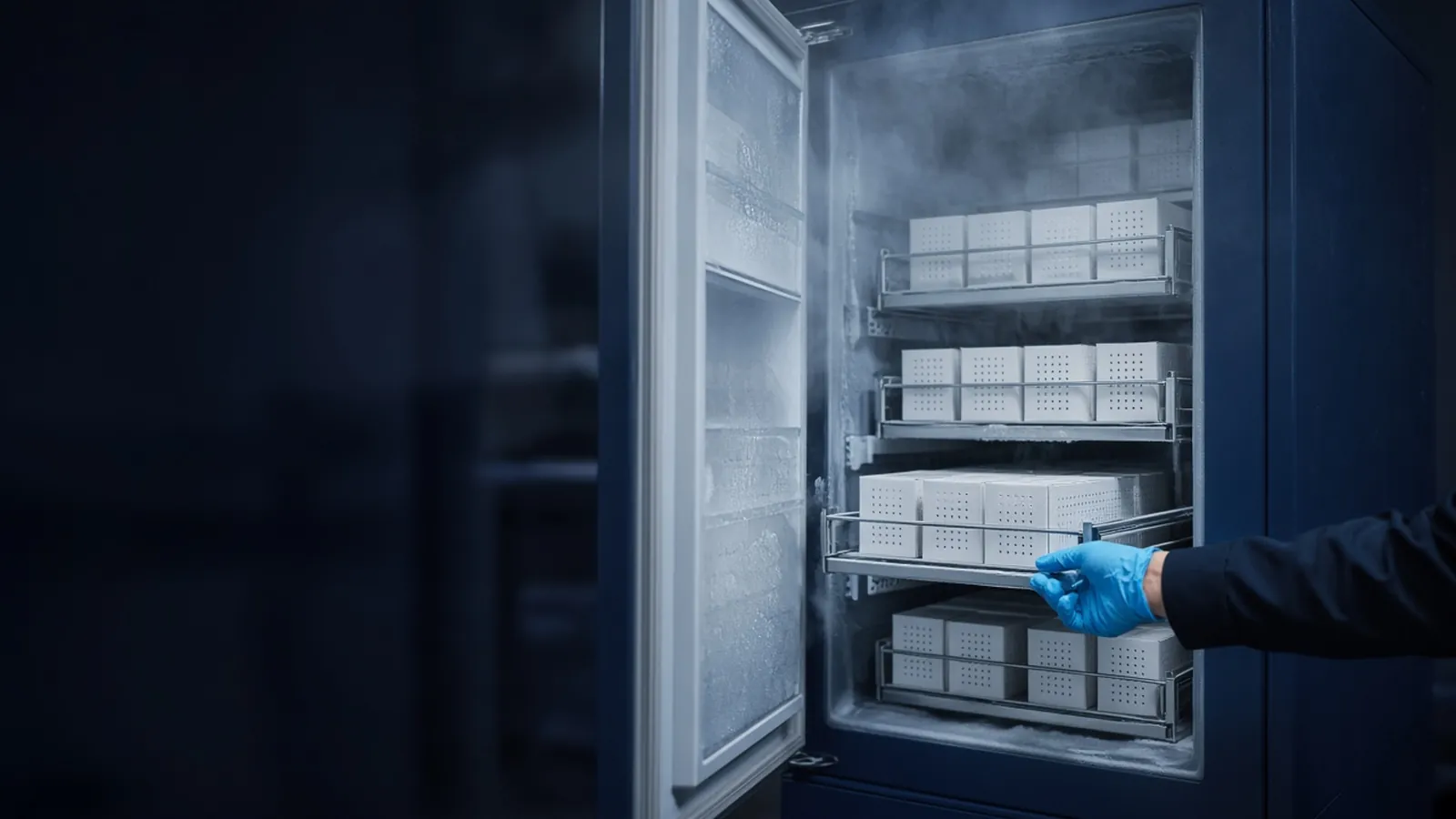
A refrigerator, a minus-20 freezer, and a minus-80 freezer are three tools that slow different processes. They are not interchangeable shelves with a shared idea of "cold." The decision this guide supports is which cabinet a named material may enter, and what you do when the convenient space is the wrong class. The cluster reference for that ladder, including nitrogen and dry ice, is storing biological samples from fridge to freezer.
Tubes and boxes are chosen from the laboratory plasticware catalogue. Labels and racks sit with laboratory consumables. The cabinet itself is an instrument class in scientific instruments. A specification for the set can be discussed through laboratory procurement and sent as a quotation request.
The decision the cabinet is making for you
You are protecting one property: enzyme activity, transformation efficiency, an intact RNA, antibody binding, or a solution that has not grown. Those properties do not fail on the same clock. A box with empty space is not an argument. If the product document names one class, another class is a new experiment you have not written down. Sample integrity is that recorded class.
What each temperature slows
Lower temperature slows molecular motion and most chemical reactions. It does not stop every reaction, and it adds injuries of its own once water turns to ice. A laboratory refrigerator, commonly held near 2 to 8 °C, keeps material liquid. Microbial growth and many chemical reactions continue, only more slowly than on the bench. That is a useful hold for reagents the label keeps cold and liquid, and a poor hold for anything that grows well in that band or that the label sends to a freezer.
A minus-20 freezer slows those reactions further. Many formulations still contain an unfrozen fraction, especially when glycerol is present so that an enzyme stock is intended to stay liquid. Proteases and ribonucleases are not abolished by that temperature. Ice, where it does form, concentrates salts and macromolecules into the remaining liquid. That concentration is a stress, not a pause button.
A minus-80 freezer slows chemistry harder again and is the usual long-term class for aqueous nucleic acids, many lysates, and competent cells. It is still not liquid nitrogen, and it is still not a licence to ignore the tube rating. Some plastics become brittle. Some formulations that were designed to stay liquid at minus 20 are not what the manufacturer told you to put here. The ATCC culture guides show a living stock arriving with a storage class you follow or replace with your own evidence.
Dry ice, which sublimates near minus 78.5 °C at atmospheric pressure, is a timed coolant for a shipment or an emergency, not a fourth shelf in this decision. Packing it is a separate method, covered in dry ice packing for sample shipments.
Classes of material, not one cold drawer
Read the document that came with the vial. Enzyme suppliers group products by storage class. A catalogue such as the NEB product list shows that an enzyme arrives with an identity and a storage expectation. It is not an invitation to copy a protocol, and it is not a reason to invent a hold time this page does not know. This guide will not tell you that an enzyme "lasts six months" in any cabinet. The insert owns that clock.
Restriction enzymes and many other glycerol-formulated enzymes are commonly assigned to a steady minus-20 freezer that does not cycle through a defrost thaw. Competent cells are a different class: they are cells prepared to take up DNA, and warming them is a functional injury. Their document almost always sends them to minus 80 °C. An ordinary glycerol stock of a strain you grew yourself is related, but it is not the same product, and your method should name its own class.
RNA is a third class. Cold slows hydrolysis and slows RNase, but it does not remove RNase already in the tube. Aqueous RNA is commonly stored at minus 80 °C and handled so that it spends little time warm. A plasmid DNA prep is often more forgiving and may live at minus 20 °C. Forgiving is not the same as interchangeable with an RNA aliquot.
Antibodies split again. A purified antibody may be stored frozen, in aliquots, at the temperature the supplier names. A working dilution may be assigned to the refrigerator for a period the supplier names. Some formulations say do not freeze. Putting those in the minus-80 freezer because the fridge looks crowded is damage you chose. Follow the document for the catalogue number you opened, not the habit you use for a different clone.
| Material class | A cabinet the document often names | The mistake that looks efficient |
|---|---|---|
| Reagent labelled 2–8 °C, including some antibody dilutions | Refrigerator near 2–8 °C | Freezing it because the freezer had a gap |
| Glycerol-formulated enzymes | Steady minus-20 freezer, no defrost pulse | A frost-free cabinet, or an unapproved move to minus 80 |
| Competent cells, many RNA aliquots, many lysates | Minus-80 freezer | A week in the enzyme freezer to "save a trip" |
| Material the method places in nitrogen | Liquid nitrogen, vapour or liquid as the SOP says | A minus-80 shelf as a convenience address |
| Anything with no document and no owner | Quarantine until someone claims it | A cold cabinet used as a lost-property drawer |
Public methods on Addgene show the same pattern. A protocol names a temperature because a property depends on it. Your laboratory SOP can be stricter than a supplier. It should not be vaguer.
When the right shelf is full
Start from the document, not from the floor plan. Write the class on the tube before you walk to the cabinet. If that cabinet has a mapped box with space, use it. If it does not, the branch is to stop. Find another cabinet of the same class, or make space by discarding material that is already expired under its own rule. Do not borrow a shelf from a warmer or colder class for the afternoon and plan to "move it tomorrow." Tomorrow is how unlabelled tubes change storage class without a decision.
If you discover a tube already in the wrong cabinet, leave it there only long enough to identify it, then quarantine it. Quarantine means a marked box that nobody uses for new work until a person compares the document with the time and temperature you can actually reconstruct. A functional check, such as a transformation control or a small enzyme digest on a disposable substrate, can support that decision when the method allows it. A cold bottle and a hopeful sentence cannot. If two people disagree about a shared reagent, the document wins, and the class goes on the map.
Failure modes that masquerade as convenience
The borrowed-afternoon failure: an RNA aliquot sits in the enzyme freezer during a power-conscious reshuffle, then stays there because the minus-80 map was not updated. The tube is labelled with a concentration and not with a class. Months later it is used as if the class had been kept. The repair is a storage-class line on the label and a quarantine rule for orphans.
The colder-is-kinder failure: a do-not-freeze antibody, or a glycerol enzyme the insert keeps at minus 20, is moved to minus 80. The cabinet did what it was built to do. The document was the control you skipped.
The forgotten-clock failure: someone asks how long the tube may stay. The honest answer is the product document or a stability study you ran. This page does not invent hold times for enzymes, cells, RNA, or antibodies.
Safety, and what this page does not approve
A minus-80 rack can freeze skin. Gloves that are merely warm are not cryogenic gloves. Biological material keeps its biosafety rules at every temperature. Cold is not disinfection. The WHO laboratory biosafety manual is an educational reference here, not a permit, and this page is not a biosafety approval or a clinical storage instruction.
Research use is the frame. Nothing here tells you how to store a diagnostic specimen, a vaccine, or a therapeutic product. Those have their own regulated chains.
A warm room
In a warm laboratory the cabinets reject more heat, and a door shelf can run warmer than the set point. Check the display against a separate thermometer on the schedule the laboratory writes, and do not store a narrow-band reagent in the door. Humidity lifts paper labels when frost melts. Power cuts need a written response for each class. This page will not guess how long any model stays cold. Dry ice, if the move requires it, is a timed coolant with a gas hazard, not a shelf.
What to put in an enquiry
Name the three classes you need: refrigerator near 2 to 8 °C, a minus-20 cabinet without an automatic defrost thaw, and a minus-80 cabinet. Ask for the alarm behaviour, the rack and box format, and whether the inner doors let you open one shelf. Ask for tubes rated to the coldest class you will use. State that storage duration will be taken from product documents and your SOP. Do not ask a seller to promise that one cabinet can stand in for the other two.
On receipt, confirm the set point, the alarm, and a place for the map before the first precious aliquot goes in.
Assign each material to one storage class and refuse the wrong cabinet
- 01Read the storage class on the product documentFind the temperature the manufacturer names for that lot, including any note that says do not freeze. A colder cabinet is a different claim, not a kinder version of the same shelf.
- 02Match the cabinet that actually holds that classUse a refrigerator near 2 to 8 °C, a non-cycling minus-20 freezer, or a minus-80 freezer as the document requires. If the only free space is another class, stop and find the right cabinet.
- 03Aliquot and label before the first long holdSplit material that will be frozen into portions sized for one use, in tubes rated for that temperature. Write the contents, the date, and the storage class on a label that survives frost.
- 04Record the address and the action if the class is missedNote the freezer, the shelf, and the box. If a tube sat in the wrong cabinet, quarantine it and decide from the document or a functional check, not from the hope that cold is cold.
Questions from the bench
Can I keep a restriction enzyme in the minus-80 freezer because it is colder?
Only if that enzyme's document allows it. Many glycerol-containing enzyme formulations are meant to stay liquid at minus 20 °C, and a much colder cabinet can freeze them solid or contradict the storage class the manufacturer validated. Colder is a different tool. Follow the insert, and do not treat the ultra-low freezer as a spare shelf for every cold bottle.
Is a working dilution of an antibody the same storage problem as the stock vial?
No. The concentrated vial and a diluted working solution can have different documents, different additives, and different clocks. Some antibodies are stored frozen in aliquots, and some suppliers tell you to keep a formulation at refrigerator temperature and not to freeze it. Read the document for the vial you actually opened.
Do competent cells, RNA, and a plasmid prep share one freezer?
They share a freezer only when each document names the same class. Competent cells are commonly assigned to minus 80 °C and lose transformation performance if they warm. Aqueous RNA is often assigned there too, with RNase control as a separate problem. A plasmid prep may be acceptable at minus 20 °C in one laboratory's method and not in another's. The product document or your own written method decides.
What should a storage-class enquiry ask for?
Ask for the cabinet class, whether it is manual defrost, the alarm, the tube and box formats you will use, and the temperature the product documents require. State that hold times will come from those documents, not from a seller's guess. Send that specification as a quotation request.
References
Manufacturer names identify published method classes. Trademarks remain with their owners. Catalogue records on this site are independent references for enquiry. They are not a statement of inventory, distribution rights or a supply commitment. This page is educational. It is not medical advice, a diagnostic protocol or a biosafety approval.
Catalogue
Related products and categories
These links follow the subject of the article into published manufacturer references. A listing is a reference for an enquiry, not a statement of stock or distribution rights.
Continue in this cluster
Related reading
Storing biological samples from fridge to freezerFridge, minus-20, minus-80 and nitrogen storage slow different kinds of damage. A warm box is a quarantine decision, not a hope. Dry ice packing for sample shipmentsDry ice keeps non-infectious research samples cold and can burn skin or displace air. Carrier rules and infectious-substance law still govern shipping.A glossary of cold-chain termsSetpoint is not air temperature, and a phase-change pack is not every coolant. Compare the cold-chain pairs labs treat as one word.