
explainer
Frost-free freezers and why enzymes hate them
Frost-free freezers warm on purpose to clear ice. That thaw pulse is a poor home for enzymes and antibodies that need a steady setpoint.
- Author
- EVRINTH Editorial Team
- Published
- 8 October 2026
- Updated
- 8 October 2026
- Reading time
- 9 min
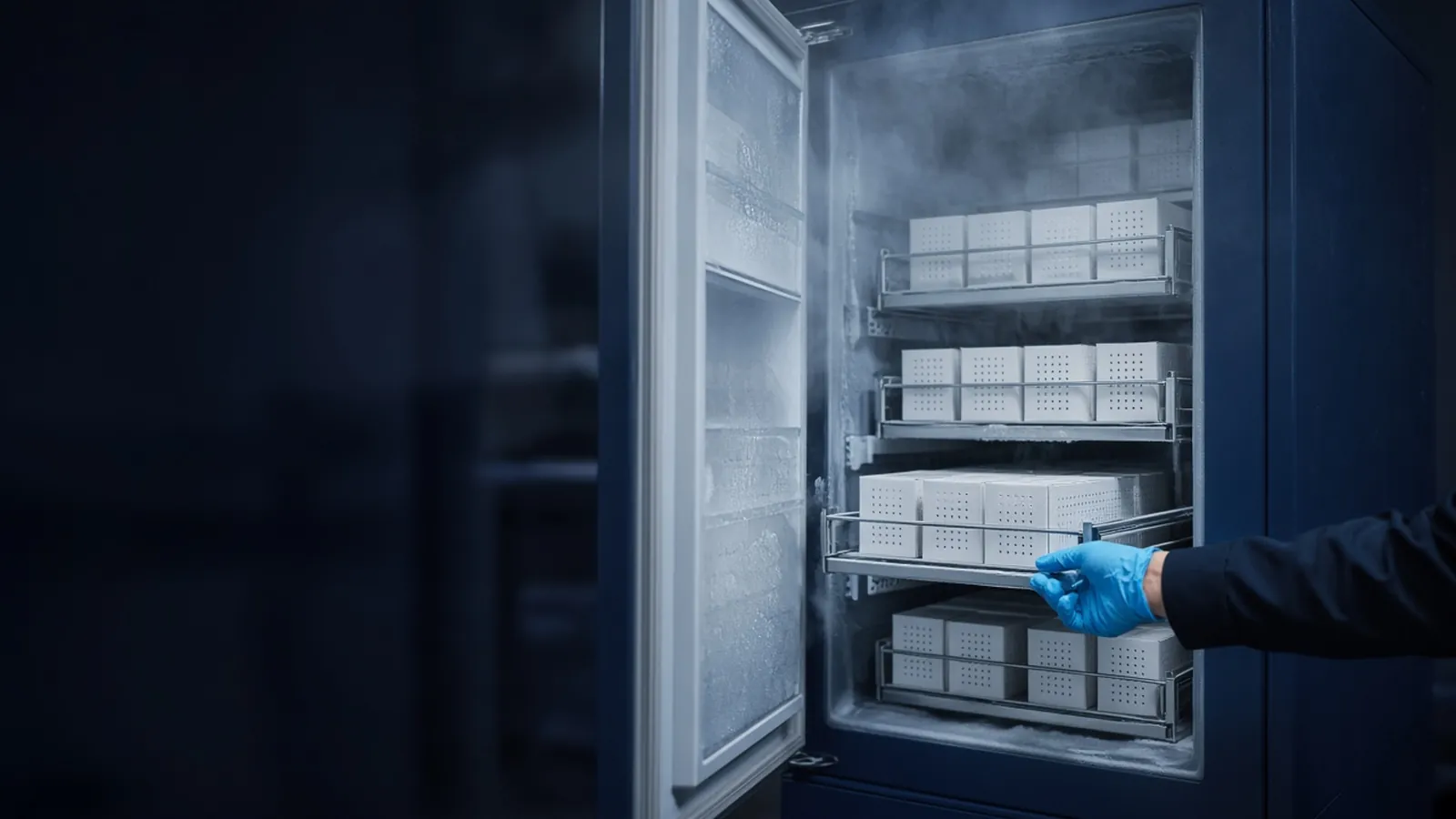
Enzymes fail in some freezers that still feel cold, because those freezers are designed to warm up. A frost-free cabinet clears ice by cycling above its setpoint. That thaw pulse is a real mechanism, and it is a poor home for enzymes and antibodies. A manual-defrost laboratory freezer does not insert that pulse, and it does grow frost. This explainer is about that difference. Where each temperature class belongs in the wider ladder is storing biological samples from fridge to freezer.
Enzyme tubes and boxes are plasticware in the laboratory plasticware catalogue. Cryo labels live with laboratory consumables. The cabinet is specified as an instrument in scientific instruments, discussed through laboratory procurement, and sent as a quotation request.
The principle hiding behind a convenient appliance
A freezer makes frost because water vapour from room air, and from poorly sealed tubes, lands on the coldest surfaces and freezes. Frost is an insulator. Left alone, it thickens, steals space, and makes the compressor work harder. Domestic designers solved the chore by defrosting automatically. A heater, or a deliberate warm refrigeration cycle, lifts the evaporator above the temperature at which frost can persist. Melt water is drained away. The cabinet then cools again.
During that interval the setpoint is not what the contents experience. The pulse is the product. How far the temperature rises, and how often, depends on the model, the load, and the room. This page will not invent those numbers. The qualitative fact is enough: the cabinet leaves its cold band on purpose, on a schedule the enzyme does not get to approve.
A manual-defrost laboratory freezer skips that cycle. Its job is to stay at the temperature you set. Moist air still enters when the door opens, so frost still grows on walls, on racks, and on boxes. You remove that frost in a planned defrost, with samples moved first. The frost is visible. The frost-free pulse is not, which is why people trust a domestic unit that "has never given trouble" until an assay drifts.
Why an enzyme notices
Many research enzymes are formulated with a substantial glycerol fraction so that, at a steady minus 20 °C, the stock is intended to remain liquid. You take a microlitre without thawing a solid pellet. That design assumes the surroundings stay at the storage temperature. A defrost pulse pushes the tube through a warmer interval. The enzyme may not freeze and thaw as a block of ice. It still experiences a warm excursion, sometimes repeatedly, while the door stays shut and nobody is in the building.
Proteins respond badly to that kind of cycling. Activity drops, or a preparation becomes less predictable, and the notebook blames the substrate. The control you missed is the cabinet. Suppliers state a storage temperature because they measured a formulation under a stated condition. The NEB catalogue is one public place to see that enzymes arrive as named products with storage expectations. Copy nothing from it into a recipe. Do read the storage line on the vial you bought, and do not replace it with the manual of a kitchen appliance.
Antibodies meet the same pulse from another direction. Freeze–thaw promotes aggregates. A cycling cabinet delivers small, unscheduled thaws even when you aliquot carefully and open the door once a month. Some antibody documents are explicit: store at a steady freezer temperature, or keep refrigerated and do not freeze. A frost-free box satisfies neither instruction well. Again, the document owns the rule. This explainer owns only the mechanism.
Glycerol stocks of bacteria and competent cells are not saved by the word "freezer" either. Competent cells in particular are sold to work after a controlled thaw. A cabinet that warms them on its own calendar spends the performance the supplier packed. Store them in the class the insert names, which is commonly a minus-80 cabinet rather than any minus-20 unit, frost-free or not.
What the pulse is not
The pulse is not the same event as opening the door. Door openings matter, and a map that lets you find a box quickly reduces them. They are a separate injury. You can have excellent door discipline and still ruin enzymes if the appliance defrosts itself at night.
The pulse is also not dry ice and not a minus-80 duty. Dry ice is a shipping coolant that disappears, described in dry ice packing for sample shipments. An ultra-low freezer has its own uniformity problems, especially near the door, but a laboratory ultra-low cabinet is not a frost-free kitchen design. Do not "solve" a frost-free minus-20 problem by moving every enzyme to minus 80 unless each document allows that move. Colder can freeze a formulation that was meant to stay liquid.
| What you observe | A likely mechanism | The next check |
|---|---|---|
| Enzymes lose activity although the door log looks quiet | Defrost pulses above the setpoint | Confirm whether the cabinet is frost-free. Move stocks to a non-cycling class the document allows |
| Ice never builds, even in a humid room | The cabinet is clearing ice by warming | Read the appliance manual for an automatic defrost. Treat "no frost" as a question, not a virtue |
| Thick frost, stable display, manual-defrost label | Moisture in, no thaw pulse | Plan a defrost. Move samples to a same-class backup first |
| Antibody aggregates after months "untouched" | Unscheduled partial thaws, or a formulation that should not have been frozen | Read the document. Quarantine the vial. Aliquot future lots only in a steady cabinet |
| A domestic unit offered as a spare | Convenience, not a storage class | Refuse it for enzymes and antibodies unless you have evidence this model does not cycle |
A worked week in a borrowed freezer
A teaching lab inherits a tall domestic freezer. The display reads minus 18. Glycerol-formulated enzymes, a box of antibody aliquots, and a few oligonucleotide tubes go in because the laboratory minus-20 is full. For six weeks nobody notices a problem. Digests then start to look weak on a plasmid that previously cut cleanly. The enzyme tube was never left on the bench. The freezer, meanwhile, has no frost on the back wall, which someone reads as "healthy."
The branch is mechanical, not mystical. Confirm the model is frost-free. Stop putting new enzyme into it. Quarantine the tubes that lived there, and test a fresh vial from a non-cycling cabinet before you condemn the DNA. Oligonucleotides may be less offended than the enzyme. That difference is not a reason to leave the enzyme behind. Write the incident as a cabinet failure, not as a bad lot, unless a fresh vial fails too.
If the only temporary address is that domestic unit, you do not have a temporary address for enzymes. Borrow a non-cycling laboratory freezer, or hold the new vial in the class the manufacturer used for shipping only for as long as that shipping condition allows, then move it. Do not invent a number of days "it will probably be fine."
The frost you still have to plan for
A laboratory freezer that does not cycle will look worse and behave better. Frost narrows the space between racks. It can cement a box to a shelf. It hides labels. It insulates the walls so the compressor runs longer. None of that is a secret thaw, but all of it becomes a sample problem if you attack it with a scraper while the boxes stay inside, or if you switch the empty cabinet off and forget a rack in the bottom.
The SOP should say when frost is thick enough to justify a defrost, which same-class cabinet receives the boxes, and how you confirm that cabinet's display before the move. Scrape ice only after the samples are gone. Let melt water go where the manufacturer designed it to go. Restart, watch the cabinet return to the setpoint, and only then reload. A rushed reload into a cabinet that has not yet recovered is a warm start you chose.
Humid air makes this chore more frequent. In a warm, humid laboratory every door opening delivers more water. That is an argument for short openings and a map, not an argument for buying a frost-free appliance to avoid the chore.
If the pulse has already happened
Quarantine the affected box. Identify which products have documents that forbid temperature cycling. Test a function that matters, on material you can afford to spend, before those tubes re-enter an assay that will be interpreted. A restriction digest on a known plasmid, or a binding control the antibody method already uses, is the shape of that test. A passed control supports use. It does not rewrite the cabinet.
Record the model name in the incident note so the next purchase does not repeat it. Domestic frost-free units remain fine for ice packs and for non-critical loads your SOP explicitly allows. They are a bad default for the enzyme shelf.
Safety and the limit of the explanation
A defrost releases water and can release whatever was in a broken tube. Treat unknown melt as a spill of the most hazardous material that cabinet was allowed to hold, and follow the laboratory spill rule. Do not chip a domestic freezer that still contains biological stocks. This page is not a biosafety approval and not a repair manual. The WHO laboratory biosafety manual is an educational reference for the biological side. Electrical safety during defrost belongs to the appliance instructions and the people qualified to follow them.
What to name when you specify a freezer
Ask whether automatic defrost is present. Ask for a cabinet that holds minus 20 without a thaw pulse if enzymes and antibodies are the load. Ask how frost is expected to be removed, what alarm exists, and which rack format fits your boxes. State that you will not accept "frost-free" as a synonym for low maintenance on this load. Compare the written reply with the storage lines on the reagents. Methods collected on protocols.io and Addgene show enzymes living at a stated temperature. Your enquiry should be able to support that statement with a cabinet, not with a slogan.
Questions from the bench
Why does a frost-free freezer clear ice by warming?
Frost on the cooling surface insulates it, so the cabinet is built to interrupt the cold and lift that surface above the frost point long enough for ice to leave as melt water or vapour. The air and the products can rise with it. The setpoint on the dial is the temperature between those pulses, not a promise that the pulse never happens.
Do antibodies care about the same pulse as enzymes?
They can. Repeated partial thawing promotes aggregation and can damage binding, which is why many antibody documents tell you to aliquot and to avoid a cycling cabinet. An enzyme in glycerol may stay liquid at a steady minus 20 and still suffer a real thaw each time the cabinet warms. Follow each product document. This page does not assign a shared survival time.
If a manual-defrost freezer grows frost, is that a sign it is failing?
Frost is what a cabinet does when it stays cold and moist air enters. It is a maintenance load, not evidence of a secret thaw pulse. Plan a defrost when the SOP says the frost is deep enough to matter, and move samples first into another cabinet of the same class. A frost-free appliance avoids that chore by warming on a cycle you do not control.
What should we specify instead of a domestic frost-free unit?
Specify a laboratory freezer that holds its setpoint without an automatic defrost thaw, name the temperature class, and ask how frost is removed. Include the alarm and the rack format. Send that as a quotation request so the reply can be compared with the product documents of the reagents you intend to store.
References
Manufacturer names identify published method classes. Trademarks remain with their owners. Catalogue records on this site are independent references for enquiry. They are not a statement of inventory, distribution rights or a supply commitment. This page is educational. It is not medical advice, a diagnostic protocol or a biosafety approval.
Catalogue
Related products and categories
These links follow the subject of the article into published manufacturer references. A listing is a reference for an enquiry, not a statement of stock or distribution rights.
Continue in this cluster
Related reading
Storing biological samples from fridge to freezerFridge, minus-20, minus-80 and nitrogen storage slow different kinds of damage. A warm box is a quarantine decision, not a hope. Dry ice packing for sample shipmentsDry ice keeps non-infectious research samples cold and can burn skin or displace air. Carrier rules and infectious-substance law still govern shipping.A glossary of cold-chain termsSetpoint is not air temperature, and a phase-change pack is not every coolant. Compare the cold-chain pairs labs treat as one word.