
troubleshooting
Gel packs versus dry ice for a short trip
A short trip still needs the coolant the label names. Gel packs hold the setpoint they were conditioned to. Dry ice is a much colder window.
- Author
- EVRINTH Editorial Team
- Published
- 8 October 2026
- Updated
- 8 October 2026
- Reading time
- 9 min
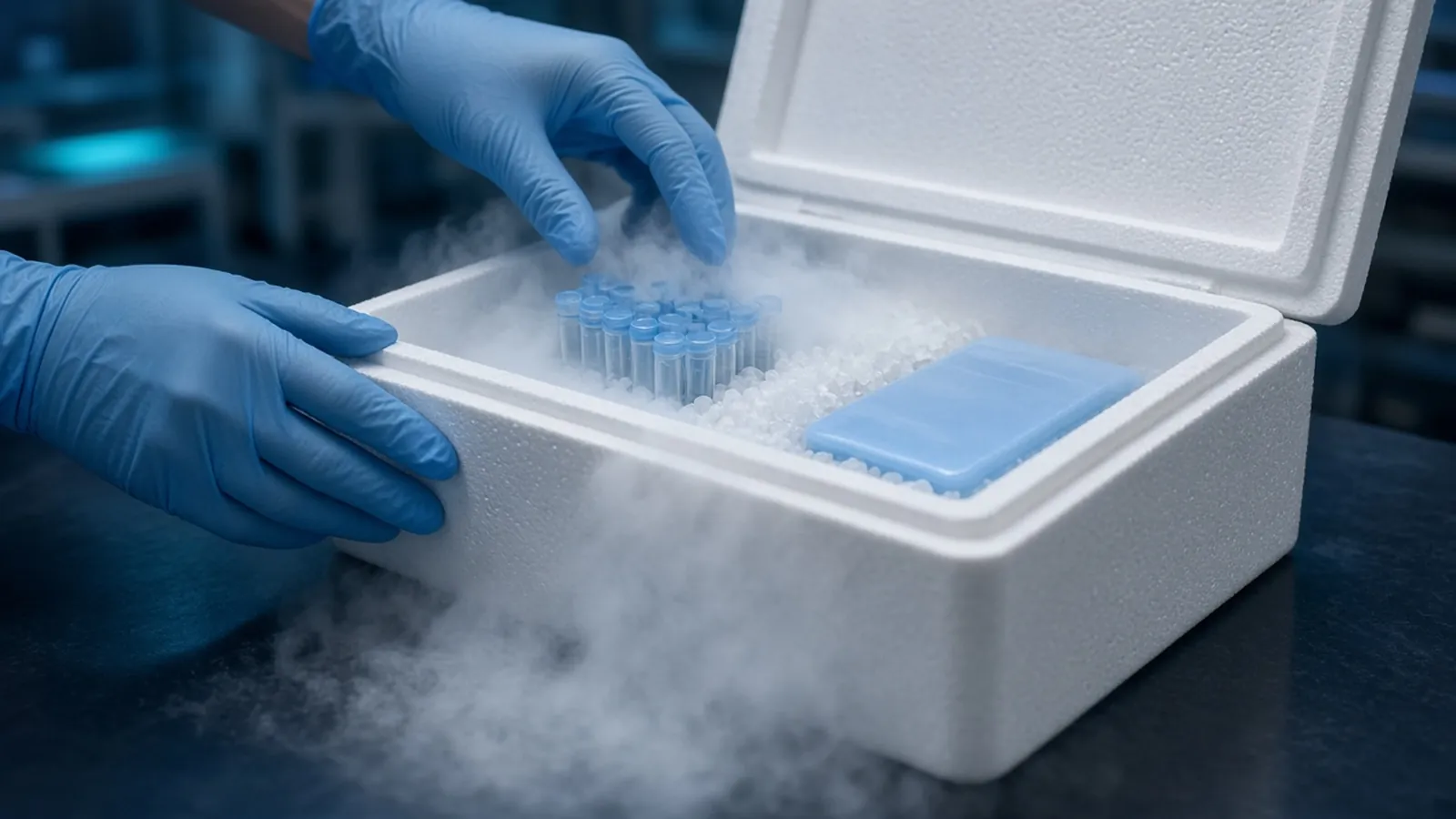
The symptom is a short trip that still arrives wrong: a refrigerated antibody frozen solid, or a frozen enzyme soft, with somebody saying the distance was too small to matter. Distance does not choose the coolant. The label's shipping condition does. Gel packs hold the refrigerated or frozen setpoint they were conditioned to. Dry ice is a much colder window, for longer or stricter trips that actually need it. This troubleshooting page starts from the arrival you can see. How to pack dry ice when it is the right class is dry ice packing for sample shipments. Where the tubes should sit afterwards is storing biological samples from fridge to freezer.
Shippers, gel packs, and tubes are laboratory plasticware. Gloves and labels are laboratory consumables. A logger for the trip is a scientific instrument. The choice is a laboratory procurement specification and a quotation request.
Symptoms at the bench
Start with the tubes, then the coolant, then the label. Do not start with the excuse that the drive was short.
The tubes are frozen, and the product document says 2 to 8 °C or another refrigerated shipping condition. Look in the shipper. If you find solid carbon dioxide, the coolant was dry ice and it did what dry ice does. If you find gel packs that were conditioned in a minus-20 freezer and packed tight against the tubes, the packs may have pulled a liquid reagent below freezing even without dry ice. Both are class errors. A short clock does not thaw the story.
The tubes are warm or slushy, and the document says keep frozen. Look again. Gel packs that were conditioned only in the refrigerator were never a frozen coolant. Gel packs that were conditioned correctly but under-filled for the heat of the vehicle spent themselves. Dry ice that was a token scoop, or that was packed in a leaking warm bag, may already be gone. The symptom "soft tubes" has several causes. The label tells you which causes are allowed.
The shipper contains both a gel pack and dry ice. Treat that as an undefined class. You do not know which temperature the tubes saw, and you may have frozen a refrigerated product while also venting carbon dioxide from a box that was designed for gel. Quarantine. Read a logger if there is one. Do not average the two coolants into "cold enough."
A puddle is not spent dry ice. Dry ice sublimes. At atmospheric pressure it does not become a liquid you can pour off. Its solid sits near minus 78.5 °C while it remains. A puddle is melted gel, condensate, or a leaked sample. A leaked sample is a spill of that sample, handled under the laboratory rule, not a coolant to tip down a sink.
Match the coolant you see to the coolant the label allowed
A gel pack is a sealed mass you pre-cool. Conditioned in a refrigerator, it defends a refrigerated band until heat soaks it. Conditioned fully frozen, it defends a colder band and then melts toward that same soak. The pack cannot invent a temperature it was not given. Taking it from a frost-free domestic freezer adds another doubt, because that cabinet warms on a cycle and the core of a thick pack may never have reached a steady frozen setpoint. Condition packs in the cabinet class the pack-out names, and give them the time that pack-out names. This page does not substitute a time.
Dry ice is not a gel pack with a lower setpoint. It is solid carbon dioxide, used when the shipping condition is a frozen or colder window and the shipper is built to vent the gas. It is the right troubleshooting conclusion when the label demands that cold and the trip is long enough, or strict enough, that a gel pack will not hold. It is the wrong conclusion when someone adds it because the afternoon looks hot and the label says refrigerated. Heat is a reason to respect the pack-out. It is not a reason to change class.
"Short" is not a class. A trip across a campus can sit in a parked vehicle. A trip between buildings can wait at a reception desk. If your real short trip includes those waits, the gel pack has to be qualified for the waits, or the trip is not the trip you packed for. You still do not upgrade to dry ice unless the label allows that cold.
| What you see on arrival | Likely cause | Next check |
|---|---|---|
| Refrigerated reagent frozen, dry ice in the box | Coolant class too cold for the label | Quarantine. Read the document before any thaw. Do not repeat the mix |
| Refrigerated reagent frozen, only gel packs | Packs conditioned too cold, or packed against the tubes | Check how the packs were conditioned. Quarantine until the document is read |
| Frozen reagent soft, gel packs warm | Packs never frozen, or spent by heat and delay | Check the conditioning cabinet and the waits. Quarantine |
| Frozen reagent soft, no dry ice left | Too little dry ice, or a shipper that was not the right class | Record the absence. Do not guess a survival time |
| Both gel and dry ice | Two classes in one box | Quarantine. Read the logger. Pack one class next time |
| Puddle, no solid CO2 | Melted gel, condensate, or a leak | If the primary container failed, treat a spill. Do not call it dry-ice melt |
| Logger on the gel, tubes warm | The probe measured the pack, not the tubes | Believe placement. Time out of range decides, not the coldest point |
A worked short trip
You need to move an enzyme and a tube of diluted antibody from one building to another before lunch. The enzyme document says ship frozen, storage minus 20 °C. The antibody dilution says 2 to 8 °C and do not freeze. A colleague suggests one box, a handful of dry ice, and the remark that it is only ten minutes.
That box is two failures sharing a handle. The antibody can freeze. The enzyme might be fine on dry ice and might also be fine on a properly frozen gel pack. The ten minutes is not the controlling fact. Split them. The antibody goes in a shipper with gel packs conditioned to the refrigerated band, not touching the tube so closely that a too-cold pack freezes it, and with a pack-out someone has actually used for this hop including the wait at reception. The enzyme goes frozen, on conditioned frozen gel packs if that pack-out holds for this hop, or on dry ice in a vented shipper if the label and the duration require it. Two shippers are the troubleshooting repair. One heroic coolant is how both tubes arrive as a single ambiguous story.
If they have already travelled together on dry ice, quarantine both. The enzyme may be acceptable once you confirm the document allows that shipping condition. The antibody may not survive being frozen, and thawing it "to put it back" can add a freeze-thaw injury to the class error. Read the supplier's excursion language. Do not invent a forgiveness window because the buildings were close.
Conditioning is a control you can fail on a quiet morning
Gel packs stacked in a freezer for an hour are not automatically ready. The core lags the surface. Packs taken out and left on a bench while tubes are labelled warm up before the trip starts. The trip then begins with a coolant that has already spent part of its life. The symptom later looks like a hot vehicle. The cause was the bench.
Write the conditioning cabinet on the pack-out card. If that cabinet is frost-free, do not assume a thick pack is fully frozen. Dry ice needs no conditioning step of that kind. It needs a vented shipper, insulated gloves, and a room that can take the gas. One checklist for both coolants is how dry ice ends up in the gel box with the lid taped.
The NEB catalogue is one public place to see that reagents arrive with distinct shipping and storage lines. Use it as a reminder to read the line, not as a menu to copy. Your tube has its own document.
The logger, if you packed one
A probe buried in a gel pack reports the pack. A probe in the lid reports air. Read time out of range for the placement that represents the tube. NIST's metrology pages are the public reminder that the sensor location is part of the result. A cold hand on the shipper is not a second logger.
If there was no logger, the coolant condition and the label are all you have. Spent gel and a refrigerated label mean quarantine. Dry ice remaining beside a do-not-freeze label means quarantine for a different reason. Write which one it was so the next pack-out changes the right variable.
Safety when the wrong cold is also a gas
Dry ice on a short trip is still a cold burn and still a carbon dioxide source. Do not tape the lid. Do not carry it in a closed cabin without the ventilation the packing page describes. Do not store the leftover solid in a small office. Gel packs avoid the gas hazard and still need clean handling if a tube has leaked on them. Biological classification of the samples stays with the institution. The WHO laboratory biosafety manual and the IATA dangerous goods programme are educational and regulatory contexts, not a local permit. This page is not a biosafety approval and not a first-aid sheet for a cold burn.
What to change in the next specification
State the shipping condition for each reagent class you move locally. Ask for gel packs as refrigerated-conditioned or frozen-conditioned, with the shipper they were qualified in. Ask for dry ice only as a separate, vented configuration for labels that need that window. Name who conditions the packs and who may add dry ice. Include a logger placement sentence if you will use the trace to accept tubes. A quotation that sells "cold packs and some dry ice" as one kit is the symptom waiting to happen. Split the lines.
Questions from the bench
The trip is only across the city. Can I use whichever coolant is already cold?
No. Length does not pick the coolant. The shipping condition on the label does. Gel packs hold a refrigerated or frozen setpoint they were conditioned to, then warm as they take up heat. Dry ice is solid carbon dioxide near minus 78.5 °C and is for a much colder window, including longer or stricter frozen trips. A short trip with the wrong class still freezes a 2 to 8 °C reagent or lets a frozen one thaw.
The gel packs came out of a frost-free domestic freezer. Are they conditioned?
Only if they are fully at the temperature that freezer actually holds between its defrost pulses, and only if that temperature is the setpoint the pack-out requires. A pack that spent an hour in a cycling cabinet, or that was taken out soft, is not a frozen coolant. Condition packs in a cabinet you trust, for long enough that the core is at the intended temperature, and do not invent that duration from this page. The pack-out instructions own it.
We added dry ice next to gel packs to be safe. The antibody arrived frozen. What failed?
The coolant class failed. Dry ice is not an extra gel pack. If the label said refrigerated, the dry ice was cold enough to freeze the product, and 'short trip' did not prevent that. Quarantine the antibody. Read the document before anyone thaws it and hopes. Next time, pack only the class the shipping condition names.
What should the enquiry say when we are choosing coolants for local runs?
State the shipping condition, the trip pattern, and the shipper class. Ask for gel packs as a conditioned refrigerated or frozen class, or for a vented dry-ice shipper, not for both as a vague cold kit. Ask who is expected to condition the packs. Send it as a quotation request. Leave biological classification with your institution.
References
Manufacturer names identify published method classes. Trademarks remain with their owners. Catalogue records on this site are independent references for enquiry. They are not a statement of inventory, distribution rights or a supply commitment. This page is educational. It is not medical advice, a diagnostic protocol or a biosafety approval.
Catalogue
Related products and categories
These links follow the subject of the article into published manufacturer references. A listing is a reference for an enquiry, not a statement of stock or distribution rights.
Continue in this cluster
Related reading
Dry ice packing for sample shipmentsDry ice keeps non-infectious research samples cold and can burn skin or displace air. Carrier rules and infectious-substance law still govern shipping. Storing biological samples from fridge to freezerFridge, minus-20, minus-80 and nitrogen storage slow different kinds of damage. A warm box is a quarantine decision, not a hope.A glossary of cold-chain termsSetpoint is not air temperature, and a phase-change pack is not every coolant. Compare the cold-chain pairs labs treat as one word.