
application
Gravimetric checks with a balance
Turn a balance reading into a delivered volume with the water temperature you measured, and see what a water check can support.
- Author
- EVRINTH Editorial Team
- Published
- 8 October 2026
- Updated
- 8 October 2026
- Reading time
- 7 min
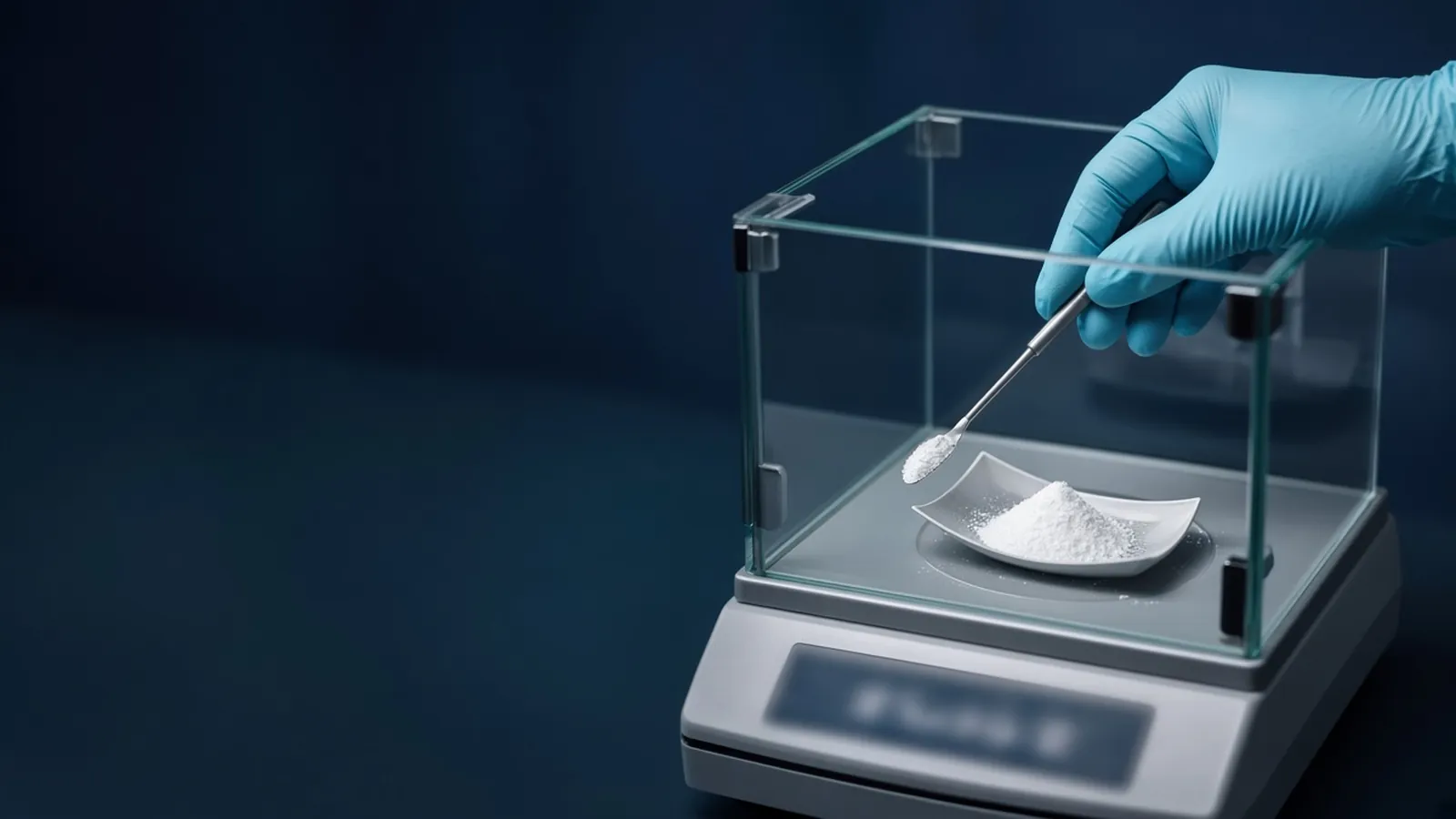
A gravimetric check is a research use of a balance: you deliver water with a pipette, weigh what arrived, and turn that mass back into a volume. The decision it supports is whether this micropipette, at this setting, with this tip, may create a number you will trust. The limit of the claim is sharp. The check describes water and the stroke you used. It does not describe every liquid the pipette will meet next week, and it is not by itself a full calibration certificate. How to make the stroke repeatable is in accurate micropipetting technique. How an interim series sits between formal calibrations is in checking a pipette between calibrations.
From mass to volume
The balance reports mass. The pipette claims volume. The bridge is the density of the water at the temperature you measured, with a buoyancy allowance if the procedure you claim includes one. People wrap those corrections into a Z-factor, a multiplier that converts the balance reading into microlitres. The numerical factor comes from a density table or from the procedure, not from a memory that water weighs one gram per millilitre.
Near room temperature, water density is about 0.998 grams per millilitre. At a warmer bench it is lower. At a cooler one it is higher. Use a density table for the actual water temperature. Write the temperature in the same row as the masses. A series weighed while the vessel warmed, with one temperature scribbled from the start, has already blurred the conversion.
ISO 8655-1:2022 is where the shared words and user recommendations live. It is not a statement that your check passed. The pipette error limits you might compare against are in ISO 8655-2:2022 and in the manufacturer specification. Gravimetric reference practice, often discussed as ISO 8655-6, adds the balance, the repeats, and the evaporation control. Follow those concepts at decision level. This page does not paste the table or invent a maximum permissible error.
NIST's Office of Weights and Measures points at the public metrology culture behind a balance you can defend. BIPM is the home of the SI units the gram and the litre belong to. Your laboratory still chooses the limit and does the weighing.
Equipment that can see the error
Match the balance resolution to the volume. A display that steps by a milligram is a blunt tool below a few microlitres, because the error you care about may sit inside one step. Level the balance, let it warm up, and close the draft shield. A fan, a sunny window, or a person walking past can move the reading by more than the pipette error.
Use a vessel that the aliquot actually lands in, narrow enough to limit evaporation and compatible with the balance. An evaporation trap or a cover with a small opening helps when the series is slow or the volume is small. High humidity slows evaporation. It does not remove the need for a cover if the series is long. Dry air does the opposite and adds static that makes a plastic vessel cling to the pan. Ground yourself, use a metal vessel if the method allows, and do not record a reading that is still running.
Tips are part of the apparatus. Use the family you claim, seated so they seal. A leaking tip is a failed measurement already. Water should be clean and equilibrated to the room where you weigh, not ice-cold from a jug and not warm from a windowsill.
Workflow and the branch when the numbers split
Tare. Deliver with the mode the method names, almost always forward pipetting for a water check of an air-displacement pipette. Touch the vessel in a repeatable way. Do not chase droplets you disliked by adding an extra squirt. Repeat enough times to separate a mean shift from scatter. Convert each mass, or the set, with the Z-factor or density correction for the measured temperature.
Branch on the pair of results. A mean outside the specification you claim is a systematic problem. Stop using the pipette for quantitative work and send it for adjustment or repair. A mean inside the limit with a scatter wider than you claim is a precision problem. Change the tip and repeat once with the same technique. If the scatter remains, the pipette or the balance setup is unfit, even though the average looked polite. If a new tip repairs the scatter, the finding is tip fit, and you still throw away the data from the leaking tips.
If the balance will not settle, fix the weighing before you condemn the pipette. Draughts, a cold vessel sweating in a humid room, and a balance just switched on all imitate a bad piston. That distinction is why the water temperature and the balance condition belong in the record.
| What you record | Why it is in the conversion | Limit of what it supports |
|---|---|---|
| Water temperature | Density and Z-factor depend on it | Nothing about a warmer liquid used later |
| Tip family and seating | The apparatus includes the tip | A different box next month |
| Mean of the repeats | Systematic error | That every single dispense was fine |
| Spread of the repeats | Random error | That the mean was on target |
| Balance resolution and shield | Whether the mass can show the error | A smaller volume you did not weigh |
Failure modes
The classic self-deception is discarding light dispenses until the mean passes. Those light points were the random error, or they were the leak. Another is using ice-cold water in a warm tip and blaming the piston for a cushion that was still changing. Another is a milligram balance and a two-microlitre setting: the instrument cannot speak, and a written "pass" is fiction.
A power cut stops the balance and the room control that made yesterday's Z-factor comparable. When power returns, warm the balance up again and repeat the series if the volume is the result. The piston did not forget its seal because the lights went out, and the old reading is not a new one.
Safety and research-use limits
Water checks are the clean experiment. Do not perform them with a culture or a radionuclide to "be realistic". Those liquids need the containment your assessment named, and they are a poor density story. A gravimetric pass is not a clinical validation and not a diagnostic approval. It is evidence about a volume of water on a date.
What to ask for
If you are enquiring about a balance or a pipette for this use, state the smallest volume you must judge, the balance resolution you need, and whether the pipette specification must include a calibration document at those volumes. Instruments are in the scientific instruments catalogue. Vessels and tips are in the laboratory consumables catalogue. The specification goes with the quotation request.
Questions from the bench
Why is a milligram of water not exactly a microlitre?
Near room temperature, water density is about 0.998 grams per millilitre, and it changes as the water warms or cools. A balance also reads a mass that is slightly buoyed by air. A proper conversion uses a density table for the temperature you measured, often bundled into a Z-factor that turns milligrams into microlitres. Assuming 1.000 grams per millilitre is a small, systematic tilt. For a large volume it can exceed the error you hoped to detect. Record the water temperature beside every series.
What balance resolution is suitable?
The balance has to see a mass difference as small as the volume error you care about. One microlitre of water is about one milligram, so a balance that only reads to a milligram cannot judge a one-microlitre setting. Use a finer balance, or check a larger fraction of the pipette's range and say plainly that the smallest setting was not tested. Evaporation during a slow series can be larger than the resolution. A cover or an evaporation trap, and a steady pace, belong in the setup.
Does a water check prove the pipette for glycerol or ethanol?
It proves the piston, the seal, the tip, and the stroke for water under the conditions you wrote down. Glycerol leaves a film. Ethanol loads the air cushion with vapour. Pass the water check, then test the real liquid with its own density if that liquid's volume is the result. A failing water check is already enough to remove the pipette from quantitative service. Do not continue to the interesting liquid in the hope that it will agree.
How many repeats does a decision need?
Enough to see a shifted mean separately from a wide scatter. A reference procedure such as the gravimetric method associated with ISO 8655-6 names a count and a calculation. Use that count if you claim that procedure. An interim check can use a shorter series if your quality system says so, and it should still refuse a single dispense. One lucky drop is not a mean, and deleting drops you dislike is how a failing pipette gets a passing notebook.
References
Manufacturer names identify published method classes. Trademarks remain with their owners. Catalogue records on this site are independent references for enquiry. They are not a statement of inventory, distribution rights or a supply commitment. This page is educational. It is not medical advice, a diagnostic protocol or a biosafety approval.
Catalogue
Related products and categories
These links follow the subject of the article into published manufacturer references. A listing is a reference for an enquiry, not a statement of stock or distribution rights.
Continue in this cluster
Related reading
 Accurate micropipetting techniqueHow an air-displacement micropipette delivers a volume, how forward pipetting uses the two stops, and why temperature belongs in the result.A glossary of liquid-handling termsSeparate the liquid-handling terms people mix up, from blow-out and pre-wetting to systematic error, tip fit, and the Z-factor.Air displacement versus positive displacementTrace under-delivery and dripping to the air cushion or the piston, and choose the pipette class that matches the liquid.