
explainer
Hot climates and the last mile of a reagent shipment
The last mile is the handoff from depot to bench: a hot vehicle and a delayed receiver. Name the shipper, the coolant, and who reads the logger.
- Author
- EVRINTH Editorial Team
- Published
- 8 October 2026
- Updated
- 8 October 2026
- Reading time
- 9 min

The last mile of a reagent shipment is not a shorter version of the flight. It is the handoff from a courier depot to a bench, often through a hot vehicle and a person who is not standing at the door. In a warm climate that handoff is where cold boxes go to become ambient boxes. This explainer is about those operational risks. It does not invent weather statistics, city temperatures, or a kilogram of coolant that will "always" survive them. Packing practice for dry ice is dry ice packing for sample shipments. The cabinet that should receive the tubes is storing biological samples from fridge to freezer.
Shippers and tubes are laboratory plasticware. Labels and insulated gloves are laboratory consumables. Loggers are instruments in scientific instruments. The handover specification is a laboratory procurement subject and a quotation request.
Heat leak is the whole mechanism
An insulated shipper slows heat. It does not stop it. The rate depends on the insulation, the surface, the temperature difference, how often the box is opened, and whether the coolant is still present. A gel pack conditioned in a freezer absorbs heat until it reaches the temperature of its surroundings, passing through a melt if it was frozen. Dry ice sublimes near minus 78.5 °C at atmospheric pressure and disappears as gas. Neither coolant negotiates. When it is spent, the interior walks toward the temperature of the van, the dock, or the lobby.
A larger temperature difference drives a faster leak. A vehicle in the sun is a hotter outside than a cooled warehouse. That sentence does not require a record high. It requires you to stop copying a pack-out from a route where the dock was cool and the receiver was waiting. Ask the shipper manufacturer what they assume, and tell them the handoffs you actually have.
The product document still outranks the drama of the climate. A reagent labelled 2 to 8 °C is not helped by a last mile so cold that it freezes. A reagent labelled for dry ice is not helped by a gel pack that was merely refrigerated. The last mile amplifies whatever mismatch you packed at the start.
The handoffs, named
Draw the journey as people, not as a dotted line on a map.
The depot release. A parcel can sit between a controlled room and the vehicle while paperwork happens. If that sit is in the sun, it is part of the thermal history. The person who hands the box to the driver is part of the cold chain whether or not they were trained as if they were.
The vehicle. A closed van without active cooling becomes a hot room. Dry ice in that van is also a gas hazard in a small volume, which the packing page already forbids you to treat casually. A gel-packed box has no gas story and still has a heat story. "It is only an hour" is not a measurement. If the hour becomes three because of traffic, the pack-out you chose for one hour is the one that fails.
The receiving desk. This is the delayed receiver. The courier arrives, the named scientist is in a seminar, and the box waits in a lobby that was never in the shipper qualification. The control is a person who is actually there, with the authority to open, read, and move. A signature on a clipboard is not that person.
The bench. The last metres inside the building still count. A shipper parked by a window while someone finds the freezer key is a final heat leak. The freezer that receives the tubes has to be the class the document names, already at temperature. A warm refrigerator that is "on its way down" is another delay.
| Handoff | What goes wrong | The control you specify |
|---|---|---|
| Depot to vehicle | A wait on a hot dock | A shipper class qualified for a wait, not a hope that the wait is short |
| Vehicle | Heat soak, and gas if the coolant is dry ice | Coolant class matched to the label. Ventilation rules if the coolant is dry ice |
| Receiving desk | The scientist is not there | A named person who checks the logger and moves the tubes |
| Lobby or corridor | An unplanned hold in warm air | A rule that the box does not sit. Quarantine if it did |
| Bench to cabinet | The wrong freezer, or a search with the door open | The storage class and the map, written before the courier is booked |
Shipper class, coolant class, logger reader
These three lines are the specification. Everything else is decoration until they are filled.
Shipper class means the insulated container you mean: wall type, whether it vents, the outer size a carrier will accept, and whether it is a qualified pack-out or an untested box. For dry ice, venting is mandatory because the solid becomes gas. A design that is excellent for gel packs can be dangerous if you later drop dry ice into it and tape the lid.
Coolant class means gel packs conditioned to a refrigerated band, gel packs conditioned to a frozen band, or dry ice. Write the conditioning step. A gel pack that sat on the bench overnight is not a frozen coolant. Dry ice is the colder window and is for labels that demand it, including longer or stricter frozen trips. It is the wrong class for a short trip of a liquid reagent that must not freeze. Match the coolant to the shipping condition printed on the product. Enzyme and reagent lists such as the NEB catalogue show that products arrive with conditions. Read the condition. Do not copy a protocol, and do not let a hot route talk you into a colder coolant than the label allows.
Logger reader means a named role. The logger is an instrument. Its trace is evidence only if someone downloads it and compares time out of range with the window in the document or the SOP. NIST's laboratory metrology pages are a public anchor for the idea that a temperature record wants a method. "The box felt cold" is not the method. Say where the probe sits, because a probe in the air of the shipper and a probe against a tube do not tell the same story.
A delay you can replay without a weather report
A monoclonal antibody with a refrigerated shipping condition leaves a depot in the morning in a gel-qualified shipper. The driver parks for a meal. The laboratory contact is in a committee and has not named a deputy. The parcel sits in a glazed lobby until late afternoon. Nobody needs an outdoor temperature record to see the failure. The gel pack was asked to cover a depot, a vehicle, an unplanned park, and a lobby. The person who finally opens it finds a soft pack and a logger. The correct next act is to read time outside 2 to 8 °C, quarantine the vial, and tell the supplier if the window was missed. The incorrect next act is to put the vial in the fridge and decide it is fine because the lobby "was not that hot."
Change one fact and the story changes. If the shipping condition had been dry ice and frozen storage, a gel pack would have been the wrong coolant even if someone had been waiting at the door. Heat does not excuse a class error. It only makes the class error finish sooner.
The branch for a repeated route: write the deputy's name into the courier instruction, move the receiving point out of the sun, and ask the shipper maker whether this pattern of delay is inside the pack-out they sold you. If it is not, change the pack-out or change the delay. Do not add an unmeasured extra gel pack and call the problem solved.
What the trace cannot forgive
A logger that rode in the air space may show a warm spike when the door opened at the depot, while the tubes, with more thermal mass, moved less. The opposite can also mislead: a probe taped to a still-cold gel pack while the tubes have already left the band. The last-mile explainer's job is to make you write the placement down so the named reader does not treat every trace as a verdict. Time outside the document's window is the question. A single minimum temperature is the distraction.
If there is no logger, the last mile is a story. Quarantine when the coolant is spent or the handoff was uncontrolled. Do not reconstruct a temperature from the colour of the sky.
Safety on a warm dock
Dry ice still burns and still displaces oxygen when the weather is hot. A closed cabin with a large load is a bad place to wait out traffic. Gel packs do not remove that hazard if you also added dry ice "to be safe." Biological classification does not relax because the box is late. The WHO laboratory biosafety manual treats transport as part of risk management. The IATA dangerous goods programme is where carriers place solid carbon dioxide. Neither document is a permit you print from this page, and this page is not a biosafety approval.
Power at the receiving bench matters in the same hour. A shipment that survives the van and meets a freezer that has been off since yesterday has not arrived. The alarm response for that freezer is a separate control. Do not use the shipper as overnight storage because the cabinet is down.
What to put in the enquiry
State the product's shipping condition, the worst handoff you are willing to admit (a vehicle, a possible wait, a named receiver), the shipper class, and the coolant class. Ask whether the pack-out assumes a cooled line-haul only. Ask for a logger and say where you intend to place the probe. Ask for a vent if dry ice is the coolant. State that your institution classifies biological hazards and names the receiver. Compare replies by those lines. A quotation that offers "extra cold" without a class is the last-mile failure purchased in advance.
Questions from the bench
Why is the last mile a different problem from the long haul?
The long haul may sit in a controlled hold or a depot cooler. The last mile is the chain of handoffs after that: a vehicle, a loading step in the sun, a receiving desk, and a person who may be in another room. Each handoff is a chance for the shipper to wait in heat with nobody watching the coolant. The physics is ordinary heat leak. The failure is organisational.
Does a hot climate require a specific outdoor temperature before we plan for it?
No. You do not need a weather statistic to specify the shipper class, the coolant class, and the person who reads the logger. Heat shortens the life of gel packs and of dry ice. How much depends on the box, the load, and the delay. Copying a coolant mass from a cooler route is the mistake. Ask the shipper maker and the carrier about the route you have.
Who is the right person to check the logger?
A named receiver who is present when the parcel arrives, who knows the acceptance window from the product document, and who can put the tubes into the correct cabinet or into quarantine. A night guard who signs a slip and leaves the box in a hot lobby is a delay, not a receiver. Write the name in the shipping instruction before the courier rolls.
What should the enquiry include for a warm-route delivery?
State the shipping condition from the product document, the shipper class, the coolant class, and that a logger will be read by a named role on arrival. Ask for a vented shipper if the coolant is dry ice. Say that biological classification stays with your institution. Send it as a quotation request.
References
Manufacturer names identify published method classes. Trademarks remain with their owners. Catalogue records on this site are independent references for enquiry. They are not a statement of inventory, distribution rights or a supply commitment. This page is educational. It is not medical advice, a diagnostic protocol or a biosafety approval.
Catalogue
Related products and categories
These links follow the subject of the article into published manufacturer references. A listing is a reference for an enquiry, not a statement of stock or distribution rights.
Continue in this cluster
Related reading
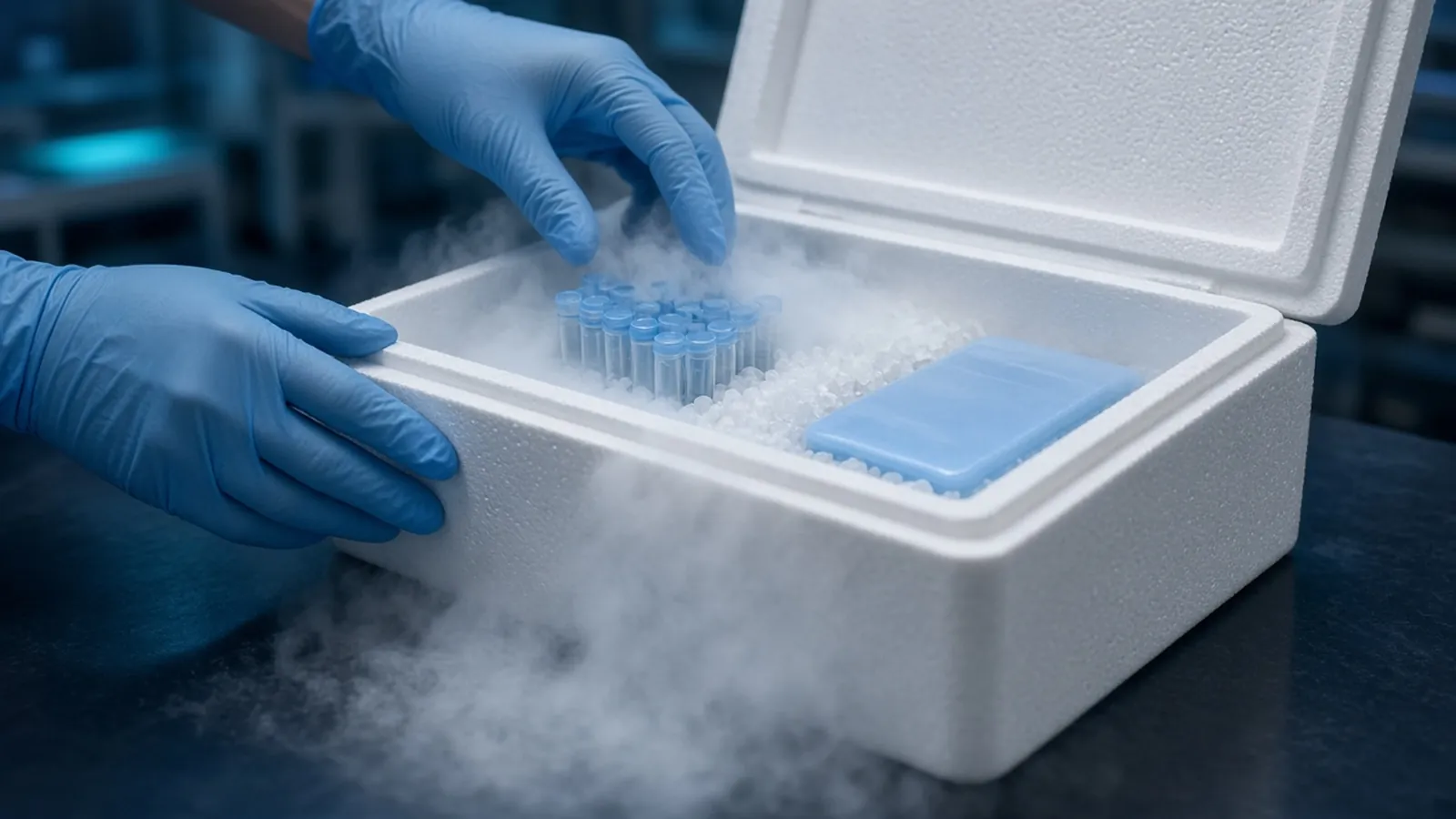 Dry ice packing for sample shipmentsDry ice keeps non-infectious research samples cold and can burn skin or displace air. Carrier rules and infectious-substance law still govern shipping.
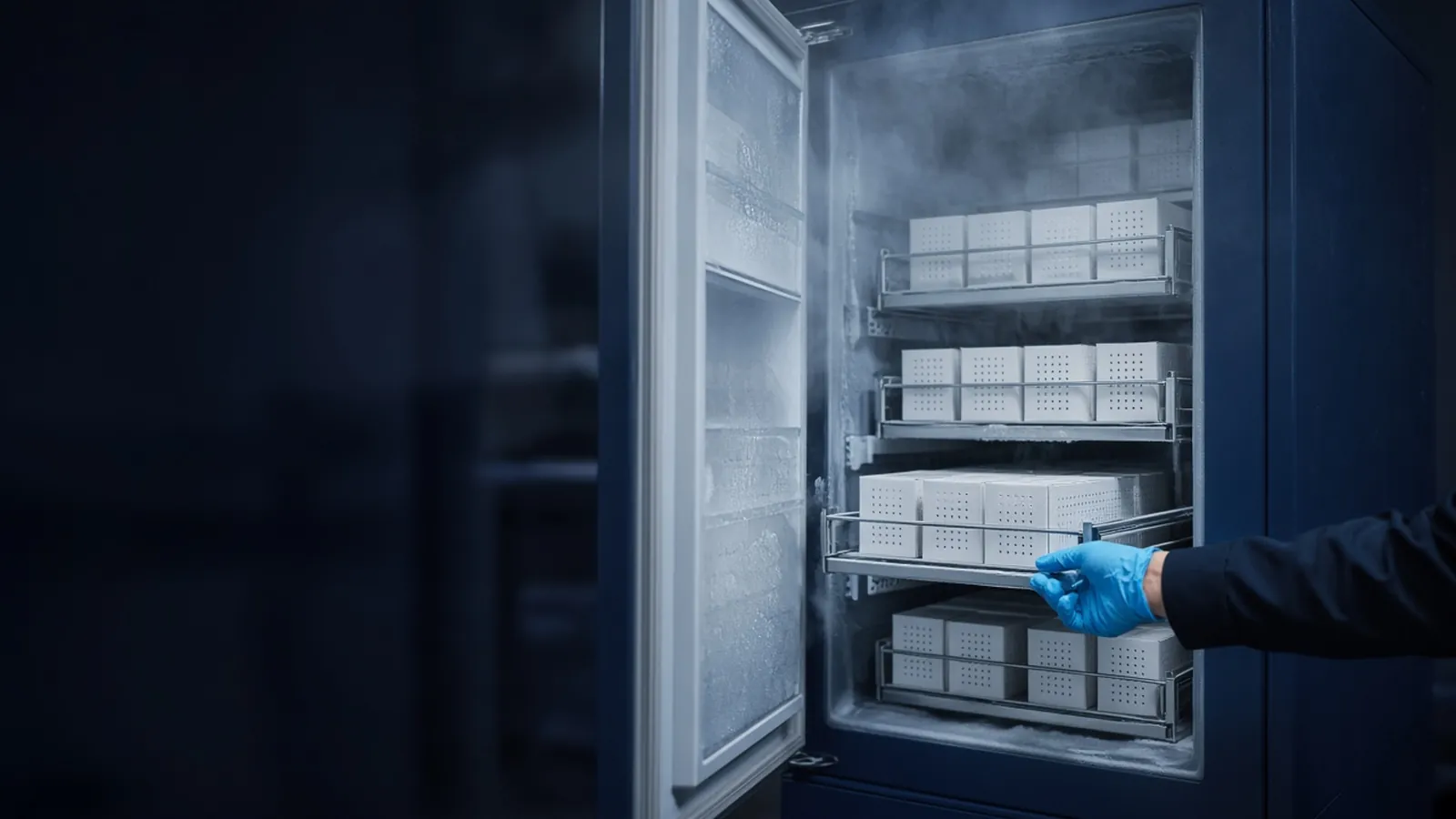 Storing biological samples from fridge to freezerFridge, minus-20, minus-80 and nitrogen storage slow different kinds of damage. A warm box is a quarantine decision, not a hope.A glossary of cold-chain termsSetpoint is not air temperature, and a phase-change pack is not every coolant. Compare the cold-chain pairs labs treat as one word.