
application
Housekeeping is a safety control
Clear benches, labelled vessels, closed waste, and a dry floor are one control. Watch them applied during a single afternoon bench reset.
- Author
- EVRINTH Editorial Team
- Published
- 8 October 2026
- Updated
- 8 October 2026
- Reading time
- 8 min
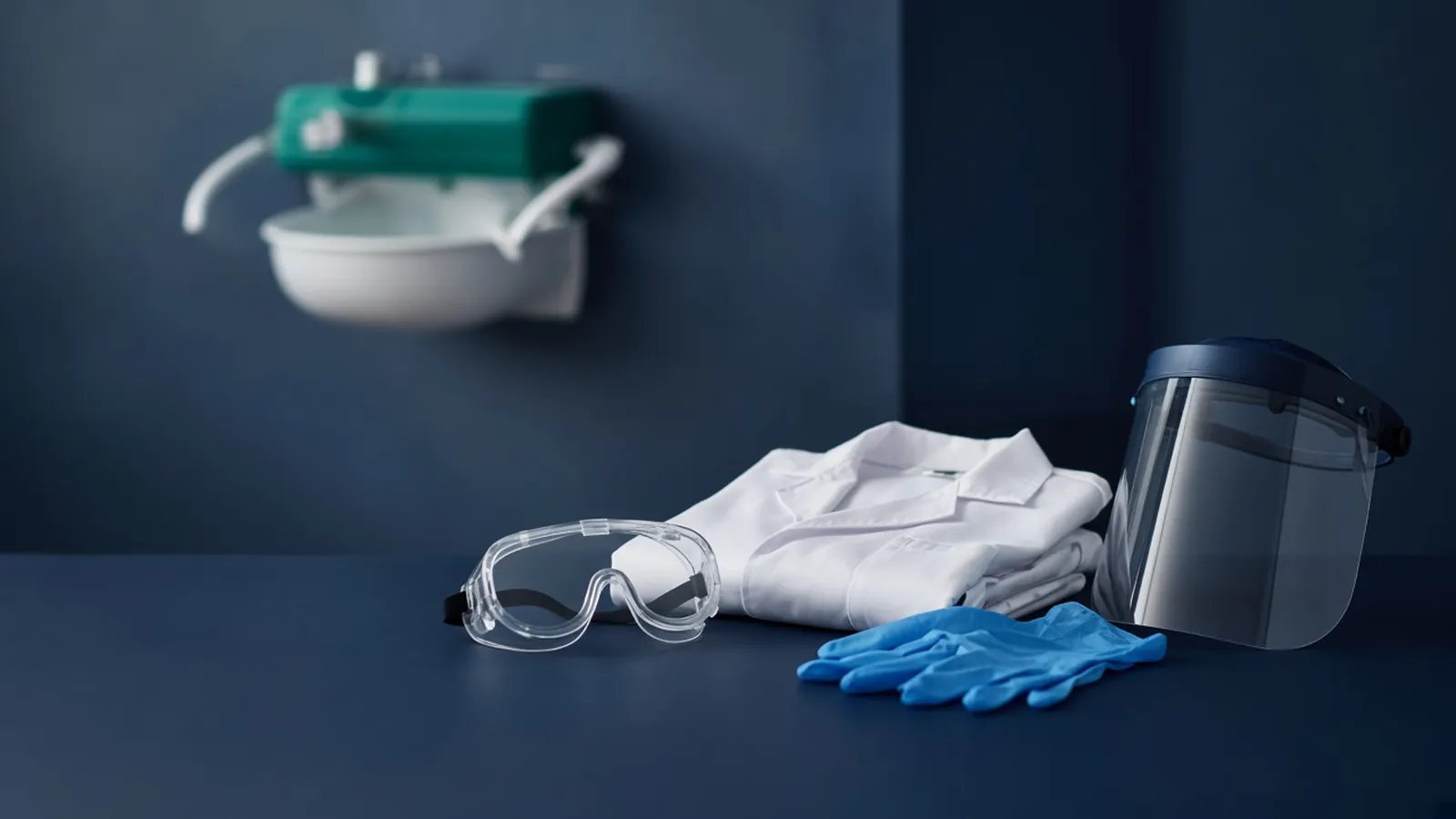
At half past four the bench still holds the afternoon. Housekeeping is the control you apply before you leave, using the vessels, the waste, and the spill kit that are already in the room. This page follows one ordinary reset, not a renovation. Why the barriers exist at all is biosafety basics for research benches. How a cabinet should look when a session ends is part of working inside a biosafety cabinet. What you must not abandon beside an autoclave is autoclaves and what sterilisation does not do. Labels, bags, and eye protection are classes in the laboratory consumables catalogue. A teaching-lab list can be specified through academic research and a quotation request.
The bench at the start of the reset
The work was a buffer and a small bacterial culture, both already assessed, nothing heroic. What remains is a beaker with a pale solution, a flask with the culture, a tip box, a paper towel, a wet patch where an ice bucket sweated, and a spill kit somewhere behind the centrifuge. The decision the reset supports is whether the next person, who may be you tomorrow, inherits a bench or a puzzle. The WHO laboratory biosafety manual and the CDC BMBL treat a cleanable, orderly bench as part of practice. The OSHA laboratory standard puts housekeeping inside a chemical hygiene plan. Your rule is the local one. The afternoon below is how that rule looks when it is used.
Labels before anything is moved
Pick up the beaker. If you made the buffer and you know the salt, the concentration, and the pH, write them, with the date and your initials, before you put it in the fridge or on the reagent shelf. A clear liquid with no words is not "probably Tris." It is an unlabelled vessel. If you did not make it and cannot defend the contents, it does not join the common reagents. The laboratory's unknown-waste path takes it. That feels wasteful. It is cheaper than a wrong bottle in someone else's assay, or a mixture created by a helpful colleague.
The culture flask gets the strain name the assessment used, not a private abbreviation the next shift will misread. A date matters because a culture that has been sitting is not the culture you think. Caps are closed. A loose foil cap "so it can breathe" on a bench overnight is how the flask becomes everyone's organism.
The surface, then the floor
Clear the dry, clean items off to the side. Wipe the bench with the disinfectant and the contact time the procedure already chose for this organism. Do not invent a new spray because the bottle nearby is familiar. If the towel you wipe with touched the culture area, it leaves with biological waste, not with ordinary paper. The tip box that never opened can stay. The tips that did are already in the bag.
Then look down. The wet patch from the ice bucket is a slip, and it is a way to walk material across the floor if the patch was not only water. Dry it. A dry floor is the control, not a shine. If the patch smells like the solvent from the neighbouring bay, it is no longer a housekeeping wipe. It is the spill plan, and you switch to that plan rather than chasing the puddle with the same towel you used on the bench. The branch is the question "what is this liquid," asked before the towel moves.
While you are low, look at the route to the eyewash. A box that has crept in front of it is moved now. An eyewash you discover during an injury is an eyewash that failed this afternoon, even though nobody was hurt.
Waste closed, and the spill kit found
The biological bag is closed before it is full enough to split when lifted. It does not contain a Pasteur pipette or a solvent bottle. Sharps are already in their container. The ordinary bin receives wrappers that never touched the work and nothing else. Chemical bottles are capped. An open waste bottle is a vapour you are leaving as a gift.
Then find the spill kit with your hand, not with a memory. In this afternoon it is behind the centrifuge, under a carton of tips. That is the failure the reset is for. Move the kit to the place the rule names, check that the absorbent is the kind your chemicals need, and check that the bag inside it has not become a second rubbish bag. You should be able to explain, in one sentence, why it is there: so a spill can be covered without a search. If you cannot find it at all, the reset is not finished by going home. Tell the person who owns the room. A missing kit is a failed control, discovered at a convenient time.
Cabinet, autoclave door, and the last look
If you used the cabinet, the deck is empty, the waste has gone by the path inside the session, and the sash is at the height your idle rule requires. A sash left fully up is not "airing the cabinet." It is an abandoned control. The airflow article explains why. You do not need to re-derive it at half past four. You need to leave the machine in the state the training record mentioned.
The autoclave is not part of the tidy by parking a bag beside it with a note that says "please run." A bag with no contents list, no owner, and a tight neck is the dense, undescribed load the sterilisation page warns against. Either you pack it as the procedure allows and start a cycle you are allowed to start, or you leave it labelled and held. You do not make it the night shift's surprise. Personal protective equipment comes off in the order the rule says, gloves last or as trained, hands washed, coat left in the place coats live. A coat on the back of a chair in the writing room is a garment that has left the control.
| What you see at half past four | The control it is | If it fails, the branch |
|---|---|---|
| Unlabelled beaker | Identity of the liquid | Label only what you can defend, otherwise the unknown path |
| Wet floor by the ice bucket | Slip and spread | Dry it, unless the liquid is a spill that has its own plan |
| Open biological bag | Separation of streams | Close it. If a sharp is inside, do not fish |
| Spill kit behind the centrifuge | A response you can start | Move it now, while nothing is dripping |
| Sash fully raised | The cabinet left as a cabinet | Set the idle position the rule names |
| Anonymous bag at the autoclave | A described load, or not a load | Label and hold, or pack as the procedure allows |
What the reset does not claim
A tidy bench is not a sterilised bench, and it is not a biosafety approval. It does not make an uncertified cabinet usable, and it does not authorise a new organism in the morning. It does not replace a clinician if the wet patch was a splash you only noticed while wiping. In that case the reset stops and the incident path starts: what the liquid was, who touched it, which route, what you did in the first minutes. Housekeeping discovered the event. It does not investigate it by itself.
Heat, humidity, and leaving the room
In humid weather the floor you dried can film over again, and paper labels fall off cold bottles as they sweat. Use a label that survives the fridge, and look once more at the floor before the lights go. A power cut in the middle of the reset is a reason to close caps by the emergency light you actually have, not a reason to leave the phenol open because you will "do it properly in the morning." Morning inherits what you closed. Specify, if the kit is empty, the absorbent and the container size your plan already uses, on the quote form. Do not ask a seller to define your waste streams or to certify that the room is now safe because it looks calmer.
The control was ordinary. That is why it works, on the afternoons when nothing dramatic is planned and something small is about to be inherited.
Questions from the bench
Is housekeeping just tidiness before an inspection?
No. A clear bench is how you see a spill while it is small. A label is how the next person avoids mixing two clear liquids. A closed waste bag is how ordinary rubbish stays ordinary. A dry floor is how nobody carries a culture across the room on their shoes. Those are controls. An inspection can notice them. It does not create them.
What do I do with a vessel that has no label at the end of the afternoon?
You do not adopt it. Unlabelled liquid is a waste or a quarantine problem under the laboratory's rule, not a gift and not a guess. If you truly watched it all afternoon and the rule allows you to label what you made, label it with the contents, the concentration, the date, and your initials. If there is any doubt, it does not go back into the common tray.
How do I know the spill kit is a control and not a carton?
You can put your hand on it without a search, the absorbent matches the liquids you actually pour, and the path to it is not blocked by a freezer. If you have to move three boxes to see it, the kit has already failed before any spill. Fix that during the reset, while nothing is dripping. Do not wait to discover the carton during the spill.
Does a reset include the cabinet and the autoclave?
It includes the state you leave them in. The cabinet sash goes to the position your rule requires when idle, the deck is clear, and waste has left by the defined path. The autoclave is not a shelf for an unlabelled bag you will run in the morning. Packing and indicators have their own limits. Housekeeping is the decision not to abandon a half-described load in the corridor.
References
Manufacturer names identify published method classes. Trademarks remain with their owners. Catalogue records on this site are independent references for enquiry. They are not a statement of inventory, distribution rights or a supply commitment. This page is educational. It is not medical advice, a diagnostic protocol or a biosafety approval.
Catalogue
Related products and categories
These links follow the subject of the article into published manufacturer references. A listing is a reference for an enquiry, not a statement of stock or distribution rights.
Continue in this cluster
Related reading
Biosafety basics for research benchesResearch-bench biosafety is a stack of barriers chosen by a risk assessment. This page explains the stack. It does not approve the work. Working inside a biosafety cabinetHow a Class II biosafety cabinet moves air, how that differs from a chemical fume hood, and which habits keep cultures and workers protected.
 Autoclaves and what sterilisation does not doSteam sterilisation holds a cleaned load at temperature. It does not wash, remove endotoxin, or prove sterility because the tape changed colour.