
glossary
Ice buckets and how long a prep really sat out
What to record when a prep is called on ice: clock time, proteases that still work at 4 C, meltwater, and a column stopped by a power cut.
- Author
- EVRINTH Editorial Team
- Published
- 8 October 2026
- Updated
- 8 October 2026
- Reading time
- 8 min
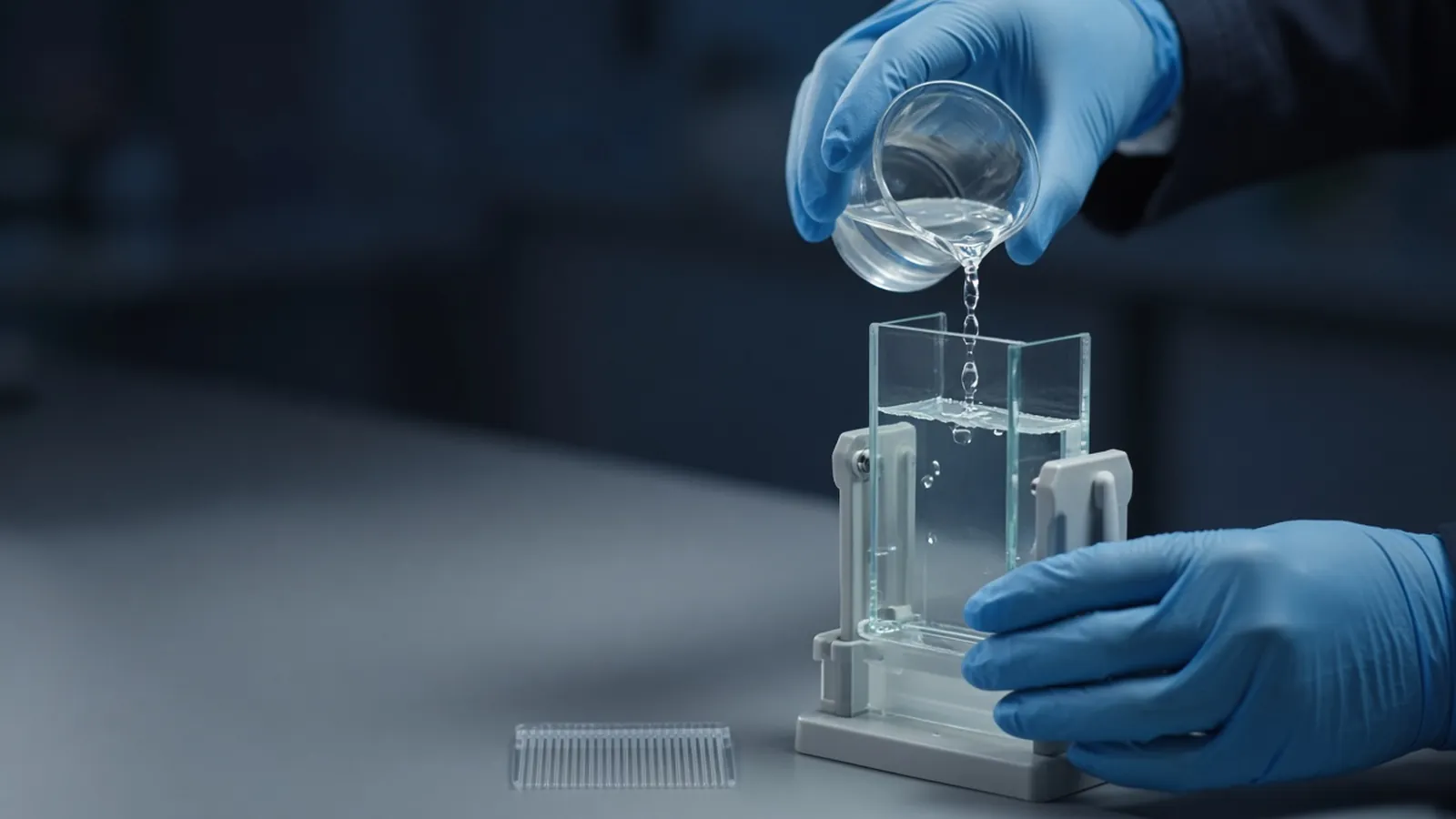
Ice is a place you put a tube. It is not a temperature history. A purification described as "on ice" can have spent the column step on the bench, the centrifuge step in a rotor that warmed, and the pause between them in a bucket of water with a few chips left. Proteases notice the difference even when the notebook does not. This page is a glossary of the times worth writing down. It will not invent a universal safe hold.
How a changed band pattern should be read is in reading a protein gel. Where the finished tube belongs is in storing biological samples from fridge to freezer. Buffers that were pH-adjusted at one temperature and used at another are in preparing a buffer and checking pH.
Words that hide the clock
"On ice" says a bucket was involved. "Cold" says the operator was trying. "In the cold room" says a room, which may be 4 C at the sensor and warmer on a crowded bench beside a motor. None of these phrases records when lysis started, when the spin ended, or when the elution was capped. The decision this page supports is to write clock times for the steps that let a protein sit in a vulnerable state: lysis, the wait before centrifugation, the column load and wash, the elution, and the wait before the tube was frozen or assayed.
A time-zero aliquot, frozen or denatured in sample buffer at the moment of lysis, is the control that makes later smears interpretable. Without it, degradation and a bad gel recipe look the same. Take that aliquot before you walk the lysate to a shared centrifuge.
Proteases at 4 C are slower, not absent
Cooling reduces enzyme rates. It does not repeal them. A protease that nicks your protein in ten minutes at room temperature may take much longer at 4 C and still finish the job during a column that runs for hours. The fold-change is protein-specific. Publishing a single safe window would be a fiction. Inhibitors belong in the lysis buffer when the target is cleavage-prone, and they belong in the notes so you know they were present. They also belong off the list when they will kill the activity you intend to measure later.
Warm spikes matter more than the average. A lysate that sits in ice for an hour and then stands at the bench for the twenty minutes a rotor takes to free up has experienced the warm spike, not the hour. Record both. If you must leave the bench, park the tube in ice or in a cold block you trust, and write the departure and return.
The gel is the judge. High-mass bands that vanish between time zero and the elution, with fragments appearing lower down, are a cleavage story. A uniform loss of every band is more compatible with a loading or quantification error. Activity that falls while the gel stays intact is inactivation without obvious proteolysis, which cooling will not fully explain either. Heat, a bad buffer, and a cofactor that left can do that with the ice bucket still full.
The bucket in a warm, humid laboratory
Ice melts quickly in a hot room. A bucket filled at the start of a three-hour protocol is water by the end, and tubes float warmer than the word ice suggests. Refill, or use a cold block kept in a real freezer, and note when you did. Humidity adds a second nuisance: moisture drips from a cold tip box or from the outside of a chilled bottle into open tubes. That drip is water you did not mean to add. It dilutes the sample and can carry whatever was on the outside of the vessel. Cap tubes between additions. Do not leave a column fraction open under a sweating shelf.
Condensation on a cuvette or a plate taken from the cold makes quantification noisy. Wipe optical faces and let the condensation decision be deliberate. A wet lid that drips back into a protein tube is not a blank. It is a dilution event. Write it down if it happens.
Shared cold rooms warm up when the door is propped and when a power sag hits the plant. A thermometer in the room is more honest than the setpoint on a panel outside. If you place a column in that room, the column temperature is the room's temperature only after the resin and the buffer have equilibrated. The first fractions of a column wheeled in from a hot corridor are not yet cold.
A column that stops is a new sample
Gravity columns and pumps assume continuous flow. A power cut, a tripped socket, or a lunch that became a meeting can stop an elution halfway. Protein sits on the resin in a partial salt or imidazole gradient. When flow returns an hour later the room may be warmer, the gradient has diffused, and the next fraction is not the fraction you would have collected on time. Label it as an interrupted elution. Run a gel against a completed prep before you pool. If the pattern differs, keep the batches apart.
The same logic applies to a centrifuge that stops and restarts. A pellet that sat in a warm rotor in the supernatant is not the pellet you spun and immediately decanted. Decant when you can, or accept that the hold is part of the method and write the minutes.
None of these events has a universal rescue time. Some proteins are indifferent. Some are not. The record lets the next person repeat the hold you really used, or avoid it.
| Event | What to write | Why the phrase on ice is too small |
|---|---|---|
| Lysis | Start time, inhibitor yes or no, time-zero aliquot | Cleavage starts when cells break |
| Wait for the centrifuge | Minutes, and whether the tube was in ice or on the bench | A warm spike dominates the average |
| Column load and elution | Start, finish, room or cold room, flow that stopped | Resin time is contact time |
| Interrupted elution | Power or pause times, fraction identity | Restarted flow is a different gradient |
| Ice bucket | When it was filled, when it was mostly water | Meltwater is not 0 C slurry |
| Final tube | Time it was frozen or assayed | The hold after a pretty chromatogram still counts |
Failure modes the ice bucket gets blamed for
A smear blamed on ice can be overload. A lost activity blamed on ice can be the wrong pH, because Tris buffers change with temperature and a buffer set at room temperature is different in the cold room. Check the buffer note before you condemn the hold. A cloudy sample blamed on a long column can be the protein passing through its pI as the salt changed. Timing is one variable. It is not the only one.
Losing the time-zero tube means you cannot branch. Make the aliquot a habit, labelled with the same prep code as the column.
Safety
Cold rooms, wet floors, and dry ice or liquid nitrogen used to chill a secondary container are physical hazards under local rules. This page does not authorise storage of infectious material, and it does not declare a sample safe because it was cold. Biosafety level follows the organism, not the bucket. Chemical inhibitors in the lysis buffer remain chemicals when the prep is over.
An India-warm afternoon is the normal case, not an exception
Plan the ice supply for the length of the real protocol, not for the first half hour. In humid weather, drip and melt are routine. In buildings where power cuts are part of the week, do not start a long unattended elution you cannot monitor. Stay with the column, or choose a stopping point that is a real fraction boundary, and write that the method includes that stop. A prep repeated only on uninterrupted days is a different method from a prep that always includes a half-hour pause. Both can be valid. They should not share one sentence that says only "on ice".
What the enquiry should carry
If another laboratory will run the purification, tell them which steps must stay cold, which inhibitors are mandatory, and whether an interrupted column has to be discarded or gel-checked. Give them the assay that will judge damage. Buffer and inhibitor classes are in the reagents and chemicals catalogue. The purification itself can be discussed through the custom protein expression and purification reference. Put the timing constraints in the quote request beside the buffer and the gel evidence you want back. A request that says only "keep cold" repeats the ambiguity this page is trying to retire.
Questions from the bench
Does on ice mean the sample stayed at 4 C?
It means someone intended the tube to be cold. A tube in a melting slurry, a column at room temperature, and a lysate parked beside the bucket can all be described that way in a notebook. The temperature history is the clock and the place, written down.
Do proteases stop in the cold room?
They slow. Many remain active at 4 C and will nick a protein over a long hold. Inhibitors reduce that rate further and do not make an afternoon on the bench harmless. If the band pattern changed, compare a time-zero aliquot with the held sample.
Is there a safe number of minutes at the bench?
No number in this article is a safe hold for every protein. A robust enzyme and a protease-sensitive extracellular domain do not share a limit. Record the minutes you actually used and let the gel or the activity assay judge that prep.
What should I write if the power fails during elution?
Write the time the pump or the gravity column stopped, the time it restarted, and that the fraction is an interrupted elution. Pool it with an uninterrupted run only after a gel shows they match. The stopped resin is a different sample until then.
References
Manufacturer names identify published method classes. Trademarks remain with their owners. Catalogue records on this site are independent references for enquiry. They are not a statement of inventory, distribution rights or a supply commitment. This page is educational. It is not medical advice, a diagnostic protocol or a biosafety approval.
Catalogue
Related products and categories
These links follow the subject of the article into published manufacturer references. A listing is a reference for an enquiry, not a statement of stock or distribution rights.
Continue in this cluster
Related reading
Reading a protein gelHow to read a protein gel: what SDS-PAGE bands, smears, ladders and loading differences can support, and what they cannot identify. Storing biological samples from fridge to freezerFridge, minus-20, minus-80 and nitrogen storage slow different kinds of damage. A warm box is a quarantine decision, not a hope.
 Preparing a buffer and checking pHPrepare a buffer at a stated pH and temperature, record the salt form, and treat a drifting electrode or a bad slope as a failed control.