
explainer
Inventory so a sample is not stored twice under two names
One sample needs one identity. Two names for one tube make a cohort look twice as large, or make the tube impossible to find.
- Author
- EVRINTH Editorial Team
- Published
- 8 October 2026
- Updated
- 8 October 2026
- Reading time
- 8 min
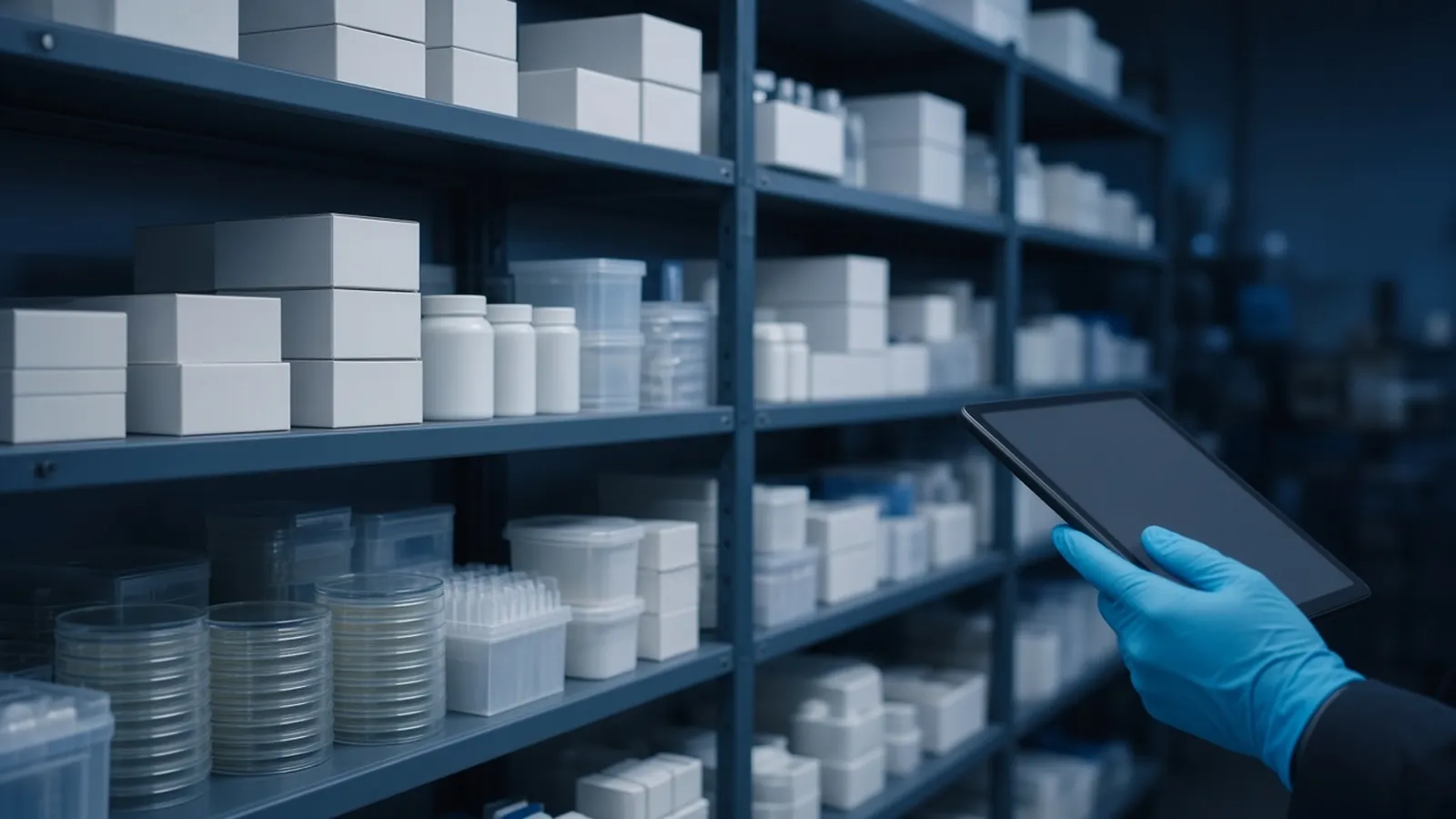
A cohort of forty livers becomes eighty results, or zero, when one tube is filed under two names. The tube did not multiply. The inventory did. One sample needs one identity: a primary code that means that physical container and no other, plus a map that takes you to it without a fishing trip through a cold cabinet. The temperature you store it at still follows storing biological samples from fridge to freezer. The way you write the requirement down for someone else follows how to write a laboratory sourcing enquiry.
Labels, cryoboxes, and racks are in the laboratory plasticware catalogue. A freezer that can hold the map you designed is a laboratory procurement question and a quotation request. The identity rule is not something a cabinet can enforce for you.
The principle: one container, one primary identity
An identity is the string you promise will refer to one physical container. A sample in the biological sense, a piece of one liver, may be split into several containers. Each container then has its own identity, linked to the parent, because each container can be thawed, dropped, or left in a warm shipper on its own life. The parent is an alias relationship. It is not a licence to print the same code on three tubes and call them interchangeable without a record.
A second name is useful. Collaborators arrive with their codes. Notebooks use nicknames. The honest structure is one row, one location, and a list of aliases that do not create extra rows. The dishonest structure is two rows, two locations, and a hope that everyone remembers they are the same tube. They will not remember. One analyst will treat them as replicates. Another will conclude the sample was lost and aliquot the wrong neighbour.
How a tube grows a second name
The second name is born in ordinary politeness. A visiting student writes "P3 liver" on the lid because that is the phrase in the protocol. The database already has "LIV-014" for the same punch, entered by the person who collected it. Both strings are now on paper. Somebody types "P3 liver" as a new line so the student's sheet will match, and invents a location from memory, often the same box, sometimes a new box they mean to create later.
It is also born in rescue attempts. A label falls off. Rather than reconcile the map, someone assigns a fresh code and freezes the tube in a "to be identified" box that slowly becomes a second collection. Months later both codes are cited in a figure legend. The cohort is analysed twice, or the statistics silently include a duplicate.
Aliquoting causes a cleaner version of the same wound. The parent stays "LIV-014" and the aliquots are also "LIV-014" with no suffix. Use of aliquot B is recorded as use of the parent. The parent is then reported as still full, and someone thaws it as well. You have spent two freeze-thaw histories and called them one.
The map is part of the identity
A primary code without a place is a rumour. The map that belongs on the same row is specific: freezer, shelf or rack position, box, and coordinate inside the box. "Minus 80, somewhere on the left" is how doors stay open. The coordinate should be the one printed on the box grid you actually bought, so two people mean the same well.
When you move a box, the move is an edit to the row at the time of the move, not a note you will enter after the seminar. A box that lives in two places in the database will be searched for twice and will be re-created by a well-meaning person who does not find it the first time. That re-creation is the second name.
The label on the tube has to carry the primary identity in a form that survives frost and solvents, and it has to match the row. A label with only the nickname, while the database has only the formal code, is two names that have not yet been typed. Put the primary code on the tube. Put nicknames in the alias column. If the tube is too small, put the primary code on the tube and the nickname only in the system.
A cohort that almost got counted twice
Forty mouse liver samples are collected. The surgical sheet uses M1 to M40. The biobank sheet uses LIV-200 to LIV-239. Both are correct descriptions. Only one is the primary identity. The laboratory picks LIV-200 and the rest as primary, and types M1 into the alias column of LIV-200. The tube label shows LIV-200. The box map shows freezer A, shelf 2, rack 1, box 4, position B3.
A collaborator emails a plot that says M1 and M2 were outliers. You can translate, because the alias is on the row. You do not create "M1" as a new sample in freezer B. If someone already did, the repair is to merge: confirm there is only one tube, void the extra row, and keep the alias. If there are now two tubes because someone re-aliquoted under the belief that M1 was missing, you have two containers and you must say so. They are not replicates of a new animal. They are two containers from one draw, and the analysis plan has to know that or the cohort is inflated.
The same week, LIV-214 is on the map at shelf 2 and physically on shelf 4 after a power-cut move that was never written down. A new student does not find it, assumes it was used, and excludes the animal. The sample is not gone. The map is lying. Reconciliation is a physical check of one box against its rows, done often enough that a move cannot hide for a whole study. You do not need a heroic inventory of the entire building to catch this. You need the rule that a move without an edit is an incident.
What to record, and what to refuse
| Situation | Harm if you open a second row | Repair |
|---|---|---|
| Collaborator code and local code | The animal or patient-sample is counted twice | One primary code, other code as alias |
| Nickname on the lid, formal code in the sheet | Search fails, a new tube is created | Print the primary code on the tube |
| Aliquots share the parent string | Use and loss cannot be separated | Suffix or new code, plus parent link |
| Two locations for one code | Double search, door left open, false loss | One location, edited at the move |
| Unlabelled tube after frost | A guessed code contaminates the cohort | Quarantine until the map and a second person agree |
Failure modes
If two people can create identifiers without checking the alias column, you will grow duplicates. The control is a unique primary key and a habit of searching aliases before minting a code.
If the label adhesive fails at minus 80, the identity falls off even when the database is perfect. The label class is part of this explainer. A paper label that lets go when frost melts is an inventory failure, not only a stationery failure.
If a private notebook is the only place a nickname is translated, the translation leaves when the person leaves. The alias column has to live where the map lives.
If quarantine tubes are given a new identity "so the hold is obvious", you have renamed a sample in the middle of its life. Use a status on the same identity. A new code is for a new container.
Biosafety and research use
Identity does not change hazard. A tube of infectious material under two names is still the hazard the biosafety office assigned, and it may be stored in the wrong room if one of the names omitted the hazard flag. The WHO laboratory biosafety manual is the programme frame. Your institution assigns the flag. This inventory rule does not de-identify human-derived research material into anonymity you were not permitted to create, and it does not make a research tube a diagnostic record.
Culture collections ship strains with their own identifiers. Keep the collection identifier as an alias or as the primary code, consistently, and do not relabel a strain into a new organism by typing loosely. The ATCC culture guides show how a deposited strain arrives already named.
What to ask for when the map needs hardware
Ask for cryoboxes with a grid you can cite, labels rated for the cold you use, and racks that match the shelf spacing in the freezer you are specifying. Put the identity rule in the same quotation request only as a statement of format: primary code plus coordinate. Do not ask a supplier to clean up a historical duplicate cohort. That reconciliation is a laboratory task, done with the tubes in front of you and the spreadsheet constrained to one row per container.
Questions from the bench
What is wrong with keeping the collaborator's code and our code as two records?
Nothing is wrong with storing the collaborator's code as an alias on one record. The failure is two records that both claim to be the physical tube, often with two locations. Analysis then counts one biological sample twice, or a search on the other name reports the tube as missing. Keep one primary identity, and hang every other name on it.
Do aliquots inherit the parent's name unchanged?
They inherit a link, not a duplicate identity. Each tube that can be thawed on its own needs its own primary identity, because each can be used, lost, or warmed on a different day. Record the parent so the cohort can be reconstructed. Recording three aliquots as three copies of the same identifier makes use and loss indistinguishable.
The map says shelf 2 and the box is on shelf 4. Which do I trust?
Trust neither until someone reconciles them. Using the sample from the surprise location without editing the map trains the next search to open the wrong shelf and warm the cabinet. Update the map in the same visit as the find, and note who moved it if you can. A map that lies is how a tube gets entered again under a new name.
Can a spreadsheet be a real inventory?
Yes, if one row is one physical container, the primary identity is unique, aliases are columns rather than extra rows, and the location is complete enough to open one rack. A spreadsheet fails when people keep a second private file of nicknames. The tool matters less than the rule that a second name is not a second sample.
References
Manufacturer names identify published method classes. Trademarks remain with their owners. Catalogue records on this site are independent references for enquiry. They are not a statement of inventory, distribution rights or a supply commitment. This page is educational. It is not medical advice, a diagnostic protocol or a biosafety approval.
Catalogue
Related products and categories
These links follow the subject of the article into published manufacturer references. A listing is a reference for an enquiry, not a statement of stock or distribution rights.
Continue in this cluster
Related reading
 Storing biological samples from fridge to freezerFridge, minus-20, minus-80 and nitrogen storage slow different kinds of damage. A warm box is a quarantine decision, not a hope.
 How to write a laboratory sourcing enquiryWrite a laboratory enquiry as measurable performance, documents and an acceptance check, so a quotation can be compared with the scientific need.A glossary of cold-chain termsSetpoint is not air temperature, and a phase-change pack is not every coolant. Compare the cold-chain pairs labs treat as one word.