
protocol overview
Ion exchange pH and salt
Set ion-exchange pH against the protein charge and plan a salt gradient that binds the target and releases it on purpose.
- Author
- EVRINTH Editorial Team
- Published
- 8 October 2026
- Updated
- 8 October 2026
- Reading time
- 8 min
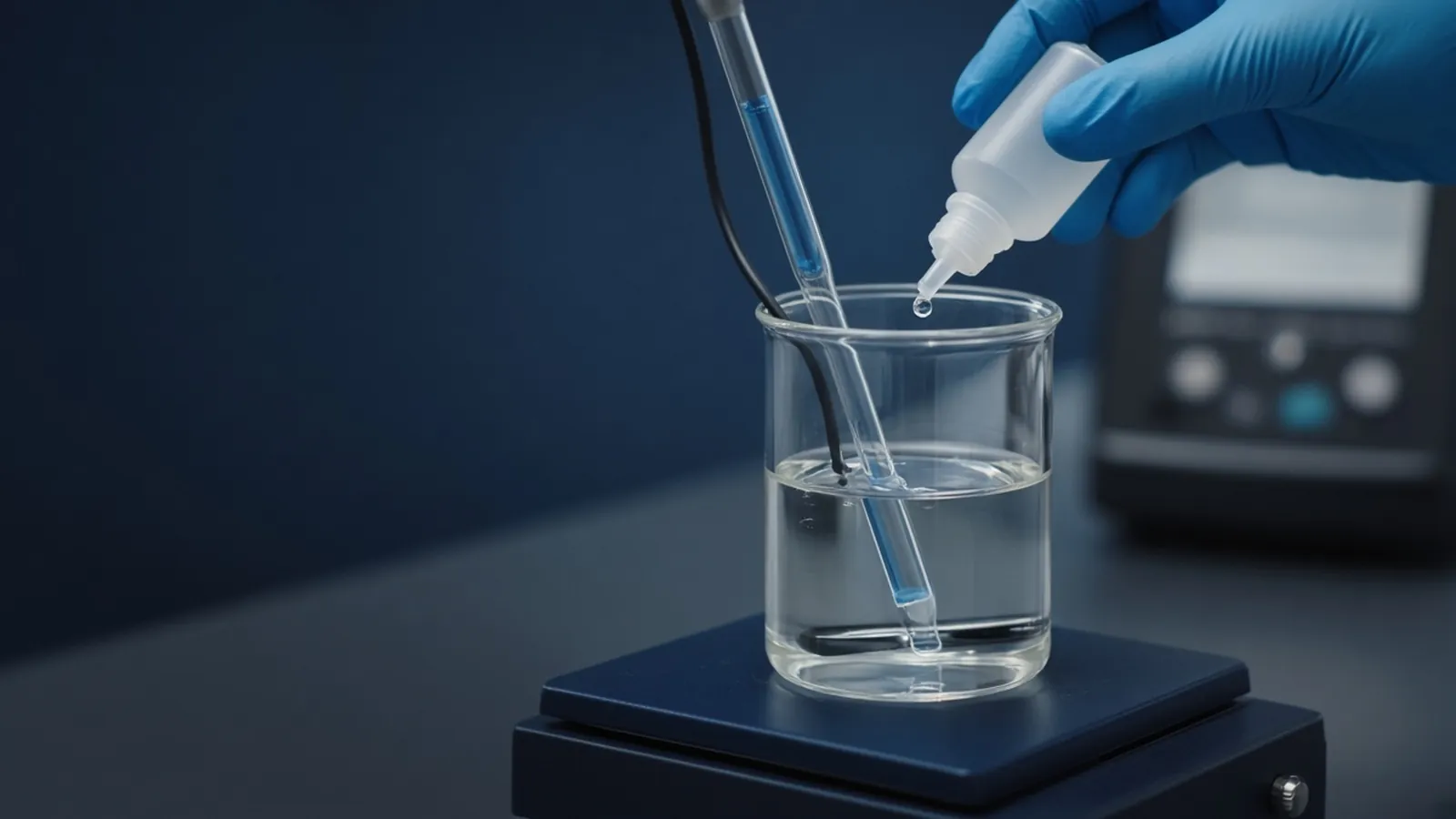
Ion exchange binds a protein when the protein carries the opposite charge to the resin, and lets it go when salt, or a pH change, removes that advantage. The decision is which pH makes the charge useful, and how steep a salt gradient still leaves neighbours in different fractions. Mode context is in chromatography methods in life-science labs. Tag capture before this polish is in affinity and ion-exchange protein purification.
Charge is a pH story
A protein's isoelectric point, the pH of zero net charge, is the landmark. UniProt sometimes carries a calculated or reported value. The calculation sees the sequence. Your buffer sees the folded surface, the tag, and the ions already bound. Treat the database figure as a place to start a scout, not as the pH of the method.
Above that point the net charge is often negative. An anion exchanger, whose ligand is positive, can bind it. Below that point the net charge is often positive. A cation exchanger, whose ligand is negative, can bind it. Binding when the charges are opposite is the whole selection rule. A protein and a resin with the same sign of charge is a flow-through experiment, useful only when you meant to bind the impurities instead.
Salt competes. At low ionic strength the protein's charge can hold the ligand. As sodium chloride or another salt the insert accepts rises, ions from the buffer occupy the ligand and the protein returns to the mobile phase. That competition is chromatography with a charged stationary phase. A step to high salt dumps everything that was bound into a small volume and spends the resolution you bought the column for. A gradient spends time and returns fractions that a gel can tell apart. There is no universal salt percentage. The conductivity where this protein leaves this resin is an experimental result.
pH gradients exist and are harder to repeat than salt gradients, because buffering species and the column's own charge both move. Prefer a salt gradient at constant pH unless you have a reason and a way to measure the pH actually leaving the column.
Buffer class and the bed
The start buffer should buffer at the working pH and should not itself be a high concentration of the competing ion. People often reach for Tris-type buffers on anion exchangers and for phosphate or a zwitterionic buffer on cation exchangers, at concentrations on the order of tens of millimolar. That is a class habit, not a recipe. The resin note names compatible buffers, the pH window, and the salt. A buffer ion that sticks to the resin will drift the pH you think you set. Measure pH at the temperature of the run. A pH electrode calibrated warm and a buffer used cold are not describing the same number. The photograph of a bench pH check is the right kind of measurement only if the temperature is the column's temperature.
Equilibrate until the pH and conductivity leaving the column match the start buffer, typically over several column volumes. A bed still full of storage ethanol or high salt will not bind. Load a clarified sample whose conductivity is at or below the start. Affinity eluates are the usual offender: imidazole and salt keep the protein from binding, and the "ion exchange failed" story is actually a solvent story. Dilute with start buffer or exchange the buffer, and confirm conductivity before the load. Measure volumes with care. ISO 8655-1 describes expectations for piston-operated volumetric apparatus when a pipette is how you build the dilution.
Strong exchangers stay charged across a wide pH. Weak exchangers titrate. Choose strong ligands when you need the resin's charge to stay put while you move pH a little. Choose the bead size for the pressure you can apply. Fine HPLC ion exchangers and soft preparative beads do not share a flow.
The run and the branches
Wash with start buffer for several column volumes after the load. Collect the flow-through. Assay it. If the target is there, stop the gradient. You are about to elute impurities and call it the product. Change pH toward a stronger opposite charge, lower the load salt, or switch exchanger sign, and scout again at small scale.
If the target bound, elute with a linear salt gradient over a length you can collect, often many column volumes on a preparative bed and a shorter programmed ramp on an analytical one. Follow the pressure limit. Collect fractions by volume or by the ultraviolet trace, and record conductivity. The salt concentration at the detector lags the pump programme by the dwell volume. Label fractions from the conductivity you measured, or correct the clock.
If the target never appears and a high-salt strip or a pH strip allowed by the insert suddenly releases it, the gradient ended too low, or the protein was precipitated and then redissolved. Cloudiness and a pressure spike favour precipitation. A clean pressure trace and a late release favour a longer or higher salt ramp. If a strip is required every run, the resin may be dirty or the protein may be denaturing on the ligand. Clean as the insert says before you decide the pH theory is wrong.
Pool only fractions the assay supports. A 280 nanometre peak during the salt rise can be several proteins of similar charge. A gel across the peak is the minimum orthogonal check. Mass spectrometry, reported with the discipline HUPO discusses, is a different and stronger identity claim.
| Scout result | What it means | Branch |
|---|---|---|
| Target in the flow-through, impurities bound | Charge sign or salt is wrong for binding the target | Reverse the exchanger or lower salt and retry |
| Target and neighbours bound, poor separation | Selectivity at this pH is weak | Scout a second pH inside the resin window |
| Target elutes mid-gradient, clean on a gel | This pH and slope are usable | Hold the method and watch conductivity |
| Target only in a harsh strip | Gradient too weak, or the protein is stuck or precipitated | Extend salt only after a clarity and pressure check |
| Empty everywhere | Lost upstream, or the assay cannot see this buffer | Assay the load again in the start buffer |
Failure modes
A pH measured in the beaker and a pH inside a concentrated protein load can differ. If binding is erratic, measure the pH of the load after dilution into start buffer, not only the buffer bottle. Temperature in a warm laboratory moves both pH and conductivity readings. Record the temperature next to the scout so next month's cold room is not declared a new protein.
A rising pressure during the salt gradient can be salt crashing into an organic co-solvent, or protein precipitating. Ion-exchange methods that stay fully aqueous still precipitate proteins at the pH of least solubility. The beaker test from the buffer article applies here. Do not exceed the rated pressure to finish a gradient.
Weak recovery with a clean flow-through and a clean elution can be a protein still on the resin. A protocol-approved strip tells you. It can also be an assay killed by the salt in the fraction. Desalt a single fraction and assay again before you conclude the protein never eluted.
Research use
The fractions support a research purification or an analytical charge profile. They are not a diagnostic test and not a drug substance. Buffers and salts are chemicals. Clarified lysates remain biological until your rules say otherwise. Stay inside the column's pH and pressure window. The resin manufacturer owns the cleaning recipe.
Enquiry
State anion or cation, strong or weak ligand if you know which window you need, working pH, salt, sample conductivity, column volume, analytical or preparative goal, and the assay you will use on fractions. Ask for bead size and the pressure rating. The scientific instruments catalogue lists hardware classes. Send the scout results you already have with the quote request. A method question about the protein campaign can use the custom protein expression and purification reference as the discussion prompt. ---
Choose exchanger, pH, and salt so the target binds and then leaves
- 01Estimate charge, then test itUse sequence-based isoelectric information as a starting guess. Bind a small sample at a pH on each side of that guess. The trial outranks the calculation.
- 02Pick the resin with the opposite chargeA protein that behaves as a net negative binds an anion exchanger. A protein that behaves as a net positive binds a cation exchanger. Equilibrate in a low-salt buffer at that pH.
- 03Wash, then raise salt and collect fractionsHold a low-salt wash for several column volumes. Elute with a salt gradient or steps the resin note allows. Keep fractions separate and record conductivity, not only time.
- 04Branch on the flow-through and the stripIf the target is in the flow-through, the charge or the salt was wrong. If it appears only in a harsh strip, the gradient never became strong enough, or the protein is precipitating. Assay before you pool.
Questions from the bench
How does pH relative to the isoelectric point choose the resin?
The isoelectric point is the pH where the protein's net charge is zero. Above it, the net charge is often negative, so a positively charged anion exchanger is the candidate. Below it, the net charge is often positive, so a negatively charged cation exchanger is the candidate. Surface patches and the buffer ions break that average, which is why a two-pH scout beats a long gradient on a resin chosen only from a calculator. Follow the resin's own pH window while you scout.
Does a higher salt concentration always elute the protein?
Raising salt competes with the protein for the charged ligand and is the usual way to elute. The concentration that works is method-specific. A protein bound by a strong local patch can need more salt than its net charge suggests. Enough salt will also keep it from binding in the first place, which is why an affinity eluate that is still salty flows through an ion exchanger. Dilute or exchange into the low-salt start, then let the gradient do the releasing on purpose.
What is the difference between a strong and a weak exchanger?
A strong exchanger stays charged across a wide pH range. A weak exchanger gains or loses charge as pH moves near the ligand's own pKa. Strong and weak are not nicknames for how tightly a protein sticks. Quaternary amine and sulfonate ligands are the usual strong classes. Diethylaminoethyl and carboxymethyl ligands are the usual weak classes. Pick them for the pH window you need, and take the elution salt from the experiment.
What should an ion-exchange enquiry specify?
State the protein's approximate isoelectric behaviour if you know it, the pH you want to work at, the salt you can use, the sample conductivity, column volume, and whether you need a step or a gradient. Ask for ligand class, bead size, and pressure rating. Send that with the quote request. Anion and cation are different products. The word ion exchange alone does not order one.
References
Manufacturer names identify published method classes. Trademarks remain with their owners. Catalogue records on this site are independent references for enquiry. They are not a statement of inventory, distribution rights or a supply commitment. This page is educational. It is not medical advice, a diagnostic protocol or a biosafety approval.
Catalogue
Related products and categories
These links follow the subject of the article into published manufacturer references. A listing is a reference for an enquiry, not a statement of stock or distribution rights.
Continue in this cluster
Related reading
 Chromatography methods in life-science labsHow life-science chromatography separates molecules on a stationary phase, and what an HPLC or column peak does not prove about purity.A glossary of chromatography termsUse chromatography terms with their real limits: retention, resolution, void, and a peak that is only a detector response.
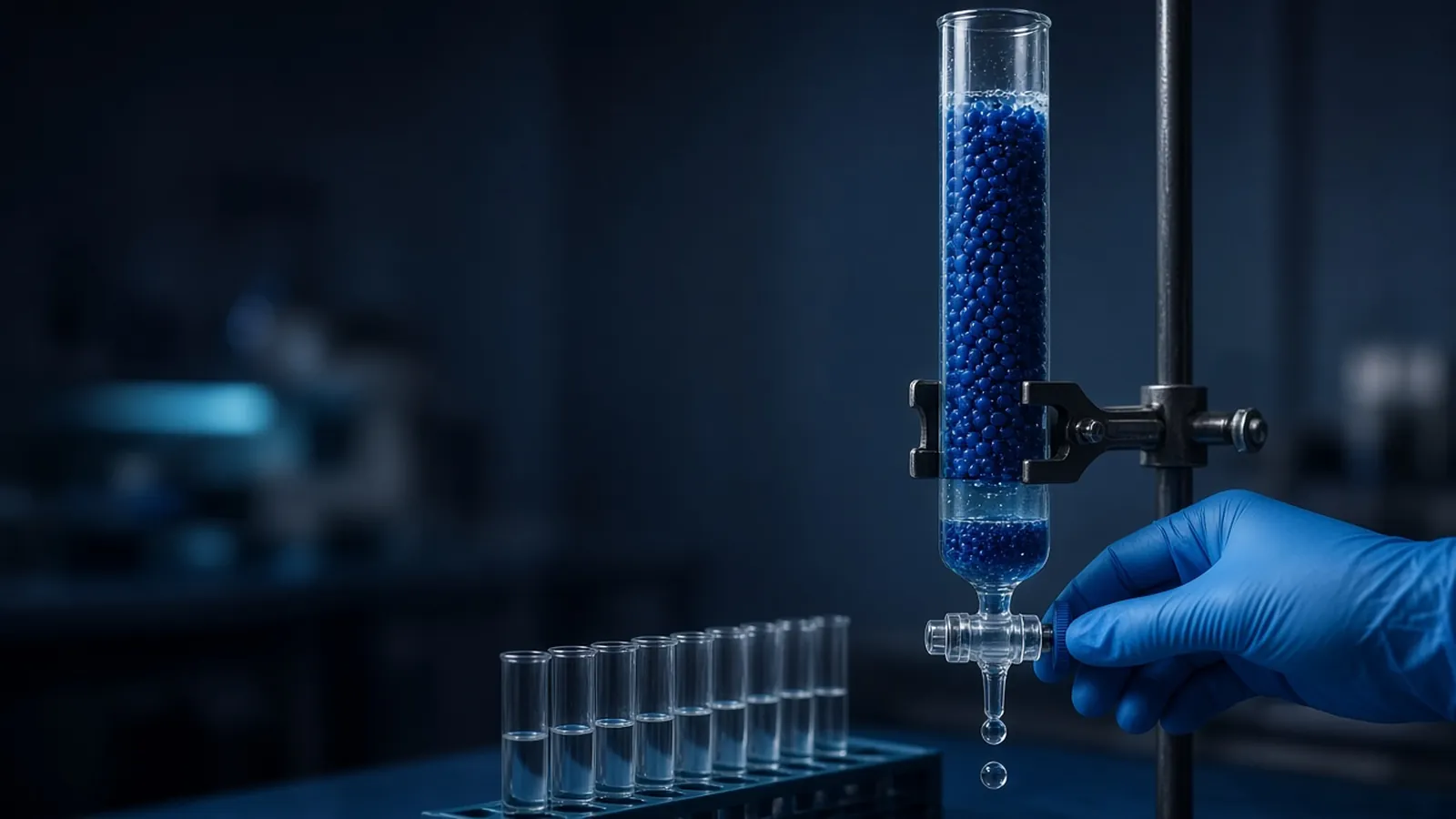 Affinity and ion-exchange protein purificationHow affinity capture and ion exchange pull a protein from a lysate, and why each collected fraction still needs an identity check.