
protocol overview
Labels that stay on at minus 80
Use a cryo-rated label and solvent-resistant ink, applied to a dry tube before it freezes. Paper labels let go when frost melts.
- Author
- EVRINTH Editorial Team
- Published
- 8 October 2026
- Updated
- 8 October 2026
- Reading time
- 9 min
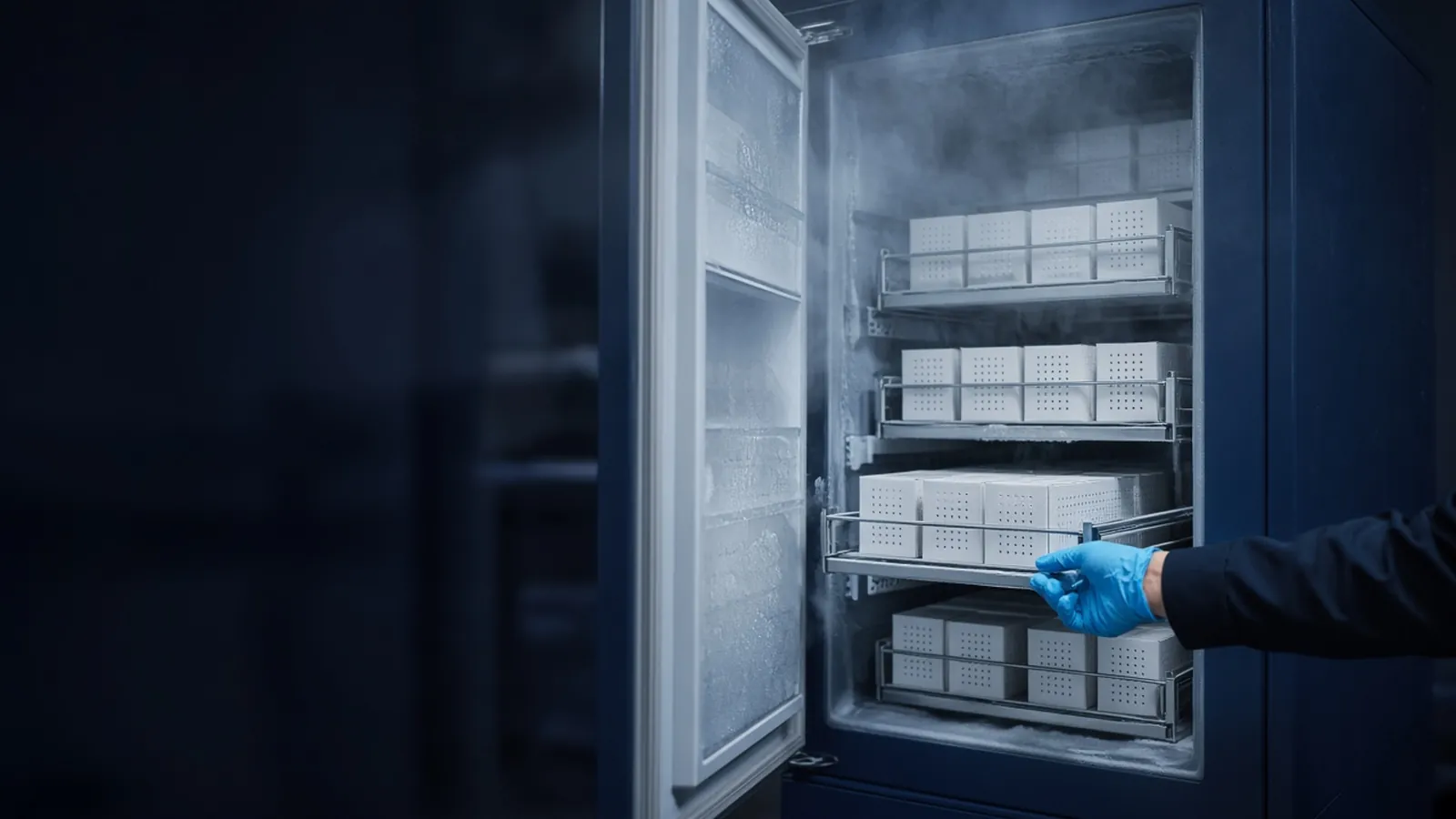
The identity of a tube at minus 80 is only as durable as the adhesive and the ink. Frost is temporary. A label that lets go when that frost melts is a lost sample that is still cold in the rack. This protocol overview is the labelling workflow: choose a cryo-rated label and a solvent-resistant mark, write the identity before the tube is frozen, match it to the map, and quarantine the tube if the label fails. Where the tube then lives, by temperature class, is in storing biological samples from fridge to freezer. Which plastics are a fair vessel at all is in when to use plastic tubes, tips and plates.
Labels and cryovials are chosen from the laboratory plasticware catalogue. Specifying them with the cabinet is a laboratory procurement conversation, sent as a quotation request.
Who this workflow is for
Use it when a tube will see minus 80, a dry-ice shipper, or a cycle of frost and thaw at the surface even if the contents stay frozen. The decision is whether a stranger can still read the primary identity after that cycle. If the tube only ever sits in a refrigerator and never meets ethanol, a lesser label may be honest. Write that limit on the drawer so the lesser label is not later promoted into the ultra-low.
Why frost beats paper
A tube taken from minus 80 into a humid room is colder than the dew point of that room. Water vapour deposits as frost. On paper, the frost is not only on the surface. The fibres take up moisture. When the frost melts, you have a wet label and, with many office adhesives, a glue line that was never meant to be underwater. The label curls, the ink runs, and the strip falls into the cryobox, where it sticks to a neighbour or to the ice sheet at the bottom.
The same tube left inside the cabinet still sees frost, because every door opening admits moist air. Warm, humid laboratories make more frost per opening than a dry cold room. You do not need a weather statistic to see it: the inner door fur grows faster in monsoon months and in rooms without dehumidification. A label class that barely survives a dry building can fail in a humid one. Test in the room you have.
Cryo-rated labels use adhesives specified for low temperature and for the thermal shock of coming out to the bench. They are still not magic. They need a clean, dry, unfrozen surface at application, a pressure the instructions describe, and a dwell time before you freeze. Skipping the dwell is a common reason a "cryo" label fails and the adhesive is blamed.
Ink is a second material
Adhesive can hold while the name disappears. Ethanol, isopropanol, and dimethyl sulfoxide dissolve many marker dyes. Those liquids are normal in a molecular laboratory: a wipe, a splash from a precipitation, a cryoprotectant on a glove. Solvent-resistant ink, or a thermal-transfer print designed for laboratory labels, is the class that survives. Ballpoint and gel pens are experiments you have not run.
Print is easier to read than handwriting after a year, and it avoids a glove smudge. Handwriting is acceptable when the pen has been checked and the characters are still unique. A scrawled "1" that becomes "7" is an identity change. If you print, the ribbon and the label face have to be a pair the printer maker and the label maker both accept. A beautiful print that rubs off with a gloved thumb has failed.
Write before the freeze
The reliable moment is while the tube is empty or just filled, at room temperature, dry, and in your hands without frost. Put the primary identity on the body of the tube. Repeat a short form on the cap only as a duplicate. Let the adhesive set. Enter the map: freezer, shelf, rack, box, coordinate. Then freeze.
If you are aliquoting, label the destination tubes before you thaw the parent, so the open time stays about the pipetting and not about searching for a pen. A tube that goes into the freezer unlabelled "for a minute" comes out as a forensic problem.
Already-frozen tubes are the branch you do not want. Frost blocks adhesion. Warming the tube to stick a label may thaw the contents, which is a storage decision, not a stationery decision. The controlled branch is: quarantine; if the SOP allows a transfer, move the contents into a pre-labelled tube of the right class; record a new container linked to the parent; do not scrape a wet paper label onto a guess.
The workflow and the failed control
| Step | Control that it worked | Branch when it fails |
|---|---|---|
| Label class | Maker rates it for the coldest storage you use | Do not substitute office labels for a short study |
| Ink or ribbon | A spare survives your solvent and a thumb rub | Change the pen or the ribbon before you label the cohort |
| Application | Dry tube, body not cap, dwell time observed | Stop and wait. Do not freeze a label that is still sliding |
| Map match | Primary code on the tube equals the row and the coordinate | Fix the row before the rack goes back |
| After one freeze cycle | Spare tube still readable, label still stuck | Quarantine any cohort tube that matches the failure. Change class |
The spare-tube cycle is the control. One spare, labelled as the cohort will be labelled, frozen overnight in the same cabinet, brought out into your humid air, then wiped with the solvent you actually use. If it fails, the cohort is not labelled yet, so you have lost a spare and not forty livers. If you skip the spare and the cohort fails, you have unlabelled material and a scientific problem.
A cohort labelled in a humid afternoon
You have twenty-four serum aliquots for a research ELISA, not a clinical report. The room is humid and the ultra-low door has been opened twice already. You label twenty-four cryo labels with a thermal-transfer code, LIV-200-A01 onward, on dry tubes, press them, and leave them on the bench for the dwell the label sheet asks for while you finish the map. You freeze a spare with the same ribbon. The next day the spare is readable after a solvent wipe. The cohort goes in.
The failure branch is the previous lot, which used paper and a fibre pen. Three labels are in the bottom of the box after one retrieval into humid air. You do not match them by "they were probably the left row". Those three tubes are quarantined as unlabelled. The ones whose labels still match the map stay in use. The paper stock is removed from the ultra-low drawer so it cannot be used for the next study. The ELISA does not quietly drop three animals or invent their codes.
Failure modes after a good start
A label that wraps over itself and not onto the plastic will lift even if the product is cryo-rated. Put adhesive on plastic.
A label on a tube still wet from extraction buffer will fail for water, not for cold. Dry the outside first. Do not bake a biological sample to dry a label.
Double labels, one nickname and one code, recreate the two-name problem. One primary string on the tube.
Dry-ice shippers add handling. Condensation when the shipper opens is the same melt event. Tubes that will travel need the same class of label, not a weaker one "because it is only shipping".
Nitrogen adds brittleness and, in liquid phase, a seal problem. A label rated only to minus 80 is not automatically a liquid-nitrogen label. Read the rating down to the coldest step in the real life of the tube, including transit.
Safety
Label solvents and the cleaners you use on benches are chemical hazards under the laboratory chemical plan. Dimethyl sulfoxide carries solutes through skin. Gloves that match the solvent are an institutional choice, framed by programmes such as the WHO laboratory biosafety manual and, where it applies, the CDC BMBL. A label is not a hazard warning. If the tube needs a biohazard mark, that mark has to survive the same cold and the same solvent, or the hazard disappears when the name does.
This workflow does not approve a tube for diagnosis. It keeps a research identity attached.
What to put in the enquiry
Name cryogenic labels rated for minus 80, or for nitrogen if that is the life cycle, and a print or pen class that is solvent-resistant. Name the tube plastic they must stick to. Ask for the temperature rating and the surface the adhesive expects, as documents, not as a slogan. Send that with the tube class through the quotation request. Do not ask anyone to guarantee that a label will survive an untested solvent or a tube that was labelled after it froze.
Label a tube so the identity survives minus 80
- 01Choose a cryo-rated label and a mark that resists solventUse an adhesive the maker rates for the coldest temperature you will store, on the plastic you actually use. Write or print with ink that survives ethanol and the other solvents your SOP already uses. Office paper and a water-based pen are the wrong class.
- 02Apply the identity while the tube is dry and unfrozenStick the label to the body of the tube, not only the cap, and let the adhesive sit as the label instructions say. Do this before the first freeze. A glove on a frosted tube will not lay a label that stays.
- 03Match the label to the box map, then freezeThe string on the tube is the primary identity in the inventory, plus a date if space allows. Record freezer, rack, box, and position before the rack goes back. A label the map does not know is a second name waiting to happen.
- 04If a label lifts, quarantine the tubeDo not press a loose label onto the nearest neighbour. Hold the tube out of use until the map and a second person rebuild the identity, or apply the laboratory rule for unlabelled material. Then change the label class that failed.
Questions from the bench
Why do ordinary paper labels fall off in an ultra-low freezer?
Paper and many water-based adhesives take up the frost that forms on a cold tube. When the tube is brought into humid room air, that frost melts and the adhesive is sitting in water. The label slides, smears, or drops into the box. A cryo-rated label is specified to stay stuck through that cycle. Paper is not.
Can I label a tube that is already frozen?
You can try, and you should expect failure. Frost prevents contact, cold stiffens the adhesive, and gloves smudge ink. If you must identify a frozen tube, quarantine it and transfer the contents to a new, pre-labelled tube only under a method the SOP allows, recording the transfer as a new container. Do not wrap tape around frost and call it labelled.
Is the cap a good place for the only label?
No. Caps are swapped when people open a row of tubes, and a cap label then names the wrong sample. Put the primary identity on the body. A cap mark can repeat it, as a convenience, but the body label is the one that has to survive.
Will any laboratory marker survive ethanol?
No. Many dye inks dissolve in ethanol, isopropanol, or dimethyl sulfoxide, which are ordinary in nucleic-acid and cell-freezing work. Use a pen or a print ribbon the maker calls solvent-resistant, and prove it on a spare tube with the solvent you actually wipe or pipette. A mark that survives water and fails ethanol has not passed your laboratory.
References
Manufacturer names identify published method classes. Trademarks remain with their owners. Catalogue records on this site are independent references for enquiry. They are not a statement of inventory, distribution rights or a supply commitment. This page is educational. It is not medical advice, a diagnostic protocol or a biosafety approval.
Catalogue
Related products and categories
These links follow the subject of the article into published manufacturer references. A listing is a reference for an enquiry, not a statement of stock or distribution rights.
Continue in this cluster
Related reading
Storing biological samples from fridge to freezerFridge, minus-20, minus-80 and nitrogen storage slow different kinds of damage. A warm box is a quarantine decision, not a hope. When to use plastic tubes tips and platesWhen polypropylene tubes, pipette tips and polystyrene plates are the right vessel, and when solvent or volume still belongs in glass.A glossary of cold-chain termsSetpoint is not air temperature, and a phase-change pack is not every coolant. Compare the cold-chain pairs labs treat as one word.