
protocol overview
Lysing cells without shearing the target
Open cells with detergent or enzyme when the assay needs long DNA, and treat mechanical bead-beating as a shearing step a short PCR may still accept.
- Author
- EVRINTH Editorial Team
- Published
- 8 October 2026
- Updated
- 8 October 2026
- Reading time
- 10 min
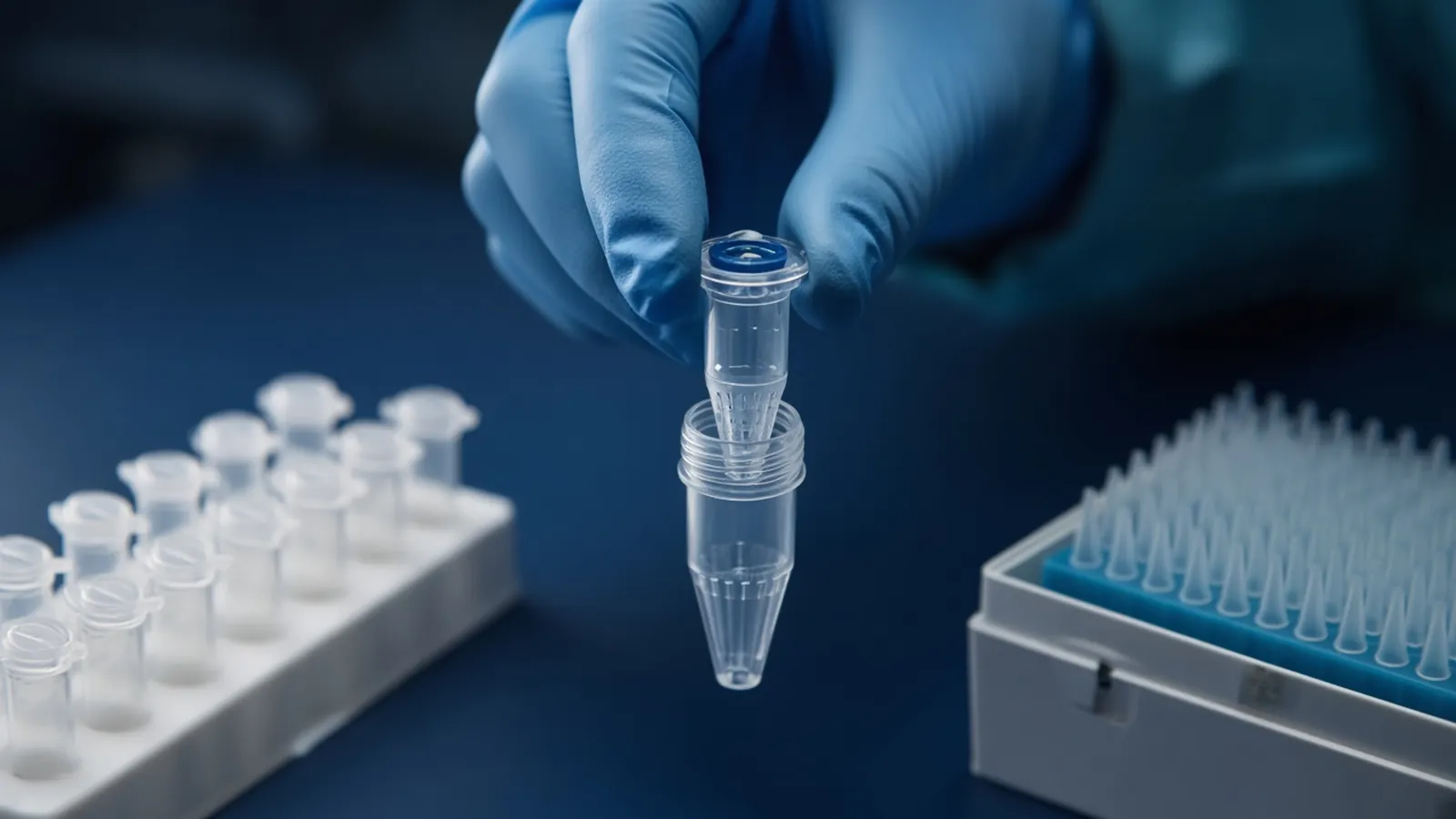
Lysis is the step that decides fragment length. Everything afterwards, including a careful silica column, can only keep what lysis left intact. The decision is how much force the wall in front of you requires, given the shortest molecule your assay still accepts. A PCR that asks whether a short allele is present can survive bead-beating. A cloning project that needs a long insert, described in plasmid cloning from insert to colony, often cannot. Long-read sequencing sits with the cloning end of that scale. This overview is the order of choices. It is not a kit insert and not a clinical collection method.
The separation methods that follow lysis are compared in how DNA extraction methods differ. If you shear during lysis and then blame the column, you will change the wrong reagent.
Four ways a cell is persuaded to open
Detergent solubilises membranes and many protein complexes. SDS is the strong, denaturing class. Milder detergents appear in protocols that still need a living enzyme afterwards. Chaotropic lysis buffers combine detergent-like denaturation with the salt that later drives silica binding. Detergent alone is often enough for cultured mammalian cells. It is often not enough for a Gram-positive wall, a yeast, a spore, or a leaf.
Proteinase K digests proteins, including histones and many nucleases, and it keeps working in SDS and in a surprising range of chaotropes. That is why it is the usual partner for a genomic DNA prep that should stay long: it releases DNA by chemistry rather than by tearing. A widely used incubation is warm, often near 56 Celsius, but the card for the enzyme and the kit sets the temperature and the time. Tissue chunks need longer contact than a cell pellet. A lump that still has a core has not been lysed, however clear the liquid around it looks.
Lysozyme-class enzymes cut specific walls. Lysozyme attacks peptidoglycan and is a common choice for many bacteria, sometimes after EDTA has disturbed a Gram-negative outer membrane. Other walls need their own enzyme class: lysostaphin for some staphylococci, lyticase or zymolyase for yeast. These enzymes are often unhappy in strong detergent. The decision-level order is enzyme first, in the buffer the card allows, then detergent and proteinase once the wall is open. Adding everything at once because the wells of a plate look tidier is how the enzyme never acts.
Mechanical lysis is the class that shears. Glass, ceramic, or metal beads shaken in a mill, a rotor-stator probe, grinding under liquid nitrogen, and repeated passage through a fine needle all open tough samples by impact or by flow. Bead-beating is the everyday version for soil, spores, faeces, yeast, and some plant tissues when the assay is a short amplicon. It heats the tube. It breaks DNA. Use it when the wall has defeated detergent and enzyme, and when you have already agreed that shorter fragments are acceptable. Do not use it as the default for a high-molecular-weight prep and then hope a gentle column will undo the mill.
Reagent and tool classes, without a secret recipe
You need a lysis buffer matched to the nucleic acid, an enzyme if the wall requires one, and a way to hold the temperature the enzyme card states. Wide-bore tips are a tool, not a luxury, once genomic DNA is out. A bead mill needs tubes the manufacturer rates for that shaker, because a split tube is an aerosol. A silica column is downstream. It is the wrong place to finish a lysis that was never complete, and it is a shear point if you force a gel-like lysate onto the frit.
Nuclease control belongs in the same list. EDTA in a DNA lysis buffer chelates magnesium that many DNases need. Chaotrope and proteinase remove proteins, including nucleases, if the contact is real. For RNA, the lysis buffer itself should be the denaturing class, and the delay before it touches the cells should be short. Cold slows enzymes. It does not replace denaturant.
None of these sentences is a volume table. The amounts live on the protocol you are authorised to run. What you copy into the notebook is the class, the order, the temperature range you actually used, and whether a mechanical step was included.
A staged workflow with a viscosity branch
Stage one is the claim. Write "short PCR", "clone", or "long fragment" at the top of the page. If you cannot write it, you cannot choose a mill speed.
Stage two is the wall. Cultured mammalian cells usually start with detergent plus proteinase K. Many bacteria start with a lysozyme-class enzyme, then detergent and proteinase. Yeast starts with its own lytic enzyme or with mechanical force if the assay allows shear. Plant tissue starts with disruption of the wall plus a buffer aimed at polyphenols, which is a different problem from a blood pellet. Spores and soil start with the assumption that chemistry may fail and that bead-beating is on the table.
Stage three is the incubation. Keep the temperature inside the range for that enzyme. Mix so the lump sees the buffer, gently if DNA length matters. Do not vortex a genomic lysate "to help". End the stage when the visible sample is dispersed. A clear halo around an intact core is not the end.
Stage four is the pipette test. If the lysate flows, you may clear debris and move to the separation. If the lysate will not enter the tip, stop. Viscosity is a signal that high-molecular-weight DNA is present, that the DNA is extremely concentrated, or both. The branches are: give proteinase K more time so proteins release their grip and the same long DNA becomes easier to handle; add more lysis buffer so the concentration drops; transfer with a wide-bore tip by slow pipetting; or, only if the assay allows short DNA, introduce a controlled shear and record it. Loading that same glass onto a silica column and hoping the spin will "mix" it will clog the frit and break the strands against the membrane.
Stage five is the evidence. A short PCR succeeding proves that some target survived, not that the DNA is long. A gel of genomic DNA should show a high band or a tight high-molecular-weight smear if length was the goal, and a low smear if the mill was in charge. An extraction blank belongs in the same check so a band from the reagents is not called a genome.
| Starting material | First lysis class | Shear you should expect | Add mechanical force when |
|---|---|---|---|
| Cultured mammalian cells | Detergent and proteinase K | Low, if you do not vortex | The pellet will not disperse at all |
| Many Gram-negative bacteria | EDTA, lysozyme class, then detergent | Low until you pipette harshly | The enzyme card has already failed on a pilot |
| Thick Gram-positive walls | A lysozyme-class enzyme matched to that wall | Low during the enzyme step | The wall is still intact after the enzyme |
| Yeast | Lyticase or zymolyase class, or beads | High if you chose beads | The enzyme route is unavailable and the assay is short |
| Soil, spores, stool | Assume a tough wall | High with bead-beating | The assay is a short amplicon and chemistry has failed |
Failure modes that look like a bad column
Low yield and an intact pellet mean the wall never opened. Repeat the enzyme class or accept a mechanical step. Low yield with a short smear means you opened the cells and broke the DNA, or a nuclease stayed active. If bead-beating was used, the smear is what the mill did. If you never used beads, look for a vortex, a fine needle, or a harsh spin through a silica column. A lysate that will not pipette, followed by a clogged column, is the viscosity branch ignored. Dilution before binding often restores flow and length. A PCR that works from a bead-beaten lysate and a cloning reaction that fails from the same tube asked different length questions. Split the next specimen and lyse the two halves on purpose differently.
Safety is mostly aerosol and enzyme, plus the specimen
Bead mills fracture tubes. That is an aerosol event, and it belongs in a cabinet if the organism requires one. Proteinase K and lysozyme-class powders are respiratory sensitisers when they are dry. Weigh them the way your laboratory already handles enzyme powders, not over an open notebook in a draught. Chaotropes and SDS irritate skin. Liquid nitrogen, if you grind with it, is a cold-burn and asphyxiant decision for the institution, not a household step.
The specimen's containment is an institutional biosafety decision. The WHO laboratory biosafety manual is background reading for that decision. This overview does not assign a containment level, and it does not make a research lysate into a diagnostic sample.
Heat from the block, heat from the mill
Proteinase incubations assume the block is at the set point and stays there. In a hot room a block that was never calibrated can run warmer than the display, and some protocols become harsher than the card intended. Check with a thermometer you trust when a new block enters the method. A power cut mid-digest cools the tube and stops the enzyme. That sample is incompletely lysed. Mark it and finish the incubation. Do not process it beside unaffected tubes and call them one batch.
Bead-beating adds its own heat. In an already warm laboratory the tube can get hot enough to nick nucleic acids beyond the shear of the impact. Shorten the bursts and cool between them if the protocol allows, especially for RNA. A mill that restarts after a power cut mid-cycle has an unknown number of hits. Discard the count and start a new timed run only if you know the sample was not sitting warm and half-broken.
What to ask for
Tell a supplier, or write into your own method file, the organism, the wall type, the fragment length you must keep, and whether a bead mill is acceptable. Ask for the enzyme class and the buffer class, not for a nickname. If a silica column is downstream, say so, because a viscous genomic lysate and a column frit are a known clash.
Browse lysis buffers, enzymes and plastics in the sample preparation catalogue, and place the step on the sample preparation pathway if it feeds a larger assay. Send the scientific need with the quote request. The nucleic acid isolation enquiry reference is a way to phrase that need. It is an enquiry reference. It does not mean someone else performs the lysis. Ask whether a quotation is possible, and keep the acceptance check as a dispersed pellet plus a gel that matches the length you wrote down.
Match lysis force to the fragment length you need
- 01Write the shortest fragment the assay can acceptA genotyping PCR of a few hundred bases can tolerate shear that would ruin a long-read library or a large clone. Record that limit before you pick a lysis class.
- 02Name the wall, not just the organismMammalian membranes, peptidoglycan, yeast walls and plant walls do not open with the same enzyme. Choose detergent, proteinase K, a lysozyme-class enzyme, or mechanical force for that wall.
- 03Keep mechanical force as a branch, not a habitUse bead-beating when the wall will not yield and the assay can live with shorter DNA. If the lysate becomes viscous, stop vortexing and treat viscosity as a signal that long DNA is already out.
- 04Branch when the lysate will not enter the tipDo not force a glassy lysate through a narrow tip. Extend the proteinase step, dilute in more lysis buffer, or switch to a wide bore. A silica column loaded with that viscosity will clog and shear.
Questions from the bench
Does a clear lysate mean the DNA is still long?
Clarity means debris is gone or dissolved. It says nothing about strand length. Bead-beating can give a sparkling lysate of fragments that are fine for a short PCR and useless for cloning a large insert. Run a gel or a trace when length is part of the claim, and do not let transparency stand in for that picture.
Why does the lysate climb the pipette?
High-molecular-weight DNA is viscous. The climb is evidence that long molecules were released, which is often what you wanted. Vortexing until the liquid behaves like water cuts those molecules. If you cannot pipette it, dilute, digest protein longer, or use a wide-bore tip, and write down which branch you took.
Can I add lysozyme and SDS at the same moment?
Only if the enzyme card says the enzyme survives that detergent. Many lysozyme-class enzymes need to work in a milder buffer first, and a strong detergent added too early stops them before the wall opens. Proteinase K is different: it is often used inside SDS or chaotrope. Follow the card for the enzyme in your hand rather than a single combined recipe.
Is bead-beating acceptable for RNA?
It can be, when the beads strike inside a denaturing lysis buffer so RNases are inactivated as the cells open, and when the assay does not need long RNA. The same shaking shears. A delay between thawing and contact with denaturant is more damaging to RNA than a slightly vigorous mix. Judge the trace, not the habit.
References
Manufacturer names identify published method classes. Trademarks remain with their owners. Catalogue records on this site are independent references for enquiry. They are not a statement of inventory, distribution rights or a supply commitment. This page is educational. It is not medical advice, a diagnostic protocol or a biosafety approval.
Catalogue
Related products and categories
These links follow the subject of the article into published manufacturer references. A listing is a reference for an enquiry, not a statement of stock or distribution rights.
Continue in this cluster
Related reading
How DNA extraction methods differHow silica columns, beads, precipitation and organic extraction change DNA yield, length and inhibitors, and which class fits the assay you actually plan toA glossary of purification termsDefine chaotrope, bind-wash-elute, yield, purity ratios and RIN, then walk a purification so those words describe one real workflow.Blood saliva and tissue as starting materialExplain how EDTA blood, heparin blood, saliva and solid tissue behave as extraction inputs, and why a serum tube is not whole blood.