
protocol overview
Passaging before a flask is overgrown
When to split an adherent culture before the flask is crowded, how split ratio and passage number change the next experiment, and what overgrowth does.
- Author
- EVRINTH Editorial Team
- Published
- 8 October 2026
- Updated
- 8 October 2026
- Reading time
- 9 min
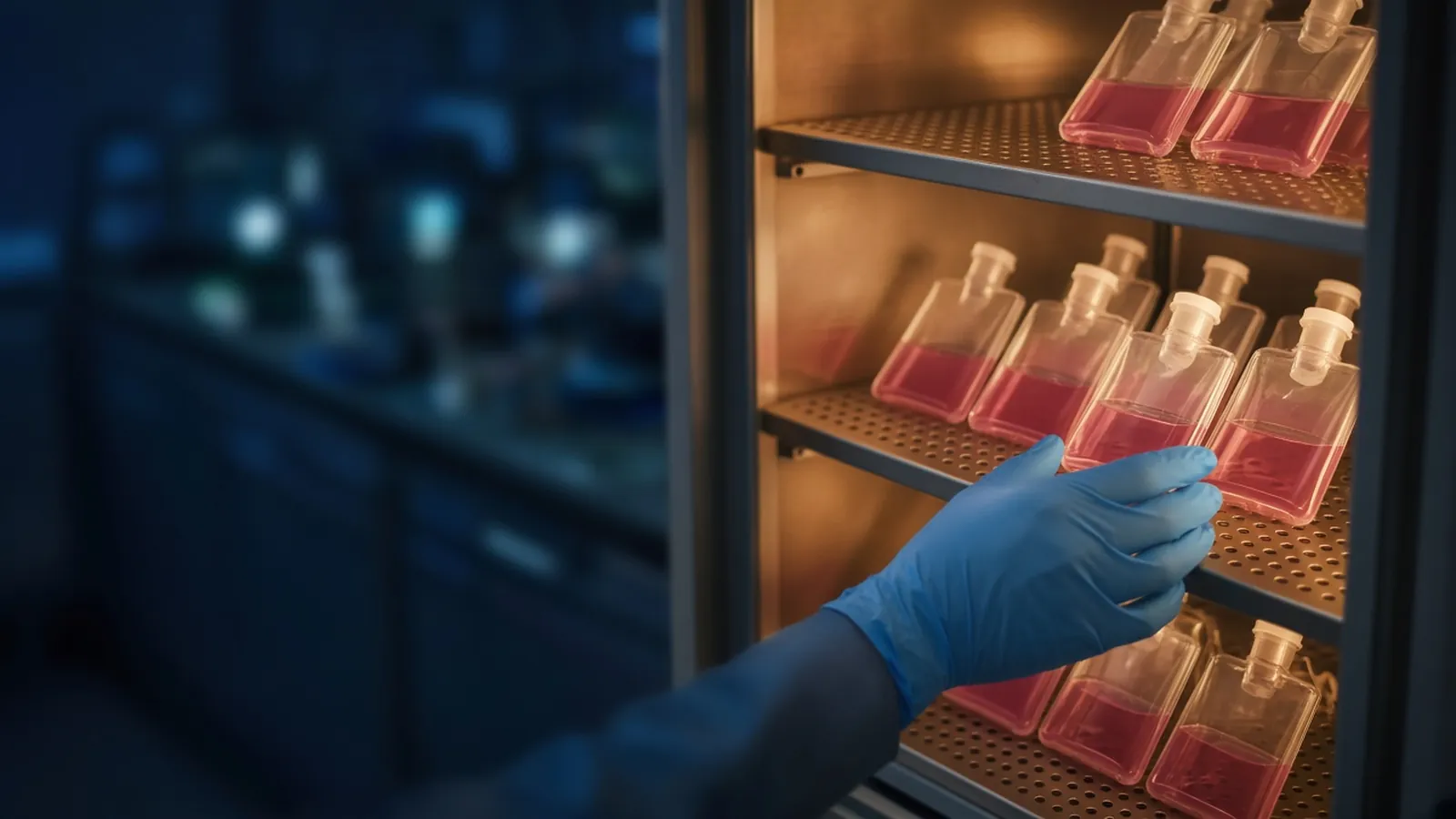
Passaging is the decision to end a crowded neighbourhood before it edits the cells you meant to study. Confluence is your estimate of how much plastic is covered. It is not a viability dye, not a count, and not a certificate that the biology is still the biology of last Tuesday. Many adherent lines should be split before the surface is paved, because contact and spent medium change signalling, shape and how the next experiment behaves. This is a protocol overview for that timing. The surrounding habits live in mammalian cell culture for research labs, and the hand work lives in working inside a biosafety cabinet.
What overgrowth does that a calendar does not
An even monolayer at the density the line tolerates is a planned starting material. A flask left until cells pile, acidify the medium and lift in sheets is a different population. Contact inhibits some lines and is ignored by others, but even lines that pile up still sit in lactic acid, low glucose and accumulated waste. Membranes get damaged. The cells that reattach after a heroic split are the ones that survived the insult, which is a selection. Transfection, drug response and differentiation protocols written for a subconfluent culture will not forgive that selection just because you wrote the same passage integer on the new cap.
Under-passaging has a quieter cost. Very sparse cells, especially lines that like neighbours, can lag, spread into odd shapes, or fail to condition the medium. The cure is not to wait until they are overgrown "so they look happy". It is to seed a density the line actually grows at, learned from the last two splits rather than from a stranger's methods note.
The split ratio is a doubling statement
Each passage increments a counter by one. The ratio tells you how many times the cells had to divide to fill the flask again. If nearly all the seeded cells reattach, a one-to-two split is roughly a doubling, a one-to-four is roughly two, and a one-to-eight is roughly three. Plating losses make that an estimate, which is still more honest than the integer alone. Primary cultures and any experiment about replicative age should record the ratio every time. A laboratory that splits one-to-two all year and a laboratory that splits one-to-twenty are not at the "same passage" in any biological sense.
Set the next ratio from the growth you saw. Reached the split density in two days when you expected four: seed thinner, or accept that this line in this serum is faster than the sheet you copied. Still patchy on the planned day: check the medium, the gas and the thaw quality before you blame the ratio, and do not compensate by leaving the flask until it is a sheet. Public sheets such as the ATCC culture guides suggest ratios for lines they distribute. Treat them as a start, then write what your flasks did. Workflow notes on protocols.io show how other groups structure a passage record. The volumes still come from your line.
Enzyme is a surface decision
Adherent cells are held by calcium-dependent contacts and by proteins stuck to the plastic. A wash in calcium- and magnesium-free saline removes leftover serum, which otherwise inhibits many trypsin-class enzymes. EDTA in the enzyme mix chelates the calcium those contacts need. Trypsin then cuts proteins that tether the cell. That is why trypsin-EDTA is a class, not a personality. The time is whatever this monolayer needs today, often a few minutes, watched under the microscope rather than timed from a poster written for a different line. Stop when the cells round and release with a gentle tap. A cloud of debris and a long incubation means you digested survival as well as attachment.
Some lines hate this class. Strongly adherent primary cells, cells you will stain for surface markers within hours, and any line whose sheet says "non-enzymatic" need the method named there. Recombinant trypsin-like enzymes, collagenase for some tissues, and non-enzymatic dissociation solutions are alternative classes. They are not milder by magic. Follow the sheet for concentration, temperature and quench. Quench means stopping the cut: serum-containing medium for classical trypsin, or the inhibitor or dilution the serum-free method specifies. A serum-free culture quenched with a splash of the wrong serum has just left serum-free conditions. Pellet or dilute as the method says so the enzyme does not travel into the new flask.
Clumps are a failed dissociation, not a counting style. If you cannot resuspend to a single-cell suspension with gentle pipetting, the next flask will have colonies and bare patches. Do not force the clumps through a needle.
A passage you can repeat
Look at the monolayer in several fields, including the edges. Decide whether you are early, on time, or late using the table below. If you are late, still split, but mark the record and do not use that passage for an assay that assumes a calm monolayer. Wash, add the enzyme the line uses, watch, quench, and collect. Count if the assay needs a number; at minimum, reseed a dilution you write down. A "drop of suspension until it looks right" cannot be repeated by the next person. Increment the passage number when you create the new culture, record the ratio, the medium lot and anything odd about the detach, and return the flask to temperature and carbon dioxide before the cells settle into a corner pellet on the bench.
Branch if the cells do not release. Check that the wash happened and that the enzyme is the one that line allows, not an expired aliquot that has been warm all week. Do not double the time as a reflex. Branch if the medium was already yellow and cloudy: that is not a passage, that is a contamination decision, and the flask does not re-enter the shared incubator. Branch if viability after a normal split is suddenly poor: suspect over-digestion, a bad thaw ancestry, or toxicity in a new reagent, and do not "split harder" next time to make up the numbers.
| State of the flask | What the cells are telling you | A useful next act |
|---|---|---|
| Sparse, many empty fields, medium still red | Seeded thinly, or growth has stalled | Check medium, gas and viability before stretching the interval |
| Even cover, the density this line is split at | On time | Dissociate, quench, reseed a written ratio, increment passage |
| Acid medium, piled centres, edges lifting in sheets | Overgrown | Split if you must keep the line, flag the passage, do not assay it as normal |
| Clumps that never became a monolayer | Uneven seed or incomplete previous quench | Gentle complete dissociation next time, not a denser seed of clumps |
| Cells round and debris-like before enzyme | Already damaged | Do not scrape and reseed as if they were healthy |
Failures that look like a technique problem and are a timing problem
Poor attachment the day after a split often starts in the parent flask or in the enzyme bottle, not in the new plastic. Over-trypsinised cells reattach slowly and throw off debris. Under-quenched enzyme keeps cutting in the new medium. A split from an acid, lifting sheet gives a low viable seed even when the haemocytometer, used badly, looked busy. If the same person gets clumps every week, watch their pipetting and their quench, and read accurate micropipetting technique only after you have watched the monolayer. The pipette is not the usual root cause of a sheet that was already peeling.
A sudden change in how many days a line takes to reach the split point is a branch. Faster plus acid plus debris leans toward contamination or a swapped faster line. Slower, with large flat cells, leans toward senescence in a finite culture or a medium problem. Mycoplasma can slow a culture without clouding it. Do not "correct" that with a richer serum splash and a closer split until you have looked at the contamination schedule your laboratory already wrote.
Biosafety does not pause for a split
The enzyme step makes aerosols and wet caps. Do it in the cabinet the risk assessment names, with the waste path that assessment names. A flask you no longer trust is not passaged into the shared incubator "to see if it recovers". Human lines are handled under the institutional assignment, not under a generic web page. The WHO Laboratory Biosafety Manual is a document laboratories use when they write rules. It does not approve your split. This overview is not a clinical procedure.
Weekends, heat and a fast line
A line that fills the flask in three days will overgrow across a long weekend if you seed it on Friday at a weekday ratio. Heat in the room does not excuse a door left open, and it does not slow the cells inside a working incubator. Seed thinner before the absence, or choose a smaller vessel, or freeze a documented passage and thaw on your return. Write the plan on the flask. A Monday sheet that has already acidified is a flagged passage. Do not plate the important dose-response on it because the calendar says the experiment starts today.
Power cuts belong in the same note. A chamber that cooled and lost gas over a night delivers cells that may look attached and are not the cells you seeded. Record the excursion beside the passage number.
What to send when you ask about vessels or reagents
Name the line, adherent or suspension, the split ratios you actually use, the dissociation class the sheet allows, and the vessel format. The laboratory consumables catalogue is the everyday plasticware list. The academic research reference frames a broader university sourcing conversation. Use the quote request to ask whether a quotation is possible. A passage method can be discussed from the line sheet. The catalogue does not choose your split ratio, and it is not a culture service.
Split an adherent flask on the monolayer you see
- 01Judge coverage before you choose a ratioLook at the whole surface, not one lucky field. Confluence is an estimate of cover, not a viability assay. If the line is already lifting or the medium is strongly acid, you are late.
- 02Set the split from the growth you actually sawA ratio copied from a poster is a hypothesis. If the cells reached the split point early, seed thinner next time. If they are still sparse at the planned day, do not invent a harsher enzyme step to compensate.
- 03Detach with the method that line uses, then quenchUse the enzyme or non-enzymatic method written for the line, watch the monolayer, and stop the enzyme as that method says. Trypsin-EDTA is a class, not a universal minute value.
- 04Reseed a known dilution and write the passageCount, or at least reseed a dilution you can repeat. Increment the passage number, record the ratio and the date, and return the new flask to the incubator before the cells sit in a pellet.
Questions from the bench
Is eighty percent confluence a rule?
It is a common teaching picture for many continuous lines, and it is still an estimate. Some lines are split much earlier because contact changes their phenotype. Some primary cultures are handled on a different schedule entirely. The line sheet and the behaviour in your flask outrank a round number.
Can I scrape an overgrown sheet instead of using enzyme?
Only when the written method for that line says mechanical harvest is acceptable. Scraping a sheet that has already exhausted the medium collects dead cells, clumps and a selected population. It feels faster and it starts the next passage from a worse place.
Does a one-to-two split equal one passage of biology?
The passage number goes up by one either way, and the population doubling does not. A one-to-two split is about one doubling if the cells all reattach. A one-to-sixteen split is several. Experiments that care about replicative age need the ratio, not only the integer on the flask.
Should I passage through a weekend plan by adding extra serum?
Extra serum does not cancel contact or spent medium. If a fast line will be crowded before someone can split it, seed thinner on the day you leave, or freeze a known passage. Do not leave an acid flask to sort itself out.
References
Manufacturer names identify published method classes. Trademarks remain with their owners. Catalogue records on this site are independent references for enquiry. They are not a statement of inventory, distribution rights or a supply commitment. This page is educational. It is not medical advice, a diagnostic protocol or a biosafety approval.
Catalogue
Related products and categories
These links follow the subject of the article into published manufacturer references. A listing is a reference for an enquiry, not a statement of stock or distribution rights.
Continue in this cluster
Related reading
Mammalian cell culture for research labsHow research labs keep mammalian cell culture workable: medium, aseptic technique, confluence, passage records and contamination checks. Working inside a biosafety cabinetHow a Class II biosafety cabinet moves air, how that differs from a chemical fume hood, and which habits keep cultures and workers protected.A glossary of culture termsPairs of culture words that laboratories mix up, and the wrong next action each pair causes, from confluence versus density through to confluent versus